
A catalog purity rating of 98% on a commercial specification sheet guarantees nothing about experimental reproducibility. When sourcing research peptides for demanding in vitro investigations, researchers frequently confront batch-to-batch variability, truncated peptide artifacts, and residual cleavage scavengers masked by superficial documentation. Incomplete Certificates of Analysis that omit raw analytical traces, paired with latent degradation from sub-optimal lyophilization, routinely compromise sensitive cell assays and exhaust laboratory resources.
Replicable molecular research demands independent, empirical verification rather than catalog claims. To safeguard experimental validity, bench scientists require an uncompromising laboratory framework for evaluating research peptide synthesis, analytical testing, and handling protocols. This guide delivers precise technical standards to interpret reverse-phase HPLC traces and mass spectra, standardize in vitro reconstitution and cold-chain storage parameters, and identify compliant, reference-grade suppliers providing batch-specific analytical verification.
Key Takeaways
- Understand the structural criteria of research peptides, including synthetic sequence integrity, terminal modifications, and counterion presence.
- Evaluate solid-phase peptide synthesis (SPPS) pathways to identify truncation sequences, deletion artifacts, and incomplete deprotection side products.
- Audit batch-specific Certificates of Analysis by correlating RP-HPLC retention times, baseline peak resolutions, and mass spectrometry m/z profiles.
- Implement standardized reconstitution and cold-chain protocols to prevent hydrolytic degradation, shear-induced aggregation, and thermal denaturation.
- Establish institutional procurement criteria to verify vendor documentation, lot traceability, and independent third-party analytical validation.
Defining Research Peptides: Molecular Architecture and Laboratory Standards
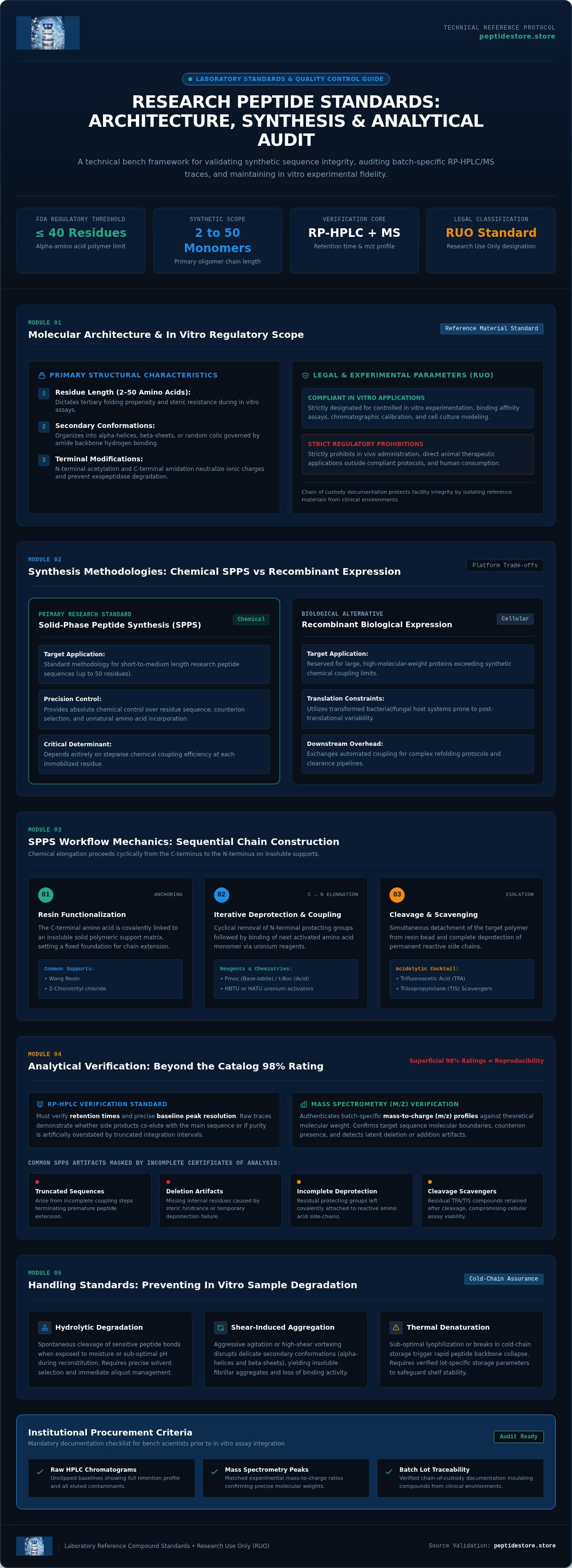
At the molecular level, research peptides are defined as precision-engineered polymers comprising short-chain alpha-amino acids linked by stable covalent amide bonds, characterized by exact molecular weights and strict sequence fidelity. The U.S. Food and Drug Administration formalizes this classification by defining a peptide as any alpha-amino acid polymer containing 40 or fewer amino acids. In contrast to finished pharmaceutical preparations formulated with systemic stabilizers, research-grade synthetic sequences function as isolated chemical reference materials. They demand rigorous handling protocols to preserve backbone stability and prevent spontaneous degradation during assay preparation.
Primary Structural Characteristics of Synthetic Peptides
Synthetic oligomers synthesized via modern peptide synthesis platforms exhibit distinct structural properties that govern their in vitro physicochemical behavior:
- Residue Length: Primary chains typically span 2 to 50 amino acid monomers, dictating tertiary folding propensity and steric resistance.
- Secondary Conformations: Sequences organize into predictable alpha-helices, beta-sheets, or random coils governed by localized hydrogen bonding along the amide backbone.
- Terminal Modifications: Strategic chemical protections, including N-terminal acetylation and C-terminal amidation, neutralize terminal ionic charges to mimic native internal sequences and limit enzymatic exopeptidase cleavage in functional assays.
In Vitro Research Boundaries and Regulatory Parameters
Regulatory frameworks designate these compounds strictly for controlled in vitro experimentation, chromatographic calibration, binding affinity assays, and cell culture modeling. Research peptides possess a defined "Research Use Only" (RUO) legal classification. This framework strictly prohibits in vivo administration, direct animal therapeutic use outside compliant protocols, or human consumption. Institutional facilities enforce rigid compliance protocols to verify chain-of-custody documentation, ensuring that synthetic materials remain insulated from clinical environments while maintaining uncompromised chemical purity standards across all experimental cycles.
Peptide Synthesis Methodologies: Solid-Phase Synthesis vs. Recombinant Expression
Solid-phase peptide synthesis (SPPS) serves as the primary production methodology for short-to-medium research peptides, whereas recombinant expression remains reserved for high-molecular-weight proteins that exceed synthetic coupling limits. Chemical synthesis provides direct control over residue sequence, counterion selection, and unnatural amino acid incorporation. In contrast, biological expression requires cellular translation machinery that introduces post-translational variability. While SPPS depends entirely on stepwise chemical coupling efficiency at each immobilized residue, recombinant systems exchange chemical automation for complex downstream refolding and clearance protocols to secure native conformations.
Solid-Phase Peptide Synthesis (SPPS) Workflow Mechanics
SPPS constructs target oligomers through cyclical chemical reactions on insoluble solid supports. In modern laboratory synthesis, this process follows strict mechanical stages:
- Resin Functionalization: The C-terminal amino acid anchors covalently to an insoluble polymeric support, such as 2-chlorotrityl chloride or Wang resin, establishing a fixed orientation for chain extension.
- Iterative De-protection and Coupling: Synthetic chains grow from the C-terminus to the N-terminus. Temporary N-alpha protecting groups (predominantly base-labile Fmoc or acid-labile t-Boc) undergo cleavage before the next activated amino acid binds, typically driven by uronium coupling reagents like HBTU or HATU.
- Cleavage and Side-Chain Deprotection: Acidolytic cocktails, predominantly trifluoroacetic acid (TFA) combined with reactive scavengers like triisopropylsilane (TIS), simultaneously cleave the anchored polymer from the resin bead and remove all permanent side-chain protecting groups.
Recombinant Expression and Protein Folding Considerations
Recombinant expression harnesses transformed bacterial or fungal host systems to generate larger biomacromolecules. Escherichia coli or Pichia pastoris strains translate the target sequence from exogenous plasmid DNA. While this route avoids the cumulative yield decline inherent to long-chain chemical coupling, it presents distinct downstream challenges. Host cell proteins, endotoxins, and non-target nucleic acids demand multi-stage affinity chromatography and size-exclusion filtration for complete isolation. Denatured expression products found in bacterial inclusion bodies require precise in vitro refolding matrices to re-establish biological disulfide bond patterns and native tertiary structures.
For standard in vitro experimental assays, chemically synthesized compounds provide superior batch consistency and defined chemical integrity. Laboratories seeking reliable chemical reference materials can review fully verified compounds through the Peptide Store analytical catalog to ensure exact sequence fidelity across every experimental replicate.
Analytical Verification: Interpreting HPLC Traces and Mass Spectrometry CoAs
Analytical verification requires objective chromatographic separation and mass confirmation, not arbitrary text summaries on a supplier PDF. When procuring research peptides, examining batch-specific raw data remains the only reliable defense against experimental failure. A legitimate Certificate of Analysis (CoA) presents complete, unaltered chromatograms paired with full mass spectra rather than self-reported numeric purities. Rigorous analytical validation mandates that target peak integration begins and ends at a stable, drift-free baseline, accounting for every trace artifact across the entire retention gradient.
Reverse-Phase High-Performance Liquid Chromatography (RP-HPLC)
RP-HPLC establishes chemical purity by separating the intact target molecule from synthesis-derived impurities based on hydrophobicity:
- Stationary C18 Phases: Alkyl-bonded silica columns retain peptides according to hydrophobic interactions, separating identical-length deletion sequences that differ by only a single residue.
- Gradient Elution Profiles: Acetonitrile-water mobile phases containing 0.1% acid modifier resolve early-eluting polar truncation fragments and late-eluting hydrophobic aggregates.
- Peak Area Quantification: Absolute purity derives from integrating total absorbance area at 214 nanometers, the specific wavelength where peptide amide bonds absorb UV energy uniformly. Commercial research standards generally demand a minimum of 95% to 98% purity, with highly sensitive assay models requiring 99% or greater.
Electrospray Ionization Mass Spectrometry (ESI-MS) Confirmation
While RP-HPLC establishes sample homogeneity, mass spectrometry confirms molecular identity. Electrospray ionization introduces the liquid sample into the high-voltage source, generating intact, multiply charged molecular ions ([M+H]⁺, [M+2H]²⁺, [M+3H]³⁺) without inducing structural fragmentation. Automated deconvolution algorithms convert these mass-to-charge (m/z) ratios back into exact monoisotopic and average molecular weights. A mass discrepancy exceeding 1.0 Dalton signals an aberrant sequence, oxidation, or an unremoved protecting group (such as tert-butyl or trityl adducts) from synthesis.
Identifying Residual Reagents and Salt Counter-Ions
Standard synthesis protocols introduce non-peptide components that directly affect mass calculations and assay viability:
- Counter-Ion Content: Standard RP-HPLC purification uses trifluoroacetic acid, leaving TFA counter-ions bound to basic residues (Arg, Lys, His). Highly sensitive cell culture assays frequently demand counter-ion exchange to acetate or hydrochloride to avoid solvent-mediated cellular toxicity.
- Net Peptide vs. Gross Weight: Lyophilized material typically contains 70% to 85% actual peptide mass, with the remainder consisting of counter-ions and bound residual moisture. Quantitative binding studies require adjusting reconstitution volumes to net peptide weight rather than gross vial weight.
Laboratory Reconstitution and Cold-Chain Handling Protocols
Lyophilized cakes remain exceptionally vulnerable to thermal fluctuations, ambient humidity, and shear forces once removed from controlled storage. When working with research peptides, improper handling at the bench can compromise an otherwise pristine synthesis batch before testing begins. Sealed peptide vials must equilibrate to room temperature for 30 to 60 minutes inside a desiccator before puncturing the septum, preventing rapid atmospheric condensation from hydrolyzing the dry cake. Selecting the proper reconstitution vehicle depends strictly on sequence hydrophobicity, isoelectric point, and downstream assay compatibility.
Sterile Reconstitution with Bacteriostatic Water
Reconstitution requires methodical solvent introduction to protect secondary structures and avoid aggregate formation:
- Equilibration and Disinfection: Confirm complete thermal equilibration to ambient room temperature. Swab the rubber septum thoroughly with 70% isopropanol and allow it to dry completely.
- Solvent Introduction: Aspirate sterile research-grade bacteriostatic water containing 0.9% benzyl alcohol using a sterile syringe. The benzyl alcohol acts as a bacteriostatic preservative to inhibit microbial growth in multi-use laboratory stocks.
- Aspiration Dynamics: Angle the needle to discharge the solvent slowly down the inner glass wall of the vial. Never inject liquid directly onto the lyophilized cake under high pressure.
- Solubilization Technique: Swirl the vial gently with a slow, orbital motion until the powder dissolves completely into an optically clear solution. Never vortex or shake violently; mechanical shear forces introduce cavitation bubbles that unfold delicate peptide backbones and induce irreversible fibrillar aggregation.
Aliquoting and Cryopreservation Standards
Once dissolved, peptides experience rapid acceleration of hydrolytic degradation pathways if left in solution at ambient temperatures. Partition the parent solution immediately into sterile, low-binding polypropylene microcentrifuge tubes to prevent surface adsorption losses. Subdividing the stock into single-use aliquots eliminates repetitive freeze-thaw cycles, which induce localized cryo-concentration and stress-cleave labile peptide bonds (particularly Asp-Pro linkages).
Store concentrated stock aliquots within monitored freezers at minus twenty to minus eighty degrees Celsius, maintaining structural integrity across multi-week assay schedules. To equip your laboratory with analytically verified reagents and reference compounds, order laboratory-grade research peptides and bacteriostatic water from Peptide Store to maintain strict chain-of-custody controls across every assay cycle.
Sourcing Research Peptides: Catalog Classifications and Verification Standards
Institutional sourcing requires strict vendor transparency, lot traceability, and supply chain consistency to preserve assay reproducibility across multi-phase studies. Rather than relying on static marketing claims, research facilities evaluate suppliers through empirical validation. Dedicated chemical repositories categorize pre-synthesized compounds by mechanistic target pathways, enabling researchers to isolate specific biochemical variables under strictly non-clinical experimental conditions. Institutional procurement audits must systematically confirm that vendors supply batch-specific analytical records, maintain validated packaging controls, and provide complete chain-of-custody documentation prior to purchase authorization.
Primary Molecular Research Categories in Scientific Catalogs
Standard scientific catalogs organize analytical-grade compounds across defined functional disciplines for in vitro investigation:
- Incretin and Metabolic Receptor Ligands: Assays evaluating glucagon-like peptide-1 (GLP-1), glucose-dependent insulinotropic polypeptide (GIP), and glucagon receptor kinetics commonly utilize Tirzepatide, Retatrutide, Semaglutide, and Cagrilintide.
- Cytoprotective and Tissue Repair Models: Studies investigating extracellular matrix remodeling, angiogenic pathways, and focal adhesion kinases focus on sequences including BPC-157, TB-500, and GHK-Cu.
- Neuroregulatory and Endocrine Signaling Pathways: In vitro receptor binding, secretagogue mechanisms, and neural signal transduction assays utilize CJC-1295, Ipamorelin, IGF-1, Selank, and Semax.
- Cellular Energetics and Metabolic Cofactors: Assays examining mitochondrial enzyme kinetics and redox states frequently incorporate NAD+ alongside peptide reference standards.
Vendor Verification and Institutional Procurement Frameworks
Procurement teams must apply objective auditing criteria when onboarding chemical distributors. Every lot of research peptides should arrive with verified third-party RP-HPLC chromatograms confirming minimum 95% to 98% purity, alongside electrospray ionization mass spectrometry profiles establishing exact mass concordance within 1.0 Dalton. Facilities should also verify access to essential preparation reagents, including dedicated research-grade bacteriostatic water, to standardize reconstitution procedures under uniform laboratory conditions.
Physical containment integrity is equally critical. Lyophilized peptides require packaging under an inert nitrogen blanket within sealed borosilicate glass vials to prevent oxidative degradation and moisture uptake during transit. Evaluating third-party testing protocols, lot traceability, and cold-chain distribution models ensures sustained experimental repeatability. You can review the catalog of reference-grade molecules at Peptide Store for your laboratory, accessing an analytical catalog of over 150 verified compounds designed exclusively for in vitro scientific research.
Advancing Experimental Reproducibility Through Analytical Rigor
Repeatable molecular assays require uncompromising sequence fidelity and empirical purity confirmation. Interrogating raw RP-HPLC traces and electrospray mass spectra ensures that synthesis artifacts, deletion sequences, and excess counter-ions don't disrupt downstream cellular models. Standardizing your bench protocols, from controlled thermal equilibration to single-use cryopreservation, preserves delicate molecular architecture against ambient hydrolysis and shear stress.
Modern laboratory workflows cannot rely on unverified catalog claims. Sourcing research peptides with transparent, batch-specific analytical verification protects both your experimental data and institutional resources. Explore the laboratory-grade catalog at Peptide Store to evaluate an inventory exceeding 150 verified analytical compounds, each supported by complete third-party HPLC and mass spectrometry documentation. With specialized cold-chain logistics and reliable nationwide research distribution, your bench can proceed with complete confidence in sequence precision and batch reproducibility.
Frequently Asked Questions
What distinguishes research-grade peptides from clinical pharmaceutical formulations?
Research-grade peptides serve strictly as unformulated chemical reference standards intended for in vitro experimentation, binding assays, and analytical chromatography. They lack human-grade sterility certifications, pharmacokinetic excipients, and regulatory authorizations mandated for clinical drugs under 21 CFR parts 210 and 211. Consequently, institutional compliance rules restrict these substances solely to controlled laboratory research, prohibiting any therapeutic administration or in vivo clinical application.
How do laboratories determine the net peptide content versus gross lyophilized mass?
Laboratories quantify net peptide content by running elemental nitrogen analysis (Dumas method) or quantitative amino acid analysis (AAA). Gross vial weight encompasses both the target peptide and non-peptide adducts, including counter-ion salts like trifluoroacetate and residual crystal moisture. Net peptide content typically ranges between 70% and 85% of total mass. Technicians must factor this actual percentage into molarity equations to avoid under-concentrating working assay solutions.
Why is reverse-phase HPLC preferred over standard chromatography for peptide analysis?
Reverse-phase HPLC provides exceptional resolution by exploiting subtle differences in hydrophobic interactions between amino acid side chains and alkyl-bonded silica matrices (typically C18 or C8). While standard size-exclusion methods struggle to differentiate molecules with near-identical molecular weights, RP-HPLC easily resolves full-length target peptides from deletion sequences, diastereomers, and premature truncation fragments that vary by only a single amino acid residue along the chain.
What role does bacteriostatic water play in laboratory peptide solubilization?
Research-grade bacteriostatic water provides a sterile aqueous vehicle containing 0.9% benzyl alcohol, which serves as a preservative against microbial contamination. Standard sterile water lacks antimicrobial agents, leaving reconstituted peptide solutions susceptible to rapid bacterial degradation within days. Using bacteriostatic water allows laboratories to safely store multi-use working stock solutions at 4 degrees Celsius for extended experimental assay periods without microbial contamination.
How do amino acid sequences influence peptide solubility during experimental reconstitution?
Overall peptide charge and hydrophobicity dictate vehicle compatibility in laboratory workflows. Sequences with an abundance of basic residues (arginine, lysine) dissolve efficiently in sterile aqueous vehicles or dilute acetic acid, whereas acidic peptides (aspartic acid, glutamic acid) require neutral or slightly basic buffers. Hydrophobic sequences with extensive leucine, isoleucine, or valine residues often require pre-dissolution in minimal volumes of sterile dimethyl sulfoxide (DMSO) before aqueous dilution.
What causes chemical degradation in synthetic peptide stocks stored at room temperature?
Ambient exposure accelerates three primary chemical degradation pathways: deamidation, oxidation, and peptide bond hydrolysis. Asparagine and glutamine residues readily deamidate into aspartic and glutamic acid via cyclic succinimide intermediates at ambient temperatures. Concurrently, methionine and cysteine residues undergo rapid atmospheric oxidation, while trace moisture cleaves acid-labile bonds. Maintaining research peptides in desiccated storage at minus twenty degrees Celsius suppresses these destructive kinetic reactions.
How should researchers interpret secondary peaks observed on an HPLC chromatogram?
Secondary peaks indicate chemical impurities, incomplete synthesis artifacts, or molecular degradation products eluting at different retention times. Early-eluting peaks typically represent hydrophilic truncation fragments lacking hydrophobic terminal residues, whereas late-eluting shoulders point to hydrophobic aggregation or unremoved protecting groups. Calculating purity requires dividing the integrated area of the primary target peak by the sum of all resolved peaks at 214 nanometers.