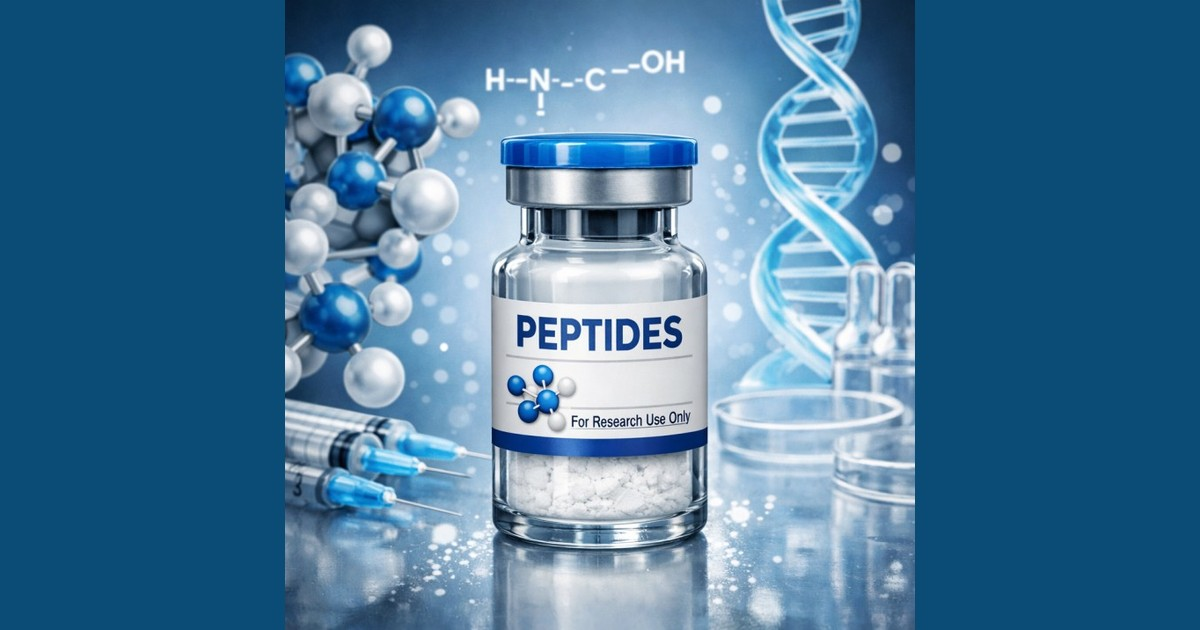

Dual-incretin modulation was long viewed as the theoretical ceiling for synthetic peptide design, yet simultaneous triple-pathway activation fundamentally redefines multi-receptor signaling. Investigating the retatrutide peptide requires laboratory researchers to evaluate an entirely novel pharmacophore that co-activates GIP, GLP-1, and glucagon receptors in a single molecular framework.
Most qualified investigators agree that while earlier incretin generations established functional benchmarks, obtaining verifiable data regarding tri-agonist receptor affinity and physical stability remains a persistent bottleneck. Between ambiguous reconstitution protocols and the absence of standardized mass spectrometry profiles across commercial suppliers, it's difficult to ensure high assay reproducibility before committing institutional resources.
This guide examines the molecular architecture, triple-agonist receptor dynamics, and analytical laboratory standards governing retatrutide research peptides. Below, we detail its engineered backbone structure, compare tri-receptor mechanisms against legacy incretins, and provide rigorous HPLC criteria alongside verified reagent handling protocols for preclinical research.
Key Takeaways
- Explore the 39-amino-acid backbone modifications that enable the retatrutide peptide to achieve balanced, single-molecule triple agonism across GIP, GLP-1, and glucagon receptors.
- Compare differential receptor binding profiles and downstream cyclic AMP signaling cascades observed across preclinical in vitro and rodent model assays.
- Implement precise laboratory reconstitution protocols using sterile Bacteriostatic Water alongside defined thermal storage parameters to prevent molecular aggregation.
- Establish rigorous analytical verification protocols using HPLC chromatograms and mass spectrometry data to confirm batch-level identity, structural integrity, and purity thresholds.
Molecular Architecture and Tri-Receptor Agonism of Retatrutide Peptide
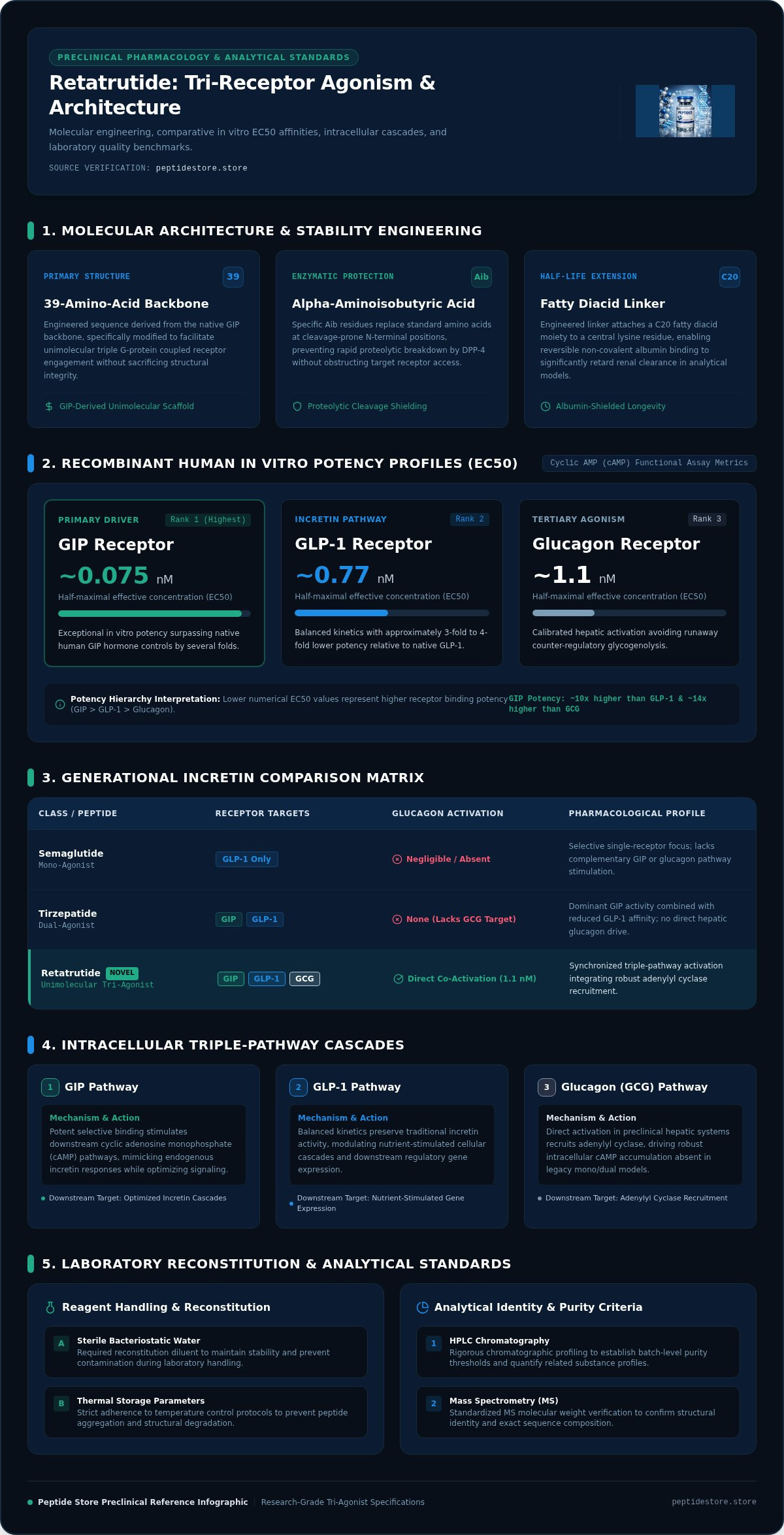
The retatrutide peptide represents a milestone in rational peptide engineering, functioning as a synthetic unimolecular tri-agonist. While mono-agonists such as semaglutide focus strictly on the GLP-1 receptor, and dual-agonists like tirzepatide target both GLP-1 and GIP receptors, the Retatrutide sequence incorporates synchronized binding affinity across three distinct metabolic pathways: GIP, GLP-1, and glucagon (GCG) receptors. Its primary structure consists of an engineered 39-amino-acid backbone derived from the native GIP sequence, deliberately altered to coordinate triple G-protein coupled receptor engagement without sacrificing structural stability.
The Tri-Agonist Mechanism Across GIP, GLP-1, and Glucagon Receptors
Receptor engagement occurs in a coordinated, multi-target sequence that broadens cellular signaling pathways:
- GIP Receptor: Potent, selective binding stimulates downstream cyclic adenosine monophosphate (cAMP) pathways, mimicking endogenous incretin responses while optimizing complementary signaling.
- GLP-1 Receptor: Balanced binding kinetics preserve traditional incretin activity, modulating nutrient-stimulated cellular cascades and downstream gene expression.
- Glucagon Receptor: Direct activation in preclinical hepatic systems recruits adenylyl cyclase, driving robust intracellular cAMP accumulation that is entirely absent in mono- or dual-incretin models.
Structural Modifications and Lipid Moiety Engineering
Unmodified peptide backbones undergo rapid enzymatic cleavage via dipeptidyl peptidase-4 (DPP-4). To protect metabolic longevity in analytical testing, specific alpha-aminoisobutyric acid (Aib) residues replace standard amino acids at cleavage-prone N-terminal positions. This modification prevents rapid proteolytic breakdown without hindering receptor access.
Extended assay persistence relies on deliberate side-chain modification. An engineered linker connects a C20 fatty diacid moiety to the peptide backbone at a central lysine residue. This hydrophobic diacid facilitates reversible, non-covalent binding to laboratory albumin matrices. Albumin shielding significantly slows renal filtration and prolongs functional exposure in preclinical models. Through these combined structural modifications, the retatrutide peptide achieves balanced tri-receptor affinity while preserving physical stability across sustained in vitro experimental timelines.
Preclinical Binding Affinities and Pharmacological Profiling
Evaluating multi-incretin candidates requires exact quantification of receptor interaction kinetics. The retatrutide peptide displays a distinctly biased potency hierarchy across recombinant human receptor cell lines. Rather than uniform affinity across all targets, pharmacological characterization reveals a calibrated binding cascade that prioritizes glucose-dependent insulinotropic polypeptide receptor activation over secondary and tertiary pathways.
Receptor Potency Metrics and In Vitro EC50 Values
Preclinical functional assays utilizing cyclic AMP reporter systems delineate specific half-maximal effective concentrations (EC50) across targeted receptors:
- Human GIP Receptor: Displays exceptional in vitro potency with an EC50 of approximately 0.075 nM. Preclinical data indicates that GIP receptor recruitment potency actually surpasses native GIP hormone controls by several folds.
- Human GLP-1 Receptor: Exhibits an EC50 of approximately 0.77 nM, demonstrating roughly three-fold to four-fold lower potency relative to native human GLP-1 reference molecules.
- Human Glucagon Receptor: Demonstrates balanced activation with an EC50 near 1.1 nM, intentionally calibrated to facilitate controlled hepatic signaling without triggering runaway counter-regulatory glycogenolysis.
Comparative Pharmacology: Single, Dual, and Triple Agonists
Contrasting these affinity profiles against prior molecular classes illustrates the unique pharmacology of tri-agonism. Semaglutide operates purely as a selective GLP-1 mono-agonist, showing negligible affinity for GIP or glucagon receptors. Tirzepatide functions as a dual agonist with dominant GIP activity and reduced GLP-1 activity, completely lacking glucagon receptor affinity. Retatrutide integrates a balanced tertiary glucagon component while retaining the primary GIP drive.
Preclinical cell models demonstrate that concurrent engagement alters receptor trafficking dynamics. While pure GLP-1 agonists trigger rapid beta-arrestin recruitment and extensive receptor internalization, retatrutide induces different internalization kinetics at the GLP-1 receptor. This altered desensitization profile sustains downstream cAMP signaling in cultured cell lines. For comparative pharmacology projects, research teams can buy research peptides with verified identity profiles to evaluate these multi-receptor kinetics in controlled laboratory assays.
Intracellular Cascades and Metabolic Pathways in Preclinical Models
Downstream cellular signaling initiated by the retatrutide peptide diverges sharply from conventional incretin pharmacology. When the molecule docks simultaneously at GIP, GLP-1, and glucagon G-protein coupled receptors, it triggers rapid, robust adenylyl cyclase activation. This enzymatic conversion converts adenosine triphosphate (ATP) into second-messenger cyclic adenosine monophosphate (cAMP), activating protein kinase A (PKA) and exchange protein directly activated by cAMP (EPAC) across targeted cell lines.
Hepatic Lipid Oxidation and Mitochondrial Biogenesis
In high-fat diet rodent models, primary glucagon receptor signaling fundamentally redirects hepatic lipid routing. Rather than precipitating hyper-glycemic spikes, balanced glucagon co-activation elevates intrahepatic cAMP levels to stimulate downstream transcriptional networks:
- PPAR-alpha Activation: PKA signaling up-regulates peroxisome proliferator-activated receptor alpha (PPAR-alpha), accelerating hepatic fatty acid oxidation enzymes.
- Carnitine Palmitoyltransferase-1 (CPT-1) Induction: Enhanced CPT-1 transcription facilitates fatty acyl-CoA transport across outer mitochondrial membranes for beta-oxidation.
- Steatosis Reduction: Preclinical tissue histology from rodent studies demonstrates marked reductions in intrahepatic triglyceride accumulation, reversing baseline steatotic morphology.
Adipose Tissue Thermogenesis and Energy Expenditure
Unlike selective incretins that alter caloric dynamics almost entirely through centralized satiation pathways, retatrutide recruits peripheral thermogenic networks. Experimental models demonstrate that triple agonism drives elevated resting energy expenditure via synchronized adrenergic and incretin cross-talk in adipose depots.
In brown and beige adipose tissue, the peptide stimulates uncoupling protein-1 (UCP1) transcriptional cascades via cyclic-AMP-mediated phosphorylation of p38 mitogen-activated protein kinase (p38 MAPK). This uncouples mitochondrial electron transport from ATP synthesis, dissipating energy as heat. Concurrently, white adipocytes show rapid activation of hormone-sensitive lipase (HSL) and adipose triglyceride lipase (ATGL) through direct PKA phosphorylation, promoting intracellular lipolysis.
Central nervous system appetite networks reinforce these metabolic shifts. Preclinical neurobiology assays indicate that co-stimulating hypothalamic GLP-1 and GIP receptors modulates pro-opiomelanocortin (POMC) neurons while suppressing neuropeptide Y (NPY) signaling. By simultaneously augmenting peripheral lipid oxidation and regulating central feeding drive, the retatrutide peptide establishes a multi-system signaling framework unattainable through mono-incretin pathways.
Laboratory Reconstitution, Storage, and Analytical Purity Standards
Analytical reproducibility depends heavily on proper handling of the retatrutide peptide prior to in vitro testing. Due to its hydrophobic lipid diacid side chain and extended 39-amino-acid sequence, this research compound is vulnerable to physical aggregation, deamidation, and atmospheric oxidation if handling controls fail.
Handling and Solubilization Protocols with Bacteriostatic Water
Sterile technique is critical when preparing lyophilized vials for analytical assays:
- Solvent Selection: Reconstitute using sterile Bacteriostatic Water containing 0.9% benzyl alcohol. This preserves sterility across multi-aliquot in vitro study cycles and prevents microbial enzymatic breakdown.
- Solvent Introduction: Direct the diluent stream against the internal glass wall of the vial under an inert laminar flow hood. Avoid letting the liquid stream strike the lyophilized cake directly to prevent localized shear stress.
- Dissolution Mechanics: Never vortex the vial violently. Agitation disrupts secondary alpha-helical structures and induces irreversible aggregation. Swirl the vial gently until the solid dissolves into an optically clear, particle-free solution.
Lyophilized and Solution Stability Guidelines
Thermal stability requires strict adherence to documented cold-chain parameters. Solid lyophilized peptide cakes maintain molecular stability when stored at minus twenty degrees Celsius in desiccated environments. Following reconstitution, keep liquid aliquots between two and eight degrees Celsius, protected from light exposure. Avoid repeated freeze-thaw cycles completely, as thermal fluctuations accelerate peptide dimerization, peptide clipping, and covalent degradation.
Evaluating HPLC and Mass Spectrometry Verification
Confirming analytical authenticity before initiating laboratory assays requires independent verification data. Qualified investigators should evaluate two primary testing benchmarks:
- Reverse-Phase HPLC: High-Performance Liquid Chromatography profiles must show a sharp, symmetrical retention peak with purity verified at ninety-nine percent or higher, confirming the absence of truncated synthesis failures.
- Electrospray Ionization Mass Spectrometry (ESI-MS): Deconvoluted mass spectra must yield an observed molecular mass matching the theoretical molecular weight of the conjugated sequence within standard instrument tolerances.
Always cross-reference lot numbers with manufacturer Certificates of Analysis before assay execution. To secure verified inventory for analytical evaluation, research facilities can order laboratory-grade peptides with complete analytical batch documentation.
Sourcing Specifications for Research-Grade Retatrutide Peptides
Procuring raw analytical materials for in vitro studies demands rigorous regulatory compliance and strict vendor vetting. Because research peptides are manufactured exclusively for scientific, non-clinical laboratory applications, they exist entirely outside retail pharmacy channels. Regulatory frameworks require investigators to document that all acquired compounds are strictly designated for in vitro experimentation rather than human administration, compounding, or clinical use.
Institutional Vendor Assessment Criteria
Institutional procurement protocols should apply systematic auditing criteria before onboarding any peptide distribution partner:
- Independent Analytical Verification: Avoid suppliers relying exclusively on internal, self-reported quality claims. Require transparent, lot-matched analytical documentation generated by third-party testing laboratories.
- Cold-Chain Logistics: Audit transit packaging standards to confirm that lyophilized compounds remain protected from elevated ambient temperatures and moisture intrusion during domestic transit.
- Metabolic Compound Specialization: Partner with distributors that maintain dedicated expertise across complex metabolic analogs, including Retatrutide, Tirzepatide, and Semaglutide.
- Chain of Custody Documentation: Ensure every shipment includes traceable batch identifiers matching accompanying Certificates of Analysis to satisfy institutional laboratory compliance audits.
Procuring Laboratory Compounds from Peptide Store
Peptide Store provides US academic, institutional, and biotechnology researchers with analytical-grade reagents manufactured to exact molecular specifications. Qualified investigators can source verified Retatrutide research peptides backed by comprehensive HPLC and mass spectrometry testing data. Each batch arrives with transparent purity metrics to ensure high baseline reproducibility in metabolic assay environments.
Beyond triple-agonist candidates, the company maintains a dedicated catalog of over 150 laboratory-grade research peptides. The inventory includes foundational dual-incretins like Tirzepatide, selective mono-agonists like Semaglutide, complementary metabolic analogs like Cagrilintide, and essential reconstitution reagents including sterile Bacteriostatic Water. By maintaining rigorous molecular verification benchmarks, dependable nationwide distribution capabilities, and strict compliance boundaries restricted exclusively to laboratory research use, Peptide Store serves as a dependable partner for preclinical scientific discovery.
Advancing Multi-Receptor Protocols in Preclinical Incretin Research
Coordinating GIP, GLP-1, and glucagon receptor pathways positions the retatrutide peptide as an indispensable tool for dissecting complex metabolic cascades. Achieving consistent assay results requires adherence to validated laboratory reconstitution techniques, precise thermal containment, and strict analytical thresholds. Verifying single-peak HPLC purity and theoretical mass spectrometry values ensures that downstream experimental observations reflect true receptor kinetics rather than synthesis artifacts.
Maintaining assay fidelity starts with an uncompromised supply chain. Peptide Store supports institutional research facilities with rigorous quality benchmarks, lot-specific analytical documentation, and prompt nationwide fulfillment. Investigators can access over 150 laboratory-grade research peptides alongside essential reconstitution reagents like sterile Bacteriostatic Water, with every batch restricted strictly to in vitro scientific applications. When your institution is ready to expand multi-pathway incretin studies, Source Research-Grade Retatrutide for Laboratory Applications to ensure your experimental pipeline is supported by analytical precision.
Frequently Asked Questions
What is retatrutide peptide in laboratory research?
The retatrutide peptide is a synthetic 39-amino-acid research compound designed as a unimolecular triple agonist. Investigators use this engineered molecule strictly in vitro and in animal research models to study simultaneous multi-incretin pathway activation. It serves as an experimental reagent to evaluate differential intracellular signaling across glucose-dependent insulinotropic polypeptide, glucagon-like peptide-1, and glucagon receptor complexes without requiring separate multi-compound co-administrations.
How does retatrutide differ fundamentally from tirzepatide and semaglutide?
Structural targeting defines the primary distinction between these metabolic compounds. Semaglutide operates solely as a mono-agonist targeting the GLP-1 receptor, while tirzepatide functions as a dual agonist co-activating both GLP-1 and GIP receptors. Retatrutide integrates a balanced glucagon receptor activation component alongside potent GIP and GLP-1 agonism. This third target pathway engages distinct hepatic oxidation cascades and thermogenic mechanisms absent in single or dual agonists.
Which biological receptors does retatrutide peptide target in assays?
The retatrutide peptide selectively binds three distinct class B G-protein coupled receptors: GIPR, GLP-1R, and GCGR. In recombinant cell assays, it displays highest potency at the GIP receptor, surpassing the recruitment capacity of native human GIP. GLP-1 and glucagon receptors are activated with balanced, sub-nanomolar to low-nanomolar affinity, generating coordinated cyclic AMP accumulation across targeted cellular pathways.
Why is Bacteriostatic Water utilized for peptide reconstitution?
Sterile Bacteriostatic Water contains 0.9% benzyl alcohol, an effective bacteriostatic preservative that prevents microbial contamination. Research workflows often require multi-aliquot sampling across successive days. Using preserved diluent rather than standard sterile water suppresses bacterial growth during storage, protecting peptide purity and preventing enzymatic degradation catalyzed by microbial introduction during needle punctures.
What purity threshold is required for retatrutide research compounds?
Preclinical assays require a minimum purity threshold of ninety-eight percent, with analytical standards favoring ninety-nine percent or greater. Laboratories verify this threshold using reverse-phase High-Performance Liquid Chromatography (HPLC) to confirm the absence of truncated sequences and synthesis byproducts. Electrospray ionization mass spectrometry (ESI-MS) must run alongside HPLC to verify exact molecular mass before assay integration.
How should reconstituted retatrutide solutions be stored in laboratories?
Reconstituted peptide solutions must be stored at two to eight degrees Celsius inside a dedicated laboratory refrigerator, sealed and protected from ambient light. Researchers should divide the solution into single-use microcentrifuge tubes immediately after solubilization. This practice avoids repeated freeze-thaw cycles, which degrade secondary molecular folding, cause covalent cross-linking, and induce physical aggregation in aqueous peptide matrices.
Is retatrutide peptide approved for human administration or clinical therapy?
No, retatrutide is an investigational compound that is not approved by the FDA for human therapy, clinical administration, or medical compounding. Commercial pharmacy dispensing is prohibited under federal regulatory statutes. All retatrutide compounds distributed through scientific channels are restricted exclusively to laboratory research use, analytical assay calibration, and institutional in vitro experimentation.
