
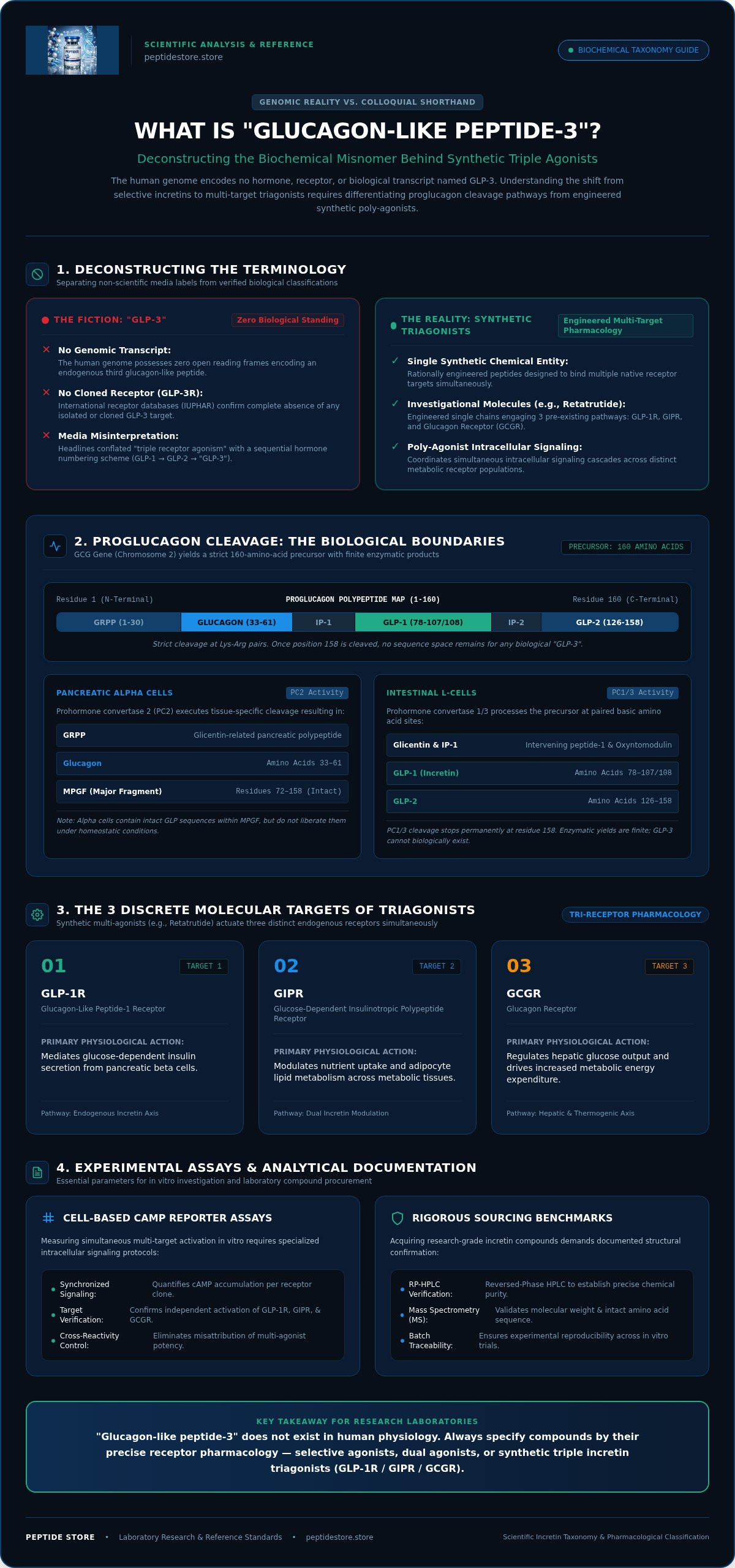
The human genome encodes no hormone, receptor, or biological transcript named glucagon-like peptide-3. Despite its explosive circulation across trade publications and metabolic forums, glucagon-like peptide-3 is a biochemical misnomer. Non-scientific coverage frequently invents the label as an informal shorthand for next-generation multi-receptor triagonists, mistaking multi-target pharmacology for a novel endogenous peptide.
You have likely encountered this confusing terminology while tracking the rapid shift from selective GLP-1 agonists to multi-pathway compounds. Unraveling the science behind this phrase requires separating physiological peptide cleavage from synthetic molecular engineering. This analysis clarifies the true post-translational processing pathways of the proglucagon gene, establishes precise pharmacological nomenclature for GLP-1, GIP, and glucagon receptor agonists like retatrutide, and outlines critical purity parameters for in vitro research.
Below, we deconstruct the proglucagon sequence map to isolate verifiable endogenous peptides from multi-agonist compounds, equipping your laboratory with accurate structural distinctions and analytical benchmarks.
Key Takeaways
- Clarify why glucagon-like peptide-3 is a biological fiction rather than an endogenous hormone, stemming from non-scientific shorthand for synthetic triple receptor agonists.
- Map prohormone convertase cleavage of the proglucagon gene to identify the true biological boundaries of natural incretin peptides.
- Examine the multi-receptor pharmacology of synthetic triagonists like retatrutide across distinct GLP-1, GIP, and glucagon signaling pathways.
- Review cell-based cAMP reporter assay protocols designed to measure simultaneous multi-target activation in vitro.
- Identify rigorous analytical documentation criteria, including RP-HPLC and mass spectrometry verification, essential for sourcing research-grade peptides.
Deconstructing the Term: What Is "Glucagon-Like Peptide-3"?
The term glucagon-like peptide-3 is a colloquial misnomer that possesses zero biological standing. In academic literature and physiological taxonomies, the phrase does not designate a functional hormone, a distinct genomic transcript, or an isolated receptor target. Instead, it represents a semantic shortcut coined by lay media to describe synthetic multi-target therapies currently under investigation.
The International Union of Basic and Clinical Pharmacology (IUPHAR) classifies peptide ligands and receptors based on verifiable genetic origins and molecular structures. Natural mammalian physiology produces specific peptide families from distinct precursor genes. In contrast, multi-agonist peptides are rationally engineered synthetic constructs designed to interact with multiple native receptor targets simultaneously, rather than individual novel biological hormones.
The Scientific Definition: Why Biological GLP-3 Does Not Exist
Human endocrinology recognizes only two glucagon-like peptides: GLP-1 and GLP-2. Both derive from the tissue-specific post-translational processing of the proglucagon precursor. Genomic sequencing has confirmed that the human genome contains no open reading frame for an endogenous third glucagon-like peptide. Likewise, international receptor databases confirm the complete absence of a cloned GLP-3 receptor (GLP-3R). The suffix "3" was mistakenly attached by lay commentary attempting to reconcile molecules that target three metabolic pathways at once.
How Popular Media Misinterpreted Triple Agonist Pharmacology
Public confusion intensified alongside the publication of clinical trial data for investigational compounds such as retatrutide. Non-technical coverage struggled to interpret how single synthetic molecules could demonstrate affinity across distinct receptor classes. Consequently, headlines conflated the phrase "triple agonist" with a sequential hormone numbering scheme, incorrectly predicting a biological successor to GLP-1 and GLP-2.
This reporting failed to understand that triple agonism involves a single chemical entity binding to three discrete, pre-existing receptor targets:
- Glucagon-like peptide-1 receptor (GLP-1R): Mediates glucose-dependent insulin secretion.
- Glucose-dependent insulinotropic polypeptide receptor (GIPR): Modulates nutrient uptake and adipocyte lipid metabolism.
- Glucagon receptor (GCGR): Regulates hepatic glucose output and increases metabolic energy expenditure.
Rather than discovering a mythical glucagon-like peptide-3, biochemical research has evolved beyond selective GLP-1 receptor agonists toward poly-agonist peptides. These engineered single chains bind multiple receptor populations to trigger synchronized intracellular signaling cascades in laboratory assays.
Proglucagon Cleavage: The Biological Boundaries of Incretin Peptides
Every natural incretin hormone originates from the expression of the GCG gene, located on chromosome 2. This transcriptional unit encodes proglucagon, a precursor polypeptide consisting of 160 amino acids. Differential post-translational cleavage of this single chain governs metabolic signaling across distinct tissues. Because enzymatic processing follows strict steric rules, biological yields are finite. There is simply no enzymatic pathway capable of cleaving an endogenous glucagon-like peptide-3 from this sequence.
Prohormone Convertase Pathways in Endocrine Cells
The processing architecture depends entirely on tissue-specific endoproteases known as prohormone convertases:
- Pancreatic Alpha Cells (PC2 Activity): Prohormone convertase 2 cleaves the proglucagon precursor to yield glicentin-related pancreatic polypeptide (GRPP), active glucagon (amino acids 33-61), and the extended major proglucagon fragment (MPGF, residues 72-158). Intact MPGF contains both GLP sequences, but alpha cells do not liberate them under standard homeostatic conditions.
- Intestinal L-Cells (PC1/3 Activity): Prohormone convertase 1/3 processes the same precursor into glicentin, intervening peptide-1 (IP-1), oxyntomodulin, and the distinct chains GLP-1 and GLP-2. PC1/3 cleaves at paired basic amino acid sites (Lys-Arg residues), liberating GLP-1 (amino acids 78-107/108) and GLP-2 (amino acids 126-158).
Once PC1/3 cleaves the terminal residue at position 158, the proglucagon sequence terminates completely. No further downstream sequence or hidden enzymatic junction remains to yield a third iteration. Thus, any notion of an endogenous glucagon-like peptide-3 contradicts basic molecular biology.
Comparative Overview of Valid Endogenous Proglucagon Peptides
The products liberated by intestinal and pancreatic processing serve specialized physiological functions:
- GLP-1 (7-36 amide): Potentiates glucose-dependent insulin secretion, inhibits glucagon release, and reduces gastric motility via GLP-1R activation.
- GLP-2 (1-33): Stimulates crypt cell proliferation, inhibits enterocyte apoptosis, and maintains gut mucosal integrity without altering glycemic curves.
- Oxyntomodulin: Retains both the glucagon sequence and an eight-amino-acid C-terminal peptide, exhibiting low-affinity dual agonism at GLP-1R and GCGR.
- Glicentin: Contains the complete 69-amino-acid N-terminal sequence, serving primarily as a metabolic intermediate.
Understanding these enzymatic boundaries helps researchers distinguish genuine endogenous endocrinology from engineered therapeutics. For teams conducting in vitro binding experiments, acquiring verified materials from a reputable supplier of research peptides ensures downstream assays reflect precise molecular targets rather than inaccurate naming conventions.
Triple Incretin Receptor Agonists: The True Molecular Targets
The operational reality behind the colloquial glucagon-like peptide-3 label is rational poly-agonist design. Rather than relying on a newly identified physiological peptide, researchers synthesize unimolecular multi-agonists. These single peptide backbones possess engineered motifs capable of engaging GLP-1R, GIPR, and GCGR across picomolar to nanomolar concentration ranges. This approach circumvents the formulation instability and variable pharmacokinetics that complicate co-administering three individual compounds.
Retatrutide Peptide Structure and In Vitro Binding Dynamics
Retatrutide represents the benchmark model for synthetic triple receptor agonism. Its architecture comprises a 39-amino-acid linear backbone derived from a modified GIP sequence. Key molecular features include:
- Metabolic Stabilization: Non-coded alpha-aminoisobutyric acid (Aib) residues at positions 2 and 20 shield the N-terminus from rapid dipeptidyl peptidase-4 (DPP-4) enzymatic degradation.
- Lipidation Strategy: A C20 fatty diacid moiety conjugated via a gamma-glutamyl-PEG linker at Lys17 facilitates reversible binding to albumin, extending circulating half-life in assay media.
- Differential EC50 Profiles: Recombinant cell lines express distinct functional potencies. Retatrutide demonstrates primary potency at the human GIP receptor, coupled with balanced, nanomolar EC50 activation profiles at both GLP-1R and GCGR.
Evolution of Incretin Analogs: Single, Dual, and Triple Agonists
Therapeutic peptide architecture has advanced through distinct pharmacological generations:
| Peptide Class | Benchmark Compound | Target Receptor Profile | Primary Functional Signaling |
|---|---|---|---|
| Single Agonist | Semaglutide | GLP-1R selective | Increases beta-cell cAMP; delays gastric motility. |
| Dual Agonist | Tirzepatide | GIPR / GLP-1R co-agonist | Augments insulinotropic response; modulates lipid storage. |
| Triple Agonist | Retatrutide | GIPR / GLP-1R / GCGR triagonist | Synchronizes insulin secretion, glucagon-mediated hepatic lipid oxidation, and cellular energy expenditure. |
Adding glucagon receptor activation to the established GIP/GLP-1 backbone transforms in vitro cellular energetics. Selective GLP-1 agonists primarily target insulinotropic and satiety pathways. Triagonists recruit GCGR-driven mitochondrial activity, accelerating lipid oxidation and oxygen consumption rates in hepatocyte cultures.
These synchronized actions illustrate why researchers study engineered triagonists rather than chasing a non-existent glucagon-like peptide-3. The challenge lies in balancing cross-reactivity without triggering rapid receptor desensitization or off-target internalization.
Laboratory Research Applications: Investigating Multi-Agonist Peptides
Quantifying poly-agonist activity requires assay systems capable of isolating three concurrent signaling events. Media discussions surrounding glucagon-like peptide-3 often obscure this practical reality: bench scientists aren't measuring an undiscovered biological pathway, but rather dissecting cross-activation across established G protein-coupled receptors. In vitro screening relies on homogeneous cell systems to measure cyclic adenosine monophosphate (cAMP) accumulation, beta-arrestin recruitment, and metabolic enzyme regulation.
Cell Culture Models for Evaluating Glucagon and Incretin Receptors
Accurate pharmacological dissection demands clonal cell lines stably expressing human GLP-1R, GIPR, or GCGR, typically maintained in CHO-K1 or HEK293 expression backgrounds. Because triagonists trigger multiple pathways at once, researchers apply pathway-selective antagonists to decouple individual receptor contributions. Co-incubating with exendin(9-39) selectively antagonizes GLP-1R, isolating GIPR- and GCGR-driven Gs protein coupling.
Downstream functional assays in primary adipocyte cultures quantify glycerol liberation and the expression of uncoupling protein 1 (UCP1). This confirms glucagon-driven lipid mobilization alongside incretin-mediated pathways, validating compound activity across all targeted cascades.
Solubilization and Storage Protocols for In Vitro Assay Peptides
Preserving peptide fidelity throughout experimental runs requires strict reconstitution and handling protocols:
- Equilibration: Allow lyophilized vials to reach room temperature in a desiccator before reconstitution to avoid condensation-induced moisture absorption.
- Reconstitution: Reconstitute using sterile, research-grade solvents or bacteriostatic water, ensuring gentle rotational agitation without aggressive vortexing.
- Adsorption Control: Utilize low-retention, non-pyrogenic polypropylene consumables to prevent peptide loss from surface adsorption, particularly when handling lipidated analogs.
- Storage Parameters: Divide concentrated stock solutions into single-use aliquots and store at -80°C. Repeated freeze-thaw cycles shear secondary peptide structures and reduce receptor-binding potency.
Acquire analytical-grade reference materials for your metabolic screening assays by selecting verified compounds directly from Peptide Store.
Procuring Research-Grade Incretin Compounds for Experimental Assays
Rigorous biochemical experimentation requires absolute chemical fidelity. When sourcing compounds colloquially described as glucagon-like peptide-3, investigators must look past colloquial nomenclature to confirm exact molecular structures. Obtaining meaningful in vitro data across complex, multi-receptor networks depends directly on procuring research-grade materials accompanied by transparent, verifiable analytical documentation.
Every commercial batch must include independent verification via reversed-phase high-performance liquid chromatography (RP-HPLC) and mass spectrometry (ESI-MS or MALDI-TOF). RP-HPLC traces confirm chromatographic purity by measuring retention times and peak area integration under defined gradient systems. Meanwhile, mass spectrometry resolves the exact molecular mass, confirming correct amino acid assembly and ruling out sequence-truncated artifacts.
Analytical Quality Standards: Verifying Peptide Identity and Purity
Inconclusive or irreproducible in vitro assay results often trace back to low-grade chemical inputs. To safeguard experimental integrity, laboratory quality standards must verify three distinct parameters:
- Purity Thresholds: Assays demand a minimum purity threshold of 98% by HPLC. Trace impurities, deletion sequences, and diastereomers introduce competitive binding artifacts at G protein-coupled receptors.
- Impurity and Salt Analysis: Solid-phase peptide synthesis leaves residual counter-ions, scavengers, and trifluoroacetic acid (TFA). High residual TFA levels induce cytotoxicity in primary cell cultures, skewing cell viability markers and basal cAMP reads.
- CoA Traceability: A valid Certificate of Analysis (CoA) must provide verifiable batch traceability, lot numbers, and matching chromatographic traces corresponding to the physical vial in hand.
Peptide Store Catalog Specifications for Scientific Laboratories
Peptide Store supplies qualified research laboratories with over 150 analytical-grade research peptides synthesized specifically for in vitro experimentation. The catalog features validated single, dual, and triple agonist references, including retatrutide, tirzepatide, and semaglutide. Investigators investigating GLP-1, GIP, and glucagon receptor dynamics can also obtain laboratory-grade bacteriostatic water alongside their lyophilized peptide orders.
Every lot undergoes stringent analytical validation to document molecular mass and chromatographic purity. Lyophilized peptides are packaged under inert gas to maximize shelf stability during logistical transport, ensuring structural integrity upon delivery. Because the colloquial term glucagon-like peptide-3 mislabels real scientific advances, Peptide Store provides the verified chemical constructs, complete documentation, and specialized logistics your laboratory requires to evaluate multi-receptor biology with complete confidence.
Advancing Multi-Receptor Metabolic Research with Verified Peptide Standards
Precision in metabolic research requires exact scientific taxonomy. Physiological proglucagon processing terminates at defined enzymatic junctions, confirming that glucagon-like peptide-3 does not exist in biological systems. The phrase merely reflects media shorthand for synthetic triple receptor agonists engineered to target GLP-1R, GIPR, and GCGR pathways simultaneously. Generating reproducible in vitro data across these interconnected cascades demands moving past colloquial nomenclature to focus on validated chemical inputs.
Peptide Store supports your experimental pipeline with a catalog of over 150 research-grade peptide compounds, including multi-agonist references like retatrutide, tirzepatide, and semaglutide. Every batch undergoes comprehensive HPLC and mass spectrometry verification to certify molecular mass and chromatographic purity, supported by strict non-clinical compliance and reliable laboratory supply logistics. Selecting fully documented reagents provides your bench with the structural fidelity required for repeatable, high-resolution assay data. Access High-Purity Incretin Compounds for Laboratory Research to advance your laboratory's metabolic screening protocols.
Frequently Asked Questions
Does glucagon-like peptide-3 (GLP-3) exist in the human body?
No, glucagon-like peptide-3 does not exist in human biology or mammalian endocrinology. The human GCG gene encodes proglucagon, which cleaves strictly into GLP-1 and GLP-2 alongside glucagon and related fragments. Enzymatic processing by prohormone convertases terminates at amino acid 158 without producing a third iteration. Additionally, no physiological GLP-3 receptor exists in genomic databases. The label is entirely a media-generated colloquialism.
Why is retatrutide frequently referred to as a GLP-3 peptide in popular media?
Popular media incorrectly adopted "GLP-3" as an informal shorthand for retatrutide because the molecule targets three distinct receptors simultaneously. Non-scientific commentary conflated the concept of triple receptor agonism (GLP-1R, GIPR, and GCGR) with numerical peptide succession following GLP-1 and GLP-2. Retatrutide is a rationally engineered unimolecular triagonist, not a novel biological hormone. Using the phrase glucagon-like peptide-3 mischaracterizes its multi-target synthetic pharmacology.
What is the primary difference between GLP-1 and GLP-2?
GLP-1 and GLP-2 differ fundamentally in receptor selectivity and biological roles despite originating from the same proglucagon precursor. GLP-1 targets pancreatic beta cells and central nervous system receptors to stimulate glucose-dependent insulin secretion and delay gastric emptying. GLP-2 binds to distinct enteric receptors to promote intestinal mucosal growth, increase crypt cell proliferation, and enhance mucosal integrity without exerting direct glycemic or insulinotropic control.
How do triple incretin receptor agonists activate multiple cellular targets?
Triple agonists achieve multi-receptor activation through a single, rationally engineered peptide sequence designed with structural motifs recognized by three distinct class B G protein-coupled receptors. Specific amino acid substitutions along the backbone allow high-affinity binding to GLP-1R, GIPR, and GCGR. Once bound, the peptide triggers receptor-specific intracellular Gs protein coupling, elevating cyclic AMP levels and recruiting downstream beta-arrestin effectors across each targeted pathway.
Can synthetic multi-agonist peptides be used in clinical treatment regimens?
No, research-grade synthetic multi-agonist peptides cannot be used in clinical treatment regimens or for human administration. Reagents supplied for scientific research are strictly designated for in vitro, biochemical, and cellular assays. Unapproved investigational compounds lack regulatory authorization for clinical applications. Scientific institutions utilize these synthetic peptides exclusively within controlled laboratory settings to elucidate receptor pharmacology, cross-reactivity, and metabolic cellular pathways.
What analytical testing is required to verify research peptide purity?
Verifying research peptide quality requires complementary analytical testing via reversed-phase high-performance liquid chromatography (RP-HPLC) and mass spectrometry (MS). RP-HPLC measures chromatographic purity, ensuring compounds meet minimum specifications such as 98% purity while detecting truncated sequence fragments. Mass spectrometry (MALDI-TOF or ESI-MS) confirms exact molecular mass and elemental identity, ensuring the physical peptide matches theoretical structural models without counter-ion degradation.

