
Cagrilintide is an amylin analogue, not a GLP-2 peptide. That distinction matters when interpreting research on the cagrilintide peptide and its proposed synergy with incretin therapies. Cagrilintide is associated with a different hormonal pathway from GLP-1 receptor agonists such as semaglutide.
These compounds are often discussed together in research on appetite and metabolic regulation, particularly as combination studies attract attention. But shared research outcomes do not make their classifications or mechanisms interchangeable. Cagrilintide remains investigational and is not FDA-approved as a standalone therapy. Findings from clinical trials or laboratory models must be interpreted within the scope of the particular study.
This article explains cagrilintide’s classification and proposed mechanism, distinguishes amylin analogues from incretin peptides, and outlines how researchers assess potential pathway synergy. It also offers a framework for interpreting preclinical results without treating them as clinical evidence, and for reviewing research material documentation while recognizing what those records can and cannot substantiate.
Key Takeaways
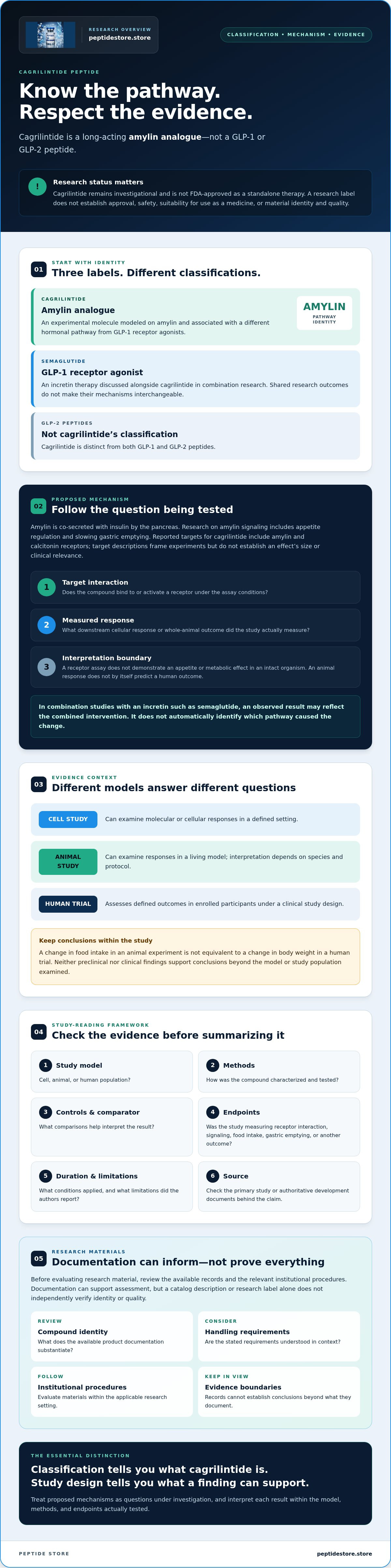
- Identify the cagrilintide peptide as a long-acting amylin analogue, distinct from GLP-1 and GLP-2 peptides.
- Separate proposed receptor-level mechanisms from the outcomes actually measured in each laboratory model.
- Assess findings by checking the study model, methods, controls, endpoints, limitations, and source.
- Review compound identity, available product documentation, handling requirements, and institutional procedures before evaluating research material.
- Keep preclinical and clinical findings within their evidence boundaries. Neither alone supports conclusions beyond the model or study population.
What Is Cagrilintide Peptide? Define Its Research Identity
Cagrilintide is a long-acting amylin analogue under investigation for its effects on appetite and metabolic regulation. The term cagrilintide peptide refers to an experimental molecule modeled on amylin, not a GLP-1 or GLP-2 agonist. This section covers its research identity and evidence context, not personal treatment decisions or clinical recommendations.
Cagrilintide as an amylin analogue
Amylin is a peptide hormone co-secreted with insulin by the pancreas. Research on amylin signaling includes its role in appetite regulation and slowing gastric emptying. Cagrilintide is classified as an analogue of this hormone, but that relationship does not establish identical behavior across biological systems. The Cagrilintide overview provides background on the compound and its research context.
“Long-acting” is a pharmacological descriptor, not a complete account of exposure or activity. Check duration and pharmacokinetic claims against primary studies or authoritative development documents, paying attention to the species, formulation, and study design. A finding in one model should not be assumed to predict the same response in another.
What researchers mean by a peptide research compound
A peptide research compound is a molecule studied in defined laboratory or clinical research settings. That designation does not establish approval, safety, or suitability for use as a medicine. As of September 2026, cagrilintide is investigational and is not FDA-approved as a standalone therapy. A research label or catalog description is not a clinical recommendation, and it does not independently verify a material’s identity or quality.
Interpret findings in context. A receptor assay, cell model, or animal study measures particular endpoints under specified conditions. It cannot by itself establish clinical benefit or predict outcomes in people. Check the model, how the compound was characterized, which controls and endpoints were included, and what limitations the authors report. Cagrilintide’s classification as an amylin analogue is distinct from proposed effects that remain under investigation.
How Cagrilintide’s Proposed Mechanism Is Studied
Mechanistic research asks how a compound interacts with biological targets and whether those interactions align with measured responses. For cagrilintide, the working framework is amylin signaling. Amylin is associated with appetite regulation and slower gastric emptying, while reported targets for cagrilintide include amylin and calcitonin receptors. These target descriptions help frame experiments, but they do not establish the size or clinical relevance of an effect.
Amylin signaling and the questions researchers investigate
Researchers may first examine whether a compound binds to or activates a receptor, then test for downstream cellular responses or changes in a whole-animal model. These are separate questions. A receptor assay may show activity under controlled conditions, but it cannot demonstrate an effect on appetite or metabolism in an intact organism. A response in an animal model may reflect that model’s biology and experimental conditions rather than a human outcome.
When reviewing work on the cagrilintide peptide, identify whether the paper measured receptor interaction, signaling, food intake, gastric emptying, or another endpoint. Treat pathways as proposed or model-specific unless replicated evidence supports a broader conclusion. A mechanism diagram can oversimplify the evidence, so use it only when each step is documented in primary research.
Interpreting preclinical and clinical evidence
Keep evidence categories distinct. Cell studies isolate molecular or cellular responses. Animal studies capture effects in a living model but remain dependent on species and protocol. Human trials assess defined outcomes in enrolled participants under a clinical study design. Each type of study answers a different question.
Evidence type describes where and how an observation was made, while interpretation determines what that observation can support. Before summarizing a finding, note the model or population, study design, comparator, duration, and measured endpoint. A change in food intake in an animal experiment, for example, is not equivalent to a change in body weight in a human trial. Neither establishes an effect beyond the conditions tested.
Combination research calls for the same discipline. When cagrilintide is studied alongside an incretin such as semaglutide, a result may reflect the combined intervention. It does not automatically identify which pathway caused the observed change. Look for comparison groups that help assess each compound’s contribution, and check how the authors describe limitations and uncertainty.
Researchers reviewing procurement information can consult the research peptide catalog as a starting point, then verify compound identity and documentation against their laboratory requirements. Catalog access is not evidence of experimental efficacy or a substitute for study-specific validation.
Cagrilintide vs. GLP-1 and GLP-2: Correct the Classification
Cagrilintide is an amylin analogue, not a GLP-2 peptide. The terms can be confusing because amylin, GLP-1, and GLP-2 are all peptide hormones discussed in metabolic or gastrointestinal research. Their appearance in related research does not make them members of the same peptide class or establish equivalent effects.
Why cagrilintide is not a GLP-2 peptide
Cagrilintide is classified in pharmacology and clinical-development literature as a long-acting amylin analogue. Its reported receptor targets are amylin and calcitonin receptors. GLP-2, by contrast, is a distinct hormone derived from the proglucagon peptide system and is studied chiefly in relation to intestinal growth and function. The phrase “GLP-2 peptide” may appear in search queries, but it is not an accurate classification for cagrilintide.
How cagrilintide differs from GLP-1 research peptides
GLP-1 is a distinct peptide hormone associated with incretin signaling. Semaglutide is a GLP-1 receptor agonist, not an amylin analogue. Research combining semaglutide and cagrilintide examines two different pathways, not two interchangeable compounds. Assess any proposed additive or synergistic effect using the specific study design and results.
| Peptide system | Classification | Broad research context | Evidence caveat |
|---|---|---|---|
| Amylin | Peptide hormone | Appetite regulation and gastric emptying | Effects depend on model and endpoint. |
| GLP-1 | Incretin hormone | Glucose regulation and related metabolic research | Findings for a GLP-1 agonist do not establish amylin activity. |
| GLP-2 | Proglucagon-derived peptide hormone | Intestinal growth and function | Its classification and research context differ from cagrilintide’s. |
| Cagrilintide | Long-acting amylin analogue | Amylin-pathway and combination research | Investigational findings are not proof of clinical equivalence or benefit. |
For accurate interpretation, start with the compound’s classification, then check the target, model, comparator, and measured endpoint. A study involving semaglutide may provide context for combination research, but it does not reclassify cagrilintide or show that the compounds act identically. Researchers seeking broader catalog context can review the supplier’s research peptide categories. Assess catalog information separately from experimental evidence.
How to Evaluate Cagrilintide Research Findings and Study Materials
A disciplined review separates what a study measured from what its authors or later summaries infer. Apply the same approach to the cagrilintide peptide and to documentation accompanying research material. Neither a favorable result nor a document title is sufficient without checking its scope and supporting details.
A source-first checklist for reading studies
Use this sequence before drawing conclusions:
- Identify the source. Determine whether it is a primary study, review, trial registry entry, or commercial summary. A review can help orient the reader, but check primary sources for methods and results.
- Define the model. Record whether the research used cells, animals, or human participants. Note relevant population or model characteristics and experimental conditions.
- Inspect the design. Identify the comparator, controls, and whether the study examined cagrilintide alone or in combination with another compound. These details shape which differences can reasonably be attributed to the intervention.
- Record the endpoint. Distinguish the outcome actually measured, such as a receptor response or a change in a defined physiological measure, from broader claims about appetite, metabolism, or clinical relevance.
- Read the analysis and limitations. Check how outcomes were reported, including statistical uncertainty, and whether the authors discuss sample size, model constraints, or other limitations. Statistical significance alone does not establish practical importance or predict results in a different setting.
- Trace claims to evidence. Compare headlines and summaries with the study’s results. Treat explanations that go beyond the design or measured endpoint as interpretation, not direct observation.
This sequence helps prevent a cell or animal result from being presented as proof of human benefit. It also makes combination findings easier to assess: the comparator groups and endpoints determine what the study can say about each compound.
Research-material documentation to review
Review documents as evidence to inspect, not automatic proof that a material is suitable for a particular experiment. Check whether the records identify the compound and connect the information to the relevant batch. If an analytical report is provided, note the method, report date, and stated scope. A method supports only the results it actually measures. Do not infer identity, purity, stability, or other properties that the document does not report.
Compare available information with the study protocol and institutional procedures. Treat documentation gaps as gaps rather than filling them with assumptions. Supplier catalog information is a procurement reference, separate from evidence of biological activity or study validity. Researchers seeking catalog access can review the research compound catalog and assess any available product information against their laboratory’s requirements.
Research-Only Procurement: Assess Cagrilintide Information Responsibly
Procurement review is separate from scientific interpretation. As of September 2026, cagrilintide is investigational and has no FDA-approved, commercially available form as a standalone therapy. Material described as research-grade is not a human medicine, and a supplier listing does not establish that it is appropriate for a particular protocol. Keep procurement decisions within laboratory research and institutional oversight.
Questions to resolve before a laboratory order
Before placing an order, confirm the compound name and intended laboratory application with the responsible research team. Then determine whether the available records are adequate for the planned work and whether the proposed material fits institutional procedures.
- Confirm identity. Check that the product description identifies cagrilintide and matches the compound specified in the protocol.
- Review batch documentation. Determine whether documents identify the relevant batch and state the analytical method, report date, and scope. Do not assume unreported properties or results.
- Verify handling requirements. Consult the documentation provided and the laboratory’s approved procedures. Do not infer storage or handling conditions from general peptide information.
- Follow institutional processes. Use applicable procurement, safety, and compliance review procedures before acquiring or handling research material.
Catalog access within a research-only scope
Peptide Store lists cagrilintide among its research compounds. That catalog entry is a procurement reference, not confirmation of clinical suitability, experimental performance, or unreported product specifications. Evaluate any available documentation against the specific requirements of the laboratory’s protocol, and resolve gaps before deciding whether the material is suitable for the intended research.
These boundaries matter because a cagrilintide peptide listing cannot substitute for study validation or institutional review. The supplier does not provide prescription medications, clinical dosing, or medical consultations. Assess research materials only within the laboratory’s authorized research context. They are not presented here for human use or as treatment guidance.
For researchers reviewing procurement options, the research peptide catalog provides a place to examine catalog information. Review it and verify that available details align with your laboratory’s documentation and procedure requirements.
Apply a Clear Evidence Framework to Future Research
Accurate interpretation starts with classification: the cagrilintide peptide is an amylin analogue, not a GLP-1 or GLP-2 peptide. Assess its proposed mechanisms and potential interactions using the specific evidence available, keeping cell, animal, and human findings distinct.
For each study, check the model, methods, controls, endpoints, and limitations before drawing conclusions. For research materials, review available identity and batch documentation, analytical method, and report scope, then compare them with laboratory and institutional requirements. A document or catalog listing can inform procurement, but it does not establish experimental suitability or clinical evidence.
Peptide Store lists cagrilintide among its research compounds and describes a catalog spanning more than 150 research peptide compounds. To review catalog information, visit the research peptide catalog and assess it within your laboratory’s research-only procedures.
Frequently Asked Questions
Is cagrilintide a GLP-2 peptide?
No. Cagrilintide is classified as a long-acting amylin analogue, not a GLP-2 peptide. Amylin, GLP-1, and GLP-2 are distinct peptide systems, even though researchers may study them in related metabolic or gastrointestinal contexts. Classification depends on the compound’s identity and biological targets, not on overlapping research questions. If a source labels cagrilintide as GLP-2, check its cited evidence and terminology against authoritative references.
What is cagrilintide studied for in laboratory research?
Researchers investigate cagrilintide in relation to amylin signaling and outcomes such as appetite regulation and gastric emptying. The specific question depends on the model and study design: a receptor assay examines a different process from an animal study measuring food intake or a clinical trial tracking body weight. Describe results by their actual model and endpoint. A finding in one setting does not establish an effect in another.
How does cagrilintide differ from GLP-1 peptides?
Cagrilintide is an amylin analogue; GLP-1 peptides belong to the incretin system. Semaglutide, for example, is a GLP-1 receptor agonist, not an amylin analogue. The distinction matters when interpreting combination research: a study may examine compounds acting through different pathways, but that does not make them equivalent or prove synergy. Review the study’s comparison groups and measured outcomes before drawing conclusions about either compound.
Can cagrilintide be studied alongside semaglutide?
Yes. Research has examined cagrilintide in combination with semaglutide, a GLP-1 receptor agonist. The combination is investigated as an approach involving distinct peptide pathways, but results must be interpreted from the specific study rather than assumed from the proposed mechanism. Check the model or participant population, comparator groups, endpoints, and limitations. Combination findings do not independently establish the contribution of each compound or prove effects outside the study conditions.
What should a certificate of analysis show for a research peptide?
Check whether the certificate of analysis identifies the compound and relevant batch, and reports the analytical method, report date, scope, and results. Confirm that the document corresponds to the material being evaluated. A certificate supports only the properties and measurements it explicitly reports; it does not automatically establish suitability for a particular protocol. Do not infer unreported identity, purity, stability, or performance claims. Compare available documentation with laboratory requirements.
Is cagrilintide approved for human use?
No. As of September 2026, cagrilintide is investigational and is not FDA-approved as a standalone therapy. Its use in people is limited to authorized clinical trials. Regulatory status can change, so verify current information through authoritative sources before publication or research planning. Clinical trial results describe findings in defined study settings; they do not mean that an investigational compound is an approved or commercially available treatment.
Can research-grade cagrilintide be used as a medication?
No. Research-grade cagrilintide should not be treated as a medication or used for human treatment. A research designation does not establish approval, safety, or suitability for human use, and supplier documentation is not a substitute for clinical evaluation. Peptide Store lists cagrilintide among its research compounds for laboratory and scientific applications. Its products are not human prescription medications, and the company does not provide clinical dosing or medical consultations.


