
The same peptide name can appear in listings from very different supply models. In peptide sales, a catalog product, a custom synthesis service, and a prescription medicine pathway are not interchangeable, even when search results place them side by side. Receptor affinity profiles describe molecular interactions, but they don’t establish a product’s intended use or clarify what a supplier offers.
When comparing semaglutide and tirzepatide, research teams need clear product specifications and a clear understanding of the supplier’s role. Catalog descriptions may not make documentation or research-use boundaries easy to identify. Before comparing listings, determine what type of supplier you’re viewing and what information accompanies each product.
This article explains common peptide supplier models and what to review, including compound identity, available documentation, and stated intended use. It also distinguishes catalog distribution from medicines and custom synthesis, so teams can assess whether a catalog listing fits laboratory work without treating research materials as products for human use.
Key Takeaways
- Interpret peptide sales in context. Search results may refer to research products, service providers, or sales employment.
- Compare catalog distributors, custom synthesis providers, and specialist reagent suppliers by scope and selection process.
- Before assessing a listing, check compound identity, stated form, specifications, documentation, and intended-use language.
- Distinguish supplier statements from independently verified analytical evidence when reviewing documentation.
- Peptide Store is a national online supplier of research-grade catalog peptides, with more than 150 compounds across research categories. Verify current listing details before assessing fit.
What peptide sales means in research and laboratory purchasing
Peptide sales is a broad search phrase that can refer to peptide products, related services, or commercial sales jobs. Here, it means laboratory purchasing: evaluating research compounds and supplier models, not obtaining medicines, treatment, or clinical advice. Search results can mix these intents, so check the page type before using it to guide a purchasing decision.
Research-use labeling describes a stated boundary, not a universal fit. It doesn’t show that a compound is suitable for every experiment, verify a listing’s specifications, or replace review of the research protocol. Compare the stated intended use and product information with your research requirements.
For background on the receptor class relevant to this comparison, see the GLP-1 receptor agonist overview. Semaglutide acts at the GLP-1 receptor, while tirzepatide engages both GIP and GLP-1 receptors. The video below discusses semaglutide and tirzepatide; it isn’t clinical advice or a guide to selecting laboratory materials.
Watch: Semaglutide vs Tirzepatide from DPC Health.
Catalog peptide sales versus peptide sales jobs
Employment marketplaces may appear in search results because “sales” can describe a job as well as a transaction. A job post usually focuses on responsibilities, qualifications, or a commercial territory. A research product page identifies a compound, product form, or specifications for evaluation. Check the result title, page type, and terminology before assuming it addresses laboratory purchasing.
What laboratory peptide suppliers may offer
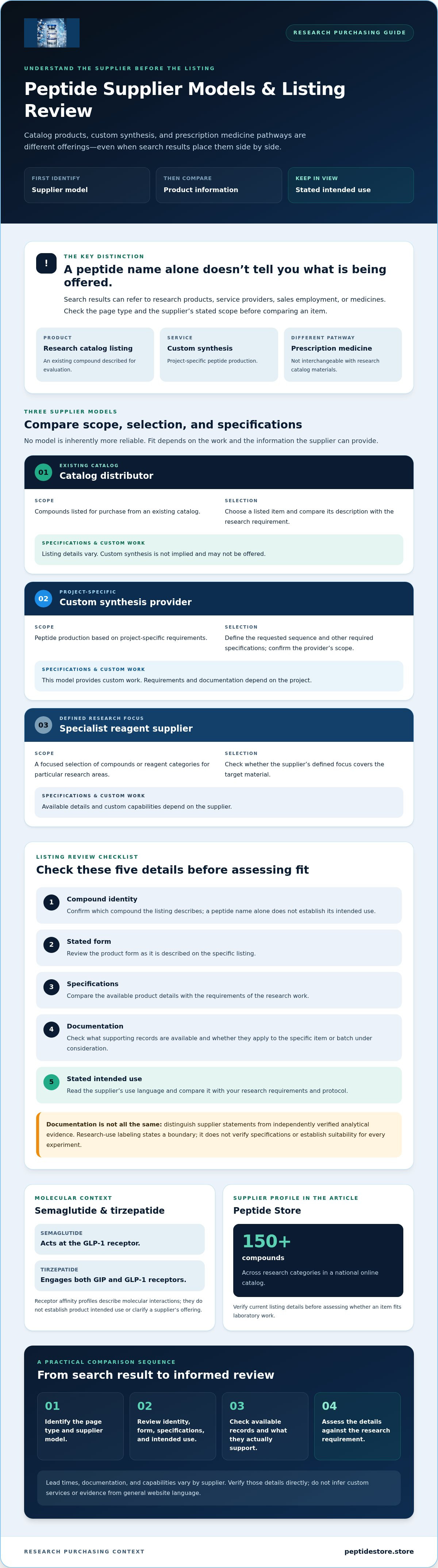
Supplier models vary. A catalog distributor lists existing compounds for selection. A custom synthesis provider produces a peptide to project-specific requirements, while a specialist research reagent supplier may focus on particular compound or reagent categories. These are distinct offerings, and an individual supplier may provide one, several, or none of them. Confirm the supplier’s stated scope rather than inferring services from general website language.
For more on research considerations such as synthesis, purity claims, and analytical standards, consult this research peptide laboratory guide. Treat product descriptions as supplier-provided information, then assess whether the available details support your laboratory comparison.
How peptide sales models compare for research buyers
For laboratory buyers, the key difference is the scope of the supply relationship. A catalog distributor offers listed compounds, a custom synthesis provider works from project-specific requirements, and a specialist reagent supplier focuses on defined research categories. No model is inherently more reliable. Suitability depends on the work and the information the supplier can provide.
| Supplier model | Scope | Selection process | Specifications and custom work |
|---|---|---|---|
| Catalog distributor | Compounds listed for purchase from an existing catalog. | Select a listed item and compare its description with the research requirement. | Listing details vary. Custom synthesis is not implied and may not be offered. |
| Custom synthesis provider | Project-specific peptide production. | Define the requested sequence and other required specifications, then confirm the provider’s scope. | Requirements and documentation depend on the project. This model provides custom work. |
| Specialist reagent supplier | A focused selection of compounds or reagent categories for particular research areas. | Assess whether the supplier’s defined focus covers the target material. | Available details and custom capabilities depend on the supplier. |
Lead times, documentation, and capabilities vary by supplier, so verify them directly. Ask which specifications are listed, what supporting records are available, and whether those details apply to the specific item or batch under consideration. Catalog presence alone doesn’t prove independent testing or suitability for every experiment.
Catalog compounds and ready-to-order listings
Catalog purchasing means selecting from compounds a supplier lists for order. It can suit a defined requirement when the listing’s identity, form, and specifications align with the planned work. Compare those details rather than relying on a familiar compound name. A catalog entry shows that a supplier lists the compound; it doesn’t establish independent analytical verification or suitability for every research application.
Custom synthesis and specialist research suppliers
Custom synthesis is a separate service for projects that require a peptide produced to specified requirements. It involves communicating the requested material and confirming the provider’s capabilities. Specialist suppliers may instead concentrate on particular reagent classes or research fields rather than offer a broad catalog. Compare each supplier’s scope and documentation with the project requirements, not with assumptions about which model is superior.
Peptide Store operates as a catalog supplier for laboratory and scientific research applications. Its catalog includes more than 150 compounds, and the business does not offer custom peptide synthesis. Researchers evaluating this supply model can review the research peptide product catalog and compare current listing details with their defined requirements.
What to compare on research peptide product listings
A useful listing should help a research team compare the material with a defined protocol, not just recognize a compound name. Review the information provided and flag missing details for clarification. A clear product description is a starting point, not proof that the material fits a particular experiment.
Product suitability depends on the stated specifications and the experimental design. Use this checklist when evaluating listings in peptide sales:
- Compound identity: Does the listed name match the exact compound required?
- Stated form: Is the product form identified, and does it match the protocol’s requirements?
- Listed specifications: Are the relevant attributes described clearly enough to compare equivalent materials?
- Documentation: What records or supporting information are available, and what do they demonstrate?
- Intended-use language: Does the listing clearly state its research context and boundaries?
Identity, form, and product specifications
Start with identity, then check the listed form and specifications against the protocol. Similar names don’t prove that two listings describe equivalent materials. If the form or a required attribute is missing, ambiguous, or described differently across listings, ask the supplier rather than filling the gap with an assumption. Don’t infer concentration, purity, storage conditions, or experimental performance unless the listing provides verifiable information.
Record unresolved details before comparing suppliers. For example, ask whether a specification applies to the listed product generally or to a particular batch, if that distinction matters to the study. This keeps the comparison grounded in documented information rather than marketing language.
Documentation and research-use boundaries
Documentation can support traceability when it identifies the material or batch it covers and provides enough detail for review. However, a supplier statement is not the same as a validated analytical result, and the presence of a document alone doesn’t establish independent verification. Check the source, scope, and date of any available record. Ask what was tested and whether the result corresponds to the material being evaluated.
Read intended-use language as a boundary, not as evidence of suitability for every application. Research products are not substitutes for prescribed medicines or medical advice, and this information does not provide treatment guidance. Keep purchasing decisions within the laboratory’s defined research purpose, and ask the supplier for clarification when product information leaves an important question unanswered.
A practical process for comparing peptide suppliers
A consistent review process helps research teams compare peptide sales listings without relying on product names or broad supplier claims. Start with the experiment, then assess whether each supplier can provide the information needed to evaluate the material and complete institutional purchasing.
Define the research requirement before browsing
Document the target molecule, experimental context, and required product form before reviewing catalogs. Identify the specifications and records your laboratory needs to assess the material, then apply the same criteria to each supplier. Keep research procurement separate from requests for medical use or dosing guidance. A research supplier cannot determine clinical suitability.
Use this workflow to keep comparisons consistent:
- 1. Set the requirement. Record the compound identity, intended laboratory context, product form, and essential specifications.
- 2. Identify the supply model. Determine whether the listing is a catalog compound, custom synthesis service, or specialist reagent offering. Compare like with like.
- 3. Review available information. Note listing details and documentation relevant to your criteria. Separate documented evidence from supplier statements, and mark missing details as unverified.
- 4. Ask focused questions. Request clarification about ambiguous identity, specifications, documentation, or handling information. Use consistent questions across suppliers so their responses can be compared.
- 5. Check purchasing conditions. Review current supplier policies and fulfillment information, and follow your institution’s applicable purchasing and approval procedures.
- 6. Assess fit. Compare each response with the original research requirement. If a critical detail remains unclear, record it as unresolved rather than assuming equivalence.
Product names alone aren’t a reliable basis for comparison. Listings with similar names may differ in stated form or available specifications, while different labels may require closer identity review. Compare equivalent compounds and equivalent documented specifications. Don’t assume that a shared name means the same research fit.
Maintain a simple comparison record with one row per supplier and fields for identity, form, relevant specifications, documentation, unanswered questions, policies, and fulfillment information. This makes gaps visible and helps the team distinguish confirmed details from information that still needs verification.
Once the research requirement is defined, browse the research peptide categories to identify relevant catalog groupings. Review current listing information and assess each item against your laboratory’s criteria before proceeding.
Peptide sales at Peptide Store: catalog scope and next steps
For laboratory buyers, peptide sales at Peptide Store means catalog distribution of research-grade peptides for laboratory and scientific applications. The online supplier serves customers nationally, and its catalog includes more than 150 compounds across research categories. This describes the overall catalog scope; it doesn’t mean every compound is available at all times or establish suitability for a particular experiment.
Tirzepatide is a priority offering in the catalog. Its inclusion is for research contexts, not as a human prescription medicine or a treatment recommendation. Peptide Store distributes catalog compounds and does not offer custom peptide synthesis, clinical dosing, or medical consultations. Confirm the purpose and limits of each listing before assessing its fit with a laboratory requirement.
Catalog categories and appropriate research context
The catalog includes GLP-1 agonists, healing peptides, growth hormone peptides, and cognitive research molecules. These labels help organize catalog browsing; they don’t establish clinical effects or predict experimental outcomes. Start with a defined research question, then review the identity and specifications stated for relevant listings. Don’t treat a category name as evidence of suitability.
For broader technical context on research peptides, including synthesis and analytical standards, consult the research peptides laboratory guide. Once the research-use scope is clear, review the available research peptide products and compare current listing information with the criteria established for the work.
Review the catalog and confirm product details
Before making a research purchasing decision, check the current product page for the stated compound identity, product form, specifications, documentation, and intended-use language. Don’t assume information that isn’t listed, and don’t treat a catalog entry as proof of independent analytical verification. If a detail relevant to the protocol is unclear, ask for clarification rather than inferring it from the product name or category.
Questions about product information or ordering can be directed through the supplier contact page. Review current listing details and compare them with your laboratory requirements before deciding whether a product warrants further consideration.
Make the next supplier comparison evidence-based
Peptide sales can refer to different supply models, so identify whether a listing represents catalog distribution, custom synthesis, or another research supplier before comparing options. For laboratory purchasing, assess compound identity, stated form, specifications, and available documentation against the experiment’s requirements. A product name alone can’t establish equivalent specifications or suitability.
Peptide Store is a national online supplier of research-grade catalog peptides for laboratory and scientific applications. Its catalog includes more than 150 compounds. This describes catalog scope, not continuous availability of every compound. Review current product details and intended-use information before deciding whether a listing fits your research needs.
Review the research peptide catalog by category and compare relevant listings with your laboratory’s requirements. A methodical review keeps purchasing decisions grounded in the available information.
Frequently Asked Questions
What does peptide sales mean?
Peptide sales can refer to peptide products, services related to supplying or producing peptides, or commercial sales jobs in the peptide industry. For laboratory buyers, it often points to catalog compounds or specialist research suppliers, but search results may also show employment listings or custom synthesis providers. Check the page type and supplier’s stated scope to confirm that the result matches your research purchasing needs.
Are research peptides the same as prescription medications?
No. Research peptides and prescription medications are distinct product categories and shouldn’t be treated as interchangeable. A research-use statement doesn’t establish that a product is approved, evaluated, or suitable for human use. Research materials are intended for laboratory and scientific applications, not as substitutes for prescribed medicines or medical advice. For medication questions, consult a qualified healthcare professional rather than relying on a research product listing.
How do catalog peptide suppliers differ from custom synthesis services?
Catalog suppliers offer compounds listed for selection from an existing product range. Custom synthesis services produce material according to project-specific requirements, which must be discussed with the provider. These models differ in scope and selection process, not in guaranteed reliability. Confirm what the supplier offers, which specifications are available, and whether the model can address the defined laboratory requirement. Peptide Store distributes catalog products and does not offer custom peptide synthesis.
What should researchers check before ordering a peptide?
Check the exact compound identity, stated product form, relevant listed specifications, available documentation, and intended-use language. Compare these details with the research protocol and institutional purchasing procedures. If a specification or document is missing or unclear, ask the supplier rather than assuming an answer. Distinguish supplier statements from analytical evidence, and verify that any documentation reviewed applies to the material or batch under consideration.
Does Peptide Store offer custom peptide synthesis?
No. Peptide Store is an online supplier of research-grade catalog peptides for laboratory and scientific applications; it doesn’t offer custom peptide synthesis. Researchers looking for a listed compound can review the current catalog and assess available product information against their research requirements. If a project needs a peptide produced to specific requirements, confirm that a potential provider explicitly offers custom synthesis and can address the project’s specifications.
Can peptide suppliers provide certificates of analysis?
Some suppliers may provide certificates of analysis, but availability and content vary. Ask whether a certificate is available for the specific product or batch, what analytical information it contains, and who performed the analysis. Don’t automatically treat a supplier-provided document as independent verification. Check its source, scope, and date, and contact the supplier if the document or its relationship to the listed material is unclear.
How can I tell whether a peptide listing fits my laboratory research?
Compare the listing with a defined research requirement. Confirm that the compound identity and stated form match the protocol, then review relevant specifications, documentation, and intended-use language. Consider whether the available information is sufficient for your laboratory’s evaluation, and record unresolved questions for the supplier. A matching product name alone doesn’t establish equivalent specifications or experimental suitability. Assess the listing in the context of the study design.


