
The better-known comparison does not mean the two molecules have equivalent evidence. Thymosin beta-4 is a naturally occurring, 43-amino-acid protein, while TB-500 is a synthetic seven-amino-acid fragment modeled on it. Human trials discussed for thymosin beta-4 tested the full-length protein, not TB-500, so their findings cannot be treated as direct evidence for the fragment.
Researchers have studied thymosin beta-4 in areas including tissue repair, wound healing, cell migration, and recovery in laboratory models. TB-500 research also addresses tissue healing and cell migration, but evidence for its effects in humans is limited. The distinction in TB-500 vs thymosin beta-4 research applications therefore starts with molecular identity and continues through the type of evidence available.
This comparison explains how the compounds differ, what human clinical studies have examined, and which biological effects appear in preclinical research. It also separates findings for full-length thymosin beta-4 from those for TB-500, helping readers interpret the evidence without treating a shared research theme as proof of equivalent effects.
Key Takeaways
- Distinguish the full-length protein from the shorter synthetic fragment before interpreting findings or comparing proposed applications.
- Separate laboratory and animal results from human clinical evidence; studies of one form do not establish effects for the other.
- Identify which tissue-repair processes researchers have investigated, including cell migration, wound healing, and regeneration.
- Assess angiogenesis and immune effects as distinct research areas rather than assuming the compounds act identically.
- Use the comparison to frame research questions around molecular form, study model, and the specific biological outcome being measured.
Does literature support studied applications?
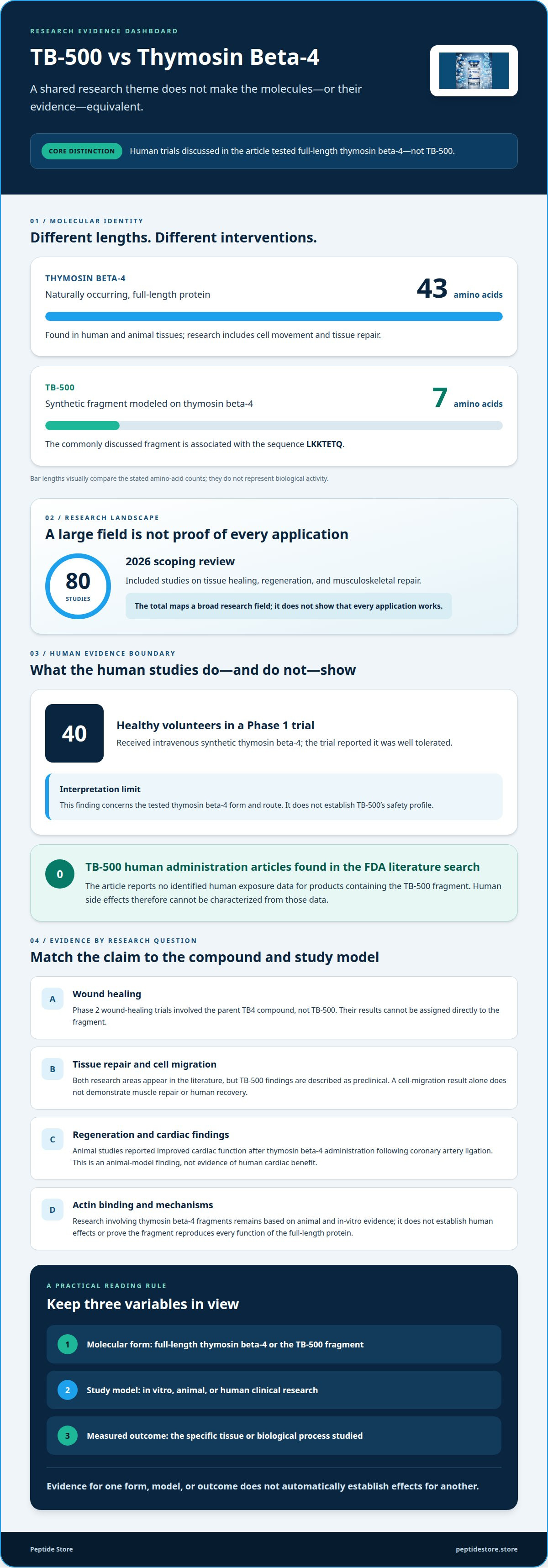
Evidence for TB-500 wound healing, muscle recovery, and injury repair centers on preclinical work, not demonstrated human outcomes. Phase 2 wound-healing trials involved the parent TB4 compound, so they do not establish TB-500 efficacy.
Research examines tissue repair through different models and biological processes. The distinction between a peptide fragment and full-length thymosin beta-4 matters when interpreting each result.
Wound-Healing Applications
Wound-healing research examines whether these compounds influence cell movement and tissue recovery. TB-500 studies include tissue healing and cell migration, while thymosin beta-4 research also examines wound healing and regeneration. The evidence differs by molecular form: Phase 2 wound-healing trials used the parent TB4 compound, not TB-500. Their results cannot be assigned directly to the shorter fragment.
Tissue Repair and Regeneration
Tissue-repair research asks how biological processes contribute to healing beyond a wound surface. Thymosin beta-4 studies include tissue regeneration and organ recovery, while TB-500 research includes cell migration and repair-related questions. A 2026 scoping review included 80 studies on tissue healing, regeneration, and musculoskeletal repair. That total maps a broad research field, not proof that every application works.
Study model changes what a finding can support. Animal studies reported improved cardiac function after thymosin beta-4 administration following coronary artery ligation. This is evidence from an animal model, not evidence of human cardiac benefit. Research on thymosin beta-4 fragments and actin binding likewise consists of animal and in-vitro evidence. These findings help define mechanisms for further study, but they do not establish clinical injury recovery.
For muscle recovery and other musculoskeletal claims, evidence must match both the compound and the tissue being studied. Results involving the parent protein cannot establish effects for TB-500. Likewise, a cell-migration result does not by itself demonstrate muscle repair. Compare the intervention, model, and measured outcome before drawing conclusions about healing.
| Research option | Wound-healing scope | Evidence model | Interpretive limit |
|---|---|---|---|
| TB-500 | Tissue healing and cell migration | Preclinical research | Does not establish human repair |
| Full-length thymosin beta-4 | Wound healing and regeneration | Animal and clinical research | Findings concern the parent compound |
Match the evidence to the compound, tissue, and outcome being studied.
What Is Thymosin Beta-4?
Thymosin beta-4 is a naturally occurring protein found in human and animal tissues, particularly the thymus. It contains 43 amino acids and is present in virtually all human cells. Its biological role includes involvement in cell movement and tissue repair. Research also examines its role in stimulating new blood vessel formation.
TB-500 is a synthetic fragment modeled after a portion of thymosin beta-4. The commonly discussed fragment is seven amino acids long and is associated with the sequence LKKTETQ. That difference in structure matters: findings for the full-length protein cannot automatically be assigned to a shorter fragment. Researchers therefore distinguish the intervention tested, rather than treating both names as interchangeable.
The LKKTETQ fragment also appears in research on actin binding, a cellular process relevant to how cells maintain structure and move. Research on tissue repair and actin binding involving thymosin beta-4 fragments remains based on animal and in-vitro evidence. These models help investigate biological mechanisms, but they do not establish human effects or show that the fragment reproduces every function of the full-length protein.
For United States regulatory status, TB-500 is not FDA-approved. Human trials of full-length thymosin beta-4 are evidence of clinical study, not evidence that TB-500 is approved or that the fragment has the same regulatory status.
Safety evidence also depends on which form researchers administered. A phase 1 trial included 40 healthy volunteers receiving intravenous synthetic thymosin beta-4 and found it was well tolerated. Phase 3 trials of full-length formulations reported acceptable safety profiles. These findings concern the full-length protein, not TB-500, and cannot define the fragment’s safety profile.
The FDA has not identified human exposure data for drug products containing the TB-500 fragment, and its literature search found no articles in which TB-500 was given to humans. Consequently, human side effects for TB-500 cannot be characterized from those data. This distinction is important when interpreting potential risks: tolerability findings for full-length thymosin beta-4 do not demonstrate equivalent tolerability for TB-500.
For research comparisons, record the molecular form, the model, and the measured outcome. A study using full-length thymosin beta-4 answers a different question from one examining LKKTETQ. The same applies to safety: the administered form and route define what the findings can support. Keeping these variables separate prevents mechanistic observations from being mistaken for human clinical evidence.
Human clinical evidence for thymosin beta-4
Clinical findings for full-length thymosin beta-4 come from specific medical indications and formulations. They do not establish human efficacy for TB-500, a distinct fragment.
Human Efficacy Evidence
A randomized, double-blind trial tested topical thymosin beta-4 for venous leg ulcers in 73 people. About 25% healed completely within three months. This is an observed result for that trial and formulation, not proof of broad tissue repair. An eye-drop trial reported less ocular discomfort than vehicle at day 56, another indication-specific outcome.
Phase 3 studies of full-length thymosin beta-4 formulations reported acceptable safety profiles. A Phase 3 neurotrophic keratopathy trial reported no clinically significant safety signals. These findings describe safety observations, not proof of efficacy for every use. The route, formulation, condition, and measured endpoint define what each clinical result can support.
A 2026 scoping review categorized 19 studies as human studies. Within its study classifications, 70 studies involved TB4 interventions, four involved other derivatives or fragments, and one directly studied TB-500. These categories show why evidence totals need careful interpretation: a human study of full-length TB4 is not a human study of TB-500.
Research Limitations and Evidence Gaps
Evidence for TB-500 remains distinct from clinical evidence for the parent protein. One ClinicalTrials.gov trial is reported for TB-500, while the FDA’s literature search found no articles in which TB-500 was given to humans. The FDA also has not identified human exposure data for drug products containing the LKKTETQ fragment.
The 2026 review found no human interventional studies administering TB4 or TB-500 for tendon, ligament, muscle, bone, cartilage, adipose or fat-graft, or spine and disc indications. This leaves a gap between laboratory or animal findings and human musculoskeletal outcomes. Completed published randomized controlled trials have not established human efficacy for common TB-500 wellness claims.
TB-500 is not FDA-approved for human use. For research peptides, identity, purity, and contamination are product-specific quality considerations; analytical testing can evaluate composition, but it does not establish clinical safety or efficacy. This distinction matters because laboratory specifications and medical evidence address different questions.
Angiogenesis and progenitor-cell mobilization
Angiogenesis means new blood vessel formation, a process relevant to tissue recovery. Thymosin beta-4 is strongly involved in blood vessel growth in research on tissue recovery. By comparison, TB-500’s angiogenesis effects are described as limited. This difference matters when comparing proposed biological properties: shared interest in repair does not mean equal evidence for every pathway.
Researchers distinguish angiogenesis from progenitor-cell mobilization. Angiogenesis concerns the formation of blood vessels; progenitor-cell mobilization concerns cells moving from their source into circulation or tissue. These are related but distinct research questions. Measuring vessel growth alone does not demonstrate cell mobilization, and observing cell movement does not establish that functional blood vessels have formed.
For thymosin beta-4, vessel-growth research connects angiogenesis with recovery processes. New vessels can be examined as part of a tissue-repair response, alongside other endpoints such as cell migration. Those measurements answer different questions. A wound-healing model that records tissue changes cannot automatically show which mechanism produced them or whether progenitor cells contributed.
TB-500 research includes cell migration and tissue healing, but its angiogenesis effects are characterized as limited. That distinction narrows interpretation. Cell migration describes movement; it does not demonstrate new vessel formation. When researchers compare the compounds, they need to identify the measured endpoint before translating a result into a broader claim about regeneration.
Experimental design shapes what an angiogenesis finding can show. Researchers can examine a defined tissue, record vessel-related changes, and compare them with measures of cell migration. In an animal model, an observed response applies to that model and the intervention tested. It does not establish a human outcome or prove that a peptide fragment reproduces the properties of the full-length protein.
Progenitor-cell mobilization requires its own evidence. A study must distinguish mobilized cells from local cell migration and then relate that finding to the tissue response being measured. Without that separation, a change in wound healing cannot be attributed specifically to mobilization. The same reasoning applies to both thymosin beta-4 and TB-500.
For a useful comparison, organize findings by compound, model, and endpoint. Record whether the intervention is thymosin beta-4 or TB-500; note whether the model is laboratory-based or animal; then separate angiogenesis, cell migration, and progenitor-cell mobilization. This prevents a result for one biological process from being presented as evidence for another.
The clearest distinction is therefore about research emphasis: thymosin beta-4 has stronger reported involvement in vessel growth, while TB-500 has limited angiogenesis effects. Neither label alone establishes clinical benefit. For wound healing or regeneration, the measured tissue outcome and the mechanism studied must remain explicit.
Anti-inflammatory and anti-fibrotic effects
Inflammation and fibrosis describe different parts of tissue response. Inflammation involves immune activity after injury, while fibrosis concerns scar-like tissue changes. Thymosin beta-4 research examines immune regulation and oxidative stress. TB-500 is described as having less significant immune modulation. These distinctions help separate proposed recovery mechanisms from evidence about tissue structure.
For thymosin beta-4, the reported biological effects include helping regulate immune responses and reduce oxidative stress. These are related but separate research questions. Immune regulation concerns how the response is controlled; oxidative stress concerns damage associated with reactive molecules. Neither observation alone establishes a particular medical outcome, such as faster recovery after a muscle injury.
TB-500 is described as having less significant immune modulation than thymosin beta-4. That comparison does not mean the two compounds have identical inflammatory effects. Researchers need to identify the tested molecule, model, and measured outcome. For example, an immune-response measurement cannot stand in for a direct assessment of scar formation or tissue repair.
Anti-fibrotic claims require particular care. A study addressing inflammation does not automatically demonstrate reduced fibrosis. To assess an anti-fibrotic effect, research would need to examine a fibrosis-related outcome, such as tissue structure, alongside the intervention and model. The stated comparison identifies immune modulation and oxidative stress, but does not establish a specific anti-fibrotic result for TB-500.
Published findings should therefore be read by endpoint rather than grouped under a broad label such as healing. A laboratory model that measures immune regulation answers a different question from an animal model examining tissue architecture. The distinction also applies to thymosin beta-4: reported effects on immune responses do not prove an anti-fibrotic effect in people.
For a structured literature review, separate the evidence into three fields: compound, biological process, and outcome. Record thymosin beta-4 or TB-500 as the intervention. Classify the process as immune regulation, oxidative stress, inflammation, or fibrosis. Then note whether the published result measures that process directly or only an associated tissue change.
This distinction keeps a mechanistic observation from becoming a broader medical claim. For example, reduced oxidative stress in a laboratory model alone would not demonstrate less fibrosis after injury. An inflammatory measure would not establish improved recovery either. Conclusions should stay within the model and endpoints actually studied.
Compounding status and research findings answer separate questions. Regulatory classification does not demonstrate an anti-inflammatory or anti-fibrotic effect, and laboratory evidence does not establish approval for human use. These distinctions are not medical advice; they define how evidence should be interpreted. For thymosin beta-4 and TB-500, keeping mechanism, tissue outcome, and research model separate produces a more accurate comparison.
Peptide Store
Peptide Store supports researchers who are translating peptide literature into laboratory research plans. The central distinction in this comparison is between evidence about a molecule and the identity of a compound selected for research. Peptide Store’s research-grade catalog provides a next step for laboratory applications, while interpretation of published findings should remain tied to the specific molecule, model, and measured outcome.
For related research interests, its catalog includes Tirzepatide, Retatrutide, Semaglutide, and Cagrilintide. These compounds address different research areas, so they should not be treated as substitutes for thymosin beta-4 evidence. Contact Peptide Store with questions about its research catalog.
Define the next research question
Future work can make the TB-500 vs thymosin beta-4 research applications comparison more informative by defining the question before selecting endpoints. Specify the molecular form, biological mechanism, tissue model, and measured outcome. This framework distinguishes a test of cell migration from one assessing inflammation or tissue recovery, making findings easier to interpret across studies.
For laboratory planning, keep compound selection separate from conclusions about clinical use. Peptide Store offers Tirzepatide, Retatrutide, and Semaglutide among its research catalog offerings. These distinct compounds cannot substitute for evidence about thymosin beta-4 or TB-500. A clearly framed TB-500 vs thymosin beta-4 research applications question can help keep a project’s objectives and interpretation aligned.
If you’re planning research and need information about the available catalog, contact Peptide Store for assistance. A clearly defined question is a practical starting point for rigorous, reproducible work.
Frequently Asked Questions
What Is TB-500?
TB-500 is a synthetic peptide fragment modeled on part of thymosin beta-4. Its commonly discussed form is seven amino acids long, so it should not be treated as another name for the full-length protein. Peptide Store supplies TB-500 solely for laboratory and scientific research. It is not intended for human consumption, veterinary use, diagnostic, food, or household chemical applications.
Which Should You Choose?
For laboratory research, select the compound that matches the research question and the evidence being evaluated. A study of full-length thymosin beta-4 cannot establish effects for TB-500, and a result about one biological endpoint may not answer another. Define the molecule, model, and measured outcome first. Neither compound should be selected on the assumption that laboratory findings establish a human benefit.
What is thymosin beta-4 (Tβ4) and how does TB-500 differ from it?
Thymosin beta-4, or Tβ4, is a naturally occurring protein with 43 amino acids. TB-500 is a shorter synthetic fragment modeled after part of that protein. The difference affects how study results should be classified: research that administers full-length Tβ4 evaluates a different intervention from research involving TB-500. For literature comparisons, record the precise molecular form rather than grouping both under one label.
Is TB-500 a fragment, synthetic analog, or formulation of thymosin beta-4?
TB-500 is described as a synthetic fragment of thymosin beta-4, not a formulation of the full-length protein. The fragment is associated with the seven-amino-acid sequence LKKTETQ. Calling it a fragment helps distinguish its structure from the parent protein; it does not mean that findings for full-length thymosin beta-4 automatically apply to TB-500. Keep the molecular identity explicit when comparing experiments.
What research applications of thymosin beta-4 have been studied in humans?
Human studies of full-length thymosin beta-4 have examined topical treatment for venous leg ulcers, eye drops, and intravenous administration in healthy volunteers. These represent different formulations, routes, and research questions. They should not be combined into a general claim about all tissue repair. Human findings for a particular indication or formulation do not establish outcomes for TB-500 or for unrelated conditions.
What preclinical research applications of TB-500 have been studied?
Preclinical TB-500 research has examined tissue healing and cell migration. Those studies investigate biological processes and model-specific responses, rather than establishing clinical recovery after human muscle or other injuries. When reviewing a result, separate the test compound from related thymosin beta-4 research, then identify the model and endpoint. This helps prevent an experimental observation from being interpreted as proof of human efficacy.
What clinical trials have evaluated thymosin beta-4 or TB-500, and what were their results?
Trials of full-length thymosin beta-4 have reported indication-specific findings, including wound-healing, ocular-discomfort, and safety outcomes. For TB-500, one ClinicalTrials.gov trial is reported, but the FDA’s literature search found no articles in which TB-500 was administered to humans. A trial record alone does not establish efficacy. Check which molecule was studied and whether results were published.
How do proposed mechanisms of TB-500 compare with thymosin beta-4?
Research on thymosin beta-4 covers cell migration, actin binding, vessel formation, and immune regulation. TB-500 is also studied in relation to tissue healing and cell migration, while its angiogenesis and immune-modulation effects are described as more limited. These are proposed research mechanisms, not interchangeable outcomes. Compare each mechanism with the specific endpoint measured, rather than inferring that both molecules produce the same biological response.


