
Freezing a reconstituted peptide can support long-term storage, but the freezer alone doesn’t determine whether the solution remains stable. Storage at −20°C or lower may be appropriate, depending on the peptide’s stability in solution, and repeated freeze-thaw cycles can increase degradation risk. For long-term storage of reconstituted peptides in a freezer, aliquoting the solution helps avoid thawing the full supply each time.
Temperature matters, but moisture, solution conditions, and container handling also affect preservation. This guide covers practical steps for aliquoting samples, limiting moisture exposure, choosing suitable containers, and reducing temperature fluctuations when storing reconstituted peptides in a freezer. Storage requirements vary by peptide, so use the guidance for the specific material and your laboratory protocol.
Key Takeaways
- Plan aliquots around expected use so each portion can be handled separately and unnecessary thawing is limited.
- Keep peptide material protected from moisture, which can undermine the stability of solid peptides over time.
- Choose sterile, well-sealed containers and handle them in a way that limits contamination and repeated exposure.
- Match solution conditions and storage temperature to the peptide’s stability rather than assuming one method suits every compound.
- Consider freezer temperature consistency as part of a long-term storage plan, not just the set temperature.
Aliquoting and freeze-thaw cycles
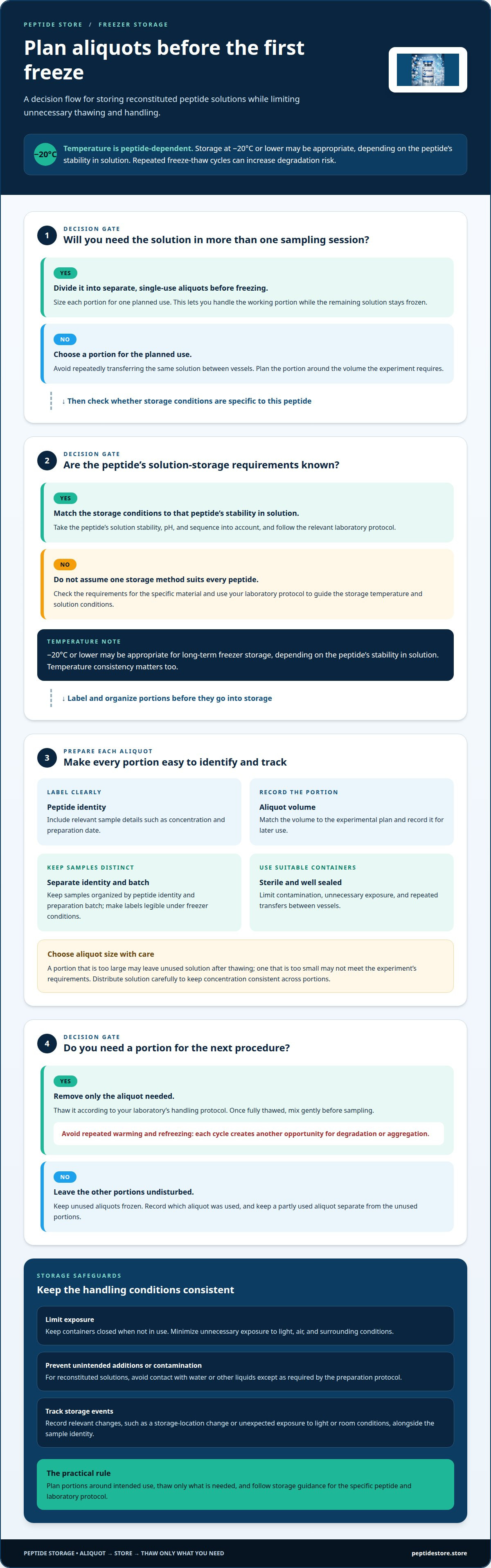
Divide a reconstituted peptide solution into aliquots before freezing it for later use. Repeated freeze-thaw cycles can increase the risk of degradation, including aggregation, so thaw each working portion only when needed.
-
Prepare peptide solution aliquots
Dispense the reconstituted solution into separate, single-use portions before freezing. Size each aliquot for one planned use so the remaining solution stays frozen while you handle that portion. Use clean, suitable containers and avoid repeatedly transferring the same solution between vessels. Label each aliquot with the peptide identity and relevant sample details, such as concentration and preparation date.
- Choose aliquot volumes based on the planned experiment. A portion that is too large may leave unused solution after thawing; one that is too small may not meet the experiment’s requirements. Distribute the solution carefully to keep the concentration consistent across portions. Record the volume of each aliquot so it can be matched to the experimental plan.
- Separate samples by peptide identity and preparation batch before storage. Clear labels help prevent mix-ups and maintain traceability between a solution and its experimental use. Keep labels legible under freezer conditions, and position each container so its identity is visible. Don’t rely on vial appearance or memory to distinguish samples.
-
Thaw and mix frozen aliquots
Remove only the aliquot needed for the next procedure, then thaw it according to your laboratory’s handling protocol. Once fully thawed, mix it gently to redistribute the solution before sampling. Avoid repeated warming and refreezing, since each cycle creates another opportunity for degradation or aggregation. Keep a partly used aliquot separate from the unused frozen portions.
- How should frozen peptide solutions be thawed and mixed before use? Thaw one selected aliquot according to your laboratory’s handling protocol, then mix it gently once fully thawed. Avoid thawing the full supply or putting a used aliquot through repeated freeze-thaw cycles.
- Plan storage around the number of intended uses and the solution volume needed for each. For example, separate sampling sessions may call for separate aliquots. This limits handling of the remaining material and makes each thaw easier to track. Record which aliquot you used, and leave the others undisturbed until needed.
Effects of moisture on peptide stability
Protect peptide samples from moisture and light, and keep storage conditions consistent. Minimize unnecessary air exposure during handling. When stability needs assessment, use an appropriate analytical method.
-
Assess moisture effects on stability
Keep solid peptide material dry during storage and handling. Moisture contamination can reduce the long-term stability of solid peptides, so check containers for a compromised closure or signs of dampness before use. For example, don’t leave an open vial exposed while preparing other samples. Close it promptly after removing material, and limit repeated opening that exposes the contents to ambient humidity.
- Manage moisture differently for dry material and reconstituted solutions. Moisture can enter a dry peptide’s container, while a prepared solution already contains liquid, so the focus is on preventing unintended additions or contamination. Keep tools and work surfaces dry when handling solid samples. For solutions, prevent contact with water or other liquids except as required by the preparation protocol.
-
Protect peptides from light oxygen and moisture
Store peptide containers away from direct light and limit unnecessary exposure during handling. Avoid changes in temperature and light, which can make storage conditions less consistent. Keep the cap or closure in place whenever the container is not in use. Limiting air exposure is a prudent handling measure, but it doesn’t replace protection from light, moisture, or temperature changes.
- Use the same handling sequence for each sample: prepare the workspace, remove the container only when needed, complete the transfer, and close it promptly. For example, arrange the necessary tools before opening a vial rather than leaving it uncapped while you look for equipment. This limits exposure to the surrounding environment and helps prevent accidental contact with moisture or other materials.
- Track storage conditions alongside each sample’s identity. Record relevant events, such as a change in storage location or unexpected exposure to light or room conditions. These notes help interpret later results, especially when samples have different handling histories. Keep records specific to each sample rather than relying on memory or a general freezer log.
- Use analytical testing when your research workflow requires evidence of solution stability. High-performance liquid chromatography, mass spectrometry, and circular dichroism can help assess reconstituted peptide stability. Choose a method that addresses the question, such as whether the sample’s composition or structural characteristics remain suitable for the intended analysis.
- Compare results with an appropriate reference or baseline from the same analytical workflow. A single observation, such as a visible change in a vial, does not establish peptide integrity. Record the method and sample conditions alongside the result, so later comparisons account for differences in handling. For broader peptide handling context, consult the peptide information resource.
Storage of reconstituted peptide solutions
Match storage conditions to the peptide’s stability in solution and the intended research use. Temperature, solution pH, and peptide sequence all affect storage decisions.
-
Consider solution pH and sterile buffers
Choose a sterile buffer that suits the peptide and the experimental method. Solutions with a pH around 5-6 are used to prolong storage life, while acidic conditions around pH 4-6 are often preferred to reduce aggregation and deamidation risk. These ranges overlap, but they don’t establish one suitable pH for every peptide. Avoid changing a prepared solution’s pH without considering its composition and intended analysis.
-
Assess peptide stability in solution
Set the storage temperature according to the peptide’s stability after reconstitution. Reconstituted solutions are generally stored at −20°C or lower when longer storage is needed; some peptides may require −80°C to prevent rapid degradation. For short-term use, 4°C may be appropriate for a few days, depending on inherent stability. Treat these conditions as peptide-dependent, not as a universal shelf-life guarantee.
-
Follow manufacturer storage instructions
Follow the handling and storage instructions for the specific material, and keep them with its records. Therapeutic peptide products and research-grade peptides may have different labeling, intended uses, and handling directions. How do manufacturer instructions differ? Follow therapeutic products’ labeling and research-grade materials’ accompanying specifications and laboratory protocols. Don’t transfer one product’s directions to another.
-
Account for sequence and modification effects
Consider the peptide’s sequence and any modification when assessing solubility and solution behavior. Peptides with hydrophobic residues approaching 50% or more may not dissolve adequately using otherwise suggested procedures. How can sequence or modification affect stability in frozen solution? They can influence solubility and inherent stability, so a storage condition suitable for one sequence may not suit another. Avoid assuming that shared storage temperatures mean equivalent stability.
- Record the buffer, pH, temperature, and reconstitution date alongside each sample’s identity. This links observed changes to the conditions used and supports consistent comparisons between experiments. If stability matters to the study, assess the solution using an appropriate analytical method, such as HPLC, mass spectrometry, or circular dichroism. Record the method and storage conditions when interpreting results.
such as stability testing. Peptides should be stored at 4°C or colder for best preservation. Forum members have described keeping unmixed peptide vials in a medicine cabinet and mixed vials in a baggie in the refrigerator’s vegetable bin; another stored unreconstituted peptides in a cool, dry place and refrigerated them after reconstitution. A further member kept reconstituted peptides refrigerated. These reports describe personal practices, not universal guidance.
Choosing peptide storage containers
Select containers that close securely, suit the sample volume, and fit the planned freezer workflow. Clear labels and an organized storage position make each vial easier to identify and handle.
- Choose a laboratory container intended for frozen sample storage. Check that the container and closure are compatible with the planned temperature and that the cap seals securely. For example, use a vial specified for freezer storage rather than an unmarked general-purpose tube. Avoid containers with damaged threads, cracked bodies, or uneven closures.
- Match the container size to the volume of each sample portion. A vial with too much unused space can make handling less efficient, while an overfilled container may not leave enough room for the solution. Follow the container’s fill guidance and keep the closure area clean. Confirm that the vial holds the aliquot without spills or contact with the cap.
- Inspect the closure before storage and after each opening. Check for a secure fit, visible damage, residue, or moisture around the cap. Don’t rely on a compromised closure to protect the sample. Replace the container according to your laboratory’s handling protocol, then update the sample record to maintain traceability.
- Use sterile, suitable containers for reconstituted solutions, and keep their inner surfaces from contacting hands or work surfaces. Prepare the workspace before opening a vial, transfer the sample carefully, and close the container promptly. For example, don’t set an open cap beside a pipette tip or leave the vial uncovered while doing another task.
- Label each vial with the peptide identity and details needed to retrieve the sample. Include the preparation date, concentration, and batch identifier when those details are part of the laboratory record. Use labels that remain legible under storage conditions. Before putting a vial away, confirm you can read the label without removing or warming the sample.
- Organize containers so they remain upright and identifiable during retrieval. A dedicated storage box can separate vials by sample or batch and reduce loose containers in the freezer. For example, an 81-well cryogenic storage box provides a defined arrangement for sample vials. Keep the box map consistent with written records.
- Record the container type and storage location with the sample entry. If you move a vial, update its location rather than relying on memory. When retrieving a sample, handle only the required container and return nearby vials to their assigned positions. This supports traceability and limits unnecessary disturbance of stored samples.
Freezing and long-term storage
For longer storage, use −20°C or lower when the peptide remains stable in solution. Some reconstituted peptides may require −80°C to prevent rapid degradation. Freezer consistency matters too: frost-free models cycle temperatures during automatic defrosting.
- Set the storage temperature according to the peptide’s documented stability in solution. Use −20°C or lower as a general storage condition, and use −80°C when the peptide’s stability requires colder storage. These temperatures are not interchangeable guarantees of a fixed storage life. Record the selected setpoint with the sample’s storage information.
- Choose a freezer that avoids repeated temperature variation. Don’t use a frost-free freezer for peptide solutions, because automatic defrost cycles cause temperature changes. A freezer that maintains consistent conditions better supports controlled storage than one with routine warming cycles. Consider this limitation when assigning a freezer to long-term peptide samples.
- Place samples in a stable storage position rather than an area that is frequently disturbed. Repeatedly opening the freezer or moving vials can expose them to changing conditions. For example, keep research samples together in a designated storage box, and retrieve only the vial needed for the next procedure.
- Track freezer conditions and sample locations in the laboratory record. Note the assigned freezer, storage position, and any observed temperature fluctuations. This helps distinguish storage history from preparation history. If a freezer experiences a disruption, document it alongside the affected samples rather than relying on memory.
- Plan around the freezer’s actual performance, not just its displayed setpoint. A home freezer may fluctuate, so don’t assume its nominal setting represents an uninterrupted sample temperature. Keep the storage arrangement stable and minimize unnecessary door opening. For laboratory equipment, compare its specifications with the temperature required by the peptide.
- Review the freezer’s operating instructions before storing samples. Confirm its stated temperature range and intended use, then compare them with the peptide’s storage requirements. A unit designed for laboratory storage may suit a controlled workflow better than a household frost-free model. Keep sample records consistent if storage equipment changes.
- For research workflows requiring dedicated equipment, review the −80°C laboratory freezer specifications against the intended storage conditions. Select equipment based on the required temperature and storage procedure, not on the assumption that colder storage alone ensures stability.
Peptide Store
Peptide Store supplies research-grade peptides for laboratory and scientific applications, supporting researchers selecting materials for controlled study workflows. Its offerings include Tirzepatide, Retatrutide, Semaglutide, and Cagrilintide. After establishing storage conditions for a specific peptide, researchers can use the catalog to identify relevant research compounds and plan sample handling around the material selected. Product-specific storage instructions remain essential because solution stability depends on the peptide and its conditions. For questions about research-grade peptide offerings, contact Peptide Store.
Build a consistent storage workflow
Include sample handling in the experimental plan, and record storage conditions alongside the study protocol. For long-term storage of reconstituted peptides in a freezer, these records connect each sample’s history with later research observations. Select research materials for the intended laboratory application, then follow the relevant product information when preparing a workflow. Peptide Store offers Tirzepatide, Retatrutide, and Semaglutide for research applications.
If you’re identifying materials for a laboratory study, contact Peptide Store to discuss its research-grade peptide offerings. A deliberate storage plan supports more consistent handling throughout your work.
Frequently Asked Questions
How long can reconstituted peptides be stored in a freezer?
There isn’t one storage duration that applies to every reconstituted peptide. The usable period depends on the peptide’s stability in solution, its buffer, and its storage conditions. For long-term storage of reconstituted peptides in a freezer, don’t assign a fixed shelf life without stability data for that specific preparation. If duration matters to a study, assess samples using an appropriate analytical method and document the conditions.
What freezer temperature is recommended for long-term storage of reconstituted peptides?
Store reconstituted peptides at −20°C or lower, depending on their stability in solution. Some peptides may require −80°C to prevent rapid degradation. Choose the temperature based on the material’s storage instructions and the research protocol, rather than assuming every peptide needs the same setting. A frost-free freezer is unsuitable because its automatic defrost cycle causes temperature fluctuations that can affect consistent storage.
Which solvents or buffers are suitable for reconstituting peptides before freezing?
Use a solvent or sterile buffer compatible with the peptide’s solubility and intended analysis. Sterile dilute acetic acid at 0.1% is one suggested solvent for preparing a concentrated stock solution. Sterile buffers around pH 5-6 are used to prolong storage life; acidic solutions at pH 4-6 are often preferred to reduce aggregation and deamidation risk. These options aren’t universal substitutes for peptide-specific instructions.
Should reconstituted peptides be aliquoted before freezer storage?
Yes. Divide the solution into portions sized for planned use before freezing. Thaw only the portion needed for an experiment instead of repeatedly warming the full supply. For example, prepare separate aliquots for separate sampling sessions. Keep the remaining portions frozen and record each aliquot’s identity and preparation details to maintain a clear sample history for later analysis.
How many freeze-thaw cycles can reconstituted peptides tolerate?
No single cycle count applies to every peptide solution. Repeated freeze-thaw cycles can increase degradation risk, including aggregation, so minimize them rather than relying on a fixed allowable number. Prepare aliquots before storage and thaw only the amount needed for the next procedure. Don’t routinely return a used, thawed portion to the freezer to preserve unused solution.
What containers and seals are best for storing peptide solutions in a freezer?
Use a sterile container suitable for frozen sample storage, with a closure that fits securely and remains intact under the intended conditions. No single container material or seal type suits every peptide and protocol. Match container capacity to the aliquot, keep the closure area clean, and label the vial with the sample identity and relevant preparation details. Don’t use a cracked container or damaged closure.
What are signs that a stored peptide solution has degraded or become contaminated?
Cloudiness, particles, discoloration, or a damaged closure may warrant investigation, but appearance alone can’t establish whether a peptide has degraded or become contaminated. A solution may need testing even if no visible change appears. HPLC, mass spectrometry, or circular dichroism can assess reconstituted peptide stability. Compare results with an appropriate reference and interpret them alongside the sample’s preparation and storage records.


