
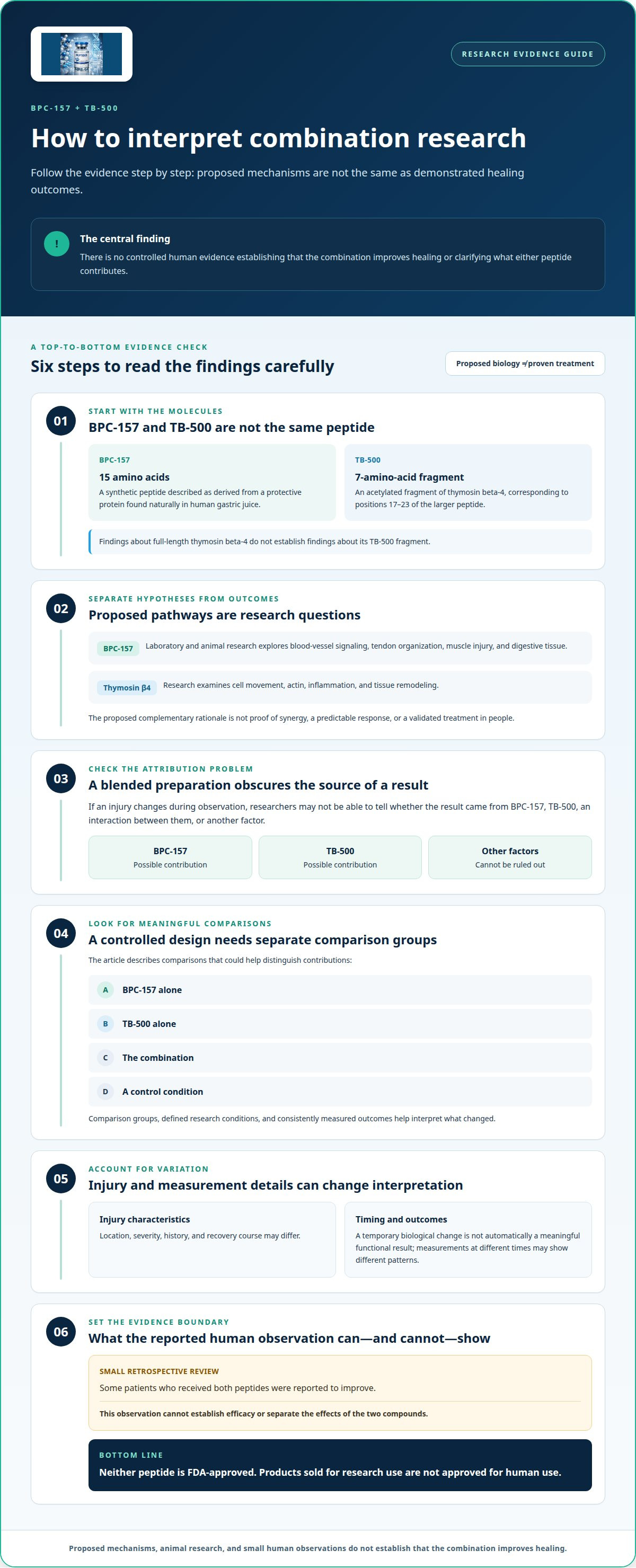
The central finding in BPC-157 and TB-500 combination research is a lack of controlled human evidence establishing that the combination improves healing or clarifying what either peptide contributes. A small retrospective review reported improvement among some patients who received both, but that observation cannot establish efficacy or separate the effects of the two compounds. Neither peptide is FDA-approved, and products sold for research use aren’t approved for human use.
Interest in combining them reflects proposed complementary effects, but a blended preparation makes attribution difficult: a changed result cannot readily be assigned to one peptide, both, or other factors. This article explains what BPC-157 and TB-500 combination research does and doesn’t show, why combination results are hard to interpret, and how the FDA’s compounding-policy developments affect the regulatory picture. It also distinguishes research on full-length thymosin beta-4 from evidence about TB-500, a fragment, so findings about one aren’t mistaken for proof about the other. A careful reading of BPC-157 and TB-500 combination research keeps proposed mechanisms distinct from demonstrated outcomes.
Key Takeaways
- Distinguish BPC-157 from TB-500 by their molecular structures and proposed research roles; findings about full-length thymosin beta-4 do not establish findings about its fragment.
- Interpret animal and small human observations cautiously. They do not establish that combining the peptides improves healing or clarify the contribution of each compound.
- Recognize that a blended preparation makes it harder to attribute a research result to one peptide and can complicate interpretation of stability and compatibility.
- Separate FDA compounding-policy developments from approval for human treatment. A policy change or advisory recommendation does not establish safety or clinical effectiveness.
BPC-157 and TB-500 definitions and proposed mechanisms
Peptides usually contain 2 to 50 amino acids. BPC-157 is a synthetic peptide composed of 15 amino acids, while TB-500 refers to an acetylated seven-amino-acid fragment of thymosin beta-4. Its sequence corresponds to positions 17 through 23 of that larger peptide. These structural differences matter: TB-500 is not interchangeable with full-length thymosin beta-4, even when findings about the native peptide inform hypotheses.
BPC-157 is described as derived from a protective protein found naturally in human gastric juice. Laboratory and animal research explores whether it affects blood-vessel signaling, tendon organization, muscle injury, and digestive tissue. Those proposed mechanisms span different tissues and biological processes. They do not establish one action, a predictable response, or a validated treatment in people. For example, a finding involving tendon organization cannot by itself demonstrate an effect on a digestive-tissue model.
Thymosin beta-4 research examines cell movement, actin, inflammation, and tissue remodeling. Actin is a structural protein involved in cell shape and movement. A proposed mechanism suggests that changes in actin regulation could support cell migration toward damaged tissue. Researchers also examine how cell movement may relate to tissue remodeling and vessel formation. These are research hypotheses; evidence about full-length thymosin beta-4 does not prove that its TB-500 fragment produces the same effects.
The proposed complementary rationale pairs BPC-157’s studied tissue and vessel-related pathways with thymosin beta-4’s actin-related cell-movement pathways. That model suggests separate biological processes might converge during repair. However, overlapping research themes are not evidence of synergy. A combination could produce distinct, overlapping, or unrelated effects, and each possibility requires direct testing. The mechanisms alone cannot establish whether combining the compounds changes an outcome.
“Wolverine Stack” is an informal label for combining BPC-157 and TB-500 in discussions of recovery research. The name doesn’t identify a validated formulation, standardized protocol, or established treatment. Its rationale generally follows the proposed pairing: one compound is associated with several tissue models, and the other with actin-related cell migration. A label or theoretical rationale does not establish that the combination is effective or safe.
Interpreting a proposed actin mechanism requires separating molecular activity from a meaningful repair outcome. Researchers need to identify which compound produced a measured change, in which tissue model, and through which pathway. For example, observing cell movement in an animal model alone does not show that a human injury heals faster. Vessel formation is a biological measure, not proof of improved function. These distinctions shape what combination research can evaluate.
Difficulty isolating the effects of BPC-157 and TB-500
Combining BPC-157 and TB-500 creates an attribution problem: a changed result cannot readily be assigned to either compound. In a blended vial, their concentrations cannot remain independently measurable. If an injury changes during observation, researchers therefore cannot tell whether BPC-157, TB-500, their interaction, or another factor produced that result. The combination may appear to act as one treatment, even though it contains two peptides.
Separate preparations can make experimental comparisons clearer, but they don’t establish which mechanism caused an outcome by themselves. A controlled design needs comparison groups, defined research conditions, and outcomes measured consistently. For example, researchers could compare BPC-157 alone, TB-500 alone, the combination, and a control condition. Without those comparisons, a change after combined exposure cannot demonstrate that the peptides work together or that either one contributed independently.
Injury characteristics also complicate interpretation. Tissue injuries can differ in location, severity, history, and recovery course. If these factors vary between groups, observed effects may reflect the injury rather than the compounds. Timing matters too: a measurement at one point may capture a temporary change, while a later assessment may show a different pattern. Clearly defined outcomes help distinguish a biological change from a meaningful functional result.
Reported side effects differ by compound and route. BPC-157 has been associated with nausea and gastrointestinal discomfort, especially with oral administration. TB-500 has been associated with redness, mild pain, and swelling at the injection site. These reports don’t establish how often effects occur or whether the combination changes them. When both peptides are used together, an adverse event may also be harder to link to one specific compound.
Long-term human safety data for BPC-157 and TB-500 is absent. That gap limits conclusions about repeated exposure, delayed effects, and possible interactions. A short observation period, for example, cannot characterize outcomes that emerge later. Safety interpretation also depends on the preparation and study conditions. If a formulation changes or the two peptides are combined, the findings may not apply to either compound studied separately.
Research precautions therefore center on clear attribution and documented outcomes, not assumptions about complementary action. Researchers need to record the compounds studied, whether they were separate or blended, the exposure conditions, the injury model, and observed effects. This structure helps show where evidence supports a specific conclusion and where uncertainty remains. Without it, a reported change cannot reliably be distinguished from variation in the injury, measurement, or study design.
FDA status and research-only product caveats
Neither BPC-157 nor TB-500 is FDA-approved for human use. They are not approved for post-surgical recovery or treatment of a specific medical condition. Products sold online for research use are not approved for human use. A research label does not establish a safe injection protocol, clinical benefit, or suitability for tissue repair. Those distinctions remain central when interpreting product claims and regulatory developments.
The FDA placed both peptides in Category 2 of its compounding bulks policy in September 2023, citing significant safety concerns. The FDA removed BPC-157 and TB-500 from Category 2 in April 2026. That removal did not itself amount to FDA approval. On July 23 and 24, 2026, the FDA Pharmacy Compounding Advisory Committee voted 8 to 6, with one abstention, to recommend adding both substances to the 503A list.
A committee recommendation and a final policy action are different steps. Formal rulemaking to add BPC-157 and TB-500 to the 503A list has not begun and may take 12 to 24 months. On October 28, 2026, HHS issued a draft interim policy and announced a temporary policy under which the FDA would not take enforcement action against certain compounding of these peptides. That policy is not FDA approval of either substance.
Product identity also matters. TB-500 is a marketplace name often used for an acetylated fragment corresponding to positions 17 through 23 of thymosin beta-4. It is not interchangeable with full-length thymosin beta-4. The FDA’s 2026 review found that submitted wound-healing studies used full thymosin beta-4, not the TB-500 fragment. According to that review, no human study had administered TB-500 itself.
The FDA review also found no human exposure data or animal toxicology program for TB-500. Those gaps limit conclusions about safety, movement through the body, and potential effects after injection. Evidence involving native thymosin beta-4 cannot fill those gaps automatically. A product name that references the fragment does not establish equivalence to the native peptide or to preparations used in other studies.
Online research products present separate quality considerations. Purity, potency, and safety can vary, and research chemicals are not regulated as prescription medications for these purposes. A stated amount on a label does not establish a product’s identity, sterility, or suitability for human administration. Two preparations with the same stated quantity, for example, may differ in composition or quality controls. For individuals navigating the peptide landscape, services such as dkpep.com focus on providing access to peptides, supplements, and structured clinical guidance.
Compounding policy and scientific evidence answer different questions. A temporary enforcement policy concerns regulatory action under defined circumstances; it does not validate a treatment or establish a clinical protocol. For BPC-157 and TB-500, readers should distinguish the FDA’s compounding actions from approval, human safety evidence, and proof of therapeutic benefit.
What Does the Research Actually Show?
For tendon, muscle, and ligament injuries, evidence-based treatments have stronger human support than these experimental peptides. No controlled human trial has established that BPC-157 and TB-500 together improve healing or outperform established care.
Potential Benefits Across Tissue Types
Potential benefits refer to tissue changes studied across different models, not proven clinical outcomes. BPC-157 research explores tendon organization, muscle injury, digestive tissue, and blood-vessel signaling. Those areas suggest several possible research purposes, but results in one tissue cannot establish effects in another. A tendon model, for example, cannot demonstrate effectiveness for a human ligament injury.
A 2021 retrospective knee chart review reported improvement from three of four patients who received both peptides. That observation is preliminary: a small chart review cannot establish causation, compare the combination against established treatments, or show which compound contributed. It also does not establish benefit across other tissue types or injury settings.
Animal Research on Tissue Healing
Animal studies of BPC-157 and TB-500 have shown promise, while robust human clinical data remains limited. BPC-157 models examine tissue responses involving tendon, muscle, and digestive systems. These findings can help researchers develop questions about biological pathways, but they cannot establish how a human injury responds to the compounds.
The distinction matters because animal and human tissues can differ in important ways. A measured change in an animal muscle model, for example, does not prove faster human muscle healing. As of April 2026, no completed, published human randomized controlled trials had directly investigated TB-500 for musculoskeletal or tissue-repair applications.
Angiogenesis and Tissue Repair
Angiogenesis is the formation of new blood vessels, a process examined in BPC-157 research. Vessel signaling may be relevant to tissue repair because blood flow supports biological activity at an injury site. However, a change in vessel-related measures is not itself proof of improved healing, restored function, or a better outcome for patients.
Researchers must distinguish a pathway marker from a clinical result. For example, evidence of altered vessel signaling in an animal model cannot show that a human tendon injury heals more effectively. No controlled human trial has established that combining BPC-157 and TB-500 improves angiogenesis or tissue repair.
Inflammation and Scar Tissue
Thymosin beta-4 research examines inflammation and tissue remodeling, processes that may relate to scar formation. These areas are research questions, not proof that TB-500 reduces inflammation or prevents problematic scarring. Evidence involving native thymosin beta-4 also cannot establish that the TB-500 fragment produces the same effect.
Interpretation depends on the tissue, measured outcome, and study model. Reduced inflammation alone, for example, would not establish stronger tendon structure or restored muscle function. As of early 2026, no published human studies had examined the full BPC-157 and TB-500 combination, leaving its effects on inflammation and scar tissue unestablished.
Reported complementary roles of BPC-157 and TB-500
Proposed complementary roles pair separate biological hypotheses, not established clinical effects. BPC-157 research considers tissue and vessel-related pathways, while thymosin beta-4 research examines actin and cell migration. That rationale suggests different processes could intersect during recovery. It does not demonstrate that combining the compounds improves muscle or other tissue healing.
Published human evidence does not establish a validated combination schedule. No controlled human trial has determined a dose, duration, or balance of benefit and risk for both peptides together. Schedules sometimes circulated online are conventions, not clinically established protocols. Their presence should not be taken as evidence of effectiveness or as treatment guidance.
Reported schedules commonly describe a blend dose of 250 mcg once daily, in the morning, 5 days per week. A standard recovery convention describes that amount for 4-6 weeks. These figures describe claims about research use, not an evidence-based clinical regimen. They do not show that this amount or schedule is safe or effective for a person.
Other circulated examples describe 500 mcg of the blend once daily for 4-8 weeks as an aggressive-healing schedule. A maintenance convention lists 250 mcg every other day for 2-4 weeks. The terms “aggressive” and “maintenance” do not define medically recognized phases. No human trial has validated those schedules or established that one sequence improves recovery.
Some discussions also describe a 4-8 week cycle. That timeline is not a demonstrated recovery period. A cycle length cannot establish when a tendon, ligament, or muscle injury heals. Injury type, tissue condition, and the outcome being measured all affect recovery assessments. Without controlled clinical data, a calendar schedule cannot predict a clinical result.
Reported clinic-style schedules warrant the same caution. A once-daily morning convention, for example, is not a validated clinic protocol. No medically supervised dosing or administration protocols are established for these unapproved peptides. Clinical evidence does not establish a schedule combining them for a specific injury or recovery goal.
These distinctions matter for research interpretation. A protocol should separate a reported convention from a tested intervention, and should distinguish each peptide from a blend. Without that separation, observed effects cannot reliably be assigned to BPC-157, TB-500, or their interaction. Regulation and clinical evidence also remain separate questions: a compounding-policy development does not validate a dosing schedule.
For researchers evaluating these claims, the distinction is straightforward: a reported schedule describes what is circulated, while a clinical protocol requires evidence supporting its use. Current findings do not establish that any listed schedule improves tissue repair or defines a reliable recovery timeline.
Peptide Store
Peptide Store supports laboratory and scientific work through a catalog of research-grade compounds. After reviewing the evidence and regulatory distinctions, researchers can use the catalog to identify materials relevant to their separate research questions. Its offerings include Tirzepatide, Retatrutide, Semaglutide, and Cagrilintide; these are distinct compounds, not substitutes for evidence about BPC-157 and TB-500.
Peptide Store is relevant when your next step concerns research materials, rather than treatment decisions or clinical dosing. The available evidence does not establish a human-use protocol for the combination, so this article should not be interpreted as medical guidance. For catalog or research-material inquiries, contact Peptide Store.
Make the next research step deliberate
Future BPC-157 and TB-500 combination research needs designs that distinguish each compound’s contribution and measure clearly defined outcomes. For laboratory planning, keep research questions separate from assumptions about human treatment, and select materials according to the scientific purpose. Peptide Store’s catalog includes Tirzepatide, Retatrutide, and Semaglutide, alongside other research compounds; these offerings do not establish evidence about the combination discussed here.
Use the available findings to frame precise questions, not to infer a clinical protocol. If you have a catalog-related question about research materials, contact Peptide Store with your question. A careful next step begins with a defined research objective and appropriately bounded interpretation.
Frequently Asked Questions
BPC-157 vs TB-500 Surgery Recovery: What's Hype?
Claims that either peptide, or their combination, improves surgical recovery go beyond the established human evidence. No controlled human trial has shown that the combination improves healing after surgery or outperforms evidence-based care. A recovery claim should identify the specific outcome measured, such as tissue structure or function, rather than rely on a general phrase like “faster healing.” Animal findings do not establish a surgical treatment effect in people.
Is TB-500 the same as Thymosin Beta-4, or should I be reading those studies differently?
TB-500 is not the same as full-length thymosin beta-4, so studies of the native peptide should be read separately. The FDA’s 2026 review described wound-healing studies using full thymosin beta-4, not the TB-500 fragment. For example, a study of native thymosin beta-4 cannot by itself establish what TB-500 does. Compare the specific molecule studied before applying a finding to another compound.
Safety: What Are the Risks?
Long-term human safety data for BPC-157 and TB-500 is absent. Reported effects include nausea and gastrointestinal discomfort with BPC-157, and injection-site redness, mild pain, and swelling with TB-500. These peptides are not FDA-approved for human use. Products are sold solely for laboratory and scientific research, not human consumption, veterinary use, diagnostic, food, or household chemical applications. Research-use labeling does not establish safety for personal use.
What Are BPC-157 and TB-500?
BPC-157 is a synthetic peptide made of 15 amino acids. TB-500 refers to an acetylated fragment of thymosin beta-4, not the full-length native peptide. The distinction affects how researchers interpret evidence: a finding involving one molecule does not automatically apply to the other. For instance, a study reporting an effect from full thymosin beta-4 does not establish the same effect from TB-500.
What are BPC-157 and TB-500, and how are they claimed to work?
BPC-157 research examines pathways involving vessel signaling and tissue models, while thymosin beta-4 research considers actin-related cell movement. These proposed mechanisms motivate questions about tissue repair, but they do not demonstrate that the compounds produce a beneficial outcome together. For example, a measured change in a laboratory pathway is not equivalent to evidence that an injury heals better in people.
What human clinical research exists on TB-500 or thymosin beta-4 for tissue repair?
Human studies of native thymosin beta-4 include wound-healing research, and Phase I and Phase II trials have investigated it for cardiac repair after myocardial infarction. Those findings concern the native peptide, not necessarily TB-500. According to the FDA’s 2026 review, no human study had administered TB-500 itself. The molecules and study purposes therefore need to be distinguished when interpreting clinical findings.
Are there studies testing BPC-157 and TB-500 together?
No published human studies had examined the full combination as of early 2026. A 2021 retrospective knee chart review reported improvement among three of four patients who received both peptides. Because the review was small and retrospective, it cannot establish that the combination caused improvement or determine each peptide’s contribution. Treat it as an observation, not a controlled comparison or proof of surgical recovery benefit.
What do animal and laboratory studies show about combining BPC-157 and TB-500?
Animal and laboratory findings support investigation of proposed biological pathways, but they do not establish a combined effect in humans. A result involving BPC-157 in a tissue model, for example, cannot show that adding TB-500 improves the result. To demonstrate a combination effect, a study would need comparisons that distinguish each peptide alone from the pair and measure defined outcomes under the same conditions.


