
A label alone cannot establish peptide stability. To buy stable BPC-157 for research, assess the lyophilized material’s stated storage conditions alongside component purity, endotoxin screening, and batch-specific documentation. The listed storage instruction for lyophilized powder is −20 °C; handling should follow the product’s stated conditions. A purity result is only one part of the assessment and doesn’t replace endotoxin data or lot traceability.
A sound review considers what each document demonstrates: whether the certificate of analysis identifies the tested lot, which analytical methods support the reported purity, and whether endotoxin results are reported separately. Third-party testing can provide additional analytical verification, while research-use-only restrictions define the product’s intended scope. This article explains how to evaluate these records, interpret lyophilized-product details, and distinguish a documented quality profile from a claim based on a label alone. The aim is a clear, evidence-led basis for selecting BPC-157 for laboratory research.
Key Takeaways
- Assess a certificate of analysis for batch identification and distinct results for purity and endotoxin screening.
- Interpret purity figures alongside the analytical method and the specific lot they describe.
- Use the stated storage conditions for lyophilized material and distinguish them from handling instructions after reconstitution.
- Keep research-use-only labeling and third-party analytical results within their proper scope when evaluating a peptide.
- Apply these criteria to compare documentation and determine whether a product’s quality records fit your laboratory requirements.
Endotoxin screening and certificates of analysis
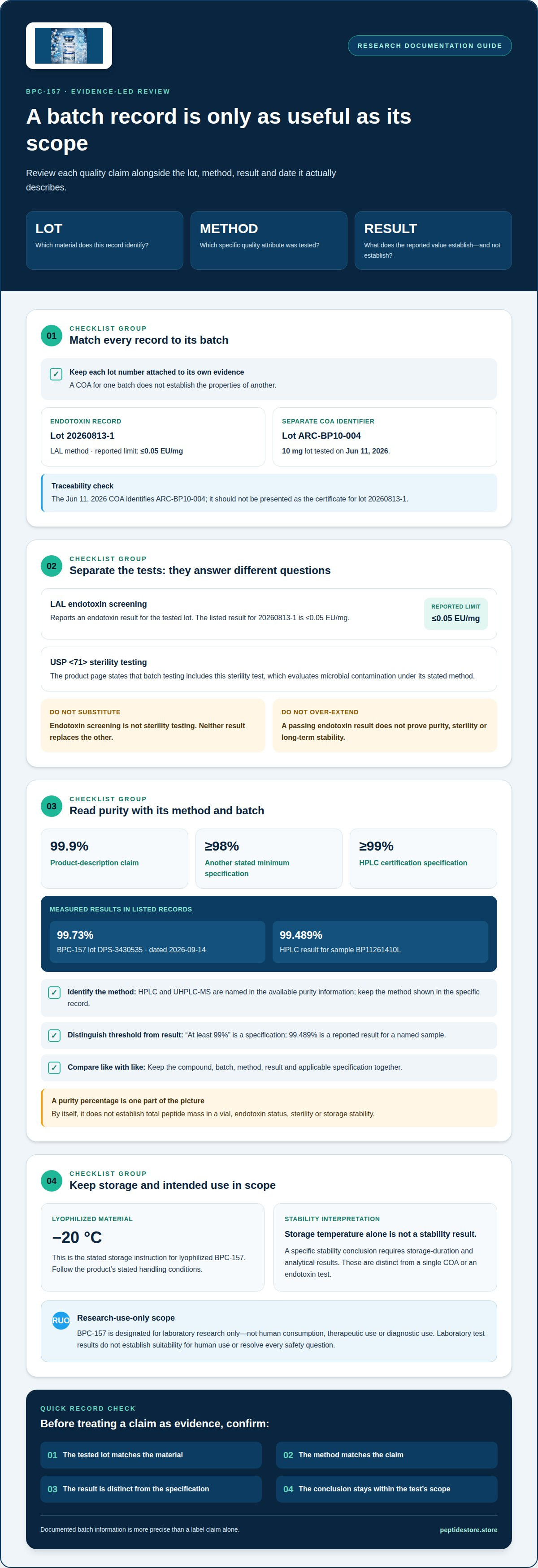
For BPC-157, endotoxin screening and a certificate of analysis (COA) document different quality attributes. A listed lot, 20260813-1, passed endotoxin testing at a limit of ≤0.05 EU/mg. The product description identifies the LAL method for batch-level endotoxin screening. These details indicate the reported test approach and result for that lot; they don’t establish results for other batches.
The available storage instruction for lyophilized BPC-157 is −20 °C. This handling condition is not, by itself, evidence of stability over time or a measured degradation rate. A specific stability conclusion requires storage-duration and analytical results, which are distinct from endotoxin screening and a single COA.
Endotoxin is assessed separately from sterility. The product page states that batch testing includes USP <71> sterility testing, while endotoxin screening uses LAL. These assays address different questions: endotoxin results report a measured limit, whereas sterility testing evaluates microbial contamination under its stated method. Neither result should be treated as a substitute for the other.
A COA is useful only when its identity and scope are clear. A listed certificate identifies lot ARC-BP10-004, a 10 mg lot tested on Jun 11, 2026. That is a separate identifier from lot 20260813-1. Keep each lot number attached to its own result; a test report for one batch cannot establish the properties of another.
- Lot identity: Match the COA’s batch identifier to the material being evaluated.
- Test scope: Distinguish LAL endotoxin results from USP <71> sterility testing.
- Result interpretation: Read ≤0.05 EU/mg as the reported endotoxin limit for lot 20260813-1.
- Document context: Record the tested lot and date shown on the certificate.
These steps make document review more precise. For example, the Jun 11, 2026 COA for ARC-BP10-004 should not be presented as the certificate for 20260813-1. Similarly, a passing endotoxin result does not prove purity, sterility, or long-term stability. Each claim requires evidence tied to its own test and batch.
Safety risks and uncertainties remain relevant even with a COA. Endotoxin and sterility results cover specific laboratory checks; they don’t establish suitability for human use or resolve every safety question. BPC-157 is designated for laboratory research only, not human consumption, therapeutic use, or diagnostic use. Keep the assessment within that stated scope.
For research purchasing, prioritize traceability over a standalone quality claim. A useful record links the material and lot identifier to the test method, result, and test date. Follow the storage instructions as handling guidance, and interpret each assay only as evidence for the attribute it measures. This distinguishes documented batch information from broader claims the results do not support.
Individual component purity
Purity figures for BPC-157 vary across the listed specifications and test records. One product description reports 99.9% purity, while another states a minimum of 98%. A separate specification identifies at least 99% purity by HPLC certification. These values should be read as claims tied to particular product information or analytical records, not combined into one universal result.
Method matters. HPLC and UHPLC-MS are named methods in the available purity information. A listed certificate analysis uses UHPLC-MS against a 98% or 99% specification, depending on the compound. A percentage without its method and applicable specification is harder to interpret. The method describes how the reported result was obtained; the specification states the threshold used for comparison.
Batch records provide more specific examples. BPC-157 lot DPS-3430535 had reported purity of 99.73%, dated 2026-09-14. A sample from batch BP11261410L had an HPLC purity result of 99.489%. Those figures belong to distinct batch identifiers. They should not be treated as interchangeable results or automatically applied to material from another lot.
For a useful comparison, keep four details together: the compound, batch identifier, analytical method, and reported result. Then compare the result with the stated specification for that compound. For example, 99.489% by HPLC is a measured result for BP11261410L; it does not establish that every BPC-157 batch has the same profile. Likewise, “at least 99%” describes a threshold, not a batch-specific result.
- Identify the method: Distinguish HPLC from UHPLC-MS in the record.
- Keep the batch attached: Preserve identifiers such as DPS-3430535 and BP11261410L.
- Separate threshold from result: Read a minimum specification differently from a measured percentage.
- Compare like with like: Use the specification stated for the same compound and record.
A purity percentage has limits. It reports analytical purity under the specified method; by itself, it does not establish the total peptide mass in a vial, endotoxin status, sterility, or storage stability. These are separate attributes that require separate evidence. A high purity figure answers one quality question, not every question about research suitability.
The available figures illustrate why precise documentation matters: 99.9% is a product-description claim, while 99.73% and 99.489% are results associated with identified lots or samples. When evaluating BPC-157, retain that distinction. A clear record connects the stated purity to its method, specification, and batch, supporting a more disciplined comparison without overstating what the number proves.
Lyophilized peptide product
The listed BPC-157 research peptide is supplied as 10 mg of lyophilized powder. Lyophilization removes water through freeze-drying, leaving material in a dry form. Product listings specify freezer storage, with instructions ranging from −20 °C to −15 to −20 °C. Follow the temperature stated for the specific product rather than assuming all listings use identical wording. Researchers who buy stable BPC-157 for research should assess the powder form and its storage instructions together.
For storage, the listed instructions place lyophilized BPC-157 at −20 °C, while another product description recommends −15 to −20 °C. Once reconstituted, instructions specify refrigeration at 2-8 °C, not freezing, and use within 2-4 weeks. That post-reconstitution period applies to the reconstituted material; it should not be treated as a shelf-life claim for sealed, dry powder.
A shelf-life figure is meaningful only alongside its storage state and conditions. A claim for lyophilized material concerns dry powder; a claim after reconstitution concerns a different state. The stated 2-4-week period applies after reconstitution, not automatically to an unopened vial. For a research protocol, keep the applicable product instructions attached to the material’s storage record.
Temperature control is one part of handling. A laboratory record can note the product form, specified storage conditions, and any change from dry powder to reconstituted material. Keep instructions for the dry powder distinct from any subsequent refrigeration guidance, and do not apply post-reconstitution information to the unreconstituted product.
- Identify the form: Confirm that the material is lyophilized powder, not reconstituted solution.
- Apply the stated condition: Use the listed freezer range for dry powder.
- Record the state change: Distinguish dry storage from the 2-8 °C instruction after reconstitution.
- Keep time claims scoped: Apply the 2-4-week period only to reconstituted material.
Product quantity also belongs in the record. The listed vial contains 10 mg of lyophilized powder. That quantity describes the vial’s stated content; it does not define storage duration or establish stability. Keep quantity, form, and handling conditions as separate fields when documenting research materials.
For example, a record for a 10 mg lyophilized vial can note its freezer condition. If that material is later reconstituted, record the state change and apply the specified refrigeration instruction. The dry-powder storage range and the 2-4-week period answer different handling questions. A decision to buy stable BPC-157 for research should keep those instructions distinct and apply each only to the product’s stated storage state.
Research-use-only restrictions
BPC-157 is designated for laboratory research only. Its stated intended use excludes human consumption, therapeutic use, and diagnostic use. That distinction matters when interpreting a product description: a research label describes the product’s scope, not evidence of clinical suitability or a medical outcome.
A research protocol should therefore define BPC-157 as an experimental material, with handling and analysis confined to the laboratory purpose. Keep product records, sample identifiers, and analytical results linked to that research context. A purity percentage or endotoxin result does not change the stated restriction or establish a therapeutic application.
A research-use-only label does not establish whether FDA warnings, recalls, or enforcement actions apply to a particular product. Nor does it demonstrate FDA approval or clearance. These questions are distinct from the product’s stated intended use and require product-specific regulatory evidence.
U.S. prices vary by quantity and formulation, such as lyophilized powder versus another product form. A general price range cannot responsibly cover those differences. Do not infer a product’s price from its research designation, purity claim, or vial quantity alone.
Payment, shipping, and return policies depend on the supplier’s stated terms. Payment methods, delivery arrangements, and return eligibility are separate policy matters; none can be inferred from the phrase “research use only.” Keep these operational terms distinct from scientific documentation when making a purchasing decision.
Keeping these distinctions clear prevents common interpretation errors. A COA documents particular analytical findings, while a research-use-only statement limits the stated application. Neither, on its own, establishes regulatory status, clinical safety, or return eligibility. Interpret each claim using the record or policy that specifically addresses it.
- Purpose: Keep BPC-157 use within laboratory research, not human consumption or treatment.
- Evidence: Distinguish analytical results from regulatory status and clinical claims.
- Commercial terms: Separate product quantity and formulation from payment, shipping, and return conditions.
For laboratory work, document intended use alongside material identity and handling records. Do not describe experimental observations as established therapeutic effects or present a research label as proof of FDA review. These distinctions keep technical documentation precise and avoid implying that a product description establishes more than it does.
When comparing research materials, assess stated scope, analytical evidence, and transaction terms separately. A COA may report a batch result, while a product label states laboratory intent. Payment and return terms govern another part of the purchase. This approach supports a clearer decision without treating one document as a substitute for another.
Third-party HPLC and mass spectrometry verification
Independent testing adds analytical evidence beyond a supplier’s product description. BPC-157 is described as tested by independent third-party laboratories against a purity specification of at least 99%. That claim concerns purity testing; it does not establish that every method, result, or batch has been independently assessed. Keep the testing claim within its documented scope.
HPLC separates components in a sample and supports a reported purity assessment. Mass spectrometry provides molecular-mass information that can support compound identification. UHPLC-MS combines chromatographic separation with mass analysis. These methods offer related but distinct evidence, so a report should name the method used rather than group every result under a general “tested” label.
To evaluate supplier identity, purity, and batch testing, connect the supplier’s name, product identity, lot identifier, analytical method, and result across the product record and certificate. A report naming BPC-157 but lacking a corresponding batch identifier does not connect its result to a particular lot. Likewise, a purity result alone does not document endotoxin screening or sterility.
Third-party status is useful only when the report makes the testing relationship clear. The laboratory should be identifiable in the document, and the report should state what sample or batch it tested. The available product information gives a third-party purity specification of ≥99%, while listed analytical documentation also names UHPLC-MS. These details should not be treated as proof that all batches received both tests.
- Identity: Match the named compound to BPC-157 and its specific product record.
- Traceability: Connect the batch identifier on the report to the material under review.
- Method: Distinguish HPLC, UHPLC-MS, and mass spectrometry descriptions.
- Scope: Separate purity evidence from endotoxin and sterility results.
For example, a report stating ≥99% purity must be interpreted as a specification or result according to its wording. The method, laboratory, and batch determine how that statement applies. A general product-page claim cannot replace a batch-linked report, while one batch’s analysis cannot establish the same result for other lots.
Use these distinctions to assess whether the documentation supports your laboratory’s purchasing criteria. Explore research peptide products when comparing product records and testing details.
Peptide Store
Peptide Store supplies research-grade peptides for laboratory and scientific applications. Researchers can use purity methods, batch records, and storage instructions as criteria when evaluating relevant catalog materials. The catalog includes Tirzepatide, Retatrutide, Semaglutide, and Cagrilintide. Select materials according to the intended research application and the documentation relevant to each product.
For this BPC-157 assessment, the practical next step is to apply the same evidence-based approach to the product information and records associated with a research purchase. Distinguish stated specifications from batch-specific analytical results, and keep research-use limitations in view. For questions about Peptide Store’s catalog, contact Peptide Store.
Make the next research decision traceable
When you buy stable BPC-157 for research, make selection part of a defined laboratory workflow. Establish internal acceptance criteria before procurement, then retain purchase records with the relevant study documentation. This gives the research team a consistent basis for recording material receipt, assigning samples, and tracking handling decisions throughout the project.
A practical next step is to align procurement documentation with your laboratory’s recordkeeping process. Decide who records receipt, how material identifiers carry through to study files, and where deviations are documented. These procedures support continuity when authorized research personnel review or share project records. Keep the material’s use strictly within laboratory and scientific research.
Peptide Store’s catalog also includes Tirzepatide, Retatrutide, and Semaglutide.
Contact Peptide Store for assistance as you determine the appropriate next step for your research workflow.
With clear criteria and disciplined records, your team can proceed methodically.
Frequently Asked Questions
Is BPC-157 approved by the FDA for human use or sale in the United States?
Peptide Store sells BPC-157 solely for laboratory and scientific research, not human use. Its research-use designation should not be interpreted as FDA approval for human consumption or therapeutic use. The product information does not represent BPC-157 as FDA-approved. Keep procurement and use within the stated research purpose, and do not treat laboratory testing or a supplier’s product description as evidence of regulatory approval.
What FDA rules apply to selling BPC-157 labeled for research use only?
A “research use only” label is not, by itself, proof of FDA approval or legal compliance. The product is stated to be for laboratory and scientific research, and its label should not imply human use or therapeutic suitability. Applicable requirements depend on the product and how it is represented and sold. Peptide Store’s terms require purchasers to comply with applicable laws governing acquisition, handling, storage, and research use.
What are the legal risks of buying or importing BPC-157 in the United States?
Legal considerations can depend on the transaction, destination, and intended use, so no blanket conclusion applies to every purchase or import. Peptide Store’s terms require buyers to comply with applicable federal, state, local, and international laws governing acquisition, handling, storage, and use. The supplier’s research-use label does not replace those obligations or establish that a particular import or use is lawful.
What independent testing documents should buyers request for BPC-157, such as certificates of analysis?
Review a batch-specific certificate of analysis and any available independent laboratory report. The records should link the compound and batch to the reported test, method, result, and test date. For example, HPLC can support a purity result, while mass spectrometry can provide molecular-mass evidence. Interpret each result within its stated scope; purity documentation alone does not establish endotoxin status, sterility, or storage stability.
How do lyophilized and liquid BPC-157 products compare for research stability?
Lyophilized BPC-157 is supplied as dry powder, while liquid material has already been reconstituted or formulated. Their storage needs and stability evidence are not interchangeable. For lyophilized material, follow the stated product storage instructions; after reconstitution, use the applicable refrigerated-storage directions. A comparison should consider the product’s form, stated conditions, and any stability data for that specific form, rather than assuming one format always lasts longer.
What evidence exists for BPC-157 stability and degradation during storage?
The material gives storage instructions: lyophilized powder at −20 °C (or −15 to −20 °C), and reconstituted material at 2-8 °C for use within 2-4 weeks. These instructions do not provide measured degradation rates or establish stability over time.
What are typical U.S. prices for research-grade BPC-157 by quantity and formulation?
No prices are given for other quantities or formulations.
What payment, shipping, and return policies do U.S. BPC-157 research suppliers offer?
In-stock orders placed and paid before 12 PM PT typically ship the same business day from the United States.


