
A high purity result alone doesn’t prove that a sample is BPC-157. To understand how to verify BPC-157 purity, distinguish two questions: chromatography estimates purity, while mass spectrometry supports identity confirmation. A Certificate of Analysis (COA) is useful when it reports both results and corresponds to the product’s specific lot.
It’s reasonable to expect a COA to settle the question, but its value depends on the tests and details it contains. A summary purity figure cannot, by itself, establish what compound produced the measured peak or reveal every substance in a sample.
This guide explains what a COA can and cannot confirm, how high-performance liquid chromatography (HPLC) and mass spectrometry contribute to verification, and why visual or other home checks fall short. It also clarifies how research-grade and pharmaceutical-grade purity descriptions differ, so you can interpret a stated threshold without mistaking it for proof of identity, full composition, or suitability for a particular use.
Key Takeaways
- Match a Certificate of Analysis to the specific product lot; a COA for another batch doesn’t establish the contents of yours.
- Read HPLC purity as a relative measure of detected peak area, not a complete account of every component in a sample.
- Use mass spectrometry results to support identity confirmation; a purity percentage alone can’t show that the detected compound is BPC-157.
- Home checks can’t reliably establish peptide identity or purity, which depend on analytical laboratory methods.
- Interpret research-grade and pharmaceutical-grade labels by their stated purity thresholds, not as interchangeable quality or regulatory claims.
What does a chromatographic purity result actually tell me?
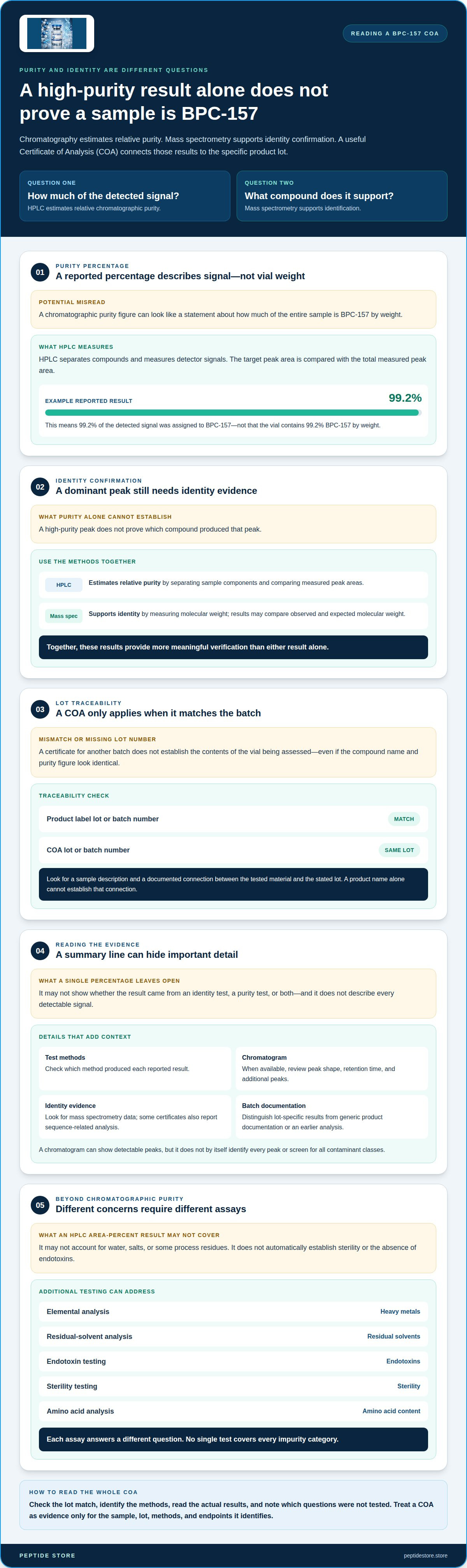
High-performance liquid chromatography (HPLC) separates compounds in a sample, then measures their detector signals. Reverse-phase HPLC is commonly used to assess BPC-157 purity. A chromatogram displays peaks: the target peptide’s peak area is compared with the total measured peak area. A reported 99.2% therefore means 99.2% of the signal detected was assigned to BPC-157, not that the entire vial contains 99.2% BPC-157 by weight.
HPLC and liquid chromatography-mass spectrometry (LC-MS) answer different questions. HPLC estimates relative purity by separating components, while mass spectrometry measures molecular weight to support compound identification. Used together, they provide more meaningful verification than either result alone: a high-purity peak does not prove its identity.
For independent testing, the submitted sample should be traceable to the same lot as the product being assessed. A third-party laboratory can analyze that sample rather than relying only on a supplier’s summary. The chromatogram adds useful detail: peak shape, retention time, and additional peaks can reveal signals that a single percentage hides. HPLC can detect impurities below 1% of a sample, depending on the method and detector.
Chromatographic purity is not a complete contaminant screen. Area-percent results may not account for water, salts, or some process residues. Additional testing may include elemental analysis for heavy metals, residual-solvent analysis, endotoxin testing, and sterility testing. Each assay answers a different question: an HPLC purity result, for example, does not establish that a sample is sterile or free from endotoxins.
Other analyses can provide further information about composition. Amino acid analysis assesses amino acid content, while mass spectrometry supports identity by comparing the observed molecular weight with the expected value. Absolute quantitative nuclear magnetic resonance can detect analytes such as water and sorbents that other approaches may miss, according to the National Library of Medicine. No single test covers every impurity category.
The scope of testing affects the cost; broader panels add separate analytical work. BPC-157 is not an FDA-approved drug, according to the U.S. Food and Drug Administration. A laboratory result does not establish that it is legally sold for human use.
Testing can also help investigate degradation or contamination. New chromatographic peaks may indicate additional compounds, while mass spectrometry can help characterize detected components. Residual solvents, heavy metals, endotoxins, and microorganisms require their own targeted methods. For laboratory preparation, the dilution guide addresses handling after testing; dilution does not verify identity, purity, or sterility.
Certificate of Analysis contents
A Certificate of Analysis (COA) summarizes analytical results for a defined sample. For BPC-157, its value depends on whether the document identifies the tested material, the methods used, and the results reported. A certificate without a traceable lot number cannot establish that its results apply to the vial being assessed.
Start with lot traceability. The lot or batch number on the COA should match the number on the product label. If the numbers differ, the document refers to another batch, even if the compound name and purity figure look identical. A lot-specific certificate links the reported analysis to the material represented by that lot.
Next, identify the test methods and what they measure. HPLC or another chromatographic method can report relative purity, while mass spectrometry can support identity confirmation. A useful COA states which method produced each result. A percentage alone does not show whether the sample was tested for identity, purity, or both.
Identity data should connect the result to BPC-157. For example, mass spectrometry may compare the observed molecular weight with the expected molecular weight. Some certificates also report sequence-related analysis. These results provide different forms of evidence: a molecular-weight match supports identification, while sequence analysis can offer additional structural information.
The certificate should identify the tested sample, not merely name the intended compound. Look for a sample description and a clear link to the stated lot. An analysis of a retained or submitted sample is meaningful only when its connection to that batch is documented. A product name alone cannot establish that connection.
Read the result details, not just the summary line. A chromatographic purity percentage should be accompanied by the method or, when available, an attached chromatogram. The chromatogram shows whether the reported result reflects one dominant peak or several detectable peaks. It does not, by itself, identify every peak or screen for all contaminant classes.
A batch certificate and a generic product certificate are not interchangeable. Batch results refer to a specific production lot; generic documentation may describe a product category or an earlier analysis. Testing one lot at product launch does not establish the results for later lots. Lot-specific documentation is the relevant record for the batch being assessed.
Finally, note what the COA does not report. A purity result does not automatically document endotoxins, residual solvents, heavy metals, or sterility. Those require separate tests and results. Treat each certificate as evidence only for the sample, lot, method, and analytical endpoints it actually identifies.
Mass spectrometry identity confirmation
Mass spectrometry supports peptide identity by measuring the mass-to-charge ratio of detected ions. Mass spectrometry can help confirm BPC-157’s identity by comparing observed and expected molecular weight. A laboratory compares the observed mass with this expected value, accounting for how the instrument detects charged molecules. A matching result supports identity, but intact mass alone cannot show every detail of molecular structure.
Sequence information adds another level of evidence. The BPC-157 peptide sequence is GEPPPGKPADDAGLV, a chain of 15 amino acids. Tandem mass spectrometry, often written as MS/MS, fragments peptide ions and measures the resulting pieces. A pattern consistent with the expected sequence provides stronger structural support than a single intact-mass measurement.
Method details matter. Liquid chromatography can separate components before mass spectrometry detects them, producing LC-MS data that link a chromatographic peak with a measured mass. LC-MS/MS adds fragmentation data that can support sequence assignment. These methods help distinguish a target peptide from a different molecule that might produce a similar chromatographic purity result.
Instrument performance also affects interpretation. Modern LC-MS/MS instruments can achieve low-parts-per-million accuracy for observed molecular weight. A report giving only ±0.1% accuracy may indicate instrument limitations, rather than high-resolution confirmation. The result should identify the method and measured value, so the stated precision can be understood in context.
Mass spectrometry has limits when identifying salt forms. The instrument primarily detects ions, and counterions or other associated material may not appear as a clear peptide signal. A matching peptide mass therefore does not establish the vial’s complete salt composition, water content, or residual-solvent level. Those characteristics require suitable complementary analysis.
For BPC-157 identity verification, interpret the evidence as a set: compare observed and expected molecular weight, review sequence-supporting fragmentation when available, and connect the test result to the sample’s lot. A mass match can support the presence of the intended molecule, while chromatography assesses relative purity. Neither result alone establishes sterility or detects every possible impurity.
Can I test peptide purity at home?
No household method can reliably confirm BPC-157 identity or purity. A vial’s appearance, dissolution, or label cannot replace HPLC and mass spectrometry. For example, a clear solution does not establish that the dissolved material contains the intended peptide or excludes impurities.
A home scale measures total mass, not peptide content. A vial labeled 5 mg or 10 mg gives a stated amount, but the label alone cannot establish the quantity of BPC-157 in the material. Water, salts, and residual synthesis components can affect total mass without appearing as the target peptide.
Purity and assay results also describe different things. HPLC area-percent estimates the target’s share of detected chromatographic signal; an assay can address the amount of peptide in a sample. A result of 98% purity means approximately 2% of the measured sample consists of impurities, but it does not establish the vial’s total peptide content.
Batch-specific documentation is essential because impurity profiles can vary between lots. A COA should identify the tested batch, and its lot number should match the product label. A certificate for an earlier synthesis run does not document the current material, even when both labels name BPC-157.
Batch-to-batch consistency requires comparing results from separate lots, not repeatedly referring to one certificate. Each peptide batch should be tested independently rather than relying only on testing at product launch. A COA for each lot creates a record that links its analysis to that batch.
Common red flags include a COA with no lot number, a document reused across batches, or a purity percentage without a named analytical method. A certificate that reports purity but no identity result also leaves a key question unanswered.
To assess whether a COA relates to a specific batch, compare its lot identifier with the product label and check whether the report names the sample, method, and results. Without those connections, the document cannot establish that the analysis applies to the material being assessed. The laboratory’s report identifier and issue details also help distinguish a specific analysis from a generic product sheet.
Careful handling can help preserve sample integrity, but it cannot confirm chemical composition. Keep the vial with its lot label, retain the accompanying COA, and do not treat visual inspection or weighing as purity tests. Batch-specific identity and purity results require independent laboratory analysis.
Research- and pharmaceutical-grade purity thresholds
A BPC-157 lab report should state its chromatography method, purity percentage, and reported impurity results. Research-grade peptides typically have a minimum purity of 95% by HPLC, while pharmaceutical-grade peptides typically exceed 98%.
Purity Percentage Thresholds
A purity threshold is the minimum or target percentage of the measured chromatographic signal assigned to the intended compound. It provides context because “research grade” has no single regulatory definition in the peptide supply market. Interpret the stated threshold alongside the method and result.
At ≥99% HPLC purity, the target peptide represents at least 99% of the total peak area in the chromatogram. At that stated threshold, synthesis-related impurities may constitute no more than 1% of the material. These figures describe relative peak area, not necessarily the compound’s percentage by vial weight.
Compare thresholds only when the reports use comparable methods. For example, a 95% HPLC result and a result above 98% indicate different measured purity levels, but neither establishes the sample’s full composition. The method, sample basis, and included tests determine what the percentage can tell you.
Impurity Results in Lab Reports
Impurity results identify measurable components besides the target peptide and show how the laboratory assessed them. This matters because a single purity percentage may summarize chromatographic peak areas without identifying every impurity or contaminant.
A useful report presents the chromatogram or peak data, including detected secondary peaks and their relative areas. HPLC can reveal synthesis-related impurities that separate from the target compound. However, a chromatographic result does not automatically quantify water, salts, residual solvents, heavy metals, endotoxins, or microorganisms.
Those impurity categories require method-specific analysis. Elemental testing, for example, addresses metals, while residual-solvent analysis targets solvent traces. Endotoxin and sterility tests assess different endpoints; neither is established by a high HPLC percentage. A report should name the analyses performed and state their findings separately.
Interpret results against the stated acceptance criteria rather than treating “high purity” as a complete specification. Check whether the reported percentage refers to chromatographic area or another measurement, and whether impurity peaks are identified or simply listed. Amino-acid sequence, molecular identity, and powder weight are distinct characteristics, not interchangeable measures of purity.
Use the stated threshold as one part of an assessment: review the method, the lot-specific results, and any separate contaminant testing. For research applications, explore research peptide options alongside the analytical criteria relevant to your work.
Peptide Store
Peptide Store is a supplier of research-grade peptides for laboratory and scientific applications. After identifying the evidence needed to evaluate BPC-157, researchers can use that framework when reviewing materials for research workflows. The catalog includes compounds such as Tirzepatide, Retatrutide, Semaglutide, and Cagrilintide.
Analytical results and product selection are separate considerations. A catalog entry does not replace lot-specific testing or establish a sample’s identity or purity. Use the criteria above to assess the documentation relevant to your research, then select materials according to your study requirements.
For questions about research materials, contact Peptide Store.
Apply the same verification standard to your next study
Before beginning a research workflow, define the analytical evidence your protocol requires and record how each result will inform sample acceptance. A practical approach to how to verify BPC-157 purity is to treat verification as part of study planning, not an afterthought. Consistent documentation makes later comparisons more interpretable and helps separate sample characteristics from changes in handling or analysis.
Keep the scope of each result clear. A purity value, an identity result, and a contaminant screen address different questions; decisions should reflect the evidence relevant to the research objective. Peptide Store also supplies Tirzepatide, Retatrutide, and Semaglutide for research and laboratory applications.
For questions about research materials or product information, contact Peptide Store. A clear verification framework supports more deliberate research decisions and a stronger record of your work.
Frequently Asked Questions
Can I check identity myself from the COA?
Not by itself. A COA can provide identity evidence when it reports mass spectrometry or sequence-related results, but reading a certificate cannot independently authenticate the sample. For how to verify BPC-157 purity, treat the COA as a record to assess, not a substitute for analysis. For example, verify its lot identifier and report number, then determine whether identity and purity are separate reported tests.
Does passing your test mean my BPC-157 is safe to use?
No. A passing result applies only to the sample, test method, and properties measured; it cannot establish overall safety or suitability for human use. The U.S. Food and Drug Administration describes BPC-157 as not an FDA-approved drug. Peptide Store’s research products are for research use only and are sold to adults. A laboratory result should not be interpreted as medical approval or advice.
How Is BPC-157 Purity Tested, and What Should ≥99% Actually Mean?
Laboratories commonly use high-performance liquid chromatography to separate sample components and calculate the target peak’s share of measured peak area. A reported ≥99% means at least 99% of the total chromatogram peak area is assigned to the target peptide. It does not mean the vial is ≥99% peptide by weight, nor does it establish identity or screen for every contaminant.
Is 100% purity possible?
A report may display 100% after rounding, but that does not prove the sample contains no other material. Analytical methods have detection limits, and a result describes what that method measured under its conditions. For example, an impurity below the method’s detection capability may not appear as a reported peak. Interpret a displayed 100% alongside the method, its precision, and the underlying chromatogram.
What else should a COA confirm besides purity?
Look for identity results, such as mass spectrometry, and details linking the analysis to the tested sample. A report can also state the analytical method, test date, and sample or lot identifier. If your research requires additional controls, separate results may address residual solvents, elemental impurities, endotoxins, or sterility. These must be documented as specific tests, not inferred from a purity percentage.
What is in the other 1%?
A purity result does not identify every component in the remaining signal. Depending on synthesis and sample handling, detected material could include synthesis-related byproducts or degradation products; other components may require separate tests. Chromatography may show additional peaks without identifying them. Check what the report actually identifies, and distinguish detected impurities from water, salts, or residues the method may not measure.
What is BPC-157 and what purity standards apply to it?
BPC-157 is a synthetic peptide composed of a chain of 15 amino acids. Research-grade peptides typically have a minimum HPLC purity of 95%, while pharmaceutical-grade peptides typically exceed 98%. However, “research grade” has no single regulatory definition in the peptide supply market. Treat these figures as descriptions of reported purity, not as proof of regulatory status or suitability for human use.
How can a buyer verify a BPC-157 certificate of analysis is authentic?
Check that the report names a laboratory, includes a report identifier, and links its sample to the product’s lot. Review whether the stated methods and results are consistent and whether the document appears altered or reused. For stronger document authentication, use the laboratory’s independently obtained official contact details to ask whether the report identifier and sample record match a report it issued.


