
A 10 mL label answers one question: the stated volume. It doesn’t establish the formulation, packaging, or documentation behind bacteriostatic water 10ml. Those details matter when assessing a product for laboratory research. Use the volume to compare inventory formats, then evaluate the product’s own label and records for the specifications that volume cannot show.
Researchers need product-specific information, not assumptions based on general descriptions of bacteriostatic water. This guide explains how to interpret the 10 mL format and review label details and supporting records. It also separates general formulation information from claims that need product-specific evidence.
The sections ahead cover stated composition, container and closure details, storage and handling information, and available batch or testing documentation. Peptide Store supplies bacteriostatic water for laboratory and scientific research contexts. Evaluate a specific item using its own product information, without treating volume as proof of suitability or extending research-use information to clinical or administration guidance.
Key Takeaways
- Interpret 10 mL as the stated container volume, not evidence of formulation, sterility, compatibility, or research suitability.
- Review the ingredient statement, intended research context, and manufacturer information on the product label.
- Assess water-specific documentation separately. Peptide purity claims don’t establish the water’s composition or batch quality.
- Compare bacteriostatic water 10ml formats by documented specifications and workflow considerations, not container size alone.
- Use the procurement checklist to assess product identity, packaging, handling information, and research-use boundaries.
Bacteriostatic Water 10 mL: What the Volume Means for Laboratory Buyers
For laboratory procurement, stated container volume is a useful inventory attribute, but it is only one part of product identity. Bacteriostatic water generally refers to a water-based formulation with a bacteriostatic agent. The exact ingredients, concentrations, and other quality attributes must be established from product-specific labeling and documentation. A general definition cannot verify the formulation of an individual item.
A 10 mL label communicates the stated liquid volume in the container. It cannot establish concentration, preservative content, sterility, compatibility, or suitability for a research workflow. When evaluating bacteriostatic water 10ml, use the volume to plan inventory, then review separate evidence for formulation and handling.
What does 10 mL indicate on a laboratory water label?
10 mL indicates a nominal liquid volume of ten millilitres. It is not a concentration, which expresses the amount of a constituent relative to a defined quantity of solution. Nor does the volume identify a preservative, container material, batch characteristics, or analytical results. Two containers marked 10 mL may state the same volume while having different ingredient statements or documentation. Use the specific product label and associated records to establish those details.
A defined volume can support inventory planning. Compare the labeled quantity with documented requirements to estimate how many containers to procure. Don’t assume how much a study will consume or what result it will produce based on the volume alone. The appropriate amount depends on the research workflow and its approved procedures.
Bacteriostatic water and sterile water: distinct terms
“Bacteriostatic” describes an asserted formulation characteristic associated with a bacteriostatic agent. “Sterile” describes a separate product attribute that requires appropriate evidence. The terms aren’t interchangeable guarantees. A preservative’s presence doesn’t establish sterility, validate a container’s condition, or prevent every contamination event. Review the actual ingredient statement and any sterility claim in the product’s documentation.
Water for Injection provides general background on a water category used in specified product formulations, including versions described with bacteriostatic agents. That reference offers context, not verification of a particular research-supply item. For procurement decisions, rely on the item’s label and relevant manufacturer records for stated composition, packaging, batch information, and handling conditions. Don’t infer these attributes from the product name or volume alone.
Formulation, Preservative, and Documentation: What to Verify
Separate the product’s stated identity from claims about a broader catalog. For bacteriostatic water 10ml, review the specific listing and label for the ingredient statement, stated volume, intended research context, and manufacturer or responsible supplier information. Record the product identifier and any lot or batch number shown. These details help identify what the item is represented to be, but don’t independently validate its quality.
How to read formulation and preservative statements
Look for exact ingredient names and any stated concentrations in the product’s labeling or supporting documentation. The word “preservative” indicates a formulation role, but it doesn’t identify a substance or its concentration unless those details are explicitly provided. General descriptions of bacteriostatic water offer context, not proof of an individual item’s composition. The European Medicines Agency’s discussion of the safety of benzyl alcohol is relevant background when that ingredient is identified. It doesn’t verify that a specific water product contains it.
Keep adjacent product claims separate. A peptide’s stated purity or test results apply to that peptide unless documentation explicitly identifies the water product and its own results. Peptide records can’t substantiate the water’s formulation, preservative content, or batch-specific quality. In research procurement, evaluate each material using evidence that identifies that material.
Which quality records support traceable research purchasing?
Inspect the records supplied for the water product. These may include a certificate, analytical results, a test method, or batch-specific documentation. Check whether each record identifies the material, lot or batch, test performed, and reported result. Don’t infer independent testing, sterility validation, or certification from a general quality statement.
A batch identifier can connect a container or product listing to records for a particular lot when the identifier matches across the label and documentation. This supports traceability, but a record is evidence to assess, not a guarantee of experimental performance or suitability for every workflow.
A catalog-wide claim describes a general offering. Product- or batch-linked documentation provides evidence tied to a specific water item or lot. Use this distinction when comparing listed specifications with records, and keep documented findings separate from assumptions about study outcomes. Peptide Store’s research product catalog is a starting point for reviewing product information for laboratory and scientific research.
Comparing Bacteriostatic Water 10 mL with Other Laboratory Formats
Container size is an inventory variable, not a quality grade. A smaller format may reduce the amount held in one container, while a larger format may affect storage and tracking needs. Neither is inherently more suitable for a study. Compare documented product attributes with your laboratory’s approved requirements rather than selecting by volume alone.
| Format for comparison | Volume | Label and documentation review | Workflow considerations |
|---|---|---|---|
| 10 mL container | Stated as 10 mL | Verify ingredient statement, manufacturer information, intended research context, and any product- or batch-specific records. | Assess fit with inventory levels, storage capacity, and container identification procedures. |
| Smaller-than-10 mL container | Use the volume stated on its label | Apply the same checks. Don’t assume the formulation or documentation matches another format. | Consider how the container size aligns with documented study needs and stock control. |
| Larger-than-10 mL container | Use the volume stated on its label | Review the specific item’s label and available records independently. | Consider storage allocation, identification, and laboratory handling procedures. |
When does a 10 mL format fit a research inventory?
Assess the format against documented study requirements and inventory controls. Consider whether the labeled volume can be tracked clearly, whether the container can be stored according to its documented conditions, and how the laboratory will manage remaining material under its procedures. Clear identification of each container and its lot can support organized records. Don’t choose bacteriostatic water 10ml solely because the size appears convenient. Volume doesn’t establish composition or suitability.
How do packaging and workflow affect format selection?
Compare packaging details, such as container type or closure, only when they are stated in the product listing or documentation. Don’t infer them from an image or from another item in the same category. Laboratory procedures should define applicable opening, handling, labeling, storage, and recordkeeping requirements. Follow the relevant SOP rather than making assumptions based on container size.
For broader context on the scientific considerations behind bacteriostatic water and peptide research, see this bacteriostatic water reconstitution science guide. A separate overview of lyophilized peptide reconstitution protocols provides additional research-workflow context. These resources don’t replace the specific product label, available records, or your laboratory’s approved procedures.
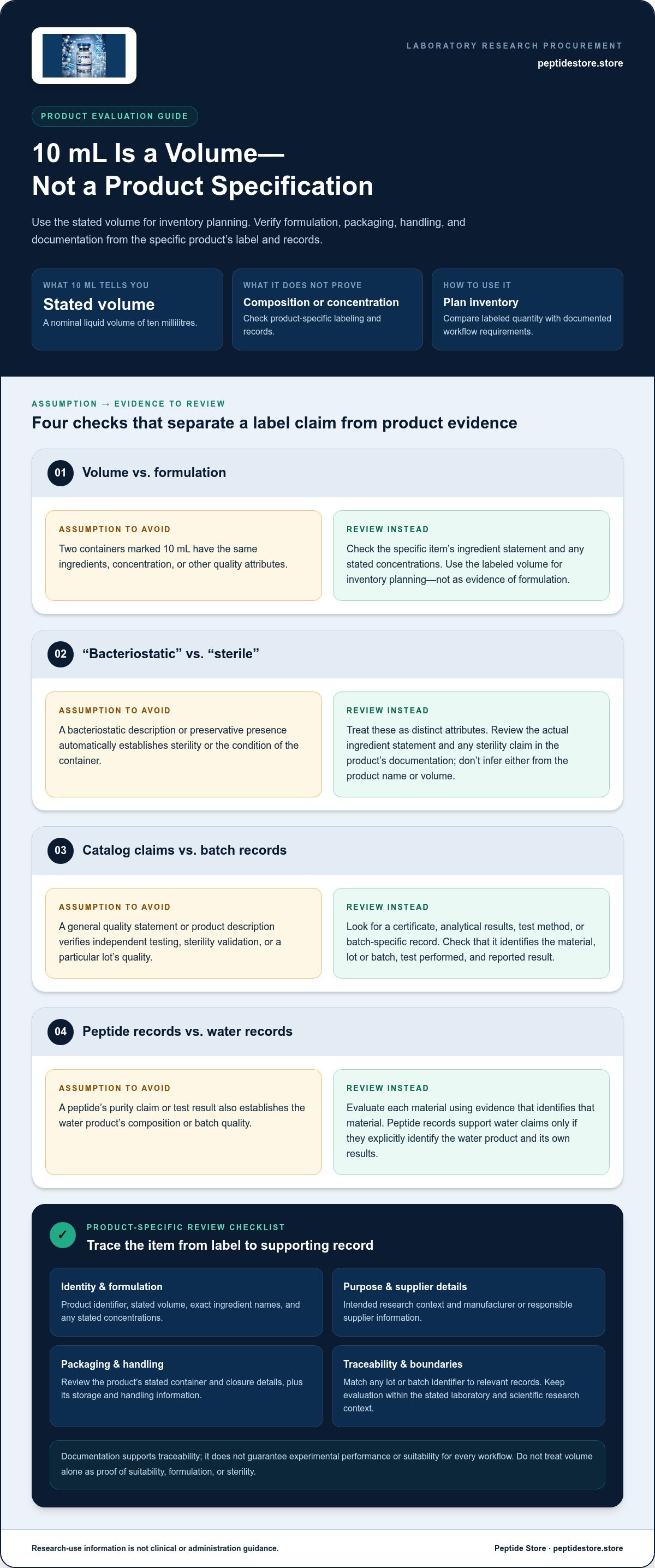
A Research Procurement Checklist for Bacteriostatic Water 10 mL
A consistent review process helps research teams compare supplier claims with records relevant to the specific water product. Use this checklist before adding a container to an approved materials list. Record what the label and documentation state, and distinguish those details from assumptions.
A stepwise label and documentation review
- Step 1: Match identity and volume. Compare the product name, intended research context, and stated volume with the study’s approved materials list. A 10 mL volume is an inventory detail, not evidence of composition or suitability.
- Step 2: Record lot information. Capture any lot or batch identifier shown on the container or product records. Check for a matching identifier in associated documents, and note the material, tests, and results they describe.
- Step 3: Review label details. Record the ingredient statement, manufacturer or responsible supplier information, and specific claims relevant to the research material. Don’t treat general catalog language as product-specific evidence.
- Step 4: Check handling information. Compare stated storage and handling details with the laboratory’s procedures. Record relevant conditions and ensure the applicable SOP governs receipt, storage, identification, and use.
- Step 5: Confirm research-use boundaries. Keep procurement and use within the laboratory and scientific research context. Don’t interpret research-use labeling as support for human or veterinary use.
At minimum, record product identity, stated volume, label claims, lot identifier, available product-specific documentation, and applicable handling requirements. This creates a concise evidence trail for review and helps distinguish documented attributes from unsupported assumptions.
Research-use boundaries and contamination controls
Bacteriostatic properties don’t replace aseptic practice, validated laboratory procedures, or the laboratory’s own contamination controls. They also don’t establish that a particular container is sterile or suitable for every research task. Follow the approved SOP for handling and recordkeeping, and base procurement decisions on evidence tied to the water product rather than headline claims or peptide purity statements. Peptide testing claims concern the peptide unless records explicitly identify and assess the water as well.
Use this review framework to assess bacteriostatic water 10ml against your study’s documented procurement criteria. To browse Peptide Store’s research supplies, explore the research product catalog.
Peptide Store Bacteriostatic Water: Evaluate the 10 mL Listing
Peptide Store includes bacteriostatic water in its catalog for laboratory and scientific research applications. A product name or category description provides a starting point, but evaluate an individual item using its product listing, label, and any records supplied for that item. This keeps general information about bacteriostatic water separate from claims about a particular container.
What the product listing can establish
Review the listing for the attributes it expressly states, such as product identity, labeled volume, ingredient information, packaging details, and intended research context. Describe a product as a 10 mL format only when that volume appears on its listing or label. Apply the same standard to formulation and packaging: use the details as written, without filling gaps with general descriptions or assumptions.
Assess documentation by what it identifies and reports. A certificate, analytical record, or batch information can be evaluated by checking the material and lot it identifies and the results it gives. A general quality statement is not equivalent to batch-specific testing, and one type of record doesn’t establish certification or other testing claims.
For item discovery, use the Peptide Store product catalog and assess the relevant product information directly. Keep the listing’s specific facts distinct from educational explanations elsewhere in this article.
How to proceed with a research-focused purchase
Before procurement, compare the item’s stated identity and specifications with institutional research requirements and the materials documented for the study. Ensure that recorded volume, ingredient, packaging, and handling details come from the relevant listing, label, or supporting documentation. If the laboratory tracks lot identifiers, maintain the connection between the received item and its associated records.
Use the laboratory’s approved procedures for receipt, storage, handling, and recordkeeping. Product information can support an evaluation, but it doesn’t replace institutional requirements or establish that a material is appropriate for every workflow. The research-use context also sets a clear boundary: this information concerns laboratory and scientific research, not human or veterinary use.
For a focused review of bacteriostatic water 10ml, compare the product’s stated details with your laboratory’s documented criteria rather than relying on category wording alone. Review Peptide Store and assess the relevant listing against your research requirements.
Make Your Next Procurement Review Evidence-Based
A 10 mL label identifies stated container volume, not the formulation, sterility, or suitability of bacteriostatic water for a specific research workflow. Evaluate those attributes separately using the item’s label and available product- or batch-specific records. Keep handling and storage decisions aligned with your laboratory’s approved procedures.
For bacteriostatic water 10ml, compare documented product details with study requirements rather than inferring specifications from a general description or unrelated peptide quality claims. A clear record of product identity, volume, lot information, and applicable documentation supports a consistent procurement review.
Peptide Store includes bacteriostatic water in its research product catalog and supplies products for laboratory and scientific applications. Review Peptide Store’s research catalog and assess the relevant listing against your laboratory requirements. Careful specification review is a practical foundation for informed research procurement.
Frequently Asked Questions
What does 10 mL mean on a bacteriostatic water label?
10 mL indicates the stated liquid volume in the container. It doesn’t identify the solution’s ingredients, preservative concentration, sterility, or compatibility with a research workflow. For bacteriostatic water 10ml, check the specific item label and available documentation for formulation and product attributes. Treat volume as an inventory measure, then assess other specifications separately against the study’s approved materials and laboratory procedures.
Is bacteriostatic water the same as sterile water?
No. “Bacteriostatic” describes a formulation characteristic associated with inhibiting bacterial growth, while “sterile” is a separate product claim that requires its own supporting information. The terms aren’t interchangeable, and the presence of a preservative doesn’t establish sterility or prevent every contamination event. Review the product’s ingredient statement and documentation rather than inferring either attribute from its name.
Can bacteriostatic water 10 mL be used with any research peptide?
No. A container’s volume and general product category don’t establish compatibility with every peptide or research protocol. Evaluate the water’s documented formulation alongside the peptide’s relevant product information and the study’s approved materials. Follow institutional procedures and research-use boundaries. Don’t infer compatibility from unrelated peptide purity claims or treat general educational information as a protocol for a specific research material.
How should a laboratory compare 10 mL with other container volumes?
Compare volumes against documented study requirements, inventory controls, storage capacity, and laboratory handling procedures. A smaller container isn’t inherently more suitable, and a larger one doesn’t establish better value or performance. Review each format’s label and documentation independently, since packaging and product attributes can differ. Select based on the laboratory’s approved requirements, not container size alone or assumed usage.
Does bacteriostatic water prevent contamination after a container is opened?
No. A bacteriostatic property doesn’t guarantee that contamination can’t occur, particularly after a container is opened or handled. It doesn’t replace aseptic practice, applicable contamination controls, or validated laboratory procedures. Follow the specific product’s handling and storage documentation and the laboratory’s approved SOP. Don’t assume that a preservative makes a container suitable for repeated use or overrides its stated handling requirements.
What documentation should I review before purchasing bacteriostatic water 10 mL?
Review the product identity, stated volume, ingredient statement, intended research context, and manufacturer or supplier details. Check whether the listing or product records provide a lot identifier and any corresponding certificate or analytical documentation. Confirm that records identify the relevant water product and batch, rather than a separate peptide. Compare documented handling and storage information with laboratory procedures, and distinguish stated facts from general catalog claims.


