
Procuring Laboratory Incretin Analogs: Institutional Guide
When an institution needs to buy peptides, the boldest claim on a product listing may be less useful than the documentation behind it. Product names and catalog categories can help locate compounds such as semaglutide and tirzepatide, but they don’t show whether a supplier’s information meets a laboratory’s requirements. Review the product details and published policies before making a procurement decision.
That review can take care: available documentation may vary by product or batch, and shipping, returns, and support terms may not be obvious at a glance. Research-use-only compounds are for laboratory research, not human use, and must be assessed within that boundary.
This guide offers a consistent way to compare suppliers based on information availability, ordering policies, and procurement fit. It covers how to review product and batch documentation where available, use catalog categories for navigation rather than experimental guidance, and check shipping, returns, storage, and support details before proceeding. The aim is to support a research-focused assessment based on verifiable information, not headline claims.
Key Takeaways
- Define the research objective, compound identity, and institutional purchasing requirements before comparing suppliers.
- Check whether product documents identify the compound and relevant batch, and note any analytical details that need verification.
- Use consistent evidence labels to compare catalog fit, policy clarity, batch records, and support without relying on unsupported rankings.
- Before you buy peptides, confirm specifications, internal purchasing approval, and applicable compliance requirements.
- Review current product information and published policies to determine whether Peptide Store’s research catalog fits your procurement needs.
Buying Peptides for Research: Define the Project Before Comparing Suppliers
Before comparing listings or deciding where to buy peptides, define the laboratory requirement. Research procurement starts with a specified objective, compound identity, and institutional purchasing criteria. It is different from obtaining prescription medication or shopping for consumer wellness products. A catalog description may indicate how a supplier classifies a compound, but it does not establish clinical efficacy, suitability for use in people or animals, or regulatory approval.
For incretin analog research, distinguish the research question from the product category. Incretins are gut hormones involved in physiological signaling, as described in this overview of incretin hormones. A catalog label such as “GLP-1 agonist” can help locate a listing. It is not a study protocol or evidence that a product is appropriate for a particular experiment.
The following video is third-party content. Evaluate it independently, and don’t treat it as institutional procurement, regulatory, or safety guidance.
Definition: Research peptide sourcing means matching a documented product identity to a defined laboratory requirement.
Specify the research requirement before browsing peptide listings
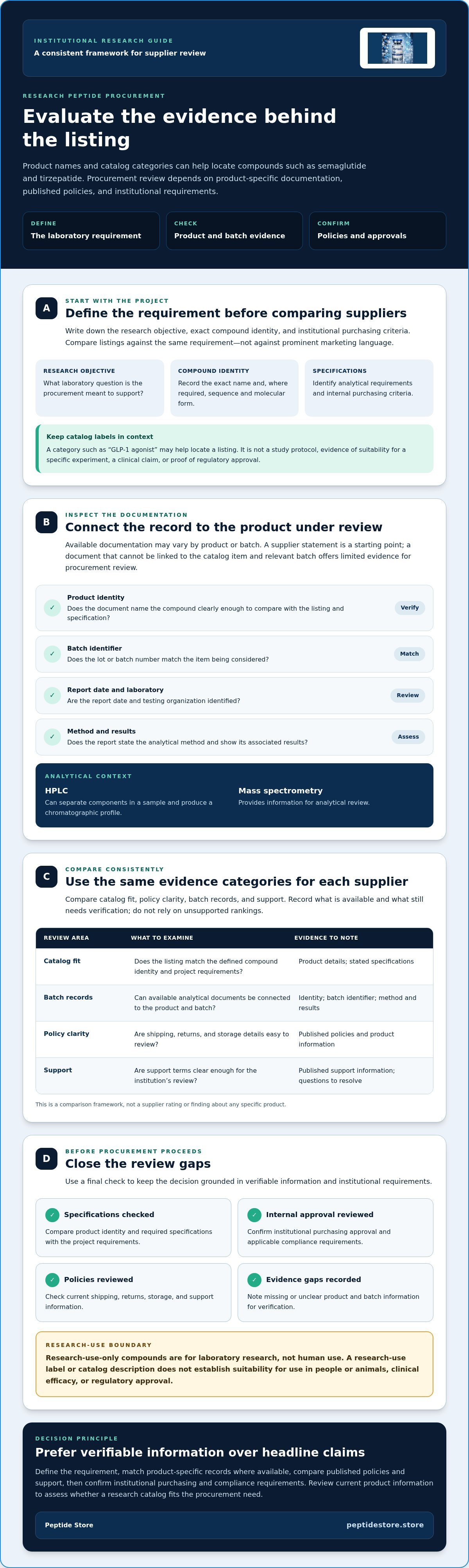
Write down the study objective and exact compound name before searching a supplier catalog. Where required by the project, also record the sequence, molecular form, and analytical specifications. Check the intended laboratory application against approved internal protocols, not vendor marketing language.
Separate must-have criteria from preferences. Compound identity and required specifications may be essential; catalog organization or other nontechnical features may be optional. This makes it easier to compare suppliers against the same requirements instead of letting prominent listing language redefine the project.
Recognize research-use boundaries when you buy peptides
A research-use label describes the stated research context. On its own, it doesn’t establish suitability for administration to people or animals. Research compounds are not interchangeable with prescription medications, and catalog descriptions should not be read as treatment claims or evidence of approval for human use.
Keep procurement materials focused on laboratory requirements. Exclude treatment claims, consumer recommendations, dosing instructions, and self-experimentation guidance. If a question concerns regulatory interpretation or institutional policy, refer it to qualified compliance personnel or the appropriate authority before proceeding.
Evaluate Peptide Supplier Documentation and Product-Specific Evidence
Supplier statements are useful starting points, but they are not a substitute for records connected to the item under review. Before deciding where to buy peptides, check whether available analytical documentation identifies the compound and the batch being offered. A document that cannot be linked to the specific catalog item and batch provides limited evidence for procurement review.
Review certificates of analysis and analytical methods
If a certificate of analysis or another analytical report is available, review it systematically:
- Product identity: Does the document name the compound clearly enough to compare with the listing and your specification?
- Batch identifier: Is there a lot or batch number that matches the item under review?
- Report date and laboratory: Are the date and testing organization identified?
- Method description and results: Does the report state which analytical method was used and show the associated results?
HPLC, or high-performance liquid chromatography, can separate components in a sample and produce a chromatographic profile. Mass spectrometry provides information about molecular mass that can support an identity assessment. Neither method, by itself, establishes clinical efficacy, suitability for administration to people or animals, sterility, or regulatory status. Interpret the results within the scope and limitations of the report.
Missing, generic, incomplete, or mismatched records are reasons to ask a specific question before procurement. Ask whether a current, product-specific report is available and how its batch identifier corresponds to the material being considered. Don’t assume a supplier has provided a method or certificate until you have reviewed the relevant evidence.
Assess traceability and consistency of supplier claims
Compare product-page statements with analytical records and published supplier policies. Check whether the documents apply to the current catalog item, whether identifiers match across records, and whether the report date is relevant to the purchase under review. If a listing makes a broad purity claim but provides no corresponding batch record, mark the claim as unverified rather than treating it as established evidence.
A general purity claim describes a supplier statement; batch-specific analytical evidence identifies the tested material and the record supporting the reported result. This distinction keeps procurement decisions tied to verifiable documentation without extending analytical findings into claims about safety or performance.
For a supplier comparison, label each document available and matched, available but unclear, or not provided. Qualified researchers can review current product listings as part of that assessment, then verify product-specific information before proceeding.
Compare Peptide Suppliers by Catalog Fit, Policies, and Support
A consistent comparison is more useful than a broad supplier ranking. Record what each supplier states, what a document supports, what remains unclear, and what needs confirmation. These labels help separate catalog language from verifiable procurement information when comparing research suppliers.
| Criterion | What to review | Evidence status |
|---|---|---|
| Product identity | Does the listing clearly identify the compound and relevant form? | Stated, documented, or unclear |
| Batch records | Are product-specific records available and linked to the batch under review? | Documented, unclear, or verify |
| Policy clarity | Can you locate current shipping, returns, and refund terms? | Stated or unclear |
| Support access | Is a contact route provided for procurement questions? | Stated or verify |
| Catalog relevance | Does the catalog include the compound category needed for the project? | Stated, documented, or verify |
Use “documented” only after reviewing a record that supports the specific point. “Stated” means the information appears in supplier materials but has not been independently confirmed. Mark incomplete or ambiguous details “unclear,” and use “verify” for information that needs direct confirmation before purchase. For analytical documentation, use the checklist in the preceding section.
Match the catalog category to the laboratory requirement
Research catalogs may group compounds under headings such as GLP-1 agonists, healing peptides, growth hormone compounds, or cognitive research molecules. These categories help researchers locate listings, but category placement doesn’t establish suitability for a particular experiment. Compare the named compound and available product information with the project specification rather than treating a category as experimental guidance. The peptide categories page provides a way to review current catalog organization.
Review ordering terms and support before checkout
Before you buy peptides, check whether shipping, returns, refunds, and support information is easy to find and clear enough for institutional purchasing. Note unanswered questions about order handling, delivery conditions, or return eligibility, then seek clarification through the supplier’s published contact channel. Published terms are procurement references, not evidence of analytical quality. Review the current shipping and returns policy and confirm that its terms fit your institution’s purchasing process.
Compare suppliers against the same criteria, and keep the status labels with your procurement notes. This makes gaps visible without relying on unsupported rankings or treating general supplier claims as verified evidence.
Use a Research Peptide Procurement Checklist Before Placing an Order
A consistent pre-order review can help institutional buyers catch specification gaps before they become purchasing or recordkeeping problems. Complete these steps before deciding to buy peptides, and pause if a required detail remains unresolved.
- Confirm the approved requirement. Record the laboratory objective and exact compound identity required by the project. Use the approved internal protocol as your reference, not catalog language.
- Match the listing to the specification. Compare the listed compound and any required form or analytical criteria with the approved requirement. If names or specifications differ, resolve the discrepancy with research and procurement personnel before purchase. Don’t infer experimental protocols, dosing, or directions for human use from a product listing.
- Check institutional approval and compliance. Confirm that the purchase has the required internal authorization. Refer regulatory or institutional questions to qualified compliance personnel or appropriate authorities rather than relying on supplier descriptions to interpret requirements.
- Verify order readiness. Confirm current product availability, applicable shipping terms, and whether required product-specific or batch documentation is available. Review published policies and seek clarification on ambiguous points before submitting the order.
- Retain the procurement record. Save the product listing as reviewed, order confirmation, relevant batch records, and the policy information applicable at the time of purchase. Keep unanswered questions and supplier responses with the related product or batch reference.
A sound procurement record links the approved requirement, selected product, and order documents. This helps reviewers understand what was authorized, what was selected, and which records supported the transaction. It also makes follow-up more precise if a product identifier, batch document, or policy detail needs clarification.
If product or order information leaves a material question unanswered, document the issue before proceeding. Use the supplier’s published contact channel to ask about the relevant listing, order, or batch, and retain the response with the purchasing file. For product or order questions, use the supplier contact page as a communication route, not as a substitute for internal approval or compliance review.
Review Peptide Store’s Research Catalog and Choose a Next Step
Peptide Store supplies compounds for laboratory and scientific applications to customers across the United States. The company’s catalog includes more than 150 compounds across specialized categories. Catalog breadth can help researchers locate relevant listings, but it doesn’t establish that a particular product meets a project specification or that product-specific analytical evidence is available.
Navigate the catalog using confirmed research categories
Catalog categories can serve as navigation aids. Peptide Store identifies GLP-1 agonists, healing peptides, growth hormone peptides, and cognitive research molecules among its research categories. These labels help organize product discovery; they don’t establish an experimental role, therapeutic effect, or suitability for a specific protocol.
Use category pages to find a relevant listing, then compare the product name and available information with the approved laboratory requirement. For incretin analog research, a category label is a starting point for locating a compound, not evidence that a listing matches a study’s exact identity or analytical specifications. Product information and availability can change, so review the current listing rather than relying on a previous catalog description.
Proceed only when documentation and policies answer your questions
Before you buy peptides, check that product details address your procurement requirements and that relevant records correspond to the specific product or batch under review. Review applicable ordering and shipping terms, and clarify material questions before checkout. Don’t infer testing, purity, shipping speed, guarantees, or availability from a category label or general supplier statement.
Products are supplied for research and laboratory applications only. Catalog descriptions aren’t evidence of clinical efficacy, regulatory approval, or suitability for use in people or animals. Keep your review focused on product identity, documentation, and procurement fit, and refer institutional or regulatory questions to qualified personnel.
Qualified researchers can review the research peptide catalog and current product information, then apply the procurement checklist in this guide to assess whether an item fits their requirements.
Make the Next Procurement Decision Evidence-Based
A sound peptide procurement decision starts with a defined laboratory requirement, then checks product identity, batch-specific records, supplier policies, and institutional approval. Catalog categories can help locate listings, but they don’t establish suitability for an experiment or for human use. Keep the evaluation focused on verifiable information and research-use boundaries.
Peptide Store’s catalog contains more than 150 research-grade compounds. Review each listing’s product-specific information before relying on it for procurement. General company details don’t replace verification of the item and batch being considered.
For your next step, compare current listings with your approved specifications and procurement checklist. Review the research peptide catalog to examine available product information. A careful, documented review can help your team proceed with greater clarity and maintain a stronger procurement record.
Frequently Asked Questions
How can I buy peptides for laboratory research?
Start by defining the research requirement, then compare the listed compound identity, applicable batch documentation, supplier policies, and support access. Confirm that the product listing matches your institution’s purchasing requirements before ordering. Research-use labeling sets a boundary; it doesn’t establish suitability for human use. Resolve missing information with the supplier before proceeding, and retain the listing, order confirmation, and relevant records with your procurement documentation.
What should I check before ordering research peptides online?
Confirm the compound name and listed specification, then review available batch records, document dates, shipping and returns terms, and supplier contact information. Check that any records apply to the specific product and batch under consideration. A broad quality statement isn’t proof without supporting documentation. Follow your institution’s purchasing and compliance procedures, and don’t treat product pages as medical advice or instructions for conducting experiments.
Are research peptides approved for human use?
A research-use description alone doesn’t establish approval or suitability for human use. This guide addresses laboratory procurement, not treatment, personal use, or clinical advice. Don’t infer safety, efficacy, or authorization from a supplier listing, analytical document, or catalog category. For questions about institutional requirements or regulatory interpretation, consult your organization’s compliance personnel and qualified regulatory counsel. Research listings should not be treated as recommendations for administration to people or animals.
What is a certificate of analysis, and how should buyers review one?
A certificate of analysis is a document reporting specified test results for an identified product or batch. Check whether it names the compound, includes a batch reference and report date, identifies the laboratory, and describes the analytical methods. Confirm that the record corresponds to the exact listing under consideration. A certificate doesn’t by itself establish clinical efficacy, human-use suitability, or regulatory approval. Ask the supplier to clarify missing or mismatched details.
Can I compare peptide suppliers using purity claims alone?
No. A headline purity claim may not identify the analytical method, tested batch, report date, or supporting records. Compare product-specific evidence alongside compound identity, traceability, policy clarity, and access to supplier support. Record which details are documented and which remain unclear. A purity figure alone doesn’t establish safety or suitability for a particular application, so verify claims against current records relevant to the product being considered.
Does Peptide Store provide prescription medication or medical consultations?
No. Peptide Store doesn’t sell human prescription medications or provide clinical dosing and medical consultations. The company supplies research peptides for laboratory and scientific applications. Its research listings aren’t medical recommendations. Anyone seeking diagnosis, treatment, or medication should consult a licensed healthcare professional. Review current catalog descriptions and terms directly, and don’t interpret a research listing as guidance for human use.
How do I verify shipping and return terms before buying peptides?
Review the supplier’s current shipping, returns, and refund policies before submitting an order. Confirm which terms apply to the product and your order, and contact the supplier if anything is unclear. Don’t rely on outdated search snippets or assumptions about delivery timing. Institutional buyers should retain the applicable policy information with the procurement record and follow their organization’s purchasing and compliance procedures before proceeding.
Ready to assess a product against your laboratory requirements? Review Peptide Store’s current research peptide catalog and confirm the relevant product information before ordering.


