

A broader receptor profile doesn’t automatically make one compound the better research tool. In retatrutide vs tirzepatide research, the useful comparison starts with the question being tested: tirzepatide activates GIP and GLP-1 receptors, while retatrutide also targets the glucagon receptor.
Those labels are useful, but they can obscure important differences in assay design and evidence. Results from different cell systems, receptor-expression levels, concentrations, and readouts may not be directly comparable. Clinical trial findings answer different questions from cellular assays and shouldn’t be treated as a guide to human use.
This article compares the compounds’ receptor profiles, explains how to interpret evidence across experimental settings, and outlines practical criteria for selecting a compound for laboratory research. It also covers the limits of cross-study comparisons and distinguishes research materials from human prescription medications. The goal is not to declare a universal winner, but to help researchers match compound selection and assay conditions to a clearly defined experimental question.
Key Takeaways
- For retatrutide vs tirzepatide research, distinguish retatrutide’s triple-target profile from tirzepatide’s GIP/GLP-1 activity, then connect that difference to the assay hypothesis.
- Assess evidence by type, separating cellular and other preclinical findings from published clinical studies and trial-registry records.
- Before comparing results, check whether the models, endpoints, study durations, and methods are aligned closely enough to support interpretation.
- Base compound selection on a defined hypothesis, suitable model, and measurable endpoints. Broader receptor targeting alone doesn’t establish a better fit.
- For laboratory materials, review identity, purity documentation, batch traceability, and handling information for the specific product and batch.
Retatrutide vs. Tirzepatide Research: Why the Comparison Starts With Receptor Targets
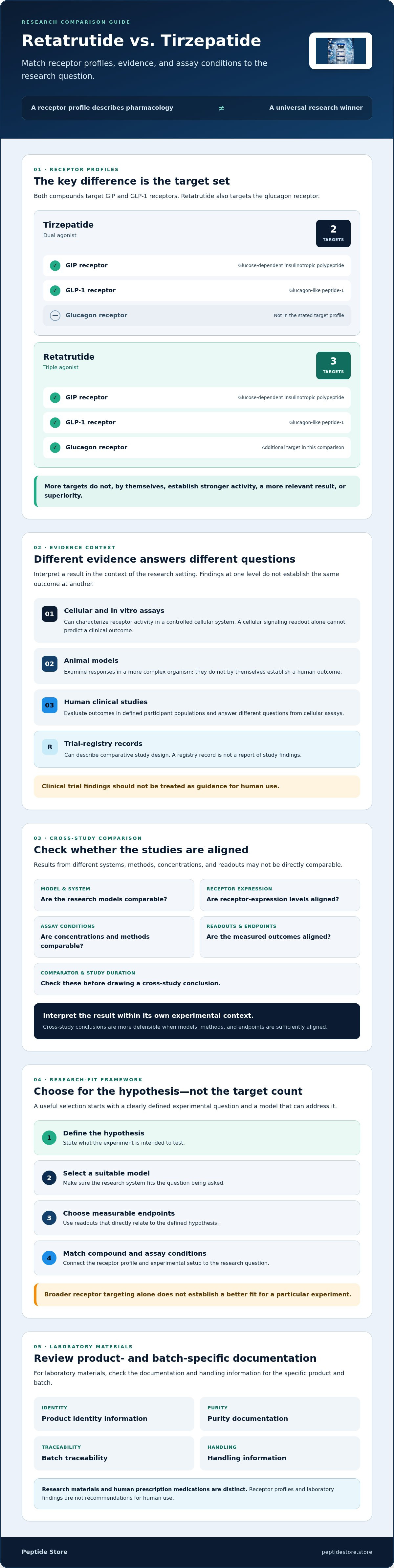
The most useful starting point for retatrutide vs tirzepatide research is receptor pharmacology, not a ranking of compounds. Tirzepatide activates glucose-dependent insulinotropic polypeptide (GIP) and glucagon-like peptide-1 (GLP-1) receptors. Retatrutide activates those two receptors and the glucagon receptor. This distinction defines their target profiles, but it doesn’t establish which compound will produce a stronger or more relevant result in a particular assay.
Agonism describes a compound’s ability to bind to and activate a receptor. That activation doesn’t guarantee a specific downstream response in every biological system. A receptor profile describes pharmacology; it is not a clinical conclusion or recommendation for human use.
The following video offers a general comparison. Treat it as an overview, not as primary evidence from a cellular assay or guidance for human use.
What does dual versus triple agonism mean in this comparison?
Dual agonism refers to activity at two receptor types, while triple agonism refers to activity at three. In this comparison, the targets are the GIP, GLP-1, and glucagon receptors: tirzepatide targets GIP and GLP-1 receptors, while retatrutide targets all three. This distinction describes receptor pharmacology, not the magnitude or clinical significance of an effect. For an overview of retatrutide’s reported mechanism and development, see Retatrutide.
Why does research context matter before comparing results?
Evidence from different research stages answers different questions. In vitro assays can characterize receptor activity in a controlled cellular system; animal models examine responses in a more complex organism; human clinical studies evaluate outcomes in defined participant populations. Findings at one level don’t establish the same outcome at another.
Interpret results in light of the model, assay conditions, comparator, endpoint, and study duration. A receptor-signaling readout in cultured cells, for example, cannot by itself predict a clinical outcome. Cross-study conclusions are more defensible when methods and endpoints are sufficiently aligned. For additional mechanism context, consult the retatrutide research overview.
How Retatrutide and Tirzepatide Differ in Receptor Pharmacology
The receptor distinction is clear; its experimental meaning requires more care. Tirzepatide is a dual glucose-dependent insulinotropic polypeptide (GIP) and glucagon-like peptide-1 (GLP-1) receptor agonist. Retatrutide also activates the glucagon receptor, giving it a triple-target profile. The original characterization of tirzepatide by Coskun et al. and the retatrutide phase 2 publication by Jastreboff et al. provide primary-source context for these classifications.
| Compound | Receptor targets | Profile | Interpretation limit |
|---|---|---|---|
| Tirzepatide | GIP and GLP-1 receptors | Dual agonist | Two targets do not establish relative activity or study outcome. |
| Retatrutide | GIP, GLP-1, and glucagon receptors | Triple agonist | One additional target does not establish superiority. |
For primary descriptions, see Coskun et al. on tirzepatide and Jastreboff et al. on retatrutide. Don’t conflate receptor-target claims with downstream effects or specific assay endpoints. The direct comparison study registry can help readers examine the design of comparative clinical research. A registry record describes a study, not its findings.
Which receptors are included in each research profile?
The shared targets are the GIP and GLP-1 receptors; the additional target in retatrutide’s profile is the glucagon receptor. This target count is a useful pharmacological distinction, not a measure of potency. Claims about receptor affinity, signaling bias, or pharmacokinetics require verification against the relevant primary experiments. They shouldn’t be inferred from the labels “dual” and “triple.”
What can receptor profiles tell researchers, and what can they not?
A receptor profile can help researchers formulate a testable question, such as whether adding glucagon-receptor activity changes a defined cellular readout under specified conditions. It cannot, on its own, rank the compounds or predict results in another model. Species and receptor sequence, receptor expression, assay format, concentration, exposure duration, and selected endpoint can all affect interpretation.
For that reason, retatrutide vs tirzepatide research should distinguish target identity from comparative performance. Researchers considering laboratory materials can review the research peptide catalog and confirm product details and documentation for the specific item before use.
What the Retatrutide and Tirzepatide Evidence Can, and Cannot, Show
Evidence comparisons depend on what was studied and how. Cellular experiments can measure receptor signaling under controlled conditions; animal studies examine responses in a whole organism; clinical trials assess outcomes in defined human populations. Each evidence type addresses different questions. A result in one setting doesn’t establish the same effect in another.
Different study designs limit direct cross-study comparisons. For a defensible comparison, examine whether studies use sufficiently similar models or populations, comparators, endpoints, follow-up periods, and analysis methods. If those features differ, observed contrasts may reflect study design as much as compound pharmacology.
How should researchers assess evidence maturity?
Label each source by study type and publication status. For example, the peer-reviewed retatrutide phase 2 study by Jastreboff et al. and the published SURMOUNT-1 tirzepatide trial by Jastreboff et al. are clinical publications, while cellular and animal experiments are preclinical evidence. Trial registry records provide protocol and status information, but registration alone isn’t proof that results have been published or peer reviewed.
Check the primary publication and the current registry record separately. Records can be updated, and trial status, planned endpoints, or reported results may change. Examples include the retatrutide phase 2 trial record and the SURMOUNT-1 trial record.
Why can study outcomes appear difficult to compare?
Studies may differ in species or cell model, receptor expression, comparator, endpoint definition, follow-up duration, and statistical analysis. A cellular signaling measure, for instance, is not interchangeable with a clinical outcome. Even two trials reporting the same named endpoint may use different populations, measurement schedules, or analysis plans.
Cross-study contrasts aren’t equivalent to randomized head-to-head evidence. A valid comparative claim requires an appropriately designed direct comparison and careful interpretation of its methods and results. One endpoint, abstract, or headline finding can’t establish a universal ranking across research settings.
For retatrutide vs tirzepatide research, record the source type, model or population, comparator, endpoint, duration, and publication status before drawing conclusions. Verify dates, outcomes, and current trial-status claims against primary papers and updated registry entries. Keep preclinical findings within their scope; they aren’t clinical recommendations.
A Research Framework for Choosing Between Retatrutide and Tirzepatide
Compound selection should follow the experimental question, not a presumption that more receptor targets are preferable. A disciplined retatrutide vs tirzepatide research plan moves from hypothesis to model, endpoints, and evidence review. This framework supports laboratory planning only; it isn’t a basis for individual treatment decisions.
Which questions should a laboratory define first?
Start by stating the biological question and the mechanism or endpoint under investigation. If the hypothesis concerns activity at a shared receptor, design the study to isolate and measure that question. If it concerns the contribution of retatrutide’s additional glucagon-receptor target, specify how the model and readout can address it.
Then document the experimental system and comparison plan before interpreting results:
- Hypothesis: State the mechanism or response being tested.
- Model: Specify the cell system or other model, including relevant inclusion criteria.
- Comparator and controls: Identify comparison groups and controls needed to interpret the readout.
- Endpoint: Define what will be measured and how.
- Evidence review: Check that existing evidence uses a model and methods relevant to the planned experiment.
Use consistent procedures and transparent reporting so another researcher can assess and reproduce the comparison. If the available literature uses a different species, assay system, or endpoint, document that mismatch rather than treating the result as directly transferable.
How should a comparison table avoid misleading conclusions?
A useful table makes differences and evidence gaps visible. Include study type and publication status alongside the model, receptor profile, endpoint, comparator, and stated limitations. Mark unavailable or non-comparable information explicitly. Don’t fill gaps with assumptions based on receptor count or results from a different experimental setting.
| Comparison field | What to record | Why it matters |
|---|---|---|
| Evidence type | Cellular, animal, or clinical; publication status | Clarifies what the source can support |
| Model and methods | System, comparator, controls, and analysis | Shows whether study conditions are aligned |
| Targets and endpoint | Receptor profile and measured outcome | Separates pharmacology from observed response |
| Limitations | Missing or non-comparable details | Prevents unsupported conclusions |
For broader standards context, consult the research peptide laboratory guide. Once the research question and documentation criteria are defined, review the research peptide catalog for listed compounds intended for laboratory and scientific applications, not human use.
Research-Grade Retatrutide and Tirzepatide: Documentation and Next Steps
Once a compound fits the research question, evaluate the material and its documentation separately from the pharmacology literature. Peptide Store supplies research-grade materials for laboratory and scientific applications, including retatrutide and tirzepatide. These materials are not human prescription medicines, and the supplier does not provide clinical consultations.
What should laboratory buyers verify in product documentation?
Review current information for the specific product and batch under consideration. Don’t assume a label or general product description establishes identity, purity, or suitability for a particular assay. Check whether relevant documentation is available and whether it clearly identifies the material and batch.
- Identity: Confirm which compound the documentation identifies and whether the stated analytical method supports that identification.
- Purity: Review the reported result, method, and stated limits. Different analytical methods measure different properties, so don’t infer a result that the documentation doesn’t provide.
- Batch traceability: Check that any records correspond to the specific batch being evaluated, rather than relying on generic or unrelated material.
- Handling: Consult current product documentation for storage and handling information. Don’t substitute assumptions from another compound or supplier.
If details aren’t supplied or are unclear, verify what information is available before incorporating the material into an experimental plan. This supports transparent sourcing; it doesn’t replace independent method validation, appropriate controls, or assessment of whether a compound is relevant to the assay.
Where can researchers review relevant catalog information?
Use catalog pages as navigation resources, not as evidence of clinical suitability or experimental performance. The research peptide categories can help locate relevant catalog groupings, while available research products provides a product-listing view. Verify current availability and product-page details, then assess the information for the specific item and batch before making a sourcing decision.
In retatrutide vs tirzepatide research, selection should stay grounded in the hypothesis, model, endpoint, and evidence quality. Catalog access is a practical next step only after those criteria are defined. Review the catalog details for laboratory research and confirm the documentation needed for your study.
Build the Next Comparison Around the Research Question
The receptor distinction is a starting point, not a verdict. Tirzepatide targets GIP and GLP-1 receptors, while retatrutide also targets the glucagon receptor. In retatrutide vs tirzepatide research, sound interpretation depends on matching the compound to the hypothesis, examining the model and endpoint, and comparing evidence only when study designs support it.
For laboratory planning, keep preclinical findings separate from clinical evidence, and assess material documentation independently from published pharmacology. Confirm that identity, analytical information, batch details, and handling guidance apply to the specific product being considered. Research-grade materials are for laboratory and scientific applications, not human use or as substitutes for prescription medicines or clinical consultation.
Peptide Store offers a catalog of more than 150 research-grade compounds, including retatrutide and tirzepatide. Review current product information and evaluate it against your study requirements before making a sourcing decision. Review Peptide Store’s research-grade peptide catalog to find catalog information for your laboratory research. A clearly defined question and careful evidence review provide a stronger basis for responsible research.
Frequently Asked Questions
What is the main research difference between retatrutide and tirzepatide?
The main difference is their receptor-target profile. Tirzepatide activates GIP and GLP-1 receptors, while retatrutide also targets the glucagon receptor. This distinction frames retatrutide vs tirzepatide research, but doesn’t by itself show which compound is more active or useful in a particular experiment. Consider the assay model, exposure conditions, controls, and measured endpoint before interpreting differences in observed responses.
Is retatrutide a triple agonist compared with tirzepatide?
Yes. Retatrutide is described as a triple agonist because it targets the GIP, GLP-1, and glucagon receptors. Tirzepatide is a dual agonist, targeting GIP and GLP-1 receptors. “Triple” and “dual” count receptor targets; they don’t quantify binding strength, signaling response, or biological effect. Check specific claims about affinity or signaling against primary studies that use the relevant assay conditions.
Can retatrutide and tirzepatide research results be compared directly?
Only when study designs are sufficiently comparable, or when a suitable head-to-head study tests both compounds under the same protocol. Check whether models or participant populations, comparators, endpoints, study duration, and analysis methods align. Differences in these features can influence results, so contrasting separate studies isn’t equivalent to a randomized direct comparison. Avoid treating one endpoint or headline result as a universal ranking.
What research evidence should be reviewed for each compound?
Review evidence by type and publication status. Cellular and animal studies provide preclinical findings; published clinical trials report outcomes in defined human populations; trial registries provide protocol and status information. A registry entry doesn’t establish that results are published or peer reviewed. For each source, check the primary paper or current registry record, study methods, endpoints, comparator, and limitations before drawing conclusions.
Does a triple receptor profile mean retatrutide is better for research?
No. An additional receptor target doesn’t make a compound universally preferable or predict the result of a particular experiment. Selection depends on the hypothesis, model, and endpoint. For example, a study focused on shared receptor targets may require a different comparison from one investigating glucagon-receptor activity. Match the compound profile to the experimental question, and don’t treat receptor count as a measure of research quality.
Are research-grade retatrutide and tirzepatide products prescription medicines?
No. Peptide Store supplies research-grade materials for laboratory and scientific applications; these products aren’t human prescription medicines. The company doesn’t provide clinical dosing or medical consultations. Research materials shouldn’t be treated as treatment or used to make personal medical decisions. Keep laboratory sourcing separate from healthcare, and consult an appropriately qualified healthcare professional for individual medical questions.
What should a researcher check before comparing peptide products?
Review documentation for the specific product and batch. Check whether identity and purity information is provided, whether the stated analytical method and its limits are clear, and whether batch details are traceable. Confirm current storage and handling instructions from the product documentation. Don’t infer purity, assay suitability, or equivalence from a label alone. Then assess whether the available information supports the planned research and comparison.


