
A preservative can inhibit microbial growth without making a liquid suitable for every peptide experiment. That distinction matters when evaluating bacteriostatic water for peptides: a formulation may serve a purpose in a defined protocol, but its name alone doesn’t confirm compatibility, sterility, or assay validity.
Comparing bacteriostatic water with sterile water is a reasonable starting point, but neither category is automatically appropriate for every research application. The choice depends on the liquid’s documented composition and intended use, the peptide’s properties, and the assay requirements. A preservative’s presence doesn’t prove that a preparation remains sterile after handling or that it won’t affect results.
This article explains what the term means, how bacteriostatic water differs from other laboratory liquids, and what to check in product labels, formulation, storage information, and compatibility records. It also sets clear limits: research materials are not medical products, and this discussion does not provide clinical preparation or administration instructions.
Key Takeaways
- Bacteriostatic water for peptides describes a formulation property, not proof that a liquid suits every peptide or research assay.
- Compare laboratory liquids by their stated composition, purpose, preservative status, and product documentation.
- Check the specific peptide, experimental objective, and supporting compatibility information before selecting a liquid.
- Review the current label and institution-approved procedures for handling and storage. A preservative does not guarantee sterility.
- Keep research materials distinct from medical products and clinical instructions, and verify the stated intended use.
What Is Bacteriostatic Water for Peptides?
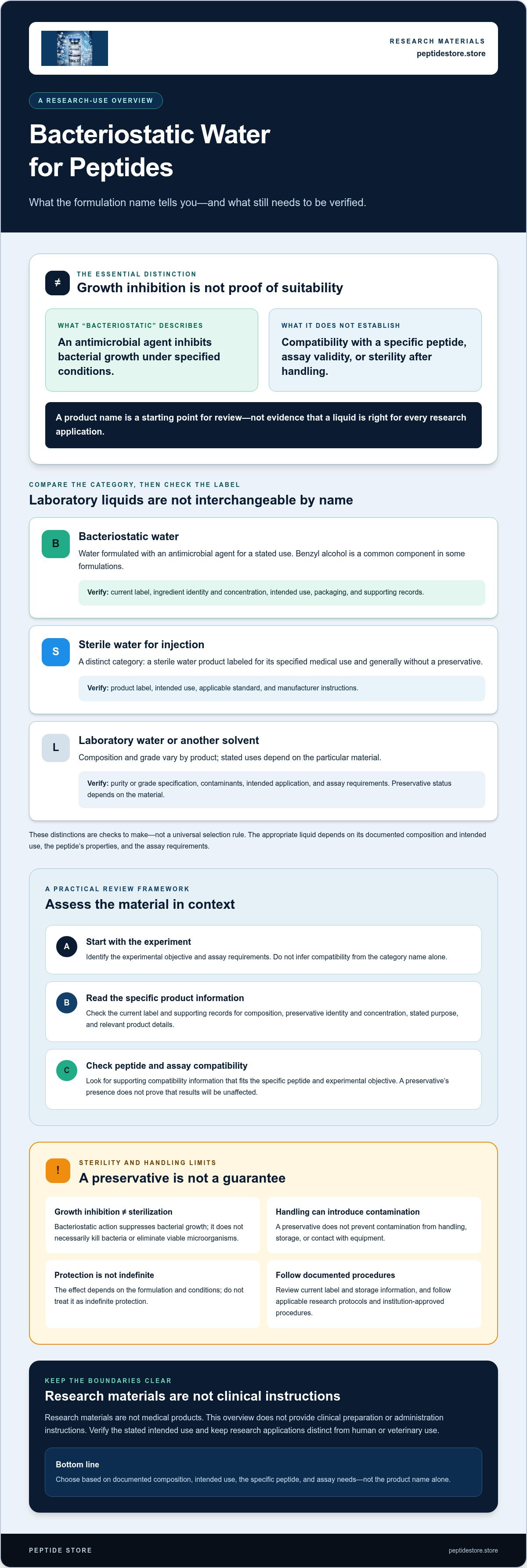
Bacteriostatic water is water formulated with an antimicrobial agent to inhibit bacterial growth under specified conditions. Its defining feature is this preservative function, not universal suitability as a peptide solvent. The phrase bacteriostatic water for peptides describes a possible research-material category, not evidence that a particular formulation is compatible with a specific peptide or assay.
Bacteriostatic action inhibits bacterial growth; it does not guarantee sterility. It also doesn’t establish that a liquid is analytically appropriate or prevent contamination during handling. Before considering a material for an experiment, verify its current label, composition, stated intended use, and fit with the protocol requirements.
The video below is included as general context only. It isn’t a validated research protocol or guidance for human or veterinary use. Follow the applicable research protocol and institutional procedures.
What does bacteriostatic mean in a laboratory context?
A bacteriostatic agent suppresses bacterial growth rather than necessarily killing bacteria. Growth inhibition is not the same as sterilization, which refers to eliminating viable microorganisms. A preservative also doesn’t prevent contamination introduced through handling, storage, or contact with equipment. For a concise overview of the term, see Bacteriostatic agent. Its effect depends on the formulation and conditions, so don’t treat it as indefinite protection or a substitute for controlled laboratory practice.
What does the word water tell researchers, and what doesn’t it tell them?
“Water” identifies the liquid’s general basis, but the name alone doesn’t specify every ingredient, the identity or concentration of a preservative, packaging details, or analytical properties. Check those attributes on the specific product label and in supporting records. Then compare them with the research protocol and the peptide’s properties. Compatibility must be established for the experimental objective, not inferred from a product name. For broader context on research materials and analytical standards, consult the research peptides laboratory guide.
Peptide Store lists Bacteriostatic Water among its research-product offerings. Verify formulation and compatibility details in current product documentation, since a category label is a starting point for review, not a conclusion about suitability.
How Bacteriostatic Water Differs from Sterile Water and Other Solvents
These terms don’t refer to interchangeable versions of the same material. Bacteriostatic water is characterized by an antimicrobial preservative, while sterile water for injection is a distinct category generally labeled without a preservative. “Laboratory water” is broader: its grade and specified uses depend on the product. Check the exact label and applicable standards rather than inferring properties from a category name.
Solvent choice depends on the formulation, peptide, and experimental design. The table below highlights distinctions to verify, not a universal selection rule.
| Material category | Composition and stated purpose | Preservative status | Documentation to verify |
|---|---|---|---|
| Bacteriostatic water | Water formulated for a stated use with an antimicrobial agent | Present; benzyl alcohol is a common component in some formulations | Current label, ingredient identity and concentration, intended use, packaging, and supporting records |
| Sterile water for injection | A sterile water product labeled for its specified medical use | Generally preservative-free | Product label, intended use, applicable standard, and manufacturer instructions |
| Laboratory water or another solvent | Composition and grade vary; specified for defined laboratory applications | Depends on the particular material | Purity or grade specification, contaminants, intended application, and assay requirements |
Bacteriostatic water versus sterile water
The difference is formulation, not a ranking of which liquid is “better.” A preservative may affect an experimental system, while a preservative-free product has different labeling and handling requirements. The U.S. FDA’s FDA Water for Pharmaceutical Use Guide discusses pharmaceutical water classifications, including products for injection. Its medical-product context shouldn’t be treated as instructions for research-grade materials. Confirm each product’s label, stated use, and relevant standard.
Why solvent compatibility depends on the research system
Peptide characteristics, assay conditions, and downstream measurements all inform solvent selection. Assess pH, excipients, and possible preservative sensitivity as variables for the specific system, rather than applying universal rules. For example, a component that doesn’t disrupt one measurement may interfere with another. Base decisions on the approved protocol and supporting literature, and document the rationale so results can be interpreted and reproduced.
Peptide Store lists Bacteriostatic Water among its research-product offerings. Use the research product listings as a category reference, then review current product documentation. The category name alone doesn’t establish compatibility with a peptide or assay.
How to Assess Peptide Compatibility and Product Documentation
Compatibility depends on the peptide and the experimental objective. A label identifying bacteriostatic water doesn’t establish that its formulation will preserve peptide integrity, avoid assay interference, or support a particular analytical endpoint. Treat bacteriostatic water for peptides as a candidate material to evaluate, not a default solvent choice.
Use this non-procedural review before considering a material for a research system:
- Intended use: Confirm the product’s stated application and whether it aligns with the laboratory’s authorized research context.
- Composition: Check the full stated formulation, including preservative identity and concentration when provided. Don’t infer ingredients from the category name.
- Label and traceability: Record product identity, lot information, storage conditions, and any stated limitations.
- Supporting records: Review available specifications, certificates, and test-method details. Confirm what each document covers and whether it applies to the specific lot.
- Protocol fit: Compare product information with the approved protocol, relevant literature, and requirements of the intended assay.
Which label and documentation details should be checked?
Start with the current product label and records for the specific material. Verify its composition, stated intended use, storage conditions, and lot identification. If a certificate, test method, or release specification is referenced, check the underlying product record instead of assuming what it covers or what its results show. Supplier-provided information describes the material; it doesn’t independently establish compatibility with a peptide or research method. Peptide Store product listings are a catalog reference, not evidence of specifications that aren’t listed.
What can alter compatibility or experimental interpretation?
Peptide characteristics interact with solvent composition, assay design, additives, and the measurement endpoint. A preservative may affect some research systems, including a downstream measurement, so assess that possibility against relevant literature or protocol requirements. pH and other formulation components may also matter. Don’t assume a result from one peptide or assay applies to another. Document the selection rationale and any protocol deviations to support reproducibility.
Keep evidence sources distinct. Supplier documentation describes product attributes; independent literature may address effects in a defined experimental system; institutional protocols specify requirements for the work. None replaces the others. If composition or compatibility information is incomplete, record the uncertainty and seek clarification through appropriate research channels before relying on the material.
Research Handling, Storage, and Sterility: Limits to Keep Clear
A preservative is one formulation attribute, not complete assurance about microbial control. For bacteriostatic water for peptides, an antimicrobial agent doesn’t establish sterility after opening, prevent every form of contamination, or validate reuse in a particular research workflow. Base handling and storage decisions on the product record and the institution’s approved procedures.
Use a document-review sequence rather than treating the product name as an instruction:
- Confirm identity: Match the label and lot information to the material under review.
- Check stated use and composition: Review the current label for intended use and formulation details.
- Locate storage and handling requirements: Follow the product-specific information and applicable institutional procedures.
- Verify time limits: Confirm any storage duration, discard timing, or post-opening instructions in authoritative product documentation.
- Resolve gaps: If information is absent or unclear, don’t substitute a general rule for product-specific direction.
Why bacteriostatic does not mean contamination-proof
Bacteriostatic describes inhibition of bacterial growth under specified conditions. It is distinct from sterile manufacture, aseptic technique, and validated storage. A preservative doesn’t establish that a container remains sterile after opening or that handling can’t introduce contamination. Avoid general claims about safe reuse or a universal post-opening period. Check any claim about microbial control against the exact product label and authoritative supporting documentation.
How to treat storage and handling information
Use only the storage conditions stated for the specific product and research setting. Don’t infer refrigeration requirements, shelf life, or a beyond-use date from the product category or from instructions for a different formulation. Institutional procedures may add requirements for the experimental context; follow the approved version relevant to the work. Keep preparation details in the applicable protocol rather than relying on general article guidance.
For traceability, retain the product identity and lot details alongside the relevant label information and protocol version. Record handling or storage deviations through the institution’s established process. This helps distinguish documented product requirements from local procedure and makes later review more reliable.
Review the research product listings as a catalog reference, then verify current product-specific handling and storage details before research use.
Bacteriostatic Water for Peptides: Research-Use Boundaries and Next Steps
A product name is not a compatibility determination. For bacteriostatic water for peptides, the formulation, the specific peptide, and the experimental objective all matter. Catalog availability also doesn’t establish suitability for a particular assay or intended application. Base decisions on current product documentation and validated research protocols, not on the category label alone.
Research-grade materials are not products or instructions for human or veterinary use. This section provides research-evaluation context only; it does not offer therapeutic, clinical, dosing, or self-administration recommendations.
When to consult a protocol, supplier record, or institutional specialist
If compatibility is uncertain, consult the validated protocol and responsible laboratory personnel before selecting a solvent. Review current product records for formulation-specific details, including stated ingredients, intended use, and storage information. Supplier documentation can describe the material, while the protocol and relevant literature address its use in a defined experimental system. If those sources don’t resolve a question, document the uncertainty and seek clarification through appropriate research channels.
Keep the decision traceable. Record which product documentation and protocol version informed the selection, and follow institutional procedures for reviewing deviations. This supports reproducibility and helps distinguish verified product attributes from assumptions about performance or assay outcomes.
Where bacteriostatic water fits in a research catalog
Peptide Store lists Bacteriostatic Water among its research-product offerings and describes its catalog as serving scientific and laboratory applications. That listing is a category reference, not evidence of a specific formulation, testing method, or compatibility with an individual peptide. Verify current product details against the label and relevant records before considering use in a research setting.
For researchers comparing catalog categories, the available research products page is a starting point for reviewing listed materials. Confirm product-specific information and protocol fit independently; a catalog listing cannot replace either.
Make the Next Research Decision with Documentation
Bacteriostatic water for peptides is a formulation category, not a universal solvent recommendation. Its preservative properties don’t establish compatibility with a particular peptide or assay, and they don’t guarantee sterility after handling. Check the current product label and supporting records, then assess them against the specific research protocol and institutional requirements.
Keep the evidence distinct: product documentation describes the material, while relevant literature and approved protocols guide its evaluation in a defined research system. Research-grade materials are not products or instructions for human or veterinary use.
Peptide Store lists Bacteriostatic Water among its offerings and describes its catalog as serving laboratory and scientific applications. Review the catalog as a starting point, then verify product-specific details before making a research decision.
Review the research product catalog and use a documentation-first approach. Careful verification supports clearer, more reproducible research decisions.
Frequently Asked Questions
Is bacteriostatic water the same as sterile water?
No. These names refer to different product categories and may indicate differences in formulation, including whether a preservative is present. Verify the exact composition, intended use, and applicable standards from the specific product’s label and records. Don’t assume instructions for a medical product apply to research-grade materials. For laboratory work, use product information and an institution-approved protocol relevant to the material and experiment.
Can bacteriostatic water be used with any peptide?
No. Compatibility isn’t universal. It can depend on peptide properties, formulation components, assay conditions, and the experimental endpoint. A bacteriostatic designation doesn’t show that the liquid will preserve a peptide’s properties or avoid interference with a measurement. Review current product documentation and relevant literature, then follow a validated research protocol. This is a compatibility assessment, not a mixing procedure or an instruction for human or veterinary use.
Does bacteriostatic water contain benzyl alcohol?
Some bacteriostatic water formulations may contain benzyl alcohol, but confirm the ingredient and its concentration on the particular product label and in supporting records. Don’t infer composition from the category name or assume that every product has the same formulation. For research evaluation, compare verified ingredients with the requirements of the peptide study and assay, and consult the applicable protocol if preservative effects are uncertain.
Does bacteriostatic water keep a peptide solution sterile after opening?
Not necessarily. Bacteriostatic properties refer to inhibiting bacterial growth under specified conditions; they don’t mean sterilization or guarantee that contamination can’t occur during handling. A preservative doesn’t establish a universal period of sterility after opening. Check the specific product’s current label and documentation for applicable handling and discard information, and follow institution-approved procedures for the research setting.
How should researchers choose a solvent for peptide studies?
Assess the peptide, experimental design, assay endpoint, and verified solvent composition together. Formulation components, including preservatives, may affect some research systems, so check relevant considerations in supporting literature and the validated protocol. Confirm the product’s intended use and documentation, then follow institutional requirements. Solvent selection is a research decision; this guidance doesn’t provide preparation, administration, or clinical instructions.
Can research-grade bacteriostatic water be used for human injection?
Research-grade bacteriostatic water isn’t for human or veterinary use. This article doesn’t provide injection, dosing, or self-administration guidance, and a research product label shouldn’t be interpreted as medical authorization. Anyone seeking medical care should consult a licensed healthcare professional about appropriately authorized products and care. Researchers should keep laboratory materials and protocols within their stated research context and institutional requirements.


