
A familiar diluent isn’t automatically suitable for every peptide research protocol. Choosing bac water for peptides requires more than following a general online mixing recipe: the peptide, study requirements, and product specifications must align.
Bacteriostatic water, sterile water, and saline can sound interchangeable, but their composition differs. This article explains the preservative’s role, compares these solution types, and outlines what to verify before laboratory use, including product documentation, lot-specific specifications, and validated handling and disposal procedures. The protocol should determine whether a diluent is appropriate, rather than assuming one option works universally. This guidance is for research and laboratory applications only, not human or animal use.
Key Takeaways
- Determine whether bac water for peptides fits a specific study by starting with the approved laboratory protocol and peptide documentation, not a universal recipe.
- Compare bacteriostatic water, sterile water, and saline by composition and preservative presence, then confirm suitability for the protocol.
- Use a structured verification workflow to check peptide requirements, product specifications, lot documents, and laboratory approval before use.
- Consult the product label, safety documentation, lot records, and laboratory SOPs for handling, storage, and disposal requirements.
- Assess suppliers by product identity, traceability, and available documentation. Distinguish verified lot information from supplier claims.
What Is Bac Water for Peptides & Its Role in Research?
Bacteriostatic water is water formulated with a preservative intended to inhibit microbial growth under specified conditions. “Bacteriostatic” describes an antimicrobial effect; it doesn’t mean the solution kills every microorganism or guarantees sterility after handling. For research, bac water for peptides is a possible diluent only when the compound-specific protocol and product documentation support its use.
Quotable definition: Bacteriostatic water contains an antimicrobial preservative that can limit microbial growth, but that action is distinct from sterilization and doesn’t guarantee that a product or opened container remains sterile.
Bacteriostatic water composition and preservative function
Benzyl alcohol is used as a preservative in some bacteriostatic water formulations. Confirm its presence and concentration on the specific product label or applicable lot documentation; the name alone doesn’t verify composition. Preservative action doesn’t replace sterile manufacturing, documented product specifications, or aseptic laboratory technique. For background on the water component referenced in some formulations, see Water for injection.
Why research protocols specify a particular diluent
A diluent can affect compound behavior, stability, and assay conditions. A solution suitable for one peptide workflow may be unsuitable for another, so neither the term “bacteriostatic” nor an online reconstitution recipe establishes compatibility. Start with the approved laboratory protocol and peptide-specific documentation, then check whether the diluent’s ingredients and specifications meet the experiment’s validated requirements.
For example, a preservative may be relevant to one documented workflow but could affect an assay sensitive to additives. The protocol should account for such variables and define appropriate handling. If the documentation doesn’t identify bacteriostatic water as suitable, don’t infer compatibility from another compound’s procedure. Review the research product catalog and verify the actual product and lot documents independently.
This article addresses laboratory research only, not human or animal use. The next step is protocol verification, not selecting a universal volume or mixing method. Treat any general reconstitution resource as background, and follow your institution’s approved method and product-specific documentation.
How to Assess Whether Bac Water Fits a Peptide Research Protocol
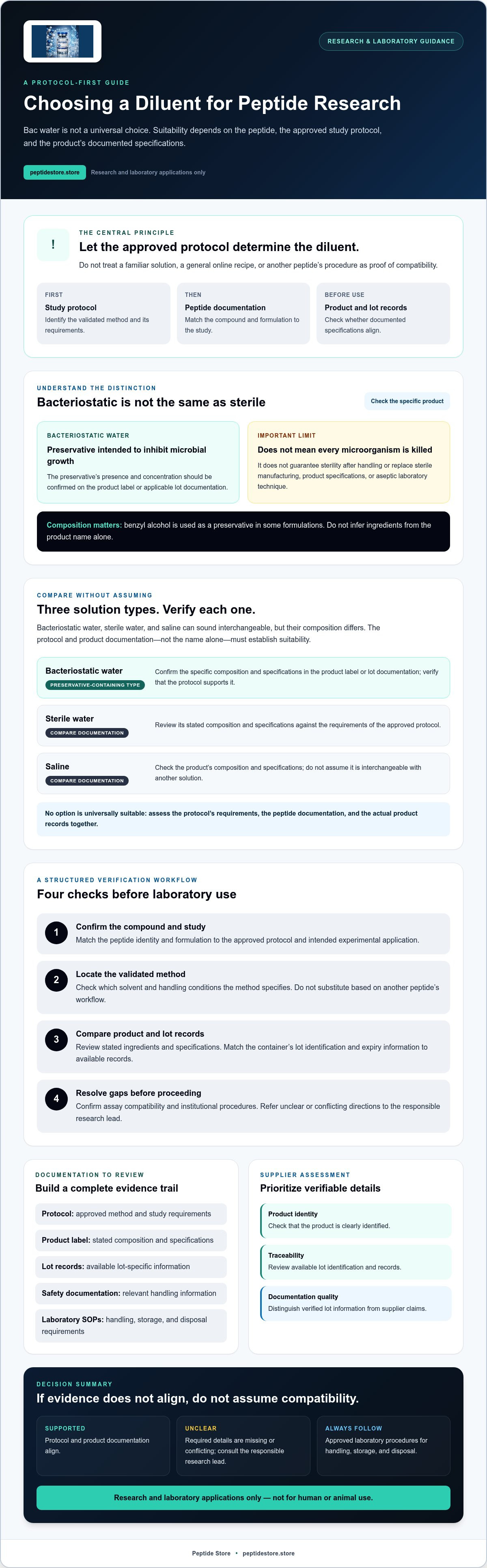
Protocol documents, not generic online ratios, govern diluent selection. Assess the specific compound, experimental conditions, and product documentation before deciding whether bac water for peptides is suitable. This is a verification workflow, not a mixing or administration recipe.
- 1. Confirm the compound and study. Match the peptide identity and formulation to the approved laboratory protocol and intended experimental application.
- 2. Locate the validated method. Check which solvent and handling conditions the protocol specifies. Don’t substitute a diluent based on another peptide’s workflow.
- 3. Compare requirements with product records. Review the stated composition and specifications alongside available lot identification, expiry information, and supporting documentation.
- 4. Resolve gaps before proceeding. Confirm assay compatibility and institutional procedures. Refer unclear or conflicting directions to the responsible research lead.
Verify the peptide and experimental protocol first
Start with primary source documents, not a generalized reconstitution chart. Confirm the exact compound, formulation, and experimental application, then identify the approved solvent and handling conditions in the validated method. These details matter because the experimental design may depend on conditions that aren’t apparent from the peptide name alone. If directions are missing or conflict, pause and ask the responsible research lead to resolve them before laboratory use.
Confirm diluent specifications before laboratory use
Compare the product documentation with the protocol’s requirements. Check the listed ingredients and applicable specifications, and match the container’s lot identification and expiry information to any available records. A product name alone doesn’t establish composition or suitability. If required documentation is unavailable, or its details don’t align with the method, don’t assume compatibility.
Documented procedures remain essential after selection. The laboratory’s SOP should govern handling. Educational resources such as JoVE’s guide to aseptic handling of microorganism-free water can provide context, but don’t replace local requirements. Record the basis for the selection and follow the approved procedure consistently.
For research catalog comparison, review the research product catalog, then assess the actual product and lot documentation against the protocol. Catalog information doesn’t replace laboratory validation or establish compatibility with a particular peptide or assay.
Bac Water vs. Sterile Water and Saline: What Researchers Should Compare
These solutions can look similar, but their formulations differ. Similar appearance doesn’t establish equivalent experimental performance. For bac water for peptides, compare the actual product label and lot documentation with the specific protocol’s requirements. A category name alone doesn’t confirm composition, assay suitability, or intended laboratory role.
| Solution type | Composition and preservative | Protocol-dependent considerations |
|---|---|---|
| Bacteriostatic water | Water with a preservative in some formulations. Verify the preservative identity and concentration on the product documentation. | Determine whether the protocol permits that preservative and whether it could affect the assay conditions. |
| Sterile water | A product category that may lack a preservative; confirm its ingredients and specifications on the label. | Check that the specific product meets the method’s requirements. “Sterile water” alone doesn’t establish compatibility. |
| Saline | A salt-containing solution, distinct from bacteriostatic water. Exact composition and any additional ingredients depend on the product. | Confirm that the protocol allows its formulation and accounts for its constituents in the experimental design. |
Compare composition and intended laboratory role
Use the table as a screening aid, not a selection rule. Bacteriostatic water is identified by its documented preservative content; sterile water and saline must also be assessed using the specific product’s label and supporting records. Formulations can vary, so don’t assume every product within a category has identical ingredients or specifications. The method should identify the required solution or define acceptable alternatives.
Why substitutes can affect experimental interpretation
Solvent composition may influence solubility or assay conditions, but the direction and significance of any effect depend on the compound and experimental design. Substituting a solution without protocol approval can introduce a variable that complicates interpretation, even if the substitute appears similar. Don’t infer equivalent performance from appearance, a shared base ingredient, or a procedure used with another peptide.
If a substitution is necessary, obtain approval through the laboratory’s established review process and document the rationale, product identity, lot, and protocol change before the experiment begins. This record helps distinguish results obtained under the original method from those generated with an approved alternative. No solution is universally safer, more effective, or compatible across all research workflows.
Laboratory Handling, Documentation, and Storage Checks for Bac Water
For laboratory use, a product name is only the starting point. Before selecting bac water for peptides, confirm that its documented identity and handling requirements match the approved protocol. Keep the product label, available lot records, safety documentation, and applicable laboratory SOPs together so the material can be traced and managed consistently.
Pre-use documentation checklist
Review the records before introducing the material into a workflow. Verify:
- Product identity and composition: Match the label to the material specified by the protocol. Confirm any preservative or other listed ingredient against product documentation rather than inferring composition from the name.
- Lot and expiry: Record the lot number and expiry information, and check that the container details match any supplied quality documents.
- Supporting evidence: If testing, sterility, or certification is claimed, check whether the supporting evidence is current, relevant to the product, and specific to the lot where applicable. A general supplier statement doesn’t establish a lot-specific result.
- Protocol fit: Compare the documented specifications with the approved method and institutional procedures. Record discrepancies and seek clarification before use.
Leave missing, mismatched, or unclear information unresolved until the appropriate laboratory lead or supplier clarifies it. Don’t fill documentation gaps with assumptions.
Post-opening handling and storage checklist
After opening, follow the product’s verified instructions and the laboratory SOP. Avoid applying a universal storage temperature, post-opening period, or discard date. These depend on the applicable product documentation and validated procedure.
- Inspect container and closure integrity before use. If the container appears compromised or contamination is suspected, follow the laboratory procedure for affected materials.
- Record the vial identity and opening date in the designated log or on the container, as required by SOP.
- Document relevant handling events and maintain traceability between the vial, lot records, and experimental record.
- Store the material under the conditions stated in verified product instructions and laboratory procedures.
- Determine discard and disposal requirements from the SOP and product documentation. Record disposal as required by institutional practice.
These records support consistent handling without substituting general internet advice for validated instructions. Peptide Store lists bacteriostatic water among its research product offerings. Researchers can review the bacteriostatic water listing and assess the actual product documentation and lot information before use.
Choosing a Research Supplier for Bac Water and Taking the Next Step
Supplier selection is a documentation review, not a substitute for protocol validation. For bac water for peptides, assess whether the supplier identifies the material clearly, provides traceable lot information, and distinguishes documented specifications from general product claims. Then confirm that the material meets your institution’s procurement requirements and the approved experimental method.
Questions to ask before procurement
- Is the product identity clear? Check whether the listing and product label identify the material, and whether its exact composition is documented. Don’t infer ingredients or concentration from the product name.
- Can the lot be traced? Confirm that the container has a lot identifier and expiry information, and ask what lot-specific records are available for review.
- Are claims supported? If the supplier describes testing, sterility, certification, or quality status, distinguish that statement from evidence. Review the actual supporting documents and check whether they apply to the product and lot under consideration.
- Are handling details available? Check for product-specific storage and handling instructions, then compare them with laboratory SOPs and procurement criteria.
- Does it meet institutional requirements? Confirm that the product and its documentation satisfy purchasing controls and the specific protocol before ordering or incorporating it into a study.
Keep supplier statements separate from verified records. A catalog description can help identify a listed offering, but it doesn’t establish lot suitability, assay compatibility, or compliance with institutional requirements. If records are unavailable, incomplete, or inconsistent, request clarification and document the issue before procurement proceeds.
Research-only scope and responsible next steps
This article provides general information for research and laboratory contexts. It is not medical advice or an instruction for human or animal use. It doesn’t replace a validated protocol or establish a universal reconstitution procedure. Refer uncertainties about a compound, diluent, or assay to the principal investigator or qualified laboratory lead, who can determine whether the available documentation supports the planned work.
Peptide Store lists bacteriostatic water among its offerings, but product specifications aren’t established here. Researchers can review the current product catalog, then evaluate the relevant product label and actual lot documents against their protocol and procurement requirements. Contact the supplier to request clarification about available documentation before making a selection.
Make Protocol Fit the Final Selection Criteria
Choosing bac water for peptides is a protocol-specific decision, not a universal recipe. Confirm the peptide documentation and approved method, compare the diluent’s documented composition with assay requirements, and follow institutional handling and disposal procedures. Bacteriostatic action doesn’t establish compatibility or guarantee sterility after handling.
Peptide Store identifies its products as research-grade materials for scientific and laboratory applications and lists bacteriostatic water among its offerings. These statements don’t verify the specifications of a particular product or lot. Review current product information and assess applicable lot documentation before procurement; refer protocol questions to the principal investigator or qualified laboratory lead.
Review the research product catalog to see current listed offerings, then verify their documented suitability for your laboratory requirements. A careful, evidence-based selection supports clearer and more reproducible research decisions.
Frequently Asked Questions
What is bac water for peptides?
Bac water for peptides refers to bacteriostatic water considered as a possible diluent in a research-laboratory protocol. It contains a preservative, commonly benzyl alcohol when confirmed by the specific product documentation. “Bacteriostatic” describes an action that inhibits microbial growth under specified conditions; it doesn’t mean the solution is sterile or guarantee sterility after handling. The term alone also doesn’t confirm compatibility with a particular peptide, assay, or experimental method.
Is bacteriostatic water the same as sterile water?
No. The terms describe different characteristics. Bacteriostatic water includes a preservative, while “sterile” describes a sterility claim for a specific product. Neither term alone establishes that one solution can replace the other in a research method. Compare the exact composition and product documentation with the approved protocol’s requirements. Formulation and intended use may differ between products, so confirm details on the label and applicable documentation before laboratory use.
Can bacteriostatic water be used with every peptide?
No. Compatibility can’t be assumed across peptides or experimental methods. Suitability depends on the compound-specific documentation, validated protocol, assay requirements, and the diluent’s documented specifications. Don’t borrow another peptide’s procedure or rely on a generic online recipe to fill gaps. If directions are missing or conflict, pause and consult the principal investigator or qualified laboratory lead before selecting a diluent for the research workflow.
How much bac water should be used for a peptide?
There’s no universal volume or concentration to apply across peptides and research protocols. Any required amount must come from the validated, compound-specific laboratory method and reflect the experiment’s requirements. This article doesn’t provide a mixing calculation, clinical reconstitution instructions, or dosing guidance. Refer to approved protocol documents and peptide-specific records; if they don’t specify a clear method, seek direction from the responsible laboratory lead before proceeding.
Does bacteriostatic water contain benzyl alcohol?
Benzyl alcohol is commonly used as the preservative in bacteriostatic water, but the exact composition and concentration must be verified for the specific product. Check its label and supporting documentation rather than treating a general description as a guaranteed specification. The presence of a preservative doesn’t establish that the solution is compatible with a particular peptide or assay. Confirm suitability against the approved protocol and applicable laboratory requirements.
How should researchers store opened bacteriostatic water?
Follow the verified product label, applicable laboratory SOP, and validated protocol. Storage conditions and discard instructions are product- and procedure-dependent, so don’t apply a universal temperature or post-opening period. Record the vial identity, opening date, and relevant handling events as required by laboratory procedures. Inspect the container and follow institutional instructions for compromised or potentially contaminated materials, storage, and disposal.
What should a laboratory verify before purchasing bacteriostatic water?
Check the product identity, documented composition, lot number, expiry information, available quality records, and handling instructions. Compare these details with the approved protocol and institutional procurement requirements. Treat general supplier statements as claims to assess, not as lot-specific evidence; confirm that any certificate or testing claim is supported by applicable documentation. If information is missing or inconsistent, request clarification before procurement or use in an experiment.
Review Peptide Store’s current research product catalog, then check the relevant product and lot documentation against your laboratory protocol and procurement requirements.


