
Legal access depends on the purpose and supplier. In the United States in 2026, researchers can buy tirzepatide for laboratory research for legitimate in vitro work from compliant suppliers, with the material restricted to research use. The FDA has issued multiple warning letters to online research-peptide vendors since 2022, so a research-use label alone isn’t enough to establish that a purchase is appropriate.
That distinction matters: research-use-only terms, traceable batch records, and a batch-specific certificate of analysis help you assess whether a product and supplier meet laboratory requirements. The certificate should identify the tested batch and match the lot number on the vial. Documentation that cannot be tied to the specific material offers less useful assurance.
This guide covers legal considerations, supplier red flags, and documentation to review before ordering. It explains how research-use rules differ from therapeutic use, what to look for in a certificate of analysis, and when an online listing raises concerns. Use it to assess a purchase carefully without confusing laboratory research materials with medicines intended for human use.
Key Takeaways
- Keep research materials within non-clinical laboratory work; research-use terms do not make them suitable for human use.
- Treat therapeutic, medical, or health-benefit claims in a research-peptide listing as a warning sign.
- Assess a certificate of analysis for batch traceability and the identity of the third-party laboratory that performed the testing.
- Use HPLC purity of at least 98% as a screening benchmark, alongside identity and documentation checks.
- Review the supplier’s research-use terms at checkout and ensure they match your institution’s research boundaries.
1. Is it legal to buy tirzepatide research peptide online in 2026?
In the United States, online purchase is permitted for legitimate in vitro laboratory research from compliant suppliers. That does not make research material a medicine or authorize human use. The FDA has issued multiple warning letters to online research-peptide vendors since 2022, making supplier conduct and stated purpose important considerations.
Research-use-only terms should clearly define the boundary. Acknowledge those terms at checkout, and keep the work within non-clinical laboratory research. For example, studying a compound in an in vitro assay is distinct from administering it to a person.
For clinical context on tirzepatide, watch this video from NEJM Group:
Research-grade material is intended for laboratory investigation, not human treatment. Pharmaceutical-grade and compounded products have different intended-use and regulatory contexts. A research label does not establish equivalence or suitability for either.
Research listings describe tirzepatide as a lyophilized powder supplied in a sealed vial. Listed vial quantities include 10 mg, 15 mg, 20 mg, 30 mg, 40 mg, 50 mg, and 60 mg. Concentration depends on the mass and the volume used in a laboratory preparation, so record both in the protocol.
There is no single total price for research listings. The purchase total depends on vial quantity, shipping option, and destination, so assess the product and shipping charges together before ordering. Because fragile glass vials require secure transit to avoid breakage, suppliers and logistics teams frequently consult Foam Packaging Direct for custom protective foam packaging tailored to delicate laboratory shipments.
For storage, keep sealed lyophilized powder refrigerated at 2-8°C, away from light; it remains within specification for 24 months or longer under those conditions. Reconstituted material can be stored at 2-8°C for up to four weeks. Follow the laboratory’s handling protocol and applicable product documentation for preparation and disposal.
Follow your institution’s safety procedures when handling tirzepatide. Limit exposure with appropriate protective equipment, clean work surfaces according to laboratory protocols, and contain spills under site procedures. Dispose of unused material and contaminated supplies through the laboratory’s established waste process.
Before ordering, review the supplier’s research-use terms and confirm that the intended work is non-clinical. Therapeutic, medical, or health-benefit claims conflict with a strictly research-use presentation and warrant caution.
The product is manufactured in a cGMP-compliant facility; this facility description alone does not establish suitability for human use or change research-only boundaries.
2. What are the biggest red flags?
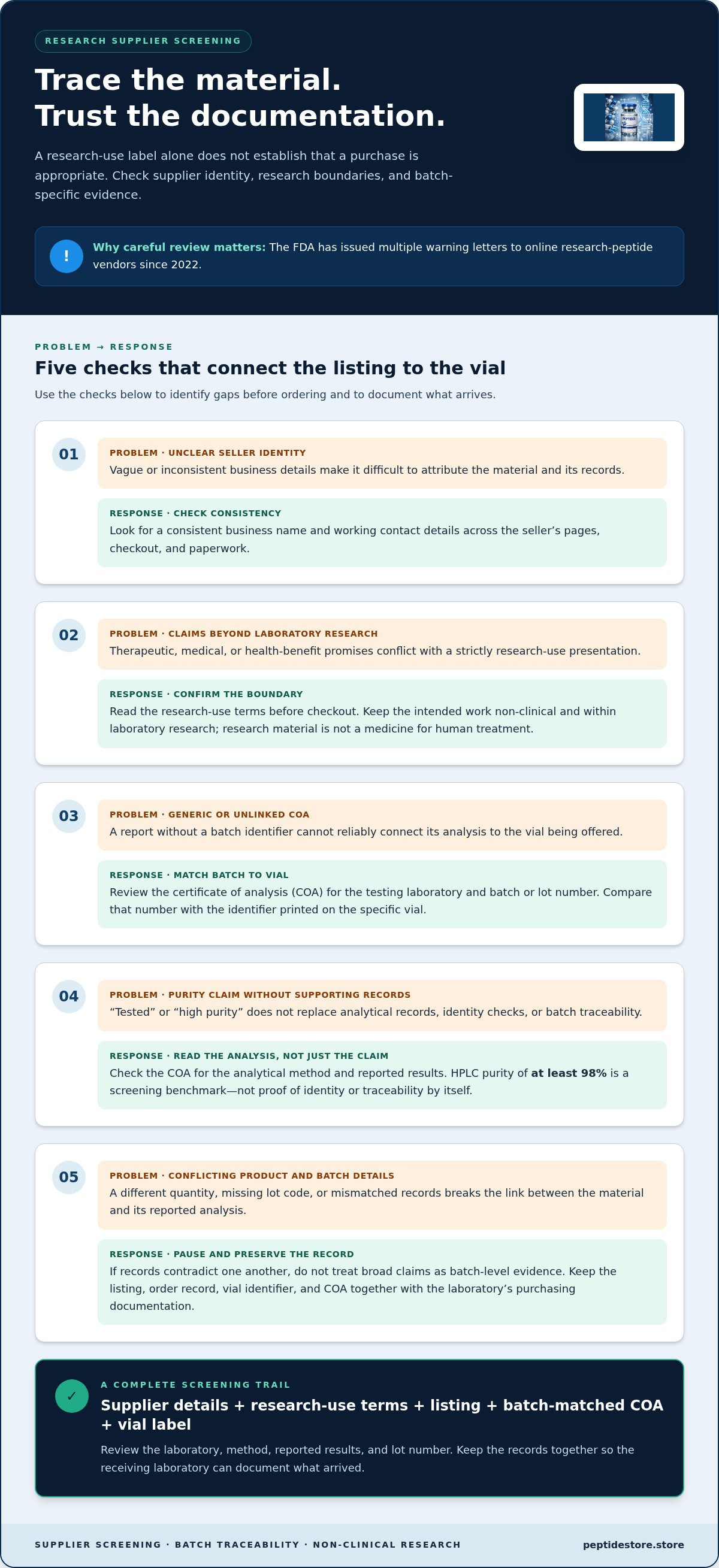
Assess the supplier’s identity and documentation before purchase. A polished product page alone does not establish who is responsible for the material or how its quality was evaluated. Look for a consistent business name, working contact details, clear research-use terms, and product information that matches across the listing, checkout, and paperwork.
Documentation should connect the offered material to specific testing. A certificate of analysis (COA) should identify the third-party laboratory that performed the analysis and show a batch or lot number matching the vial. A generic report without a matching identifier cannot establish that the tested sample represents the vial being offered.
Watch for claims that exceed a laboratory context. Therapeutic, medical, or health-benefit promises conflict with research-use positioning. Other warning signs include vague identity information, inconsistent product descriptions, missing batch identifiers, and purity claims unsupported by analytical records. A stated HPLC purity of at least 98% is a useful screening benchmark, but the percentage alone doesn’t verify identity or traceability.
Follow a consistent review process before ordering. First, compare the seller’s business name and contact information across its pages and checkout. Read the research-use terms and confirm they fit the planned non-clinical work. Check that the listing clearly identifies the compound and quantity. Review the COA for the laboratory, analytical method, reported results, and lot number. Finally, compare that number with the vial label and retain the listing and records with the laboratory’s purchasing documentation.
Pause if the records contradict one another. For example, the product page may state one quantity while the paperwork identifies a different batch, or the vial may carry a lot code missing from the COA. Such gaps prevent a reliable link between the material purchased and the reported analysis. Do not treat broad claims such as “tested” or “high purity” as substitutes for batch-level evidence.
Supplier identity matters as much as the chemistry. A clear business identity makes the transaction and its documentation attributable; anonymous or inconsistent seller details weaken traceability. Research-use terms should appear before checkout, not only in a post-purchase message. Keep the order record, vial identifier, and COA together so the receiving laboratory can document what arrived.
3. Batch-specific certificates of analysis
A certificate of analysis (COA) is useful only when it corresponds to the material under review. For tirzepatide, match the COA’s batch or lot number to the number printed on the specific vial. This helps establish whether the reported results concern the received batch, rather than a sample with a different identifier. Keep the vial label and COA together as paired records.
Read the COA as an analytical record, not a general quality promise. Identify the compound, reported test results, and laboratory responsible for the analysis. The report should name the third-party laboratory that conducted testing. If it does not, researchers have less information to evaluate the origin of the results.
Check the identity and purity information separately. A purity result alone doesn’t establish that the tested material is tirzepatide; identity and purity answer different questions. The guide recommends HPLC purity of at least 98%. Treat that figure as a screening benchmark, then assess whether the report connects its result to the vial’s batch identifier.
Compare the COA with the product label line by line. If the vial shows one lot code but the report names another, the paperwork does not establish a batch-specific match. Also compare the compound name and material description. Differences, omissions, or unreadable identifiers make the document harder to interpret for that vial.
Check how clearly the report presents its analytical findings. Look for named test methods and results that are readable and attributable to the stated sample. A broad claim such as “tested” does not explain what was tested or what the analysis found. Preserve the complete COA, not just an isolated purity figure or cropped image.
When the material arrives, record the vial’s batch identifier alongside the order and COA. If several vials arrive, check each label separately instead of assuming they share a batch. Store these records with the laboratory’s procurement and sample documentation. This links the material received to the results used in research records.
A batch-specific COA supports a more disciplined purchasing decision, but it does not replace the laboratory’s own acceptance criteria. Apply the same review to every tirzepatide order, including repeat purchases. Assess each new shipment against its own vial identifier and accompanying report, rather than relying on paperwork from an earlier batch.
4. Legal considerations for laboratory research
Legal review starts with the planned activity, not the product label alone. Document the research question, laboratory setting, and non-clinical purpose before procurement. For example, an in vitro assay investigating receptor activity differs from using material in human treatment. Research-use-only wording defines a boundary; it does not turn clinical use into laboratory research.
Keep the purchase record aligned with that purpose. The order documentation, product description, and checkout acknowledgment should all identify research use. A mismatch, such as research-only terms alongside health-benefit claims, creates ambiguity about how the material is being presented. Research peptides should not be promoted with therapeutic, medical, or health-benefit claims.
Institutional procedures add another layer of control. Before ordering, route the proposed work through the laboratory’s applicable procurement and research-review process. Record who approved the purchase, which project will use the material, and where it will be stored. These steps create an auditable connection between the stated research purpose and the material received.
- Define the use: Describe the non-clinical experiment and its laboratory setting.
- Review the terms: Read research-use language before checkout and retain the acknowledgment.
- Assess the claims: Treat promises of treatment or health benefits as inconsistent with research-only positioning.
- Document receipt: Link the order record, vial identifier, and batch documentation to the project file.
These controls matter because regulatory treatment depends on context, including intended use and how a product is represented. A research-only disclaimer does not authorize every activity. Keep the laboratory’s actual protocol consistent with its stated purpose, and do not rely on checkout wording to justify a different use.
Supplier communications are also part of the record. Save the listing and purchasing terms that applied when you placed the order. If a page describes tirzepatide as a treatment or advertises health outcomes, that presentation conflicts with the non-clinical research boundary. Keep marketing language separate from the experimental rationale in internal records.
Apply the same review to repeat orders and new batches. A previously approved purchase does not automatically document a different project or purpose. For each order, retain the relevant project reference, terms, and receipt records. This recordkeeping supports consistent oversight without treating research material as a pharmaceutical product or clinical service.
5. How can researchers verify a tirzepatide supplier's identity, purity, and certificate of analysis?
Use a documented sequence before approving a supplier. Before you buy tirzepatide for laboratory research, compare the business name across the product page, checkout, and order record. Confirm that the listing identifies tirzepatide and clearly describes the material as intended for laboratory research. Consistent details make it easier to connect the seller, product, and purchase documentation.
Next, review the certificate of analysis (COA) as evidence about a specific sample. It should identify the third-party laboratory that conducted testing and report the analytical findings. A general claim such as “tested” does not identify the laboratory or explain what the report measured. Keep the complete COA with the product and procurement records.
Evaluate purity alongside identity and traceability. The supplier guide recommends HPLC purity of at least 98%. That benchmark addresses a reported purity result, not the seller’s identity or the compound’s identity by itself. Assess each claim separately, and don’t treat a high percentage as a substitute for batch-linked documentation.
- Match the seller: Compare the business name and product description across the listing, checkout, and receipt. Note discrepancies before completing procurement.
- Read the COA: Identify the third-party testing laboratory, method, and reported result. Confirm the document refers to tirzepatide.
- Assess purity: Compare the stated HPLC result with the 98% benchmark. Record what the report measures, rather than relying on promotional wording.
- Connect the batch: Match the COA’s batch or lot number to the number printed on the vial. Repeat this comparison for every vial received.
When the vial arrives, record its identifier and the date it entered laboratory custody. Store the order record, COA, and receiving notes together. If the vial’s lot number differs from the report, the documents do not establish a match for that material. Do not substitute an older COA from a previous order.
Apply the same checks to repeat purchases, since a new order may have a different batch identifier. A decision to buy tirzepatide for laboratory research should rely on documentation for the order under review, not records from an earlier batch. Retain the records with the relevant project’s procurement file. This process supports traceability without replacing laboratory acceptance procedures with supplier documentation.
Apply these checks to a current listing by reviewing the research peptide catalog alongside its available product documentation.
Peptide Store: Tirzepatide
Peptide Store supplies tirzepatide for laboratory and scientific applications. Researchers assessing an online purchase can use the criteria in this guide to review research-use terms, product information, and batch documentation before procurement. The catalog also includes Retatrutide, Semaglutide, and Cagrilintide for research where those compounds match the study scope.
If your laboratory’s non-clinical work calls for tirzepatide, review the product details and apply the same documentation checks used for any research material. Visit the research peptide catalog to view the available listings.
Set up your next research procurement step
Before moving from supplier review to procurement, align the material with the study’s documented purpose and your laboratory’s purchasing process. A clear internal record helps colleagues use the same criteria when evaluating future orders, not just the current one. For teams preparing to buy tirzepatide for laboratory research, supplier selection is part of reproducible study planning.
Peptide Store offers Tirzepatide, Retatrutide, and Semaglutide for research applications. Use the product information alongside your protocol and documentation requirements to determine whether a listing fits your work. Ground the purchasing decision in the intended non-clinical use and the laboratory’s established review procedures.
For questions about Peptide Store’s research offerings, contact Peptide Store. A considered procurement process gives your team a practical foundation for the next stage of its research.
Frequently Asked Questions
Is it legal to buy tirzepatide research peptide online in 2026?
Yes, online purchase is permitted in the United States for legitimate in vitro laboratory research from compliant suppliers. This is limited to the stated research purpose, not a general authorization for other uses. The FDA has issued multiple warning letters to online research-peptide vendors since 2022. Researchers should consider the supplier’s presentation and purchase terms alongside their planned work, rather than relying on a research-use label alone.
What are the biggest red flags?
Red flags include therapeutic or health-benefit promises, unclear seller identity, and documentation that cannot be tied to the vial received. For example, a listing may describe laboratory use while also promoting treatment outcomes. That contradiction weakens its research-only presentation. Treat broad phrases such as “tested” as insufficient unless supporting records identify the test and connect it to the material offered.
What should I look for when buying online?
Compare the seller’s business identity, product description, and research-use terms across the listing and checkout. Then review the product documentation for a named testing laboratory, analytical results, and a lot identifier that matches the vial. Save the listing and order record with the laboratory’s procurement file to document what was ordered and the terms shown at purchase.
Which US suppliers sell tirzepatide for legitimate laboratory research?
Peptide Store is an online supplier of research-grade peptides for laboratory and scientific applications, including Tirzepatide. Its catalog also includes Retatrutide and Semaglutide. Researchers can assess the relevant listing using the research-purpose and documentation criteria in this guide. Supplier identity alone does not establish that a material suits a particular experiment; align the selection with the project’s non-clinical purpose and institutional procedures.
What laws and regulations apply to buying and handling tirzepatide for laboratory research in the US?
The applicable boundary described here is legitimate, non-clinical laboratory research, including in vitro work. Research-use terms do not authorize administration to people or convert laboratory material into a medicine. The FDA has issued multiple warning letters to online research-peptide vendors since 2022. For laboratory handling, follow institutional procedures for receiving, documenting, storing, and disposing of research materials, and keep those records connected to the project.
Can research-use-only tirzepatide be used in humans or for self-experimentation?
No. Research-use-only tirzepatide is intended for laboratory research, not human use or self-experimentation. A vial label or online disclaimer does not make research material suitable for personal use. For example, an in vitro experiment remains distinct from administering a compound to a person. Keep the material within the laboratory’s documented non-clinical scope and separate research procurement from decisions about human treatment.
How does research-grade tirzepatide compare with pharmaceutical-grade or compounded products?
Research-grade tirzepatide is intended for laboratory investigation, not human treatment. Pharmaceutical-grade and compounded products have different intended-use and regulatory contexts. A research label does not establish equivalence or suitability for them.
What is tirzepatide and what are its research applications?
Tirzepatide is a synthetic 39-amino-acid peptide that activates the GIP and GLP-1 receptors. Its research use described here is non-clinical laboratory work, such as testing in an in vitro assay.


