
Semaglutide’s research significance extends beyond glucose control. Research on semaglutide for metabolic studies examines glucose and lipid markers alongside weight, cardiovascular and kidney outcomes, while comparing injectable and oral formulations. Its clinical trajectory reflects a broader shift: semaglutide launched as Ozempic for type 2 diabetes in 2017 and as Wegovy for obesity in 2021.
This growth makes it important to interpret findings by outcome and formulation, rather than treating all semaglutide studies as interchangeable. Changes in fasting glucose or blood lipids address different questions from cardiovascular events, kidney markers, or liver outcomes.
This guide explains how researchers assess these endpoints, what comparative findings show, and how oral absorption differs from injectable delivery. It also outlines the clinical uses that have shaped semaglutide research and distinguishes clinical evidence from laboratory investigation.
Key Takeaways
- Separate weight-loss-mediated effects from potential effects on metabolic pathways that may occur independently of weight change.
- Interpret glucose and lipid measurements in the context of the study groups; one study reported LDL-C of 3.65 in its high-fat-diet group and 2.81 in its semaglutide-treated high-fat-diet group.
- Assess cardiovascular and kidney outcomes as distinct endpoints, including event rates, blood pressure, and markers of kidney disease.
- Account for formulation when comparing findings: oral semaglutide has 1-2% bioavailability, unlike subcutaneous delivery.
- Connect semaglutide’s development for type 2 diabetes and obesity with the range of clinical outcomes examined in research.
Semaglutide: a game changer for metabolic diseases?
Semaglutide research examines weight loss alongside metabolic and cardiovascular effects that may occur through other pathways. In people with type 2 diabetes, comparative studies reported different mean weight reductions for injectable and oral formulations.
For an overview of semaglutide’s pharmacology and mechanisms of action, watch this animation from Alila Medical Media.
Weight-Loss-Mediated and Independent Effects
Weight-loss-mediated effects accompany reduced body weight, while weight-loss-independent effects arise through other biological pathways. Separating these effects helps researchers interpret whether a measured change reflects weight reduction, direct drug activity, or both. An interview identified up to 10 pathways that could influence obesity and cardiovascular disease. That breadth makes it important to assess specific outcomes rather than treating every metabolic change as evidence of one mechanism.
Weight and Metabolic Changes
Weight and metabolic changes include shifts in body mass and markers such as glucose control. In comparative studies involving people with type 2 diabetes, injectable semaglutide 1 mg once weekly was associated with mean weight reduction of 6.5 kg; once-daily oral semaglutide was associated with 4.5 kg. These results describe different formulations and study comparisons. They help frame weight loss as one outcome, not a substitute for assessing metabolic function separately.
Clinical Risks and Side Effects
Clinical risks include adverse events and contraindications that shape how trial findings apply. In the SUSTAIN program, gallbladder adverse events occurred in 1.4% of people treated with injectable semaglutide and 1.9% of the placebo group. In the United States, semaglutide is contraindicated for people with a personal or family history of medullary thyroid cancer or multiple endocrine neoplasia type 2. These facts matter when interpreting safety outcomes alongside metabolic effects.
Research Limitations and Evidence Gaps
Research limitations arise when study populations, formulations, or measured outcomes differ. Weight loss can occur alongside changes in glucose and cardiovascular markers, making independent drug effects difficult to distinguish from changes associated with lower weight. Comparative findings in people with type 2 diabetes also may not represent every population or research setting. Researchers therefore need to examine study design, baseline characteristics, treatment formulation, and endpoint selection before drawing broader conclusions.
Lifestyle factors also affect how weight-loss findings are interpreted. The interview recommends combining weight-loss drugs with improved diet and exercise, and pairing resistance training with a protein-rich diet to address muscle-loss risk. In study design, record these factors alongside weight and metabolic measurements. This helps separate treatment-associated changes from differences in activity or nutrition and keeps the analysis focused on relevant outcomes.
Blood lipid and fasting glucose measurements
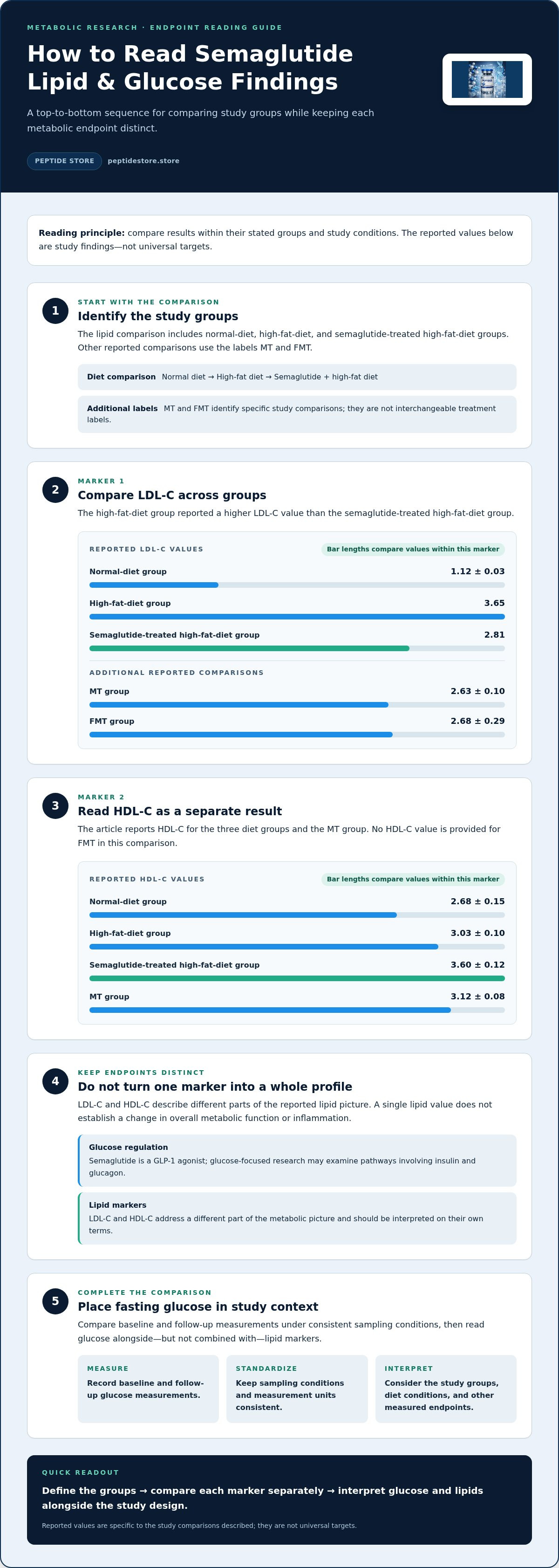
Blood lipids and fasting glucose offer distinct perspectives on metabolic change. In one study, lipid values differed among the normal-diet, high-fat-diet, and semaglutide-treated high-fat-diet groups. Comparing these groups helps researchers assess whether an intervention’s effects extend beyond glucose regulation in diabetes.
For LDL-C, the high-fat-diet group measured 3.65, while the semaglutide high-fat-diet group measured 2.81. The normal-diet group measured 1.12 ± 0.03. HDL-C measured 2.68 ± 0.15 in the normal-diet group, 3.03 ± 0.10 in the high-fat-diet group, and 3.60 ± 0.12 in the semaglutide high-fat-diet group. These values are study-group results, not universal targets.
Other comparisons help distinguish treatment effects from changes associated with diet or related interventions. The MT group had LDL-C of 2.63 ± 0.10 and HDL-C of 3.12 ± 0.08. The FMT group had LDL-C of 2.68 ± 0.29. Read these values alongside the group definitions and study methods; labels such as MT and FMT identify comparisons, not interchangeable treatments.
Fasting glucose analysis also requires consistent comparisons. Researchers can record baseline and follow-up measurements, then interpret changes alongside lipid markers and diet groups. Consistent sampling conditions and measurement units make comparisons more meaningful. A glucose result alone cannot describe the full metabolic profile, just as LDL-C or HDL-C alone cannot establish a change in overall function.
Semaglutide is a GLP-1 agonist, so glucose-focused research may also examine pathways involving insulin and glucagon. These markers can help characterize glucose regulation, while lipid measurements address a different part of the metabolic picture. Researchers should keep each endpoint distinct rather than combining glucose, glucagon, LDL-C, and HDL-C into one broad measure.
Inflammation may also be relevant to metabolic research, but it requires its own defined marker and analysis. A change in a lipid value does not, by itself, demonstrate an effect on inflammation. Likewise, an approved clinical use does not make every laboratory endpoint an established clinical outcome. Oral semaglutide was FDA-approved in 2019, while injectable semaglutide was FDA-approved in 2017; formulation and study design remain important context.
For practical interpretation, compare each group with its stated reference, retain the reported precision, and note the study population and diet conditions. The values above illustrate why: semaglutide-treated and untreated high-fat-diet groups differ in both LDL-C and HDL-C, while normal-diet results offer another point of comparison. This approach helps readers judge what the measurements support without treating one marker as a complete account of metabolic effects.
Cardiovascular and kidney benefits
Semaglutide studies assess cardiovascular and kidney outcomes alongside glucose-related measures. These endpoints address different aspects of efficacy: cardiovascular trials record major events, while kidney analyses examine renal function and nephropathy. The GLP-1 receptor mechanism provides biological context, but outcome data must be interpreted through each trial’s design and enrolled population.
In SUSTAIN 6, semaglutide reduced major adverse cardiovascular events, with a hazard ratio of 0.74. The trial enrolled 3,297 participants, and 83% had established cardiovascular disease, chronic kidney disease, or both. That high-risk population matters when interpreting the result. It describes evidence from people with substantial baseline risk, rather than establishing an identical effect across every population or clinical setting.
Blood pressure provides another cardiovascular measurement. Across SUSTAIN 6 and PIONEER 6, semaglutide reduced mean systolic blood pressure by 2.6 mmHg. This is a measured intermediate outcome, distinct from major cardiovascular events. Researchers should keep both endpoints visible: blood pressure captures one physiological measure, while event analyses evaluate outcomes such as cardiovascular complications.
Kidney findings require similarly careful separation. In SUSTAIN 6, semaglutide reduced progression or new onset of nephropathy, mainly through improved albuminuria, with a hazard ratio of 0.64. Albuminuria is a kidney-related marker; it is not identical to overall renal function. Reporting the specific endpoint clarifies what changed and prevents a marker result from being mistaken for a broad functional assessment.
PIONEER 5 illustrates why trial outcomes should not be collapsed into one conclusion. This study evaluated oral semaglutide 14 mg once daily against placebo in 324 people with type 2 diabetes and moderate renal impairment. Treatment lasted 26 weeks, and researchers observed no change in renal function between the semaglutide and placebo groups. This finding concerns renal function during that trial period, not every kidney outcome.
In the United States, semaglutide has been approved by the FDA to reduce cardiovascular risk. Approval and trial findings answer related but distinct questions: approval identifies a clinical use, while individual studies report defined outcomes in selected populations. For metabolic research, record whether the endpoint is cardiovascular events, systolic blood pressure, albuminuria, or renal function. Also retain formulation and population details, since PIONEER 5 assessed oral treatment in participants with moderate renal impairment.
Glucose control remains part of this broader clinical picture, but cardiovascular and kidney outcomes should stand on their own in analysis. SUSTAIN 6 reports both cardiovascular and nephropathy findings, whereas PIONEER 5 reports a renal-function comparison over 26 weeks. Keeping each trial, endpoint, and population distinct makes evidence easier to interpret without treating one result as proof of every possible benefit.
Oral semaglutide absorption and formulation
Semaglutide is a peptide available in oral and subcutaneous formulations, with markedly different absorption. Oral bioavailability is 1-2%, while subcutaneous bioavailability is 89%. This contrast matters when interpreting exposure, dose, and metabolic outcomes across clinical trials. An obesity study using one formulation cannot be directly compared with another without accounting for route and protocol.
In metabolic studies, administration follows the trial protocol, while monitoring tracks outcomes such as body weight, glucose, and relevant safety measures. Oral regimens are taken once daily, while injectable regimens are taken once weekly. Researchers document formulation and timing to interpret observed changes against the correct treatment exposure.
Low oral absorption reflects the challenge of delivering a peptide through the gastrointestinal tract. Unlike a small molecule, a peptide may be degraded or poorly absorbed before reaching circulation. Formulation therefore affects how much active compound becomes available to reach its target. Insulin illustrates the broader delivery challenge: peptide structure and administration route shape absorption and biological exposure.
Absorption figures also need careful interpretation. The oral formulation’s 1-2% bioavailability does not mean it has no clinical activity. It means systemic availability differs from subcutaneous delivery, so oral and injectable dose values are not interchangeable. A clinical trial comparing outcomes must identify the route, formulation, schedule, and measured endpoints.
For example, PIONEER 5 evaluated oral semaglutide 14 mg once daily against placebo in 324 people with type 2 diabetes and moderate renal impairment. The study lasted 26 weeks. Those details establish the formulation and population for interpreting its results. They should remain attached to any account of the trial, rather than being generalized to all oral semaglutide research.
Semaglutide’s elimination half-life is 7 days. This pharmacokinetic feature helps explain why dosing schedules differ from the time needed to observe metabolic outcomes. Researchers may monitor weight, glucose, and other prespecified endpoints over the study period. Consistent measurement timing helps distinguish short-term variation from changes associated with sustained treatment.
Formulation also affects how a study evaluates exposure and response. A protocol should keep route, dosing schedule, and endpoint definitions consistent across comparison groups. For instance, an oral study may focus on daily administration and glucose outcomes, while a subcutaneous study may use weekly administration and assess weight or cardiovascular measures. Analyze these approaches separately to preserve the distinction.
When interpreting findings, identify the route first, then compare dose, population, duration, and target outcome. Oral bioavailability of 1-2% and subcutaneous bioavailability of 89% show why formulation is a central research variable. These values describe absorption, not a direct measure of efficacy; clinical outcomes must be assessed through the trial’s defined endpoints.
Semaglutide development and clinical uses
Semaglutide moved from type 2 diabetes treatment into obesity care, expanding the clinical questions researchers examine. It launched as Ozempic for type 2 diabetes in 2017 and as Wegovy for obesity in 2021. This development links glucose control with weight-related and other therapeutic outcomes, while study results remain dependent on the population, formulation, and endpoint.
Approval dates also distinguish formulations. Injectable semaglutide was FDA-approved in 2017 and EMA-approved in 2019. Oral semaglutide was FDA-approved in 2019 and EMA-approved in 2020. These dates mark separate regulatory milestones; they do not make oral and injectable regimens interchangeable. Clinical studies need to identify the formulation used and the disease or outcome being evaluated.
Listed dosing regimens differ by route: oral semaglutide has a 3 mg starting dose, then maintenance doses of 7 mg or 14 mg once daily. Injectable semaglutide has a 0.25 mg starting dose, then maintenance doses of 0.5 mg or 1.0 mg once weekly. These are study and clinical regimen details, not individualized treatment instructions.
Duration depends on the trial protocol and its target outcome. For example, PIONEER 5 evaluated oral semaglutide 14 mg once daily against placebo for 26 weeks in 324 people with type 2 diabetes and moderate renal impairment. The timeframe and population define what that trial can show. Researchers should report both alongside dose when comparing clinical findings.
Different trials assess distinct therapeutic endpoints. In comparative clinical studies involving people with type 2 diabetes, injectable semaglutide 1 mg once weekly reduced HbA1c by 1.8%. The ESSENCE trial reported improved liver fibrosis without worsening steatohepatitis in 36.8% of patients receiving semaglutide 2.4 mg, compared with 22.4% receiving placebo; P < 0.001. These results concern specific populations and outcomes, not every metabolic disease.
Clinical interpretation should distinguish approved use, formulation, dose, duration, and measured endpoint. This framework helps researchers assess how evidence relates to diabetes, obesity, or liver disease without treating one outcome as a proxy for another. Resistance, metabolic status, and other patient characteristics can also affect how findings apply across study populations.
For laboratory-focused work, explore semaglutide as a research compound, separate from clinical treatment.
Peptide Store: Tirzepatide
Peptide Store supplies research-grade semaglutide for laboratory and scientific applications. Researchers studying incretin-related pathways may also consider tirzepatide, retatrutide, or cagrilintide when their study design calls for comparisons across compounds. These materials support research workflows, not clinical treatment or individualized dosing.
Start by defining the research question, then select the compound suited to the planned model and endpoints. Peptide Store’s research peptide catalog offers laboratory teams a next step for sourcing semaglutide or related research compounds.
Visit Peptide Store to review the catalog for your research needs.
Define the Next Research Question
Use the evidence as a starting point for a more focused experimental question. For semaglutide for metabolic studies, define the model, primary endpoint, and comparison conditions before selecting research materials. This makes the next phase more deliberate and keeps the study plan aligned with its intended analysis.
Peptide Store offers semaglutide, tirzepatide, and retatrutide for research applications. Researchers planning comparative work can use these compounds to identify materials relevant to their experimental scope. Selection should follow the study design and remain separate from decisions about clinical care.
For questions about research materials, contact Peptide Store with your questions. A clearly framed research objective is a practical foundation for the work ahead.
Frequently Asked Questions
How has the landscape of GLP-1 therapies evolved since the launch of semaglutide (Ozempic/Wegovy)?
Semaglutide’s launches broadened metabolic research from diabetes-focused outcomes toward obesity and cardiovascular questions. Ozempic launched for type 2 diabetes in 2017, followed by Wegovy for obesity in 2021. The landscape now includes oral formulations and research into additional obesity therapies, with over a hundred obesity products in clinical development at the time described. For researchers, this means defining the target outcome before comparing compounds or trial findings.
How might next-generation GLP-1 therapies be combined with other treatments to maximize benefits across metabolic and cardiovascular disease?
Combination research should test whether distinct interventions produce complementary effects, rather than assume that combining them increases benefit. A study could compare a candidate therapy alone with the same therapy plus a defined lifestyle intervention, then measure metabolic and cardiovascular endpoints separately. Diet, exercise, resistance training, and protein intake are relevant factors to track during weight loss. Clear comparison groups help isolate each intervention’s contribution.
What is semaglutide and how does it affect metabolism?
Semaglutide is a GLP-1 receptor agonist studied for metabolic effects involving glucose regulation and body weight. In semaglutide for metabolic studies, researchers can distinguish changes in glucose markers from changes in weight or other outcomes. That separation matters because a single endpoint cannot describe overall metabolic function. For example, a study may assess fasting glucose alongside weight, then analyze each result independently.
What metabolic outcomes are measured in semaglutide clinical studies?
Clinical studies measure outcomes such as fasting glucose, HbA1c, body weight, and blood lipid markers including LDL-C and HDL-C. Depending on the research question, protocols may also track systolic blood pressure, albuminuria, renal function, or liver outcomes. Researchers should prespecify the primary endpoint and distinguish it from secondary measures. For example, a glucose-focused trial and a cardiovascular-outcomes trial answer different questions.
What are the key semaglutide metabolic study results and effect sizes?
In comparative studies involving people with type 2 diabetes, injectable semaglutide 1 mg once weekly was associated with mean weight reduction of 6.5 kg; once-daily oral semaglutide was associated with 4.5 kg. Injectable semaglutide 1 mg once weekly reduced HbA1c by 1.8% in comparative clinical studies. These values apply to their stated study comparisons, so interpretation should retain formulation, population, and endpoint.
How does semaglutide compare with other GLP-1 drugs for metabolic outcomes?
A meaningful comparison requires matching the study population, formulation, treatment schedule, and outcome being measured. The available comparative weight results distinguish oral from injectable semaglutide, rather than ranking semaglutide against every other GLP-1 drug. For a cross-compound analysis, compare the same endpoint, such as HbA1c or body weight, and examine trial design before interpreting differences as drug effects.
What are the FDA-approved uses and prescribing rules for semaglutide in the United States?
In the United States, semaglutide is prescription-only, and the FDA has approved it to reduce cardiovascular risk. The listed clinical history includes Ozempic’s launch for type 2 diabetes in 2017 and Wegovy’s launch for obesity in 2021. Oral semaglutide was FDA-approved in 2019, and injectable semaglutide in 2017. Research materials are distinct from prescription treatment and do not provide clinical dosing or medical consultation.


