

Retatrutide activates GLP-1, GIP, and glucagon receptors through one 39-amino-acid peptide. This retatrutide mechanism of action research guide focuses on how those distinct receptor signals contribute to its pharmacological profile, rather than treating them as one pathway.
That distinction matters when comparing retatrutide with semaglutide, which targets GLP-1 receptors, and tirzepatide, which targets GLP-1 and GIP receptors. The additional glucagon-receptor activity gives retatrutide a different set of pathways to examine in research.
This guide explains the role of each receptor, how intracellular signals relate to physiological responses, and how preclinical and clinical findings shape the current picture. It also shows how to interpret retatrutide mechanism of action research without treating a proposed biological pathway as proof of a measured clinical outcome.
Key Takeaways
- Identify the distinct roles of GLP-1, GIP, and glucagon receptors in retatrutide’s combined activity.
- Compare retatrutide’s three-receptor profile with the targets of semaglutide and tirzepatide.
- Interpret preclinical findings by separating biological signals from evidence about outcomes in people.
- Trace how receptor activation can trigger intracellular cAMP increases and protein kinase cascades.
- Examine how retatrutide’s molecular design relates to its activity and stability.
Triple-receptor agonism at GLP-1, GIP, and glucagon receptors
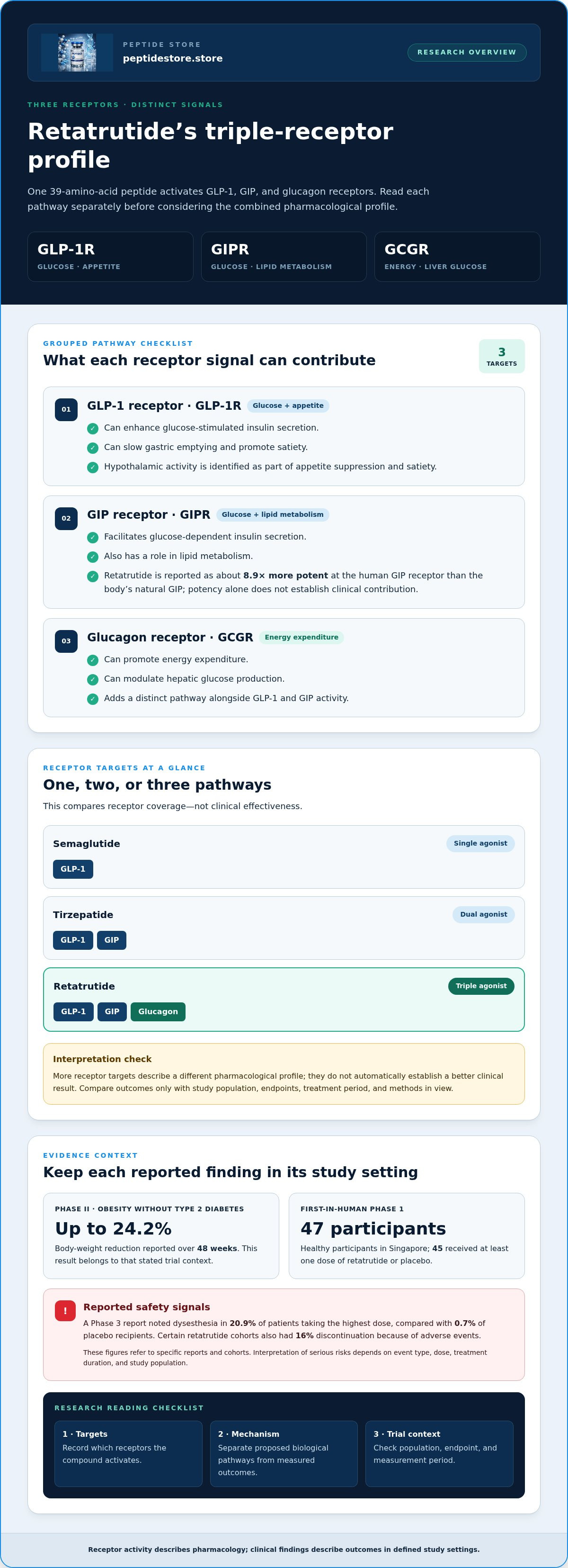
Retatrutide activates three receptors: GLP-1R, GIPR, and GCGR. It engages them as one 39-amino-acid peptide, with each receptor contributing a distinct signal.
For a concise overview of the three-hormone model, watch this educational video:
Effects on Glucose Regulation and Appetite
GLP-1R activation can enhance glucose-stimulated insulin secretion, slow gastric emptying, and promote satiety. GIPR activation also facilitates glucose-dependent insulin secretion, while playing a role in lipid metabolism. These signals matter because they connect meal-related glucose handling with appetite regulation. Retatrutide’s activity in the central nervous system, particularly the hypothalamus, is also identified as part of the appetite-suppression and satiety mechanism.
Glucagon Activity and Energy Expenditure
GCGR activation can promote energy expenditure and modulate hepatic glucose production. This gives retatrutide a pathway that GLP-1-only agonism does not provide: glucagon-receptor signaling can influence how the body uses energy, alongside effects on liver glucose output. The combined action is relevant to understanding the molecule’s overall pharmacology, because the glucagon receptor contributes a distinct signal rather than simply duplicating GLP-1 or GIP activity.
Comparison With Single and Dual Agonists
A single agonist targets one receptor pathway, while a dual agonist engages two; retatrutide activates GLP-1R, GIPR, and GCGR. Semaglutide acts through GLP-1 receptors, whereas tirzepatide targets GLP-1 and GIP receptors. Retatrutide adds glucagon-receptor activity to those two pathways. This comparison describes receptor targets, not a direct ranking of clinical outcomes, which depend on the study and population being assessed.
Receptor activation begins when the peptide binds its target and triggers intracellular signaling. The three pathways can therefore be considered separately, then as a coordinated pharmacological profile. Retatrutide is about 8.9 times more potent at the human GIP receptor than the body’s natural GIP. That finding characterizes receptor potency; it does not, by itself, establish how much any one pathway contributes to a clinical outcome.
Reported safety findings include dysesthesia in 20.9% of patients taking the highest dose in a phase 3 report, compared with 0.7% of placebo recipients. Certain retatrutide cohorts also had 16% discontinuation because of adverse events. These are specific reported safety signals; assessing serious risks requires considering the event type, dose, treatment duration, and study population.
Comparison with semaglutide and tirzepatide
Receptor targets distinguish these peptides before clinical outcomes enter the comparison. Semaglutide activates GLP-1 receptors, while tirzepatide activates GLP-1 and GIP receptors. Retatrutide adds glucagon-receptor activity, engaging GLP-1, GIP, and glucagon receptors. This difference describes pharmacology, not a ranking of effectiveness. Researchers conducting retatrutide mechanism of action research can use these target profiles to frame questions about pathway activity.
Semaglutide’s GLP-1 activity links its receptor profile with glucose-stimulated insulin secretion, slower gastric emptying, and satiety. Tirzepatide adds GIP-receptor activation, a pathway associated with glucose-dependent insulin secretion and lipid metabolism. Retatrutide combines those receptor targets with GCGR activation, which can promote energy expenditure and modulate hepatic glucose production. The three designs therefore differ in the hormone pathways engaged, giving researchers distinct mechanisms to examine.
For a research comparison, separate receptor coverage from measured outcomes. A receptor profile describes which pathways a compound can activate; clinical trials measure outcomes in defined participants and conditions. Retatrutide’s Phase II trial in people with obesity without type 2 diabetes reported up to 24.2% body-weight reduction over 48 weeks. That result belongs to its stated trial context and should not be treated as a direct comparison with semaglutide or tirzepatide.
Head-to-head interpretation requires comparable populations, treatment periods, endpoints, and analysis methods. A weight-change result over one trial duration cannot be ranked directly against a result measured over another duration. Type 2 diabetes status also matters because it defines the study population. Researchers should read clinical trial findings alongside the protocol and participant characteristics, rather than relying only on a headline percentage.
The three-receptor profile also changes what researchers can investigate. Semaglutide enables analysis centered on GLP-1 signaling. Tirzepatide enables examination of combined GLP-1 and GIP activity. Retatrutide permits researchers to study those pathways alongside glucagon-receptor effects on energy expenditure and hepatic glucose production. This framework supports retatrutide mechanism of action research without assuming that additional receptor targets automatically produce a better clinical result.
When comparing published findings, record each compound’s receptor targets, then note the trial population, endpoint, and measurement period. Keep mechanistic evidence separate from clinical outcomes. Retatrutide’s reported Phase II result applies to a specific study setting, while its triple-agonist design describes its pharmacological action. Neither measure alone establishes how compounds compare across different trials.
Preclinical studies in obesity and diabetes
Clinical research supports evaluation of retatrutide’s pharmacology across early human studies and later trials. The first-in-human Phase 1 study included 47 healthy participants in Singapore; 45 received at least one dose of retatrutide or placebo. These participants and trial stages provide context for interpreting evidence, but clinical outcomes alone do not isolate the contribution of each receptor target.
In a Phase II trial involving people with obesity without type 2 diabetes, treatment produced up to 24.2% body-weight reduction over 48 weeks. Across Phase II trials, average weight loss was reported as 17.5% at 24 weeks and 24.4% at 48 weeks. A separate reported Phase II finding described reductions ranging from 17.5% to 24.2% over a 48-week period. These figures should remain tied to their stated trial descriptions.
Other trial results involved different populations and durations. In TRANSCEND-T2D-1, participants with type 2 diabetes who took 12 mg had about 16.8% average weight loss at 40 weeks. TRIUMPH-4 reported about 28.7% average weight loss at 68 weeks among adults with obesity and knee osteoarthritis. Topline TRIUMPH-1 results reported around 28.3% average weight loss at 80 weeks in adults with weight-related health problems. These outcomes describe clinical results, not direct measurements of receptor signaling.
Clinical trials explored starting doses of 1 mg, 4 mg, 8 mg, and 12 mg. Retatrutide was administered by injection once a week. Those starting-dose levels identify studied trial groups; they do not, by themselves, describe a complete dose-escalation schedule. Dose comparisons should be read alongside the study population, treatment period, and outcome being measured.
Preclinical work adds a different kind of evidence. In a described mouse study, animals were fasted for 16 hours before acute gastric-emptying assessment, and the vehicle was administered at 10 ml/kg. Fasting duration and vehicle volume define experimental conditions. They help readers understand how the assessment was structured, but should not be mistaken for a human protocol or a reported treatment outcome.
Together, these findings illustrate how evidence develops from controlled preclinical assessments to human trials in obesity and diabetes. A mouse gastric-emptying experiment examines a specific physiological endpoint, while weight-change results measure a broader clinical outcome. Keeping these evidence types distinct clarifies what each study can establish about retatrutide’s targets and avoids treating an outcome as proof of a particular molecular pathway.
Retatrutide mechanism of action
In the United States, retatrutide is being evaluated in the TRIUMPH Phase III program for obesity and related conditions. Phase III evaluation describes its clinical-trial status, not FDA approval.
Long-term safety remains a research question because each trial measures outcomes over a defined follow-up period. Researchers need to assess how adverse events, treatment discontinuations, and metabolic effects develop over longer observation.
At the cellular level, retatrutide’s three receptor targets initiate intracellular signaling, including increases in cyclic adenosine monophosphate (cAMP) and activation of protein kinase cascades. These signals help translate receptor binding into changes in cell activity. Its mechanism therefore involves a sequence: receptor engagement, intracellular signal transmission, and downstream physiological responses.
Each receptor contributes a different input to that sequence. GLP-1 receptor signaling can affect glucose-stimulated insulin secretion, gastric emptying, and satiety. GIP receptor activation facilitates glucose-dependent insulin secretion and plays a role in lipid metabolism. Glucagon receptor activation can influence hepatic glucose production and energy expenditure. Their combined activity creates a multi-pathway pharmacological profile rather than one uniform signal.
Receptor activity alone does not explain every observed outcome. Appetite and satiety, for example, involve central nervous system activity, particularly in the hypothalamus, alongside signals affecting digestion and glucose regulation. Studying these pathways requires distinguishing direct receptor effects from broader physiological responses. This matters when interpreting clinical measurements such as body-weight change, which reflects multiple interacting processes.
Placebo-controlled trial results provide a comparison for measured outcomes, but do not isolate the contribution of each receptor. A placebo comparison can show how outcomes differ between groups under a trial’s conditions. Mechanistic interpretation requires additional evidence linking receptor activation with downstream signals and clinical endpoints. Molecular pathways and measured outcomes address related but distinct questions.
The TRIUMPH Phase III program evaluates retatrutide in populations with conditions including obstructive sleep apnea, type 2 diabetes, cardiovascular disease, osteoarthritis, and nonalcoholic fatty liver disease. These populations can help researchers examine outcomes across different clinical settings. However, a trial in one condition cannot establish effects or long-term safety across every population.
Longer follow-up can clarify whether safety patterns change with continued exposure, whether discontinuations cluster around particular events, and how metabolic outcomes persist. Researchers also need to interpret findings in light of dose, population, and observation period. The key distinction is that retatrutide’s mechanism describes receptor-driven signaling, while Phase III trials assess the clinical consequences and safety of that signaling in defined groups.
How does retatrutide work at the molecular level?
Retatrutide, also identified by the code LY-3437943, is a single peptide containing 39 amino acids. Its molecular design enables activity at GLP-1, GIP, and glucagon receptors. At each receptor, binding initiates intracellular signaling, including increased cyclic adenosine monophosphate (cAMP) and activation of protein kinase cascades. These steps connect receptor engagement with downstream cellular responses.
The peptide backbone includes structural modifications relevant to its stability. An α-amino isobutyric acid (Aib) residue at position 2 helps protect retatrutide from cleavage by dipeptidyl peptidase-4 (DPP4). This detail links molecular structure to resistance against enzymatic breakdown. It does not describe receptor selectivity by itself; receptor activity and resistance to cleavage are separate molecular properties.
A second modification is α-methyl-L-leucine (αMeL) at position 13. Considered with the Aib residue at position 2, this feature helps characterize the engineered peptide sequence. The sequence supports a molecule designed to engage three hormone receptors, while the substitutions distinguish its backbone from an unmodified peptide. Molecular structure, receptor binding, and intracellular signaling therefore form related but distinct parts of its action.
After receptor engagement, cAMP increases and protein kinase cascades transmit signals within cells. The resulting pathway depends on which receptor is activated and the responding tissue. GLP-1 receptor signaling can affect glucose-stimulated insulin secretion; GIP receptor activity facilitates glucose-dependent insulin secretion. Glucagon receptor signaling can modulate hepatic glucose production. These receptor-specific responses explain why a shared signaling step can lead to different physiological effects.
Retatrutide’s approximate half-life is 6 days, supporting once-weekly subcutaneous administration. The half-life describes how long the compound remains in the body; it is not a direct measure of receptor potency or clinical effect. Likewise, the reported 8.9-times potency at the human GIP receptor, compared with natural GIP, describes receptor-level potency rather than the magnitude of an outcome in an individual.
For laboratory research, distinguishing these molecular levels improves interpretation: sequence modifications concern peptide stability, receptor binding concerns target engagement, and cAMP signaling concerns intracellular response. Retatrutide brings these features together in one molecule. Researchers studying research-grade peptides can use this framework to separate molecular identity from biological activity and measured study outcomes.
Peptide Store: Tirzepatide
Peptide Store supplies research-grade peptides for laboratory and scientific applications, including Tirzepatide, Retatrutide, Semaglutide, and Cagrilintide. For researchers comparing receptor profiles, these compounds offer a relevant starting point for identifying options related to the mechanisms discussed in this guide. Each peptide should be considered in its research context, not as a substitute for clinical care.
Researchers can review Peptide Store’s research peptide catalog to identify compounds relevant to their work. For questions about the available offerings, contact Peptide Store through its website.
Apply the Mechanistic Framework to Your Next Research Question
For further retatrutide mechanism of action research, begin by defining the biological question the study is designed to address. Separate receptor activity, intracellular signaling, and measured outcomes in the study plan. This makes it easier to determine what an experiment supports and where additional evidence is needed.
Peptide Store offers Retatrutide, Tirzepatide, and Semaglutide for research applications. Their distinct receptor profiles can inform compound selection for projects examining related pathways. Keep the research objective, experimental model, and measurements aligned so results remain interpretable within their defined scope.
For questions about the available research compounds, contact Peptide Store for help. A clearly framed research question is a practical foundation for the next stage of your work.
Frequently Asked Questions
What is the mechanism of action of Retatrutide?
Retatrutide’s mechanism combines signaling through GLP-1, GIP, and glucagon receptors. For researchers, the key point is to distinguish receptor binding from downstream effects: a receptor assay examines target activity, while measurements of insulin secretion, appetite, or energy use examine later responses. This separation helps prevent a biological mechanism from being treated as proof of a specific outcome in every population.
Does Retatrutide Help With Blood Sugar and Type 2 Diabetes?
Retatrutide is being studied in type 2 diabetes, and glucose-related effects are biologically relevant because its receptor pathways can influence insulin secretion and hepatic glucose production. In TRANSCEND-T2D-1, participants with type 2 diabetes taking 12 mg had about 16.8% average weight loss at 40 weeks. That figure reports weight change, not a blood-sugar measurement, so it should not be presented as a glucose-control result.
How Does Retatrutide Actually Work Inside the Body?
After retatrutide engages a receptor, intracellular signaling relays that event into cellular responses. A useful research distinction is between the initial interaction, such as receptor activation, and later measures, such as changes in glucose handling or appetite. For example, cAMP signaling describes a cellular event, while a clinical endpoint measures an outcome across participants. These observations answer different questions and should be interpreted separately.
How does retatrutide affect appetite, energy expenditure, and glucose control?
Its receptor activity is associated with pathways involved in satiety, energy expenditure, and glucose regulation. Appetite research can examine central nervous system activity, including hypothalamic signaling, while metabolic research can assess glucose-dependent insulin secretion or hepatic glucose production. Keep these endpoints distinct: a change in appetite-related signaling does not quantify energy expenditure, and neither measure alone establishes a glucose outcome.
How does retatrutide compare with semaglutide and tirzepatide?
Retatrutide targets three receptors, semaglutide targets GLP-1 receptors, and tirzepatide targets GLP-1 and GIP receptors. This target comparison helps researchers frame compound selection around a study question, rather than assume one profile is superior. Peptide Store offers these compounds solely for laboratory and scientific research, not for human consumption, veterinary use, diagnostic, food, or household chemical applications.
What doses and dose-escalation schedules have been studied for retatrutide?
Clinical trials explored starting doses of 1 mg, 4 mg, 8 mg, and 12 mg. These identify studied dose groups, not a complete dose-escalation schedule.


