
For how to store tirzepatide powder before mixing, the available routine storage recommendation for lyophilized research peptide is -20°C. There isn’t a universal expiry period or room-temperature limit for unmixed powder, so the storage conditions for a finished, reconstituted medication shouldn’t be treated as guidance for the powder.
It’s understandable to want a clear expiry date and a simple refrigeration rule. The key distinction is that FDA-approved tirzepatide products have labeled storage instructions, while unmixed research powder does not have the same established guidance. This article explains what the available information says about powder storage, refrigeration, room-temperature exposure, and expiry, and where that guidance has limits.
Storage recommendations differ before and after mixing. Handling a cold vial can also affect condensation, and certain conditions may increase degradation risks. The aim is a clear, evidence-conscious overview that does not treat product-specific instructions as interchangeable.
Key Takeaways
- Separate storage instructions for FDA-approved tirzepatide products from recommendations for unmixed research powder; the forms do not share a single storage rule.
- Learn the listed refrigeration range for approved products and why a refrigerator door can be less suitable than its main compartment.
- Understand how room-temperature exposure limits differ by product form, and why heat and freezing are important storage concerns.
- Use the labeled expiration date for approved products as a key reference, while recognizing that powder stability depends on its storage conditions.
- See why -20°C is the routine storage recommendation for lyophilized research peptide and how that differs from guidance for refrigerated medication.
Does tirzepatide need to be refrigerated?
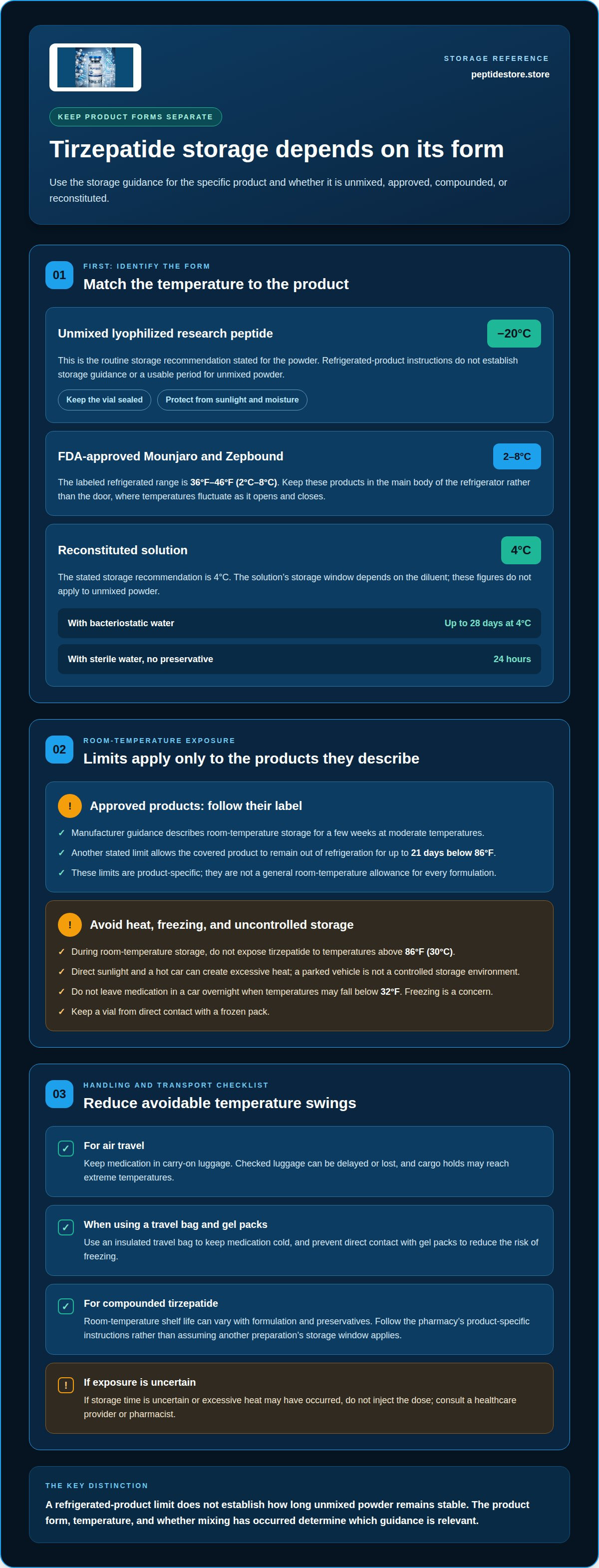
For unmixed, lyophilized tirzepatide research peptide, the routine storage recommendation is -20°C. That differs from the refrigeration instructions for FDA-approved Mounjaro and Zepbound products, which are stored at 36°F-46°F (2°C-8°C). The recommended temperature depends on the product form, so these conditions aren't interchangeable.
For a powder vial, -20°C is the relevant figure in the available routine-storage recommendation. The 36°F-46°F range applies to the approved products, not automatically to unmixed powder. A refrigerator may be appropriate for those finished products, but it doesn't provide the powder's stated storage temperature. Product identity and form determine which temperature applies.
Refrigerated storage also matters after reconstitution, when the powder has become a liquid. Reconstituted tirzepatide is recommended for storage at 4°C, and tirzepatide reconstituted with bacteriostatic water is described as generally stable for up to 28 days at that temperature. Those figures apply to the solution, not the unmixed vial; they don't establish a usable period for powder kept in a refrigerator.
For refrigerated FDA-approved products, follow the labeled temperature range and keep the product in the main body of the refrigerator rather than the door. Temperatures in the door fluctuate as it opens and closes. A brief reading there should not be used to assess whether Mounjaro or Zepbound has remained within its labeled storage conditions.
- Unmixed lyophilized research peptide: routine storage recommendation of -20°C.
- FDA-approved Mounjaro and Zepbound: refrigerated at 36°F-46°F (2°C-8°C).
- Reconstituted tirzepatide solution: recommended storage at 4°C.
Mixing changes which storage information is relevant. Reconstitution introduces liquid, so powder-storage conditions can't be used to estimate the solution's storage period. The reconstitution and dilution guide covers the process of preparing a solution; the powder and finished solution still require form-specific handling.
For healthcare use, follow the storage instructions supplied with the specific approved product. Research powder's -20°C recommendation does not replace the labeled conditions for an approved medication. Likewise, refrigeration at 36°F-46°F doesn't establish how long unmixed powder remains stable. Keep the product form, the temperature, and whether mixing has occurred distinct when interpreting storage information.
Room-temperature storage limits
Yes. FDA-approved tirzepatide products and compounded preparations have different storage instructions. A room-temperature allowance for an approved pen or vial does not establish a safe window for compounded medication or unmixed powder.
Manufacturer guidance for FDA-approved tirzepatide pens describes room-temperature storage for a few weeks at moderate temperatures. Another stated limit allows tirzepatide left out of refrigeration to remain below 86°F for up to 21 days. These figures apply to the products covered by that guidance, not every tirzepatide formulation. Follow the specific product’s instructions rather than applying one room-temperature window across all forms.
Temperature matters during handling and transport. Tirzepatide should not be exposed to temperatures above 86°F (30°C) during room-temperature storage. Direct sunlight and a hot car can expose medication to excessive heat; a parked vehicle is not a controlled storage environment. Don’t leave it in a car overnight when temperatures may fall below 32°F. Freezing is also a concern, so avoid placing a vial directly against a frozen pack.
After mixing, the liquid’s storage window depends partly on the diluent. Reconstituted tirzepatide in bacteriostatic water is described as generally stable for up to 28 days when refrigerated. In sterile water without a preservative, the stated usable window is 24 hours. These are different conditions and shouldn’t be treated as interchangeable. Adding a preservative-free diluent does not create the same storage window as bacteriostatic water.
Compounded tirzepatide is prepared by a licensed 503A pharmacy for a specific prescription. Its room-temperature shelf life can vary with formulation and preservatives. The storage window for one preparation therefore cannot be assumed to apply to another; the pharmacy’s product-specific instructions determine the relevant limits.
For air travel, keep medication in carry-on luggage. Checked luggage can be delayed or lost, and cargo holds may reach extreme temperatures. To keep medication cold, use an insulated travel bag with gel packs, but prevent direct contact with the packs to reduce the risk of freezing. If storage time is uncertain or excessive heat may have occurred, do not inject the dose; consult a healthcare provider or pharmacist.
Room-temperature limits are product-specific, not a general allowance for every vial. The product form, diluent, preservatives, exposure duration, and temperature all affect the relevant storage window. Follow the label for FDA-approved medication and the assigned guidance for compounded tirzepatide rather than applying one product’s limit to another.
Does tirzepatide expire?
Yes. Tirzepatide products have expiry limits, and freezing or unsuitable storage can make a product inappropriate to use. For unmixed powder, routine storage is recommended at -20°C; keep the vial sealed and protect it from direct sunlight and moisture during handling.
To protect powder from light and moisture, keep it in its closed vial and limit exposure during handling. Avoid direct sunlight, which can expose tirzepatide to heat as well as light. Let a cold vial reach room temperature before opening to reduce the chance of condensation forming as it warms.
Freezing is not a suitable shortcut for preserving every form. Tirzepatide should never be placed in a freezer, and medication known to have frozen should not be used. The -20°C recommendation applies specifically to lyophilized research peptide storage. It does not mean that an approved pen, vial, or reconstituted solution should be frozen.
Expiry and degradation are related, but appearance alone cannot establish a product’s full stability. Liquid tirzepatide should be clear and colorless or slightly yellow. Do not use medication that is expired, cloudy, discolored, or contains floating material. These visible changes are warning signs, not a complete test of potency.
Powder requires a different visual assessment from solution. A clear-liquid appearance check does not apply to an unmixed vial, and normal-looking powder does not prove that storage conditions were suitable. Consider the storage history alongside the product’s expiry information. Exposure to freezing, direct sunlight, or moisture matters even if the contents appear unchanged.
Visual clues have limits: an unusual appearance can signal a concern, but an unchanged appearance cannot confirm stability. Treatment decisions should not rely on appearance alone. Product form, expiry status, and exposure history all affect whether the available storage information applies.
For research powder, maintain the recommended -20°C storage condition and keep the vial closed between handling steps. For an approved medication, follow its product-specific storage instructions instead. Do not transfer the powder’s temperature recommendation to a treatment pen or liquid vial. Likewise, don’t use appearance to override an expiry date or known freezing exposure.
To assess whether tirzepatide may have expired, check the date and storage history, then look for visible warning signs appropriate to the product form. Do not use a vial that has been frozen, passed its expiry date, or shows cloudiness, discoloration, or floating material. Each is a practical warning, but none establishes a longer usable period.
Expiration dates and shelf life
An expiry date and a stability estimate describe different things. The printed date applies to the specific product under its labeled storage conditions. A stability estimate describes powder under a stated temperature condition; it does not replace a product label or establish a universal expiry date. This distinction matters when comparing research powder with prescription medication.
For lyophilized tirzepatide, expected stability varies with storage temperature. At -20°C, the expected stability is 12 to 24 months. At -80°C, it may remain stable for 3 years or longer. These figures apply to lyophilized material stored at those temperatures. They do not describe a vial kept at room temperature, refrigerated medication, or a solution after reconstitution.
Refrigerated tirzepatide is described as lasting several months to a year, subject to the expiry date printed on its pen or vial. That range does not extend the labeled date. Correct refrigeration supports storage under the intended conditions, but it does not authorize use beyond the printed expiry. Assess FDA-approved products using their own label and date, not powder stability estimates.
After reconstitution, the storage form changes, so powder stability figures no longer apply. For example, a vial that was lyophilized at -20°C cannot be assigned the powder’s 12 to 24 months once mixed. The liquid’s usable period depends on its preparation and storage conditions. A storage estimate for unmixed material should not be carried forward as a shelf-life claim for the solution.
Compounded tirzepatide has a different expiry reference: the compounding pharmacy assigns its Beyond-Use Date in line with United States Pharmacopeia standards. That date is specific to the compounded preparation. It is not interchangeable with a manufacturer’s printed expiry date or stability estimates for lyophilized research material. Follow the assigned date and storage instructions for that preparation.
For a prescription product, the label provides the relevant expiry information for its intended use. Medical advice about treatment should not be replaced by a research-powder stability estimate. A vial’s appearance also cannot establish that its contents remain within the intended shelf life; a clear solution, for example, does not override an expired date.
In practical terms, interpret each figure alongside its product form and temperature: -20°C or -80°C refers to lyophilized powder; the printed date refers to the named pen or vial; and a compounded preparation follows its pharmacy-assigned Beyond-Use Date. Keeping those references separate prevents a stability estimate from being mistaken for a universal expiration rule.
No guidance on storing unmixed tirzepatide powder
Store lyophilized tirzepatide research peptide at -20°C for routine storage. The recommendation provides a storage condition, not a universal expiry period or room-temperature allowance for every unmixed vial. The practical question of how to store tirzepatide powder before mixing therefore has a specific temperature answer, but not a single shelf-life answer.
Research powder, FDA-approved pens and vials, and reconstituted solutions are different product forms with different storage references. A refrigerator range for an approved product does not establish the correct routine storage condition for unmixed powder. Nor can a liquid’s storage window after reconstitution be used to calculate how long powder remains stable.
A sealed vial at 4°C is described as a short-term storage condition, with expected stability of days to weeks. That is distinct from routine storage at -20°C. The short-term description does not set a universal expiry date or make the two temperatures interchangeable. For researchers deciding how to store tirzepatide powder before mixing, the relevant details are the powder form, temperature, and duration of exposure.
Storage history can change how those conditions should be interpreted. A temperature reading of 4°C alone doesn’t show whether the vial was there briefly or routinely. Similarly, knowing a vial reached -20°C doesn’t establish its stability if it was exposed to other conditions before or afterward. Record the conditions and handling sequence rather than relying on one isolated reading.
Keep the vial closed during storage and avoid opening it unnecessarily. Opening a cold vial while the surrounding air is warmer can lead to condensation. Let it reach room temperature before opening to reduce that risk. Avoid direct sunlight and moisture during handling, and close the container promptly after access.
Appearance has limits as an assessment tool. Powder that looks unchanged does not prove its storage history was suitable. Cloudiness, discoloration, or floating particles are warning signs for a liquid, but they are not shelf-life tests for unmixed powder. A known temperature excursion remains relevant even when the powder looks unchanged.
Keep these conditions distinct:
- Routine storage: -20°C for lyophilized research peptide.
- Short-term condition: sealed vial at 4°C, described as days to weeks.
- Other forms: approved medication and reconstituted solution have separate storage instructions.
The practical takeaway is to use -20°C as the routine condition for unmixed lyophilized powder, without treating other product forms’ instructions as substitutes. Temperature, exposure duration, and handling history provide context; appearance alone cannot resolve concerns about stability.
Peptide Store: Tirzepatide
Peptide Store supplies tirzepatide for research and laboratory applications. The storage distinctions above help researchers keep product form in view: unmixed lyophilized peptide, reconstituted solution, and FDA-approved medication have different storage references. Research-grade tirzepatide is not a human prescription medication and is not for personal treatment.
Choose Peptide Store when your work requires tirzepatide as a research compound. The catalog also includes retatrutide, semaglutide, and cagrilintide for scientific applications.
For information about tirzepatide offerings, contact Peptide Store.
Apply the storage guidance to your next step
For research handling, document each vial’s product form, storage conditions, and time outside controlled storage. This record helps distinguish unmixed material from reconstituted solution and keeps storage decisions tied to the form being handled. The question “how to store tirzepatide powder before mixing” calls for powder-specific conditions, not instructions for pens or liquids.
Peptide Store offers tirzepatide, retatrutide, and semaglutide for research and laboratory applications. If you have questions about the research-grade offering, contact Peptide Store with your questions. For medication intended for treatment, use the product’s specific instructions and consult a healthcare professional about your care.
Clear records and form-specific handling help keep research procedures consistent. Take the next step with care and confidence.
Frequently Asked Questions
Is it okay if tirzepatide gets warm?
It depends on the product form and how long it was warm. FDA-approved tirzepatide left unrefrigerated can remain at room temperature below 86°F for up to 21 days. Unmixed research powder is described for brief room-temperature handling, hours to a day under dry, dark conditions. If a medication dose faced excessive heat or its storage time is uncertain, don’t inject it; consult a healthcare provider or pharmacist.
What temperature should it be stored at?
The temperature depends on whether the product is powder, approved medication, or reconstituted solution. Lyophilized research peptide has a routine storage recommendation of -20°C. FDA-approved Mounjaro and Zepbound products are refrigerated at 36°F-46°F (2°C-8°C). Reconstituted tirzepatide is recommended at 4°C. These values apply to different forms, so use the product’s applicable instructions rather than selecting one temperature for every vial.
Can you freeze Tirzepatide?
Don’t freeze tirzepatide medication or a reconstituted solution; medication known to have frozen should not be used. Lyophilized research powder is different: its routine storage recommendation is -20°C. That recommendation describes the unmixed powder, not a pen or liquid vial. For travel, gel packs can help keep medication cold, but avoid direct contact between the product and an ice pack to reduce freezing risk.
How should tirzepatide be stored at home?
At home, keep the product in its original closed container and follow the storage instructions for its form. Place refrigerated medication in the main body of the refrigerator, not the door, where temperatures fluctuate. Keep it away from direct sunlight and heat sources. Store research powder according to its powder-specific temperature recommendation, and do not substitute household conditions for another form’s instructions.
Should tirzepatide powder be refrigerated or frozen before mixing?
For lyophilized research powder, the routine storage recommendation is -20°C, rather than ordinary refrigeration. A sealed vial at 4°C is described as a short-term storage condition, with expected stability of days to weeks. These conditions aren’t equivalent. Keep powder storage separate from instructions for approved medication or reconstituted liquid, and allow a cold vial to reach room temperature before opening to reduce condensation.
What is the shelf life of unmixed tirzepatide powder?
Lyophilized tirzepatide stored at -20°C has an expected stability of 12 to 24 months. This is a stability estimate under that temperature condition, not a universal expiry date for every vial. At -80°C, expected stability is 3 years or longer. A vial’s assigned expiry and its storage history remain important; estimates for powder don’t establish the shelf life of a reconstituted solution.
Can tirzepatide powder be shipped or stored at room temperature before mixing?
Unmixed powder is described for room-temperature handling only briefly, hours to a day under dry, dark conditions. That handling window isn’t a general room-temperature storage recommendation. Routine storage for lyophilized research peptide is -20°C. A shipment’s exposure conditions matter because time, temperature, light, and moisture affect whether the routine storage condition was maintained. Don’t infer a stable storage period from the fact that a vial arrived.
What should you do if tirzepatide powder was exposed to heat or left unrefrigerated?
For unmixed powder, compare any exposure with its recommended storage conditions; do not treat room-temperature handling as routine storage. The described handling window is hours to a day under dry, dark conditions. If an approved medication dose had uncertain storage time or may have been exposed to excessive heat, do not inject it; consult a healthcare provider or pharmacist. Normal appearance alone cannot establish that heat exposure had no effect.


