
Concentration is calculated by dividing peptide mass by the volume of diluent: a 5 mg semaglutide vial reconstituted with 2.0 mL yields 2.5 mg/mL. For reconstituting semaglutide for lab experiments, that calculation is the starting point; the chosen materials and handling steps also affect how consistently a stock solution can be prepared.
It’s reasonable to start with the dilution math, but concentration alone does not show whether a solution suits a particular assay. The vial’s labeled mass, diluent volume, experimental requirements, and storage plan all matter when preparing research material.
This guide covers stock-concentration calculations, sterile materials, gentle mixing, and storage considerations after reconstitution. It also explains the limits of do-it-yourself preparation and distinguishes laboratory procedures from instructions for human use. The goal is a clear, repeatable workflow for research settings, not a single method for every experiment.
Key Takeaways
- Calculate stock concentration from peptide mass and diluent volume, then select a target concentration that suits the assay.
- Choose sterile materials and a diluent compatible with the research application to support consistent preparation.
- Add diluent carefully and mix gently to help dissolve the peptide without vigorous agitation.
- Plan storage and aliquoting around the solution’s intended use and handling conditions.
- Separate laboratory preparation decisions from human-use instructions; research protocols do not establish clinical suitability.
How do you calculate concentration for semaglutide stock solutions?
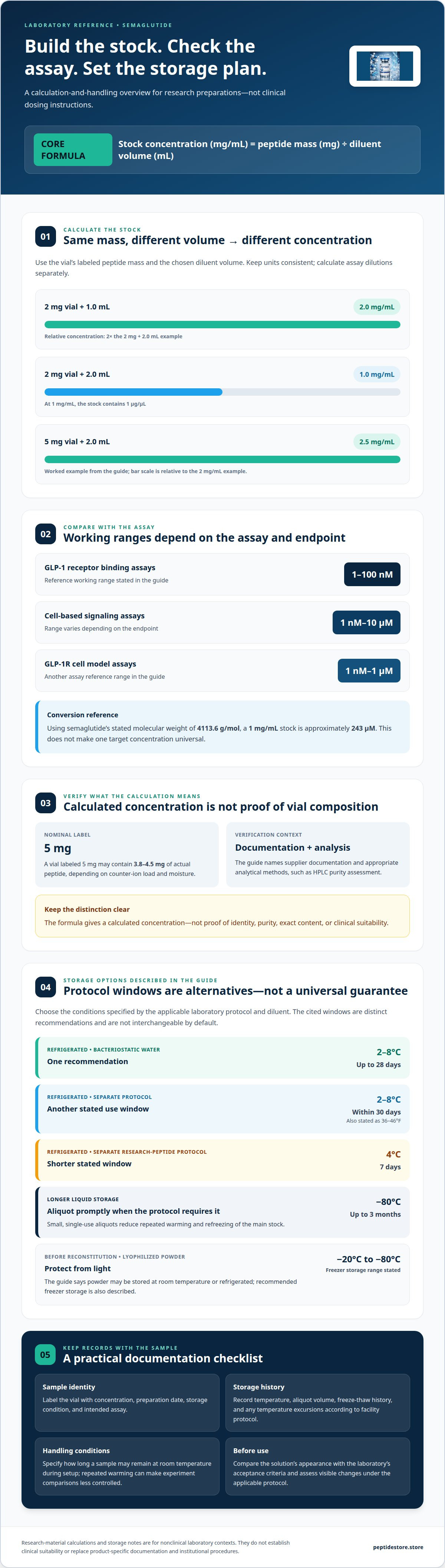
Calculate stock concentration by dividing peptide mass by diluent volume, then calculate assay dilutions separately using consistent units. This is a starting point for reconstituting semaglutide for lab experiments, not a substitute for compound-specific documentation or analytical verification.
-
Select Water Volume and Vial Size
Choose the vial’s labeled peptide mass and a diluent volume suited to the planned stock concentration. A 5 mg vial mixed with 2.0 mL yields 2.5 mg/mL. Bacteriostatic water containing 0.9% benzyl alcohol is commonly recommended for multi-use laboratory stocks.
Research-grade semaglutide may be supplied as lyophilized peptide for laboratory preparation. FDA-approved injectable products come as prefilled pens or ready-to-use solution vials, not powder for reconstitution. For nonclinical U.S. laboratory work, use research material only for its designated purpose. These calculations are not clinical dosing instructions or authorization for human use. A syringe measures volume; the vial’s labeled mass provides the peptide amount used in the calculation.
-
Calculate Stock-Solution Concentration
Divide peptide mass in milligrams by diluent volume in milliliters: concentration (mg/mL) = mass (mg) ÷ volume (mL). A 2 mg vial mixed with 1.0 mL yields 2.0 mg/mL; mixed with 2.0 mL, it yields 1.0 mg/mL. At 1 mg/mL, the stock contains 1 µg/µL.
For molar calculations, use semaglutide’s molecular weight of 4113.6 g/mol. A vial labeled 5 mg may contain 3.8 to 4.5 mg of actual peptide, depending on counter-ion load and moisture. Therefore, nominal mass calculations don’t independently establish exact content. Verify identity, purity, and concentration through supplier documentation and appropriate analytical methods, such as HPLC purity assessment. The formula gives a calculated concentration, not proof of vial composition.
In the United States, purchase and handle research material only for its nonclinical purpose and in accordance with applicable institutional procedures. Reconstituting semaglutide for lab experiments does not establish clinical suitability or replace requirements for products intended for human use.
-
Compare Concentration Reference Examples
Compare the calculated stock with the assay’s working range before preparing dilutions. GLP-1 receptor binding assays commonly use 1 to 100 nM. Cell-based signaling assays may use 1 nM to 10 µM, depending on the endpoint; GLP-1R cell model assays also use 1 nM to 1 µM.
Convert units before planning transfers. Using the stated molecular weight, a 1 mg/mL stock is approximately 243 µM. The target working concentration depends on the assay endpoint, so don’t treat one example as universal. For reconstituting semaglutide for lab experiments, keep stock calculations separate from final assay concentrations and record each dilution step. The laboratory dilution guide offers related preparation context.
Storage of reconstituted semaglutide
- Set the storage temperature in the written laboratory protocol immediately after reconstitution. Research handling recommendations describe refrigeration at 2-8°C, while other protocols specify using solution held at 4°C within 7 days. These instructions are not interchangeable by default. Record the selected temperature and use window alongside the sample identifier.
- Choose a refrigerated use period that matches the specific protocol and diluent. One recommendation describes up to 28 days for solution prepared with bacteriostatic water and refrigerated at 2-8°C; another specifies use within 30 days at 36-46°F (2-8°C). A separate research-peptide protocol gives 7 days at 4°C. Treat these as distinct protocol limits, not a universal stability guarantee.
- For longer liquid storage, aliquot the stock promptly and freeze it at -80°C when the experimental protocol requires long-term storage. A research handling recommendation gives up to 3 months at -80°C for reconstituted semaglutide. Record the date, aliquot volume, temperature, and freeze-thaw history for each container. Small, single-use aliquots reduce repeated warming and refreezing of the main stock.
- Keep refrigerated or frozen samples within their assigned temperature range during routine laboratory handling. Use a temperature-monitored laboratory refrigerator or freezer, and document excursions according to the facility’s protocol. A laboratory refrigerator and freezer provides dedicated cold-storage equipment for laboratory materials.
- Keep research-storage instructions separate from human-use dosing directions. Any storage windows for research peptides describe laboratory handling, not the in-use period for an approved injectable product. Label each vial with its concentration, preparation date, storage condition, and intended assay. Before use, compare the solution’s appearance with the laboratory’s acceptance criteria. Assess visible changes under the applicable protocol.
- Keep storage records clear when moving samples between locations. Note whether a vial is refrigerated or frozen, and record the condition used for each assay run. Specify in the protocol how long a sample may remain at room temperature during setup. Repeated warming can make comparisons between experiments less controlled.
The lyophilized powder may be stored at room temperature or refrigerated and should be protected from light. Recommended freezer storage for lyophilized semaglutide is -20°C to -80°C. Record the selected powder-storage condition before reconstitution.
Gentle mixing and dissolution
- Prepare the vial and diluent according to the laboratory protocol before mixing. Let both reach room temperature, disinfect the vial septum with an alcohol swab, and allow it to air-dry. This reduces the chance of introducing contaminants when inserting a needle. Minimize handling of the lyophilized powder and use a clean work surface.
- Measure the planned diluent volume with a sterile syringe, using graduations suited to the amount required. Insert the needle through the septum and inject the liquid slowly down the inside wall of the vial. For the described 2 mL procedure, the addition takes 15-20 seconds. Directing the stream toward the glass helps avoid foaming and forceful contact with the powder.
- Let the liquid contact the lyophilized peptide before moving the vial. Avoid directing a strong stream at the dry material, as rapid impact can create foam. Give the powder time to hydrate, allowing the solution to stand during gentle mixing rather than using vigorous motion to dissolve it.
- Roll the vial gently between your hands for 30 to 60 seconds, or swirl it with controlled movement. Don’t shake it vigorously or place it on a vortex mixer. Mechanical agitation can introduce bubbles and complicate visual assessment. Keep the stopper secure and handle the vial upright so solution doesn’t contact the closure unnecessarily.
- After gentle rolling, allow 2 to 5 minutes for the peptide to dissolve and the solution to become transparent. Inspect it against a suitable background for visible particles or persistent cloudiness. Don’t treat a clear appearance as proof of identity, purity, or concentration; visual inspection only records the solution’s observable condition.
- If undissolved material remains, continue gentle swirling and allow more time to settle instead of applying heat or shaking vigorously. Follow the validated protocol for the specific assay and diluent. Record the diluent volume, mixing method, elapsed time, and final appearance so another researcher can reproduce the preparation.
- Use the prepared solution only in its stated laboratory research context. Syringe steps describe transferring liquid into a vial, not human injection or dosing. Label the vial with its calculated concentration and preparation details, then follow the applicable storage protocol before using it in an experiment.
For semaglutide, the page recommends gently rolling and swirling the vial for 60-90 seconds to dissolve it; do not shake it vigorously.
Bacteriostatic water and sterile materials
Use sterile materials and a documented laboratory procedure to limit contamination during preparation. Bacteriostatic water, filtration, and personal protective equipment serve distinct purposes.
-
Assess Contamination Risks
Set up a clean work area and use sterile syringes, needles, and vial-access equipment for each transfer. Bacteriostatic water contains 0.9% benzyl alcohol and is commonly recommended for multi-use laboratory stock solutions, but it doesn’t replace aseptic handling. Avoid touching sterile contact surfaces, and discard equipment that becomes contaminated.
Wear a lab coat, gloves, and eye protection when handling semaglutide powder or reconstituted solution. Follow the laboratory’s risk assessment and the material’s safety documentation. These precautions apply to nonclinical laboratory handling, not clinical preparation.
- Clean each vial septum with a fresh alcohol swab before inserting a needle, then let the surface dry. Keep the needle sterile and avoid setting it down between transfers. Repeated access can introduce contamination, so label multi-use containers with preparation and opening details and follow the laboratory protocol’s in-use window.
The usual in-use window applied to bacteriostatic water is roughly 28 days. This is not a stability guarantee for every reconstituted solution. The peptide, diluent, storage conditions, and assay protocol affect how long a prepared stock remains suitable for its intended research use.
-
Consider Sterile Filtration and Safety Precautions
Apply sterile filtration only when the assay protocol requires it. Use a 0.22 micron PVDF or PES membrane, and pre-wet it with 100 to 200 µL of diluent before filtering the peptide solution. Confirm membrane compatibility with the solution and experimental method; filtration does not correct errors in concentration or establish peptide identity.
Keep research handling separate from clinical use. Sterile filtration does not make a research solution an approved injectable product. Record the filtration membrane, preparation date, and solution identifier so the laboratory can trace the sample to its experiment.
- Handle spills and waste under the laboratory’s established procedures. Keep powder containers closed when not in use, and place used needles directly into an appropriate sharps container. Gloves and eye protection reduce direct-contact risks, but do not replace training or the site-specific response procedure.
- Document the diluent type, lot information, and handling steps in the sample record. For example, note bacteriostatic water, the date opened, and whether the reconstituted solution underwent 0.22 micron filtration. These details help distinguish preparation variables from assay effects when researchers compare results across runs.
DIY reconstitution of semaglutide and tirzepatide
- Define the experiment before opening a vial. Record the compound, research question, receptor or pathway endpoint, planned concentration, and acceptance criteria. Semaglutide and tirzepatide are distinct compounds, so do not assume one compound’s preparation conditions apply to the other. Identify the material as research use only in the protocol and exclude human administration.
- Use documentation and a preparation method specific to the material being studied. A semaglutide vial’s label and accompanying analytical information guide assessment of its mass and identity. Do not assume these instructions establish tirzepatide-specific reconstitution conditions. Avoid applying semaglutide volumes, dissolution observations, or storage assumptions to tirzepatide without compound-specific experimental support.
- Prepare a controlled laboratory workspace and follow the institution’s chemical and biological safety procedures. The semaglutide protocol describes allowing the vial to reach room temperature for 15 minutes before reconstitution. It also describes cleaning the workstation and vial septum with 70% isopropyl alcohol, then allowing the septum to air-dry for 30 seconds. These details do not replace the applicable site procedure.
- Keep any syringe-based transfer within a laboratory preparation protocol, not a human dosing procedure. The described semaglutide method uses a 1 mL or 3 mL syringe to measure diluent and recommends a 21G to 25G needle for metering. It also describes injecting liquid slowly down the vial wall over 15-20 seconds. Those steps are not instructions for subcutaneous injection.
- Do not infer a dose volume from a laboratory stock calculation. Research concentration supports assay preparation; clinical dosing concerns human treatment and requires an approved product and clinical direction. Semaglutide research material may differ in formulation and handling from approved injectables. A vial prepared for an experiment is not interchangeable with a prefilled pen.
- Record every preparation variable needed to interpret an assay: compound identity, vial label, diluent, measured volume, calculated concentration, mixing method, and storage condition. For example, distinguish the stated vial mass from the measured diluent volume in a semaglutide record. Keep tirzepatide records separate to prevent accidental transfer of protocols between compounds.
- Use the resulting material only for its defined nonclinical experiment. Do-it-yourself handling cannot establish identity, purity, sterility, or suitability for human use. For receptor assays, assess compound identity and concentration with appropriate analytical methods, and interpret results within the limits of the validated laboratory protocol.
Peptide Store: Semaglutide
Peptide Store supplies research-grade semaglutide for laboratory and scientific applications. It is a relevant option when your research requires semaglutide as a distinct compound, rather than general guidance on concentration calculations or handling. The catalog also includes tirzepatide, retatrutide, and cagrilintide for research questions suited to those compounds.
Keep material selection separate from protocol design. Match the compound to the research objective, then use the laboratory’s procedures for identity assessment, preparation, and use. These research materials are not human prescription medications and are not intended to replace clinical guidance.
For product-related questions, contact Peptide Store.
Build the Next Experiment on a Clear Plan
Move from preparation to experimental design by defining the comparison your next assay needs to make. Align compound selection with the research question and use consistent preparation criteria across samples, so observed differences can be interpreted in light of the design. For reconstituting semaglutide for lab experiments, the next step is not simply preparing another stock; it is deciding what evidence the experiment must produce.
Peptide Store offers semaglutide, tirzepatide, and retatrutide for research applications. Select the compound relevant to your study, then follow the laboratory’s established handling and evaluation procedures. This connects material selection to the research objective without confusing laboratory preparation with clinical use.
When you’re ready to discuss research material selection, contact Peptide Store. Use your next experiment to sharpen the question, define the comparison, and advance the work with a clear purpose.
Frequently Asked Questions
What laboratory supplies are required before reconstitution?
Prepare sterile transfer materials and documentation before opening the vial. Common items include sterile syringes and needles, alcohol swabs, the selected diluent, a clean work area, gloves, eye protection, and a lab coat. Have a sample label and record ready for the compound identity, preparation date, and intended assay. Use separate sterile equipment for each transfer to reduce cross-contamination between solutions.
What are the manufacturer’s instructions for reconstituting research-grade semaglutide?
Follow the instructions for the specific research-grade material; do not assume one preparation protocol applies to every formulation. Confirm the labeled peptide form, recommended diluent, and handling requirements before starting. If the documentation does not provide a preparation method, do not substitute instructions for an approved injectable product. Record the method used and keep the material within its stated research-use context, separate from human treatment or dosing.
What solvent and diluent are compatible with semaglutide for in vitro laboratory use?
Compatibility depends on the assay and target concentration. Research preparation references describe 0.5 to 1% acetic acid in sterile water as a preferred option, with PBS at pH 7.4 as an alternative. PBS may have slightly lower solubility than acetic acid above 1 mg/mL. Bacteriostatic water is also used for laboratory stocks, but the chosen diluent should suit the assay’s buffer and analytical requirements.
What concentration and volume calculations are used to prepare semaglutide laboratory solutions?
Use mass balance to calculate the peptide amount needed for the final assay volume, then convert units before pipetting. Keep mass and volume units consistent, such as micrograms and microliters, and distinguish stock concentration from final well concentration. For serial dilutions, record each transfer and final volume separately. This makes the calculation traceable and helps catch unit-conversion errors before samples enter the assay.
How should reconstituted semaglutide be aliquoted, stored, and protected from degradation?
Divide prepared stock into labeled portions sized for planned experiments instead of repeatedly opening the main container. Include the sample identifier, concentration, preparation date, and storage condition on each label. Track thawing and handling in the laboratory record, and do not return a used aliquot to long-term storage. Protect containers from light during handling and storage, following the established protocol for the specific preparation.
What are semaglutide’s solubility, pH stability, and freeze-thaw limitations?
Semaglutide solubility depends on the solvent, buffer, and target concentration; assess its behavior in the intended assay matrix. Do not assume a particular pH range or freeze-thaw limit applies to every preparation. Establish these conditions through a validated stability assessment using the assay’s relevant endpoint and analytical method. Record solution appearance and assay performance for each tested condition to distinguish degradation from experimental variation.
What are common reconstitution errors and how can contamination or dosing inaccuracies be avoided?
Common errors include inconsistent units, measuring the wrong final volume, transferring with nonsterile equipment, and confusing assay dispensing with human dosing. Prevent calculation errors by recording each dilution step and asking a second qualified reviewer to inspect the arithmetic. Use sterile equipment and a clean workspace, and label every container clearly. Research solutions are for laboratory use only, not human administration or clinical dosing.


