
The strongest reported stability advantage is specific to the test conditions, not a universal shelf-life promise. In a patent experiment using artificial gastric juice at 37°C, BPC-157 acetate had 0.08% remaining after five hours at pH 3, compared with 84.9% for the arginine salt. This result gives the BPC-157 arginine vs acetate stability comparison a clear starting point, but it does not establish how either form performs under every storage or reconstitution condition.
It’s reasonable to ask whether differences come from the peptide itself or from its salt form and counter-ions. This article explains how salt composition affects peptide content, why stability results depend on test conditions, and what the available evidence does and does not show. It distinguishes the patent’s stress-test findings from practical storage guidance, and considers reconstitution and the limits of direct comparative evidence.
Key Takeaways
- Separate the peptide’s molecular weight from the total mass of its salt form to interpret peptide content accurately.
- Compare stability results by test conditions: acidic solution tests and solid-state stress tests measure different aspects of stability.
- Use the stated 2-8°C guidance for reconstituted solution, while distinguishing storage temperature from a validated shelf life.
- Assess what patent experiments show separately from whether peer-reviewed studies directly compare the two formulations.
- Consider how salt form and solution pH relate to reconstitution, without treating one laboratory result as a universal handling rule.
Arginate and acetate counter-ions
The peptide sequence remains BPC-157 in both salt forms. The difference is the counter-ion associated with it, which changes the mass and properties of the complete salt. BPC-157 itself has a molecular weight of 1,419.55 Da, whether described as arginate or acetate. That figure represents the peptide, not necessarily the total mass shown for a salt sample.
Arginine has a molecular weight of 174.20 g/mol. A di-arginine BPC-157 salt has an approximate molecular weight of 1,768 g/mol. The added arginine accounts for the difference between the peptide’s molecular weight and the full salt’s mass. As a result, a weighed quantity of salt is not equal to the same quantity of peptide.
For example, 10 mg of di-arginine BPC-157 salt contains roughly 8.0 mg of peptide. The remaining mass comes primarily from its counter-ions. This distinction matters when interpreting a stated vial amount, comparing formulations, or calculating peptide-equivalent content. A comparison based only on total salt mass can make two products appear equivalent when their peptide content differs.
The counter-ion can also affect solution characteristics. U.S. patent US9850282B2 reports a solution pH of 7.35 for BPC-157 arginine salt and 3.88 for BPC-157 acetate. Those values describe the tested solutions, not a universal pH for every preparation. Concentration, solvent, and preparation conditions can influence the measured result, so the patent figures should be read as formulation-specific data.
- Peptide mass: 1,419.55 Da for BPC-157 itself.
- Arginine mass: 174.20 g/mol per arginine molecule.
- Di-arginine salt mass: approximately 1,768 g/mol.
- Example peptide content: roughly 8.0 mg in 10 mg of di-arginine salt.
These distinctions provide a useful basis for interpreting stability comparisons. Salt mass, peptide-equivalent content, and solution pH are separate measurements; none should be substituted for another. The BPC-157 arginine vs acetate stability comparison therefore needs to specify both the salt form and the test conditions. A difference in salt composition alone does not establish clinical suitability or performance.
In the United States, availability and price depend on the specific research-product listing. Compare the stated salt identity and peptide-equivalent content, rather than treating equal vial masses as equal peptide quantities. USADA states that BPC-157 is not approved for human clinical use by the FDA or any other global health authority.
BPC-157 arginate and acetate stability
U.S. patent US9850282B2 reports different results for the two salts under defined tests. The comparison includes acidic artificial gastric juice and a separate solid-state stress test.
Arginate Formulation Stability
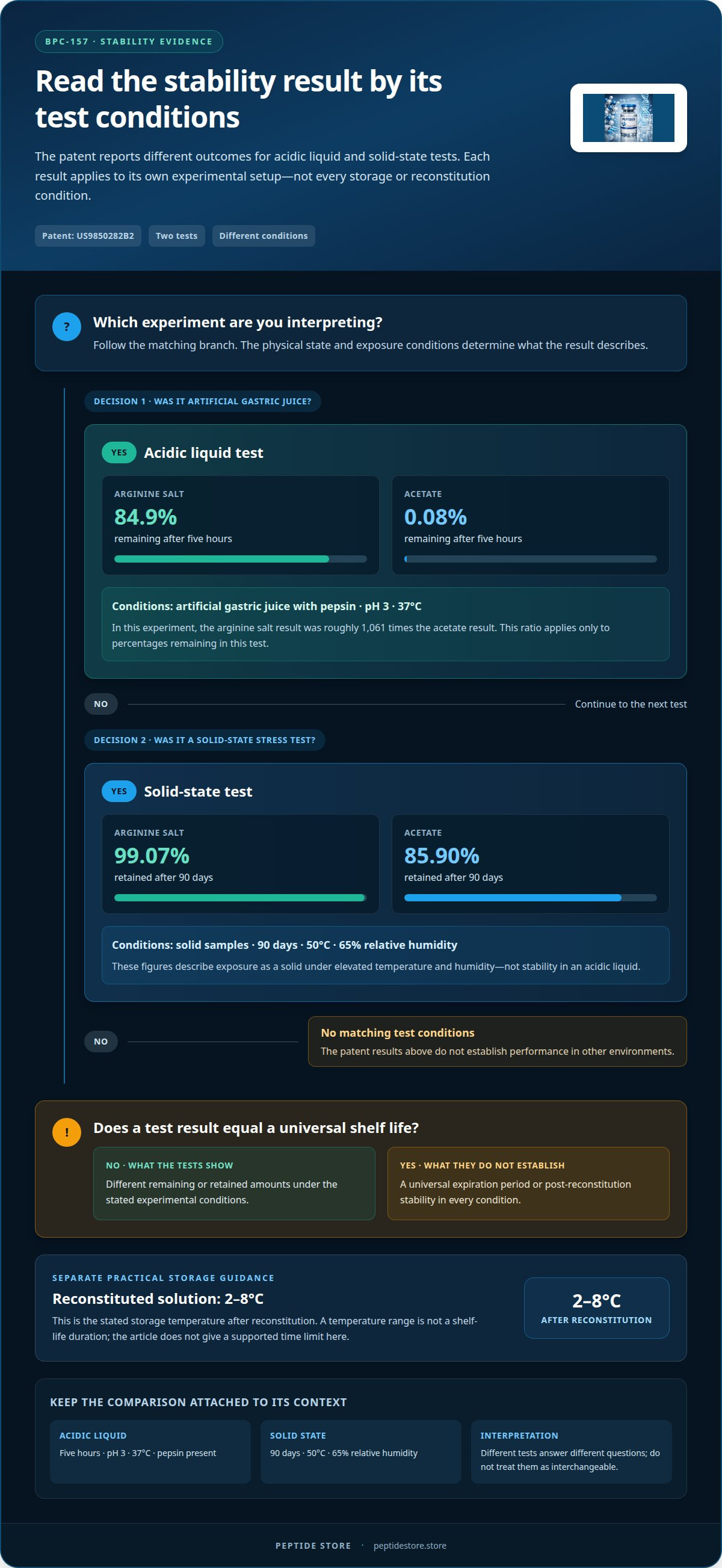
The patent’s arginine salt retained 84.9% after five hours at pH 3. Artificial gastric juice contained pepsin and was held at 37°C. In the solid-state test, the arginine salt retained 99.07% after 90 days at 50°C and 65% relative humidity. These results describe the specified experimental conditions, not every handling or storage environment.
Acetate Formulation Stability
The acetate formulation showed lower remaining material in both reported comparisons. At pH 3, it had 0.08% remaining after five hours in the artificial gastric juice test. In the solid-state stress test, it retained 85.90% after 90 days at 50°C and 65% relative humidity. The tested format and conditions differ between these experiments.
The acidic-solution results create the largest contrast. The arginine salt’s 84.9% remaining is roughly 1,061 times the acetate result of 0.08%. This ratio compares percentages remaining in one patent experiment. It is not a general measure of shelf life, potency, or performance in other conditions.
The solid-state results also favor the arginine salt, but they measure a different exposure. The 99.07% and 85.90% figures follow 90 days as solids under elevated temperature and humidity. They cannot be directly substituted for the artificial gastric juice findings, which measured remaining material in a liquid environment after five hours.
| Test condition | Arginine salt | Acetate |
|---|---|---|
| Artificial gastric juice, pH 3, five hours, 37°C | 84.9% remaining | 0.08% remaining |
| Solid, 90 days, 50°C, 65% relative humidity | 99.07% retained | 85.90% retained |
For interpretation, keep each result attached to its test conditions. The pH 3 experiment includes pepsin, while the solid test describes exposure as a solid under specified temperature and humidity. Neither result alone establishes a universal expiration period or post-reconstitution stability. The BPC-157 arginine vs acetate stability evidence therefore supports a comparison within these experiments, not an unrestricted claim that one form remains stable in every formulation.
In practical comparisons, distinguish the salt identity, physical state, exposure conditions, and reported measurement. A result from an acidic liquid test answers a different question from a solid-state stress test. Treating them as interchangeable would obscure what US9850282B2 actually measured.
What are the published shelf-life and storage recommendations for BPC-157 arginate versus acetate?
For reconstituted BPC-157, the stated storage recommendation is 2-8°C. That temperature applies after reconstitution; it does not define a shelf-life duration. A temperature range and an expiry period describe different controls. The first specifies a storage condition, while the second requires a supported time limit for a defined product and state.
Apply the 2-8°C guidance to reconstituted material, not automatically to dry powder. Reconstitution changes the sample from a solid into a solution, so storage statements for one state cannot be transferred to another. The available recommendation also does not distinguish arginate from acetate. It therefore provides a post-reconstitution temperature, not a comparative shelf-life claim for both salts.
For a research record, separate the information into three fields: salt identity, physical state, and storage condition. For example, record whether the sample is arginate or acetate, whether it remains dry or has been reconstituted, and whether the solution is held at 2-8°C. This prevents a temperature entry from being mistaken for a validated duration or a direct stability comparison.
- Salt identity: record arginate or acetate.
- Sample state: distinguish dry material from reconstituted solution.
- Temperature: use 2-8°C for reconstituted BPC-157.
- Duration: do not infer an expiry period from temperature alone.
A published shelf-life claim needs a defined starting point and endpoint. It also needs to identify the formulation and storage conditions assessed. Without those elements, a duration cannot be applied reliably to another sample. The 2-8°C recommendation should therefore remain a temperature instruction, rather than being expanded into a claim about how long either salt remains usable.
Comparisons of arginine and acetate forms require care. A temperature range alone does not show that both forms have the same shelf life or that one lasts longer after reconstitution. The salt name describes composition; storage instructions describe handling conditions. Keeping these separate makes laboratory notes easier to interpret and avoids treating unlike information as equivalent.
Use a consistent recording sequence for each preparation: identify the salt, note reconstitution, then document storage at 2-8°C. Keep any duration statement separate and tied to its supporting product-specific data. This approach does not create a shelf life; it preserves the distinction between a stated storage condition and a measured stability period.
Are there peer-reviewed studies directly comparing BPC-157 arginate and acetate formulations?
The direct comparison described here comes from U.S. patent US9850282B2, not a peer-reviewed study. The patent was granted in 2017 and reports experimental results for BPC-157 salts. A patent’s reported experiment can provide comparative data, but patent publication and peer review are distinct forms of scientific scrutiny.
One head-to-head result tested the formulations at pH 2. After 2.5 hours, BPC-157 acetate had 2.1% remaining, compared with 4.9% for the arginine salt. These figures support a difference under that specific acidic test condition. They do not establish that the same relationship applies across other environments or uses.
“Direct comparison” matters because it means both formulations were assessed under the same experiment. In the patent’s pH 2 result, the shared acidity and exposure time make the reported percentages comparable within that test. A study examining only one salt, or measuring a different outcome, would not answer the same comparative question.
Peer review and experimental design also answer different questions. Peer review evaluates a manuscript before publication; it does not, by itself, make every result universally applicable. For a salt-form comparison, readers need to identify the test environment, measured endpoint, and formulation details. The pH 2 experiment provides a specific remaining-material endpoint after 2.5 hours.
- Source type: U.S. patent US9850282B2, granted in 2017.
- Condition: pH 2 for 2.5 hours.
- Reported result: 2.1% remaining for acetate and 4.9% for arginine salt.
- Interpretation: a result for that experiment, not a universal stability ranking.
When evaluating a paper, separate the evidence into three questions: Were both salts tested directly? Were both samples exposed to the same conditions? Did the reported endpoint measure stability rather than another property? A formulation or pharmacokinetic study, for example, may address a different question from the patent’s test of remaining material.
The evidence supports a careful conclusion: US9850282B2 reports a direct experimental comparison, while the figures cited here are patent findings rather than peer-reviewed study results. That distinction keeps the comparison precise. It also prevents the pH 2 observation from being treated as proof of clinical outcomes, storage duration, or performance beyond the tested conditions.
Other records may be relevant to the broader formulation question without answering whether peer-reviewed work directly compares the two salts. European patent application EP4226918A1 was published in 2023 and describes oral BPC-157 formulation measurements; that description alone does not establish a peer-reviewed, head-to-head comparison of arginate and acetate. Regulatory review is a separate evidence category as well. The FDA advisory committee reviewed BPC-157 on 23 July 2026 for the list of substances pharmacies may compound; the page reports that the committee voted eight to six in favour. That vote records the committee’s position on the compounding-list question, not evidence that one salt outperforms the other or confirmation of a peer-reviewed comparison. Accordingly, neither item changes the narrow conclusion above.
How do arginate and acetate salts affect BPC-157 solubility and reconstitution?
Salt identity can influence solution behavior, but solubility and stability are different measurements. Solubility describes how much material dissolves under defined conditions; stability describes how much remains intact over time. The patent comparisons report solution pH and remaining material, but those results alone do not quantify solubility or establish a reconstitution procedure.
For BPC-157, pH is one factor that can affect peptide charge and interactions with a solvent. Concentration, solvent composition, and other solution conditions also influence observed dissolution. Therefore, the arginate and acetate forms should not be assumed to behave identically during reconstitution. Nor does a difference in solution pH, by itself, prove that one form dissolves faster or more completely.
A controlled laboratory comparison should keep conditions consistent. Record each preparation’s salt identity, solvent composition, target concentration, and measured pH. Use the same mixing approach and observation period for both samples. Document whether the material appears dissolved, but keep that observation separate from a chemical stability assay. This helps identify which variable may explain a difference.
- Identify the form: record arginate or acetate for each sample.
- Record solution conditions: include solvent composition, concentration, and measured pH.
- Keep comparisons aligned: use the same observation and mixing conditions.
- Separate endpoints: note dissolution separately from chemical integrity over time.
Visual clarity is not a complete stability result. A clear BPC-157 solution does not establish that the peptide remains chemically intact. Conversely, visible residue does not identify its composition or explain whether salt form, concentration, or solvent conditions caused it. A validated analytical method is needed to assess chemical integrity beyond visual inspection.
Interpret the patent’s solution pH data as properties of the specific preparations tested. They do not establish universal pH values for every solvent or concentration, nor do they provide a general mixing ratio, solvent choice, or reconstitution sequence. Keep procedures specific to the formulation and experimental conditions in use, rather than extrapolating from a different preparation.
For a defensible comparison, pair dissolution observations with defined solution conditions and an appropriate stability measurement. This separates practical handling behavior from chemical degradation and avoids treating one as evidence for the other. Researchers assessing peptide materials can review the research product catalog as part of their laboratory sourcing process.
Peptide Store
Peptide Store helps research-focused readers move from formulation comparisons to peptide sourcing for laboratory applications. The stability evidence discussed above clarifies how to interpret salt-form findings; it does not replace product-specific research or establish clinical use. For related research needs, the catalog includes Tirzepatide, Retatrutide, Semaglutide, and Cagrilintide.
Turn to Peptide Store when your next step is reviewing available research compounds for laboratory work. Keep selection criteria aligned with the study objective and the compound’s documented identity. For questions about the catalog, contact Peptide Store.
Set the Next Research Question
Use the comparison to frame a precise research question before selecting a formulation. Decide what the work needs to evaluate: salt identity, solution behavior, or a defined stability endpoint. Then align the experimental design with that objective, so observations answer the intended question rather than invite broad assumptions. A clear protocol also helps distinguish measured findings from conclusions that go beyond the experiment.
The evidence on BPC-157 arginine vs acetate stability is most useful when applied within those boundaries. For further research sourcing, Peptide Store provides a pathway to explore research compounds while keeping laboratory objectives central. Contact Peptide Store to discuss your research needs, and take the next step with a clearly defined plan.
Contact Peptide Store for help. A focused question is a strong starting point for the work ahead.
Frequently Asked Questions
BPC-157 Arginate vs Acetate: What Is Proven?
The evidence supports differences under specific experimental conditions, not a universal stability ranking. U.S. patent US9850282B2 reports comparisons in acidic artificial gastric juice and a separate solid-state test. These results can inform the BPC-157 arginine vs acetate stability comparison, but they don’t establish clinical outcomes or identical performance across other formulations. Interpret each finding alongside its test environment, measurement endpoint, and sample state.
What is the difference between BPC-157 arginate and BPC-157 acetate?
They are different salt forms of the same BPC-157 peptide, associated with different counter-ions. This distinction matters when interpreting a sample’s total mass: the weighed salt includes more than peptide alone. For example, a label stating salt mass shouldn’t automatically be read as the same mass of BPC-157 peptide. Accurate comparisons need to distinguish the salt name, peptide-equivalent content, and formulation conditions.
How does BPC-157 arginate compare with acetate in stability studies?
In the patent’s acidic artificial gastric juice experiment, the arginine salt retained more material than acetate under the reported conditions. A separate solid-state stress test also reported greater retention for the arginine salt. These are distinct experimental contexts, so they should not be combined into one shelf-life estimate. For any comparison, identify whether the result concerns a solution or solid and which endpoint was measured.
What temperatures and pH conditions affect BPC-157 arginate and acetate stability?
The patent describes an artificial gastric juice experiment with pepsin at 37°C, including acidic conditions at pH 3. It also reports an acidic comparison at pH 2 after 2.5 hours. A separate solid-state test used 50°C and 65% relative humidity. These conditions describe specific experiments; they shouldn’t be treated as general storage instructions for every preparation.
Does BPC-157 arginate remain stable longer in aqueous solution than BPC-157 acetate?
The reported acidic-solution tests showed more material remaining for the arginine salt than acetate at the measured endpoints. They don’t establish a general duration for stability in every aqueous solution. A result in acidic artificial gastric juice cannot define how long a different concentration or solvent remains stable. For laboratory interpretation, keep the test medium, pH, temperature, and measurement time attached to each result.
What evidence supports claims that BPC-157 arginate is more stable than acetate?
The principal evidence described here is the comparative experiment in U.S. patent US9850282B2, alongside its solid-state stress test. The patent reports measurements for both salt forms under specified conditions. That provides a basis for a limited, condition-specific comparison; it isn’t the same as a peer-reviewed comparative paper or a universal stability specification. Claims should identify the experiment and avoid extending its findings beyond the tested conditions.


