

The same name can refer to research compounds with different persistence profiles. The term cjc 1295 is often used for a growth hormone-releasing hormone (GHRH) analogue, but DAC status and the label “Mod GRF 1-29” can make online descriptions difficult to compare.
That confusion is understandable: terminology is used inconsistently, and preliminary findings can be presented as though they establish human benefits. This article clarifies the proposed GHRH-related mechanism and explains how CJC-1295 with DAC differs from the no-DAC form commonly described as modified GRF 1-29. It also separates reported research findings from conclusions the evidence cannot support.
The discussion reviews the limited primary research, considers why study design and molecular form matter when interpreting results, and outlines documentation considerations for laboratory work. CJC-1295 is an experimental research compound, not an established treatment. Findings from small or early studies should not be treated as proof of safety or efficacy in people. The aim is to provide a precise framework for reading the literature, understanding its limits, and placing research-grade materials in an appropriate laboratory context.
Key Takeaways
- Use the term cjc 1295 with care: identify the molecular form before comparing research findings.
- Understand how DAC and non-DAC terminology relates to differences in the compounds’ research profiles.
- Separate primary studies, reviews, model-based findings, and anecdotal claims when weighing evidence.
- Assess each study by its research question, experimental model, and measured endpoints, without treating results as clinical proof.
- Recognize that research-grade designation does not establish human suitability. Batch identification and analytical records are relevant documentation to assess.
What Is CJC-1295? A Research-Focused Introduction
CJC-1295 is a synthetic peptide studied as an analogue of growth hormone-releasing hormone (GHRH), a signaling molecule involved in regulating growth hormone release. The pituitary gland produces growth hormone (GH), while insulin-like growth factor 1 (IGF-1) is a related hormone and research marker that can respond to GH signaling. These terms describe a biological pathway, not a proven health outcome.
CJC-1295 is a research peptide classified by its relationship to GHRH signaling, not by evidence that it produces an established clinical benefit. That distinction matters: a plausible mechanism, a measured change in a laboratory model, and an effective treatment represent different levels of evidence. The name alone does not establish what a particular study tested or what its results can support.
Where CJC-1295 Fits in Growth Hormone Research
At a high level, the hypothalamus releases GHRH, which signals the pituitary to release GH. Researchers study compounds related to this pathway to examine hormone signaling and downstream responses. IGF-1 may be measured as one such response, but its level is influenced by multiple biological factors. A compound’s classification does not guarantee a change in this marker.
A paper reporting pathway activity does not, by itself, demonstrate improved health, safety, or effectiveness in people. Interpretation depends on what was tested, in which model, and against which endpoint. The CJC-1295 Wikipedia article offers an overview of terminology and reported distinctions, but primary studies and authoritative records are needed to assess individual claims.
Research Compound Versus Approved Medication
“Research-grade” describes a material supplied for laboratory or scientific research. It does not establish that the material is approved as a medicine, suitable for human use, or manufactured to clinical standards. A supplier’s product description and a regulator’s approval record answer different questions. Claims about approval or legal status should be checked against current, authoritative sources for the relevant jurisdiction, rather than inferred from online marketing.
For researchers, this distinction also shapes how evidence should be communicated. Report findings from an experimental material with the study model, methods, and limitations, without translating them into treatment claims. The term “peptide” does not itself indicate a drug’s regulatory status or establish quality for clinical use.
Peptide Store’s catalog includes CJC-1295 as a research-grade compound for laboratory and scientific applications. This article provides scientific context only; it does not offer treatment advice, dosing, or administration instructions. Keeping these boundaries clear helps readers assess research on its own terms and prevents biological descriptions from being mistaken for clinical guidance.
CJC-1295 DAC and Non-DAC Forms: What the Distinction Means
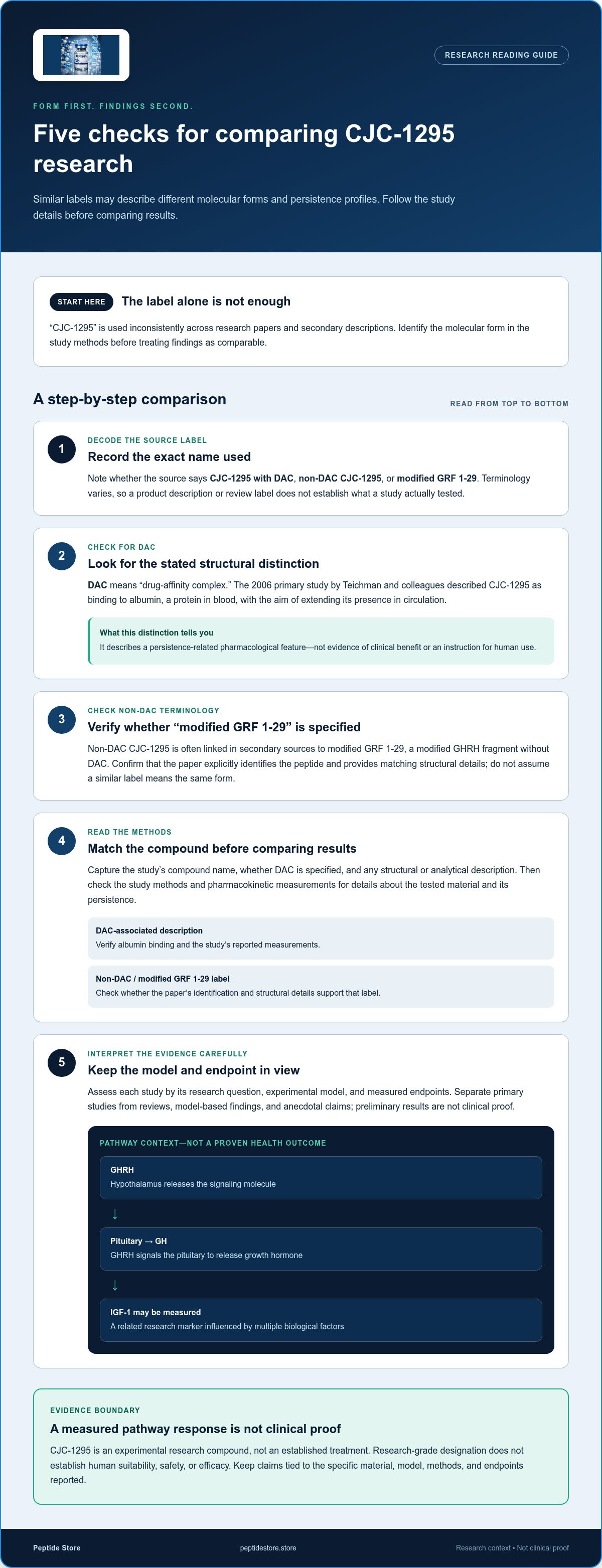
“CJC-1295” does not always identify the same molecular form across research papers and secondary descriptions. The DAC distinction matters because it describes a structural modification associated with longer persistence, while non-DAC labels are often linked to modified GRF 1-29. Check the name against each study’s methods rather than assuming these forms are interchangeable.
| Label in a source | What it generally indicates | What to verify |
|---|---|---|
| CJC-1295 with DAC | A form incorporating a drug-affinity complex, described as enabling albumin binding and longer persistence. | Exact compound identity, study methods, and pharmacokinetic measurements. |
| Non-DAC CJC-1295 | A label often used in secondary sources for a shorter-acting form associated with modified GRF 1-29. | Whether the paper explicitly identifies the peptide as modified GRF 1-29 and provides matching structural details. |
What DAC Means in Published Descriptions
DAC stands for “drug-affinity complex.” In the 2006 primary study by Teichman and colleagues, CJC-1295 was described as binding to albumin, a protein in blood, with the aim of extending the compound’s presence in circulation. This persistence is a pharmacological distinction, not a human-use instruction or evidence of clinical benefit. Use the study’s methods and results for exact duration and pharmacokinetic values, rather than relying on unsourced summaries.
How to Read Non-DAC and Mod GRF 1-29 Labels
“Mod GRF 1-29” is commonly used for a modified GHRH fragment without DAC, and some secondary sources call this non-DAC CJC-1295. Terminology varies, however. A label in a product description or review is not a substitute for a primary paper’s characterization of the tested material. Record the exact name and form stated in each study, along with the source of that identification.
Establish compound identity before comparing study results, because a shared or similar label can conceal a different molecular form and persistence profile. For example, a paper describing DAC-associated albumin binding should not be treated as direct evidence about a compound identified only as modified GRF 1-29 unless its methods support that comparison. If an article gives only an abbreviated label, note the ambiguity rather than filling it with assumptions.
For a literature review, capture the study’s compound name, whether DAC is specified, and any structural or analytical description supplied by the authors. Then compare experimental endpoints only across sources with sufficiently clear compound identification. This recordkeeping step helps prevent a terminology mismatch from being mistaken for a biological difference.
Researchers reviewing materials for laboratory work can consult the research peptide catalog in the context of the specific compound and form under study. Catalog naming should not replace review of the material’s documentation or the methods reported in published research.
What CJC-1295 Research Shows, and What It Cannot Establish
Read evidence about cjc 1295 by source type and endpoint. A primary study reports original methods and results; a review summarizes other publications; animal or cellular experiments test defined models; and anecdotes describe individual experiences without the controls needed to establish cause and effect. These categories answer different questions and should not be treated as equally strong evidence for human outcomes.
The 2006 report by Teichman and colleagues describes randomized, placebo-controlled, dose-escalation studies in healthy adults. Early human research reported increases in growth hormone (GH) and insulin-like growth factor 1 (IGF-1) after CJC-1295 exposure. These are measured hormone responses, not evidence that the compound changes body composition, extends lifespan, or improves another health outcome. The report’s population, duration, endpoints, and compound form define what its findings can support.
| Evidence or claim | What it can show | Key limitation |
|---|---|---|
| Primary human studies | Measured responses, such as GH or IGF-1 changes, under the reported study conditions. | Hormone changes do not establish clinical benefit, long-term safety, or generalizability. |
| Reviews | How authors summarize and interpret cited research. | Conclusions depend on the studies selected and their quality; a review is not a new experiment. |
| Animal or cellular models | Biological effects in the specific species, cells, and experimental conditions tested. | Model findings do not directly predict human outcomes. |
| Anecdotal reports | Questions or experiences that may motivate further research. | Without controlled comparisons, they cannot establish cause, effect, or frequency. |
| Claims about muscle, fat loss, sleep, or longevity | Potential research questions. | Human outcome conclusions remain unresolved unless directly tested with suitable evidence. |
How to Evaluate a CJC-1295 Study
Start with the methods, not the headline. Record the species or participant population, sample size, comparator, study duration, exact compound form, and measured endpoint. Then ask whether the result is a statistical observation or a meaningful clinical outcome. A finding in one population or model may not generalize to another, especially when the study measures biomarkers rather than function or health.
Why Popular Benefit Claims Need Caution
A proposed mechanism can explain why researchers measure a pathway, but it cannot prove a specific benefit. GH or IGF-1 changes alone do not demonstrate muscle gain, fat loss, better sleep, or longevity. Those outcomes require direct measurement in appropriate studies. Short or limited research also cannot settle questions about uncommon harms or long-term safety.
Reviews and online summaries are useful starting points, but trace each claim to the cited primary paper. Confirm that the paper studied the same molecular form and endpoint being discussed. If it did not measure the advertised outcome, classify that claim as untested rather than demonstrated.
How to Interpret CJC-1295 in Laboratory Research
A useful interpretation starts with the research question, not the headline result. A study may examine receptor-related signaling, changes in growth hormone (GH) or insulin-like growth factor 1 (IGF-1), or another biological endpoint. These questions require different measurements and do not support the same conclusions.
Model-specific findings should not be generalized automatically to other models or to human outcomes. A cellular response, an animal result, and a human biomarker observation each apply first to the conditions tested. Comparing them without accounting for those differences can obscure what the evidence actually shows.
Define the Research Question and Model
Before comparing results, identify what the investigators intended to measure and which system they used. Record the model, compound form, comparator, and endpoint, then note the model’s limitations. For instance, a cell-based signaling assay may help characterize a pathway, but it cannot establish a whole-organism response. Animal observations also require cautious interpretation before proposing human relevance.
A practical reading workflow is:
- Define the question: Is the study testing a signaling mechanism, hormone marker, or another outcome?
- Identify the material: Record the compound name and whether the paper specifies DAC or another form.
- Assess the model: Note the species or cell system, population, and relevant study conditions.
- Evaluate the endpoint: Distinguish the measured variable from broader claims the study did not test.
Track Variables That Affect Interpretation
Methods sections provide essential context. Check how the investigators identified the compound, whether analytical verification is reported, and what the paper says about storage and sample handling. Missing details do not prove that a study is invalid, but they can limit reproducibility and make cross-study comparisons less certain.
Assay design matters too. Look for appropriate positive and negative controls, the comparator used, the assay method, and when measurements were collected. Timing can affect interpretation of a changing biological marker; a single measurement may not describe the full response. Consider whether the reported outcome is consistent across replicates and whether the authors explain variability.
Keep experimental variables separate from clinical dosing or self-administration. This section does not provide a protocol. Technical decisions belong within the study’s approved institutional procedures, with relevant oversight and documentation in place. Researchers reviewing research peptide materials can use the compound’s identity and accompanying records as part of a broader assessment, rather than treating a catalog label as a substitute for study-specific methods.
For repeatability, document the source and batch identifier, the form named in the study, assay conditions, controls, and any deviations from the published method. Clear records make it easier to distinguish a genuine difference in findings from variation in material, model, or measurement.
Research-Grade CJC-1295: Documentation and Responsible Next Steps
A “research-grade” designation describes a material’s stated research context. It does not establish suitability for human use, clinical quality, or approval as a medicine. For researchers, documentation helps connect a material to a specific experiment and supports traceability. It cannot, on its own, validate a study’s findings or resolve questions about human safety and efficacy.
Documentation to Consider for Research Materials
Review material records against the requirements of the planned laboratory work. Focus on details that let a research team identify what was used, compare it with the study design, and document the material consistently. Do not infer analytical quality from a label alone.
- Batch identification: Record the material’s identifier so the research record can distinguish one batch from another.
- Stated specifications: Compare the named compound and form with the research question and terminology used in the relevant publication.
- Analytical records: Assess the method described, what was measured, and whether the documentation clearly corresponds to the material or batch.
- Handling information: Capture applicable storage and sample-handling details, since undocumented variation may complicate reproducibility.
These are documentation checks, not claims about a particular test, certificate, purity level, or guarantee. For cjc 1295 research, recording the stated identity and batch information can help researchers interpret results in context and distinguish material records from evidence generated by a study.
Research-Only Boundaries and Further Reading
Material sourcing and scientific evidence answer separate questions. A catalog entry describes a research material; a paper reports observations under its methods and conditions. Neither establishes that a compound is safe, effective, or suitable for human consumption. Experimental findings also do not determine an individual treatment decision.
This article is educational. It does not provide dosing, administration, treatment, or medical-consultation guidance. Technical work should follow relevant institutional procedures and oversight, while claims about approval or regulatory status should be evaluated using current authoritative sources.
Before comparing studies, preserve the distinction between compound identity, experimental documentation, and measured outcomes. A batch record cannot substitute for a controlled study, and a reported biological response cannot establish a clinical benefit. Keeping these evidence layers separate supports more accurate interpretation and responsible reporting.
For laboratory and scientific research applications, CJC-1295 is included in Peptide Store’s catalog of research-grade peptide compounds. Use the research peptide catalog as a material reference, while assessing study methods and documentation independently.
Carry Research Forward with Clear Documentation
The next useful step is to turn an open question about cjc 1295 into a research plan that can be evaluated and reproduced. Define the endpoint before reviewing results, preserve source and batch details for materials used, and document the limits of the model. This discipline helps keep future findings interpretable, especially when terminology or experimental conditions differ across publications.
Peptide Store’s research peptide catalog includes CJC-1295 and more than 150 research peptide compounds for laboratory and scientific applications. For cjc 1295, catalog access is a sourcing step, not evidence of clinical quality, human suitability, or a treatment outcome. Keep those distinctions explicit in research records and any discussion of results.
View CJC-1295 and other research compounds for laboratory research applications. With a defined question and careful documentation, researchers can assess the available evidence more rigorously and contribute to clearer future work.
Frequently Asked Questions
Is CJC-1295 FDA-approved for human use?
No. The FDA has not approved CJC-1295 for human use. Laboratory research availability is separate from FDA authorization and does not demonstrate safety, efficacy, or clinical quality. For current United States status, consult FDA records and official agency statements rather than relying on seller descriptions or wellness marketing. As of October 2026, CJC-1295 remains unapproved for medical use. This is factual context, not legal advice or a treatment recommendation.
Can findings from animal or cellular CJC-1295 studies be applied to humans?
Not on their own. Animal and cellular findings can help researchers develop hypotheses, but they do not independently establish human pharmacology, safety, or outcomes. Biological systems differ, and study design, exposure conditions, and measured endpoints can affect results. For example, a cellular response may not reflect how an intact organism responds. Before drawing conclusions, identify the model and determine exactly what the investigators measured.
Does CJC-1295 occur naturally in the body?
No. CJC-1295 is described as a synthetic peptide analogue related to growth hormone-releasing hormone (GHRH), which occurs naturally and participates in hormone signaling. A relationship in structure or pathway does not make the synthetic analogue identical to the body’s own GHRH. When reading a paper, distinguish the naturally occurring signaling molecule from the experimental compound, particularly if the authors discuss shared biological targets.
Can CJC-1295 research be combined with research on other peptides?
Combination research requires its own defined question, controls, and evidence. Results for one compound cannot establish an interaction, added effect, or benefit when another compound is present. Researchers need a design capable of distinguishing each compound’s contribution from the combination’s observed response. Avoid treating separate studies as evidence for a combined effect. This answer concerns experimental interpretation only and does not provide combinations, doses, administration instructions, or human-use recommendations.
What does a CJC-1295 study need to report for its findings to be interpretable?
Readers need enough detail to identify what was tested and how the result was obtained. Check the compound form, model or participant population, comparator, endpoints, measurement methods, study duration, and stated limitations. For example, an endpoint label without the assay method may make results difficult to compare across papers. Consult the methods and any available source data; incomplete reporting limits confidence in cross-study comparisons.
How should researchers interpret claims about CJC-1295 and IGF-1?
Treat a reported IGF-1 change as a biomarker observation, not proof of a clinical outcome. Interpretation depends on the model or participant group, measurement method, timing, and duration of observation. A result from one sampling point may not describe a longer-term pattern, and a change alone does not demonstrate a particular health benefit. Check whether the study directly measured the outcome being claimed before drawing a connection.
What does research-grade mean for CJC-1295?
“Research-grade” indicates a research-use context; the phrase itself does not establish clinical approval, human safety, or suitability for consumption. For scientific records, assess the stated material identity and associated analytical information, including whether records clearly correspond to the material being evaluated. Do not infer specific tests, certifications, or quality levels from the designation alone. Documentation supports traceability, but it does not establish clinical suitability or prove a research finding.


