

A sleep-related name can sound like a proven effect, but a label isn’t evidence. The dsip peptide, or delta-sleep-inducing peptide, has been studied in connection with sleep and other biological processes. Its name alone doesn’t establish how it works or whether it reliably changes sleep in humans. Proposed mechanisms remain uncertain, and much of the human research is older and limited.
Interest in DSIP can make preliminary findings and promotional claims difficult to distinguish. This article explains what the peptide is, summarizes its research background, and separates hypotheses and preclinical observations from human evidence. It also examines what current findings don’t establish, including clinical efficacy and long-term safety. Use the framework below to assess specific claims by checking the research model, the measured outcome, and the study’s limitations.
Key Takeaways
- Interpret the dsip peptide’s sleep-related name as historical terminology, not proof of a reliable clinical effect.
- Separate proposed biological pathways from demonstrated mechanisms, and check whether a finding shows association or causation.
- Compare evidence by research model, question, measured endpoint, and limitation before drawing conclusions.
- Trace claims to the original study and review its methods, results, limitations, and replication status.
- For laboratory research, review material identity, batch traceability, and analytical documentation without inferring clinical efficacy.
What Is the DSIP Peptide? Identity, Name, and Research Context
DSIP is a naturally occurring peptide studied for possible relationships with sleep-related physiology and other biological processes. It is commonly described as a nonapeptide, meaning it contains nine amino acids. Its sleep-related name reflects the context in which it was identified, not proof that it reliably induces sleep or has an established clinical effect.
DSIP is a nine-amino-acid peptide investigated in sleep-related research, but its name does not establish a clinical sleep effect or medical use. A research molecule can be studied to answer a biological question without being an approved medicine or a proven intervention.
What does DSIP stand for?
DSIP is commonly expanded as delta-sleep-inducing peptide. Historical accounts trace its isolation to Swiss researchers in 1974, during investigations into factors associated with sleep. The name remains in scientific and general reference material, but it should not be read as a settled description of the peptide’s mechanism or a promise of a specific outcome.
DSIP’s reported amino-acid sequence is Trp-Ala-Gly-Gly-Asp-Ala-Ser-Gly-Glu. That nine-residue structure is one part of its molecular identity. It does not, by itself, establish biological activity, safety, or clinical value. The Delta-sleep-inducing peptide (DSIP) overview summarizes the naming and historical context. For formal scientific work, use summaries as orientation, then consult primary literature and analytical documentation relevant to the research question.
Why does DSIP appear in peptide research?
Sleep involves interacting neural, hormonal, and behavioral systems. Researchers have examined whether DSIP is associated with aspects of sleep regulation and related biological responses. These questions are different from claims that the peptide causes sleep, treats a sleep disorder, or produces a dependable effect in people. A proposed pathway remains a hypothesis until evidence supports it, and observations in one model cannot automatically be generalized to another.
The term dsip peptide describes a molecule, not an indication-specific medicine. A medicine’s clinical status depends on evidence and regulatory review for a defined use. A peptide’s appearance in studies or a supplier catalog does not confer that status. DSIP should therefore be discussed as a research subject, not presented as an established treatment.
Responsible interpretation starts with molecular identity and the quality of the material used in an experiment. Documentation may include the stated sequence, batch traceability, and analytical methods used to assess identity or composition. These are general considerations in laboratory peptide standards. They support evaluation of research materials but do not demonstrate efficacy or safety. The next step is to examine what each study design measured and what its limitations leave unresolved.
How DSIP Research Examines Sleep-Related Biology
Research into DSIP asks whether the peptide is associated with measurable changes in sleep or related physiological systems. That question is narrower than claiming a reliable sleep effect. A change observed in an experiment does not, by itself, show that DSIP caused it, explain the biological route involved, or predict what would happen in people.
A proposed pathway is a testable explanation, not an established mechanism. A measured change is evidence only within the limits of the model and method used. This distinction matters because DSIP’s exact physiological role remains debated, and a specific receptor has not been identified.
Which mechanisms have researchers proposed?
Historical and later research has explored possible links between DSIP, sleep-related activity, stress responses, and hormonal regulation. These are areas of investigation, not a settled account of how the peptide acts. A reported physiological association cannot identify a receptor or prove that DSIP directly initiates a downstream response. Tie mechanistic claims to the primary study that tested them, including its model, measurement, and controls.
When evaluating a proposed signaling route, distinguish evidence that a pathway changed alongside an outcome from evidence that manipulating the pathway produced or prevented that outcome. The latter can strengthen a causal argument, but it still may not establish a mechanism across species or study conditions. Treat broad statements that DSIP “regulates sleep” cautiously unless the cited experiments support that precise conclusion.
How do researchers measure sleep-related outcomes?
Sleep is not a single endpoint. Studies may assess sleep onset, total sleep time, awakenings, or the distribution of sleep stages, known as sleep architecture. Electroencephalography (EEG) records electrical activity used to characterize sleep states. Other measures may capture behavior or physiological responses. These endpoints answer different questions: a change in one measure does not automatically mean overall sleep quality improved.
Study design also shapes what a result can establish. Species differ in sleep patterns and physiology, while experimental models may not reproduce human sleep conditions. The amount administered, timing relative to the sleep-wake cycle, observation window, and measurement method can each affect the result. A brief recording, for example, may miss changes that emerge over a longer period. Behavioral observation alone may not identify sleep stages as EEG can.
For responsible interpretation, check whether the reported outcome was defined in advance, how long it was measured, and whether comparison groups were used. Then look for independent replication. Without those details, a headline or abstract can make an isolated observation sound broader than the evidence supports. Compare findings by model, endpoint, and limitation rather than treating all DSIP studies as equivalent.
What Does the Evidence on DSIP Show, and What Remains Uncertain?
Read evidence about DSIP by study type rather than combining it into a single claim about sleep. Cell experiments can help examine biological plausibility, animal studies can test responses in a whole organism, and human studies can provide directly relevant observations. These categories do not automatically answer one another’s questions. In particular, a sleep-related name does not prove a reliable sleep effect or establish clinical efficacy.
What can preclinical studies establish?
In vitro research can investigate how a peptide interacts with cells or measured molecular processes under defined conditions. Animal research can examine broader physiological responses and sleep-related endpoints within a living model. These approaches can generate hypotheses and identify questions for further testing. On their own, they cannot show that the same effects occur in people or that a measured change would be meaningful in a clinical setting.
Interpretation depends on the model, experimental conditions, measurement method, and endpoint. A result in one species may not translate to another, and a finding about a particular sleep measure does not establish an overall benefit. Check study-specific methods and controls rather than summarizing one result as a general effect of the dsip peptide.
How should human evidence be interpreted?
Human research on DSIP is limited and largely dates from the 1980s and 1990s. The available body of work is considered methodologically dated, so it cannot support a confident clinical conclusion about efficacy or long-term safety. To assess an individual report, review its design, participant population, sample size, comparison group, measurement period, and stated limitations. Don’t infer these details from a summary or general claim.
The table separates the questions each evidence type can address from the boundaries on interpretation.
| Model | Research question | Measured endpoint | Key limitation |
|---|---|---|---|
| In vitro | Does DSIP interact with a cellular process under experimental conditions? | Cellular or molecular response selected by the study | Does not establish whole-organism or human effects |
| Animal | Is DSIP associated with a physiological or sleep-related response in that species? | Study-defined sleep or physiological measure | Species, model, and endpoint limit translation |
| Human | Was a sleep-related outcome observed in the studied participants? | Study-defined sleep measure or reported outcome | Older, limited evidence cannot establish current clinical efficacy or long-term safety |
For each claim, trace the summary back to the original paper and check whether the conclusion matches the measured endpoint. An observed association is not necessarily causation, and a result in one setting does not prove a dependable effect elsewhere. The evidence supports careful evaluation, not an assumption that DSIP is an established sleep treatment.
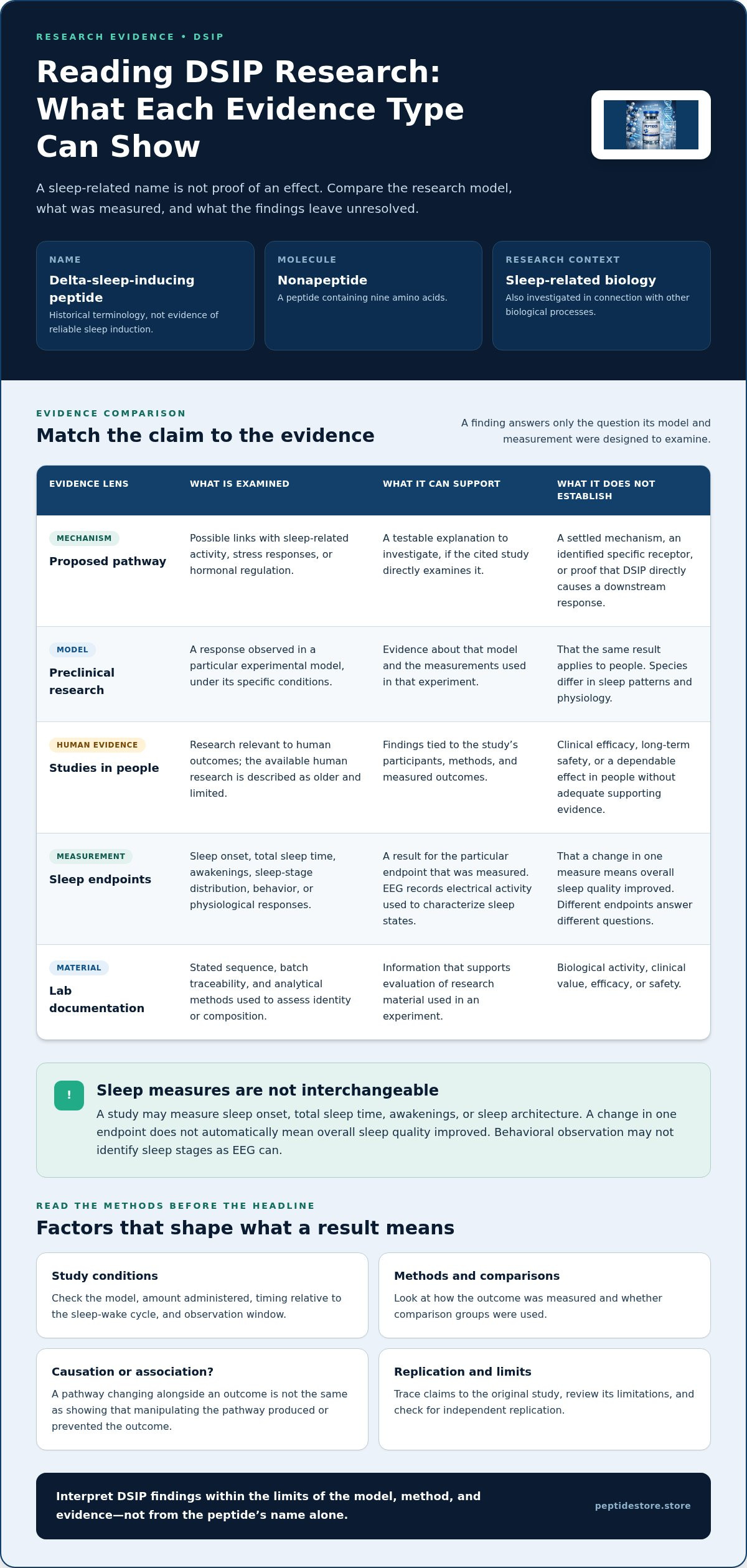
How to Appraise a DSIP Peptide Research Claim
A claim about DSIP is only as strong as the evidence behind it. Use this sequence to assess what a study actually supports instead of relying on a headline, abstract, or promotional summary:
- Identify the source. Locate the original peer-reviewed study when one is cited. A review can help map a topic, but it summarizes earlier work. Marketing copy and anecdotes are not substitutes for primary research.
- Identify the model. Determine whether the work used cells, animals, or human participants. Evidence from one model does not automatically establish an effect in another.
- Check the methods. Review the controls, sample size, study design, and measurement procedures. Missing or unclear methods make results harder to interpret or reproduce.
- Match the endpoint to the claim. Ask whether researchers measured the specific outcome being asserted. A change in one sleep-related measure, for example, cannot alone demonstrate a broad or reliable sleep effect.
- Read the limitations and replication record. Note the authors’ stated constraints, conflicting results, and whether independent studies report comparable findings.
Abstracts are useful entry points, not complete evidence reviews. They compress methods and results, and their conclusions may not convey the uncertainty visible in the full paper. Promotional summaries may omit limitations as well. Compare the stated conclusion with the actual methods, results, and discussion before repeating a claim.
Which study details matter most?
Start with the research question and comparison group: what was tested, against what, and in which model? Then verify that the measurement could answer the question. If a claim concerns sleep architecture but the study reports only a different physiological endpoint, the claim extends beyond the result. Record limitations and look for replication, including studies that disagree. A single positive report does not establish a consistent finding.
How can researchers avoid overinterpreting claims?
Separate three levels: an observed result, a proposed explanation for that result, and a clinical conclusion. A plausible mechanism remains a hypothesis unless direct evidence supports it. A cellular or animal finding does not establish a human outcome. For DSIP, unclear sourcing, absent methods, or extrapolation across models should lower confidence rather than be filled in with assumptions.
Context also matters across peptide research. Studies of BPC-157 and cellular repair ask different questions and examine a different peptide; they cannot be used as evidence for DSIP. Peer-reviewed publication means a study entered scholarly review, not that its conclusions are definitive. Keep research appraisal separate from personal medical decisions, and don’t treat laboratory findings as treatment guidance.
Peptide Store’s research peptide catalog provides a way to browse research compounds across specialized categories. Product listings and catalog access are separate from the evidence needed to assess DSIP research claims.
DSIP in Responsible Laboratory Research and Research-Material Evaluation
Responsible laboratory work begins with a defined research question and a record of the materials and methods used. For DSIP, documentation helps researchers determine whether another study used a comparable material and whether results can be interpreted or reproduced. Documentation does not resolve uncertainty about the peptide’s biological effects or turn a research finding into evidence of clinical efficacy.
What documentation supports research interpretation?
Useful documentation may identify the material, its stated sequence or identity, batch or lot identifier, and the analytical methods reported for that batch. Researchers can also record the source of each document, its date, and the specific material it describes. These details support traceability. If results differ, investigators can assess whether material identity or documentation may be relevant.
A document’s presence is not independent confirmation that its conclusions are correct. Interpret an analytical report in context, including the method, stated scope, and batch to which it applies. General principles for evaluating identity, traceability, and analytical methods are discussed in this research peptide standards guide. These principles inform material assessment; they do not verify any particular DSIP material or establish a biological effect.
Where does laboratory research end?
Research-grade materials are intended for laboratory and scientific applications, not presented as human medicines or treatment options. Research planning should remain distinct from personal medical decisions. This discussion does not provide clinical dosing, preparation instructions, self-experimentation guidance, or medical advice. The presence of a compound in research or a catalog is not evidence that it is suitable or effective for human use.
For reproducibility, connect each result in the laboratory record to the material documentation and analytical methods actually reviewed, and note any gaps or unresolved questions. Avoid describing a result more broadly than the experiment supports. A verified identity record, for example, may support material traceability, but it does not establish purity beyond the method’s scope, biological activity, safety, or efficacy.
The same discipline applies when comparing findings across publications. Differences in reported identity, batch documentation, analytical methods, and experimental models can complicate comparisons. Preserve those distinctions in notes and reports rather than assuming materials or study conditions are interchangeable. Clear records help readers assess what was examined and what remains unknown.
Peptide Store supplies research-grade peptide compounds for scientific and laboratory applications across specialized categories. Use the research catalog to browse the compounds offered for research-material evaluation, while assessing scientific claims separately through primary evidence and study documentation.
Carry Evidence Standards Into Your Next Research Step
Keep the same discipline in future peptide research: define the question before reviewing claims, record the limits of each source, and avoid extending a finding beyond the model and endpoint studied. For the dsip peptide, that approach preserves the distinction between an active research question and an established clinical conclusion.
Peptide Store supplies research-grade compounds for scientific and laboratory applications, with a catalog of more than 150 research compounds across specialized categories. The catalog is a resource for browsing research materials, not evidence of a compound’s clinical suitability or efficacy.
Browse Peptide Store’s research peptide catalog to explore available research categories. Build your assessment from primary evidence, careful documentation, and appropriately bounded conclusions.
Frequently Asked Questions
What is the DSIP peptide?
DSIP is the abbreviation for delta-sleep-inducing peptide, a peptide studied in connection with sleep-related biology. You may also encounter the name emideltide in reference material. These labels identify the research subject; they don’t establish a particular effect or intended medical use. When comparing publications, check whether authors are discussing the same molecule and terminology before treating separate reports as evidence about one consistent subject.
Does DSIP actually induce sleep?
Current evidence doesn’t establish DSIP as a reliable sleep-inducing agent in humans. The word “inducing” in its name can be mistaken for a demonstrated outcome, but a study’s result depends on what it measured and under what conditions. A sleep-related observation in an experiment doesn’t demonstrate dependable effects across people or settings. Treat claims of a guaranteed sleep effect as unsupported unless strong, relevant human evidence substantiates them.
What does DSIP research investigate?
DSIP research examines possible relationships between the peptide and biological processes, including sleep-related activity, stress responses, and hormone regulation. Researchers may ask whether a measurable change occurs or whether a proposed pathway warrants further testing. Those questions don’t necessarily establish why a change happened or whether it matters clinically. For a specific claim, identify the study’s actual question and endpoint rather than relying on a broad description of what DSIP “does.”
Is DSIP an approved medication?
No. As of October 2026, DSIP is not an FDA-approved medication in the United States for any condition. Research findings, online listings, or use of a pharmaceutical-sounding name don’t confer approval. This status is separate from whether the compound has been studied experimentally. DSIP should not be represented as an established medicine, and this research-focused discussion isn’t a recommendation for personal use or a substitute for medical guidance.
What is the difference between DSIP animal research and human evidence?
Animal research measures responses in a particular species and experimental setting; human evidence studies outcomes in people. A result in an animal model can inform a hypothesis, but differences in physiology, sleep patterns, and experimental conditions limit direct translation. Human studies are more directly relevant to people, yet their design and quality still matter. Check whether a human finding was replicated and whether it supports the specific claim being made.
How can I assess a DSIP peptide study?
Start with the original paper, then note its publication type, model, comparison group, participant or sample details, methods, and measured endpoint. Ask whether the conclusion stays within those bounds. For example, if a report measures one sleep-related outcome, that alone may not support a claim about overall sleep quality. Review the limitations and look for independent replication; an abstract or promotional description can omit important context.
Is DSIP research the same as using DSIP as a treatment?
No. Research is conducted to investigate a defined question under experimental conditions; treatment implies use to address a health concern. A laboratory result or published study does not establish a safe or effective treatment, and research-grade compounds are not presented here as human medicines. Don’t use research claims to guide self-experimentation or treatment decisions. Keep scientific interpretation separate from personal care, which requires an appropriate qualified health professional.


