
“Glow peptide” is a label to investigate, not a standardized molecular identity. Depending on context, it may refer to GHK-Cu alone, a topical cosmetic ingredient, or a multi-peptide research blend. The name itself doesn’t establish composition, intended use, or evidence.
That ambiguity matters: findings about an individual peptide cannot automatically be applied to a blend, and laboratory or preclinical results don’t establish cosmetic or clinical effects in people. This article explains what “glow peptide” may mean, how to distinguish topical cosmetic peptides from research compounds, and how to assess composition, analytical documentation, and evidence quality. It also identifies claims that require careful qualification, so you can interpret product labels and research findings without assuming that products sharing a name contain the same compounds or have been studied in the same way.
Key Takeaways
- Treat “glow peptide” as a label to investigate, not proof of a specific molecular identity or formulation.
- Compare stated components and batch identifiers to determine what material a product description refers to.
- Assess whether analytical methods are relevant to the material and the question being studied.
- Separate findings about an identified peptide from evidence about a defined blend; one does not establish the other.
- Evaluate claims by checking the compound, research model, measured endpoint, source, and stated limitations.
What Does “Glow Peptide” Mean in Research and Product Descriptions?
The term “glow peptide” is an informal product or blend label, not the name of one uniquely defined molecule. Its meaning depends on the description and documentation for the specific material. Different products may use the same label for different compositions, so the name does not establish shared ingredients, proportions, sequences, or formulations.
In product descriptions, the phrase may refer to GHK-Cu alone or to a combination that includes GHK-Cu, BPC-157, and TB-500. These are distinct compounds, not interchangeable names for one substance. A commercial shorthand can group components under one label, but that does not show that the compounds have been studied together or share evidence. The word “glow” also does not, by itself, establish a cosmetic purpose or biological effect.
Basic peptide structure provides useful context: a peptide’s identity relates to its specific amino-acid sequence and chemical structure. In research, treat the label as a starting point for identifying the material, not as a molecular specification.
Is glow peptide one specific peptide or a blend?
The answer depends on the documented composition of the specific product. A named peptide refers to an identifiable compound; a supplier’s descriptive product name may instead refer to a blend or formulation. Similar labels don’t establish that two materials contain the same compounds or ratios. When recording a research reference, separate the product name from each component’s stated identity and note what documentation supports that identity.
Do not infer the ingredients of Glow70 from its name. The Glow70 product information is a product reference. Use its stated details rather than assuming composition or specifications from the label.
Why does peptide nomenclature matter?
Sequence, chemical form, and component identity affect whether two materials can reasonably be compared. A difference in sequence or chemical modification may identify a different compound; a mixture also raises questions about which components are present and in what stated proportions. Similar-sounding names are not evidence of molecular equivalence, formulation equivalence, or equivalent research results.
For a useful comparison, record exact compound names and any stated sequence or chemical form, then connect those details to the material examined in the study. Keep blend-level conclusions separate from findings on individual compounds. This terminology discipline helps prevent a product label from being mistaken for a validated identity or a description of research outcomes.
How to Evaluate Glow Peptide Composition and Analytical Documentation
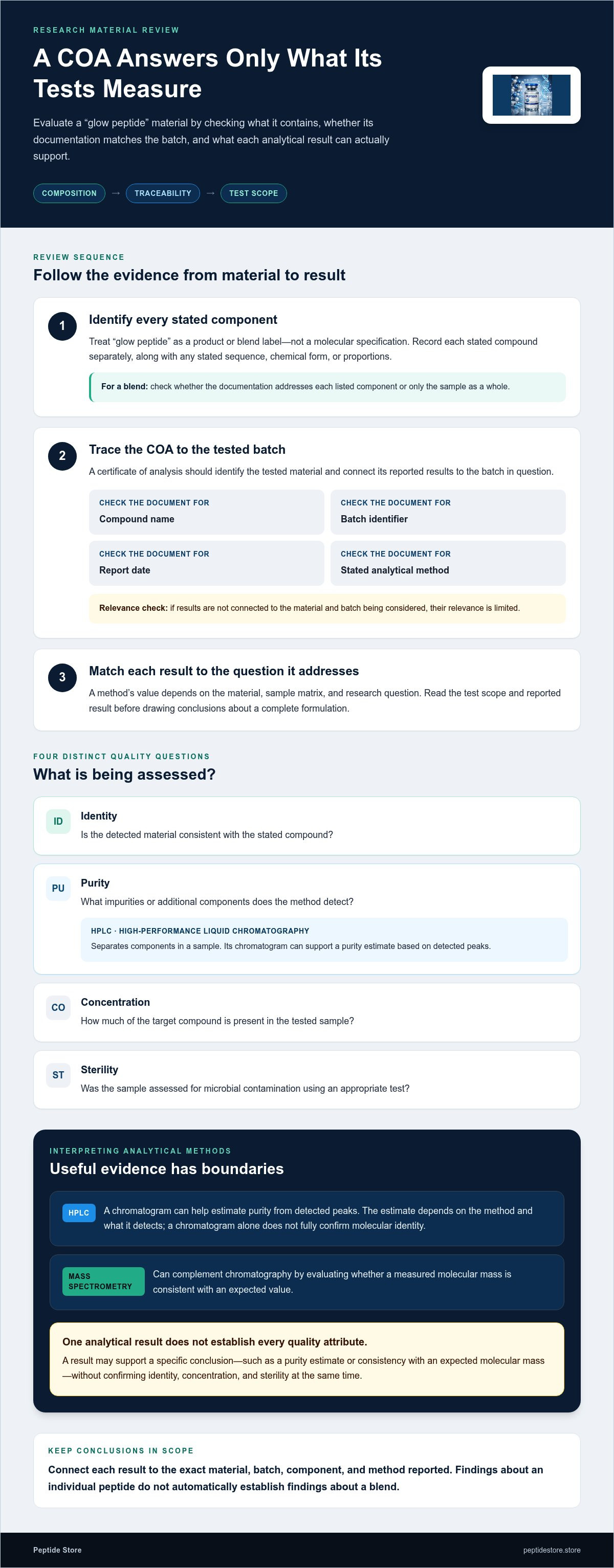
Evaluate a research material in sequence: identify every stated component, inspect documentation tied to the relevant batch, then assess whether the analytical methods address your research questions. A product label alone cannot substitute for these checks. For a blend, look for component-level information rather than relying only on a combined name.
One analytical result cannot establish every quality attribute. A result may support a specific conclusion, such as chromatographic purity or expected molecular mass, without confirming identity, concentration, and sterility at the same time. Interpret each reported test according to what it measures.
What should a research reader look for in a certificate of analysis?
Start with traceability. A certificate of analysis (COA) should clearly identify the tested material and batch. Review the compound name, batch identifier, report date, and stated analytical method. For a blend, check whether the report addresses each listed component or only the sample as a whole. If the document doesn’t connect its results to the material and batch in question, its relevance is limited.
High-performance liquid chromatography (HPLC) separates components in a sample and can provide a chromatogram used to estimate purity based on detected peaks. That estimate depends on the method and what it detects; a chromatogram alone does not fully confirm molecular identity. Mass spectrometry can complement chromatography by evaluating whether a measured molecular mass is consistent with an expected value. Neither result proves every feature of a material.
How do methods support different quality questions?
Keep the questions distinct:
- Identity: Is the detected material consistent with the stated compound?
- Purity: What impurities or additional components does the method detect?
- Concentration: How much of the target compound is present in the tested sample?
- Sterility: Was the sample assessed for microbial contamination using an appropriate test?
These are separate analytical questions, and one test should not be treated as answering them all. Method suitability depends on the material, sample matrix, and laboratory question. A method applied to one component may not characterize every component in a mixture. Review the test scope and reported result before drawing conclusions about a complete formulation.
For further context on analytical standards, consult this research peptides laboratory guide. The research peptide catalog provides a product reference; interpret composition and analytical claims using the documentation for the specific material and batch.
What Research on Individual Peptides Can, and Cannot, Tell You About a Blend
Evidence applies most directly to the material and conditions actually studied. A result for one identified peptide cannot, on its own, establish what a combination does. For a product described as a glow peptide blend, distinguish research on separate components from studies that evaluate the same defined combination, at stated concentrations and under relevant conditions.
| Evidence type | What it can inform | What it cannot establish alone |
|---|---|---|
| One identified compound | Findings for that compound in the model and conditions reported | Effects, interactions, or performance of a blend containing it |
| Defined blend | Findings for the specific combination, proportions, and study conditions tested | Results for blends with different compositions or use conditions |
Study models also differ in what they can show. Cell-based experiments examine responses in controlled laboratory systems; animal studies assess outcomes in a whole-organism model; human clinical studies examine outcomes in people under a defined protocol. These evidence types aren’t interchangeable, and a result in one model doesn’t by itself demonstrate the same outcome in another.
How should GHK-Cu and other component research be interpreted?
GHK-Cu should be treated as an independently named research compound, not as an assumed ingredient in any product. Before applying a reported result, identify the primary study, its model, measured endpoint, material, and limitations. A source focused on a compound can provide context, but it doesn’t verify the composition of a particular blend. See GHK-Cu extracellular matrix research for compound-specific discussion.
Why can’t component findings be transferred directly to blends?
A combination may differ from individual-compound studies in composition, concentration, formulation, and experimental design. Components may also interact, so their combined behavior cannot simply be inferred by adding separate findings together. Blend-level conclusions require evidence on the defined combination itself. The available research brief reports no human trials of the blend described as “Glow Peptide”; claims about individual components shouldn’t be presented as human evidence for that blend.
For example, BPC-157 cellular repair research is a separate compound-specific topic. Its title or subject does not establish outcomes for a multi-component product. Keep the compound, model, endpoint, and blend identity attached to every claim.
How to Read Glow Peptide Claims Without Confusing Research and Human Use
Assess each claim by tracing it to the material and evidence it describes. Identify the compound, study model, measured endpoint, source, and stated limitations. If any of these details are missing, the claim may be difficult to evaluate or may not apply to the material being described.
Keep evidence categories separate. A peer-reviewed study reports research conducted under specified conditions; a supplier description summarizes a product; a testimonial reports an individual account; and an unsourced summary may omit essential context. A product description is not a peer-reviewed study or independent confirmation of its claims. Check whether cited research tested the same compound, formulation, and endpoint before applying its findings to a product label.
Which evidence distinctions should readers check first?
Read the source and study details, not just the headline or summary. Note whether the work involved cells, animals, or people, and identify the species or cell model, sample size, measured endpoint, and limitations where reported. Then compare those details with the claim. A cell-based measurement describes an observation in that experimental system; it does not by itself establish a corresponding outcome in people.
For glow peptide claims, also distinguish evidence about a single compound from evidence about a specified combination. A study of one ingredient cannot independently substantiate claims about a blend, and a result for one endpoint does not establish a different outcome that the study did not measure.
What boundaries apply to research-grade peptide information?
Research-grade peptide information should be understood in the context of laboratory and scientific applications. It is not a human-use protocol or medical recommendation. Preclinical observations do not establish clinical benefit or safety in people. Nor does a research description establish that a compound is approved, prescribed, safe, or suitable for human or cosmetic use.
Keep product characterization separate from instructions for use. This discussion does not provide dosing, reconstitution, administration, or self-experimentation guidance. Those details cannot be inferred from a study result or product description. Responsible interpretation means limiting conclusions to what the documented material, study model, endpoint, and evidence actually support.
For research catalog reference, review the research peptide listings alongside the relevant product documentation, and keep conclusions within the stated laboratory research context.
A Practical Reference Checklist for Glow Peptide Research
A concise research record makes it easier to distinguish what a label says from what the available documentation supports. Use a consistent sequence, and mark unknown details as unknown rather than filling gaps with assumptions.
- Start with terminology. Record the exact product label and distinguish it from the names of any individual compounds.
- Capture stated composition. List each documented component and any stated sequence, chemical form, concentration, or proportion. Mark details that are absent rather than inferring them.
- Record traceability information. Note the batch identifier, the source of the product information, and the date you reviewed it.
- Document analytical methods. Record the methods reported and the quality question each addresses, such as identity, purity, or concentration. Don’t treat one method as evidence for attributes it doesn’t assess.
- End with evidence documentation. Keep published studies separate from product-specific descriptions. For each study, record the tested material, model, endpoint, source, and stated limitations.
What should a concise research record include?
Keep the product record and research record distinct, even when they refer to the same named compound. A product document may describe a batch, while a published study may examine a material under different conditions. Linking each statement to its source prevents a finding about one material or model from being mistaken for confirmation of another.
For the Glow70 name, use the Glow70 product information as a product reference, not as a basis for assuming composition or analytical results. Record only details stated in its documentation and clearly identify anything it does not report.
Where can readers continue their research?
Use product references to locate information, not to infer research outcomes or human-use suitability. A disciplined record preserves uncertainty when composition, batch data, or evidence is unavailable. That is more useful for later review than an unsupported conclusion attached to a familiar label.
For laboratory-oriented product information, view the research peptide catalog. Treat catalog descriptions as product references and evaluate research claims against the relevant evidence documentation.
Apply a More Precise Research Framework
The term glow peptide should prompt verification, not assumptions. A product label doesn’t establish a unique molecular identity or shared composition. Useful interpretation depends on recording the stated components and batch, understanding what analytical methods assess, and checking whether research tested the same compound or defined blend.
Evidence also needs its context attached. Cell-based, animal-model, and human clinical findings answer different questions, and results for one component don’t establish outcomes for a combination. Keep conclusions within the documented evidence and laboratory research context; product descriptions are not human-use protocols or medical recommendations.
Peptide Store supplies research-grade peptide compounds for laboratory and scientific applications, with a catalog spanning more than 150 compounds across specialized research categories. For research-oriented product information, review the peptide catalog.
Frequently Asked Questions
Is glow peptide one specific peptide?
No. “Glow peptide” is an informal label, not a standardized name for one specific molecule. Its meaning depends on the product description and supporting documentation. The label alone doesn’t establish the compound’s sequence, chemical form, formulation, or batch composition. For research records, note the exact product name separately from any identified peptide components, and treat undocumented details as unknown rather than making assumptions.
What peptides are in a glow peptide blend?
There is no single required composition. Some descriptions use the term for a blend that includes GHK-Cu, BPC-157, and TB-500, but ingredients and stated proportions can differ between products. Don’t assume every product with this label contains those compounds or contains them in the same amounts. Use product-specific documentation to identify components, and distinguish stated composition from independently verified analytical results.
Is GHK-Cu the same as glow peptide?
No. GHK-Cu is an individually named copper-containing peptide, while “glow peptide” is an ambiguous descriptive label that may refer to GHK-Cu alone or to a blend. The terms aren’t interchangeable. If a product description uses “glow peptide,” check whether it explicitly identifies GHK-Cu and whether it states other components. Research about GHK-Cu applies to that compound and study context, not automatically to a product carrying the broader label.
How can researchers evaluate glow peptide documentation?
Start by recording the exact product name and each stated component. Then review whether documentation identifies the tested material, batch identifier, report date, and analytical method. Consider what each method measures: chromatography may inform a purity estimate, while mass spectrometry can help assess whether measured molecular mass is consistent with an expected value. Treat identity, purity, concentration, and sterility as separate questions, and note when documentation doesn’t address one.
Does research on one peptide prove that a glow peptide blend works?
No. Evidence about an isolated peptide doesn’t establish effects of a blend containing it. The combination may differ in components, concentrations, formulation, and study conditions, and interactions can’t be inferred from separate findings alone. Assess whether a study tested the same defined combination and measured the endpoint being claimed. Also distinguish cell-based, animal-model, and human clinical evidence, since results from one type of model don’t establish equivalent outcomes in another.
Can research-grade glow peptides be used for cosmetic or human purposes?
Research-grade peptide information is intended for laboratory and scientific applications, not as guidance for human or cosmetic use. A research label or product description doesn’t establish approval, safety, or suitability for either purpose. Preclinical observations do not establish clinical benefit or safety in people. Don’t treat research findings as a use protocol or medical recommendation; conclusions should remain within the evidence and documented research context.


