
What if the key to understanding GHK-Cu research is separating what the molecule is from what researchers propose it may do? The ghk cu peptide refers to a copper-associated form of the tripeptide GHK, composed of glycine, histidine, and lysine. That chemistry identifies the subject of study; it does not prove every biological effect attributed to it.
Descriptions of GHK-Cu often combine molecular structure, laboratory findings, and claims about outcomes as if they carry the same evidentiary weight. They do not. For researchers examining the extracellular matrix, distinguishing proposed mechanisms from measured results helps keep conclusions tied to the evidence.
This article explains GHK-Cu’s peptide structure and copper association, then reviews proposed biological activity in the context of preclinical research and its limitations. It also outlines how experimental models, controls, and material characterization shape what findings can support. The goal is a practical framework for assessing GHK-Cu as a research molecule, without treating exploratory findings as established clinical outcomes.
Key Takeaways
- Identify GHK-Cu’s peptide name and distinguish the GHK sequence from its copper association.
- Assess copper-binding conditions alongside peptide structure when interpreting experimental design.
- Compare ghk cu peptide findings across biochemical, cell-based, animal, and human research without treating these evidence categories as interchangeable.
- Use a focused checklist to evaluate study models, controls, material characterization, endpoints, and limitations.
- Keep laboratory findings within research-use boundaries and separate molecular identity from claims about clinical outcomes.
What Is the GHK-Cu Peptide? Structure, Naming, and Research Context
GHK-Cu is a copper-associated tripeptide studied in biochemical and extracellular matrix research. GHK refers to the three-residue sequence glycyl-L-histidyl-L-lysine, while Cu denotes copper associated with the peptide. This molecular description identifies the subject of study. It does not, by itself, establish a biological effect or clinical outcome.
The distinction matters because broad claims about the ghk cu peptide can blur its chemical identity with proposed activity. The terms describe a molecule and its copper association; whether a particular preparation produces a measurable response is a separate experimental question. This section focuses on terminology and laboratory research, not personal treatment or medical use. The video below presents a public-facing perspective, so assess its claims against research evidence rather than treating them as proof.
For context, watch this video and evaluate its claims alongside the research literature:
What does GHK-Cu stand for?
GHK names the amino-acid sequence: glycine, histidine, and lysine. The fuller name, glycyl-L-histidyl-L-lysine, specifies the residues and their stated configuration. Cu is the chemical symbol for copper. In GHK-Cu, the sequence refers to the peptide, and “copper-associated” describes its relationship to copper. The notation alone does not specify the precise composition or characteristics of every experimental preparation.
Keeping those terms separate avoids a common interpretive error: the peptide sequence and its copper-associated form are related, but they are not interchangeable descriptions of every experimental condition. When comparing studies, look for how researchers characterized the material and described the copper-related conditions. The Copper peptide GHK-Cu overview provides general background on the terminology and reported areas of investigation.
How is GHK-Cu discussed in scientific research?
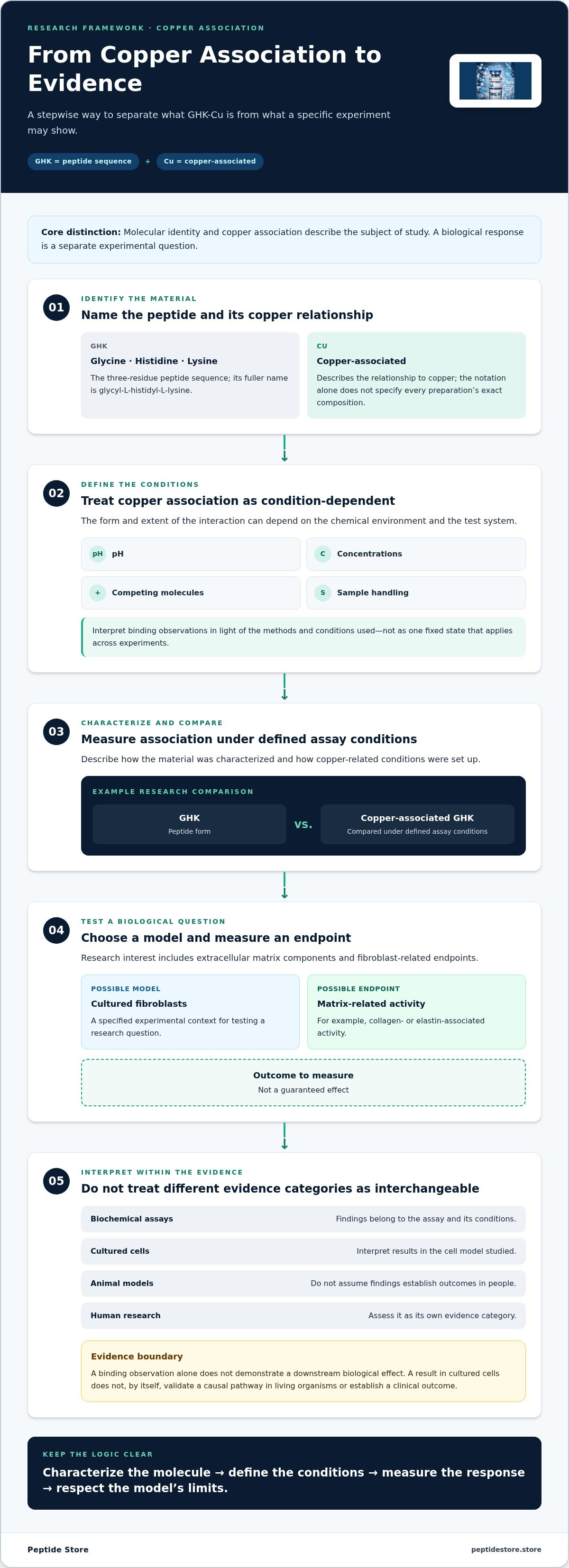
Research raises at least two distinct questions: how GHK associates with copper under specified conditions, and whether that association corresponds to a measurable biological response in a particular experimental model. A binding observation does not, on its own, demonstrate a downstream effect. Findings in biochemical assays, cultured cells, or animal models must also be interpreted in light of their methods and limits. They should not be converted into treatment advice.
This distinction is useful across related peptide literature. The cellular repair peptide research overview offers additional context for reading in-vitro research without assuming that laboratory observations establish outcomes in people. Across both topics, keep molecular identity, experimental conditions, and measured endpoints clear.
How Copper Binding Shapes GHK-Cu Research Questions
Copper association is a chemical question before it is a biological conclusion. In coordination, a metal ion interacts with available sites on a molecule. The extent and form of that interaction depend on the chemical environment. For GHK-Cu research, the peptide sequence, copper availability, and conditions in the test system can all affect what an assay detects.
What does copper association mean in this context?
The label GHK-Cu describes GHK associated with copper, but it does not guarantee that every preparation or experimental solution contains the same molecular species. Factors such as pH, concentrations, competing molecules, and sample handling can influence the interaction being measured. Researchers interpret copper-binding observations in light of the methods and conditions used, rather than assuming one fixed state applies across experiments.
A clear research diagram can make this distinction visible: show GHK beside a copper ion, with a line or reversible arrow labeled “association under defined conditions.” Then use a separate arrow to a cell assay labeled “outcome to measure,” rather than “guaranteed effect.” This represents a testable research model, not a settled clinical mechanism.
Which biological pathways are proposed for investigation?
Research interest includes extracellular matrix components and fibroblast-related endpoints, such as reported changes in collagen- or elastin-associated activity. A review indexed by the National Institutes of Health summarizes proposed mechanisms and findings across experimental contexts. These themes can help frame research questions, but a review of reported activity is not itself proof that copper binding causes a specific cellular response.
Citation-ready distinction: “GHK-Cu’s copper association is a molecular feature to characterize; any downstream effect on fibroblast activity or extracellular matrix markers must be demonstrated independently in the relevant experimental model.”
For example, a study could compare GHK with copper-associated GHK under defined assay conditions and measure a matrix-related endpoint in cultured fibroblasts. That design could test whether the forms differ in that model. It would not, by itself, validate a causal pathway in living organisms or establish a clinical outcome. The GHK-Cu peptide research review is useful background for identifying proposed mechanisms, while each underlying experiment still requires assessment of its methods and evidence level.
For controlled laboratory work, Peptide Store supplies research-grade GHK-Cu and related materials through its research peptide catalog. Material selection is one part of study planning; experimental characterization and assay design remain essential to interpreting results.
What Does GHK-Cu Research Show, and Where Does Evidence Stop?
GHK-Cu findings span different evidence levels, from copper-association studies to cell and animal experiments and human investigations. These categories answer different questions. A biochemical interaction or change in a cultured-cell marker can support a research hypothesis, but it cannot establish a clinical benefit. Biological plausibility is not proof of clinical benefit.
The table summarizes broad research themes, not a claim that all studies use the same material, controls, or endpoints. The NIH-indexed review on skin remodeling and anti-aging discusses collagen, glycosaminoglycans, and metalloproteinases in the context of GHK research. Because it is a review, trace specific causal claims to the primary studies it cites and assess them in their experimental context.
| Model | Measured endpoint | Reported finding or research focus | Key limitation |
|---|---|---|---|
| Biochemical | Copper association and related molecular interactions | Investigates how GHK and copper behave under defined conditions. | Binding observations alone don’t demonstrate a cellular or organism-level effect. |
| Cell-based | Fibroblast activity and extracellular matrix markers | Studies explore reported changes involving collagen, glycosaminoglycans, or matrix-regulating enzymes. | Results depend on cell model, controls, exposure, assay conditions, and reproducibility. |
| Animal | Model-specific tissue or repair outcomes | Preclinical work can test biological hypotheses in an organism. | Species, model design, and endpoints limit transfer to human outcomes. |
| Human | Outcomes tied to the specific formulation and study design | Human evidence must be interpreted separately from laboratory and animal findings. | Findings for one topical formulation or endpoint don’t establish effects for other forms or uses. |
How should readers interpret cell and animal studies?
Start with the experiment itself. Identify the model, comparison or control group, material characterization, exposure conditions, and measured endpoint. Then check whether the paper reports sample size, independent replication, and limitations. A change in a cell marker may help define a mechanism to test, but it does not establish that the same change occurs in people.
What can human evidence establish?
Human studies can inform conclusions only about the population, formulation, route, and outcomes they directly examine. Evidence about another peptide or a different preparation is not interchangeable with evidence about GHK-Cu. The research themes support continued investigation, but they do not justify broad clinical conclusions. Read the ghk cu peptide literature by evidence tier and state uncertainties plainly.
How to Evaluate a GHK-Cu Peptide Research Paper
A useful paper makes its experimental logic traceable: what question was tested, which model was used, how the material was characterized, and what outcome was measured. Use this checklist to assess a reported effect before drawing a conclusion:
- 1. Research question: Is the study testing copper association, a cellular response, or a broader biological outcome?
- 2. Model: Does it identify the system, such as a biochemical assay, cultured cells, an animal model, or a human study?
- 3. Controls: Are relevant negative or positive controls described and appropriate to the question?
- 4. Material characterization: Does the methods section identify the peptide and describe relevant copper-related conditions, preparation, and analytical checks?
- 5. Endpoint: Is the measured outcome defined, and does it directly address the research question?
- 6. Limitations: Are replication, statistical analysis, sample size, and constraints on interpretation reported?
Which methods and controls matter most?
Controls help distinguish an observed response from background variation or effects associated with the assay itself. For example, a study investigating copper-associated GHK should explain its comparison groups and relevant copper conditions, rather than attributing every measured change to the peptide. Review the model, assay conditions, and analysis plan. Then check whether results are replicated and uncertainty is reported. Missing details limit interpretation, but do not, by themselves, prove that a result is invalid.
How can analytical results be interpreted responsibly?
Methods such as high-performance liquid chromatography (HPLC) can assess sample components under specified analytical conditions. Mass spectrometry can help characterize molecular identity based on measured mass. What these methods establish depends on the method, reference standards, and reporting. Neither a purity estimate nor an identity check demonstrates biological activity, reproducibility in a cell assay, or efficacy in people.
For GHK-Cu, interpretation also depends on whether the paper clearly describes copper-related conditions, including material preparation and the assay environment. If batch, storage, or preparation details are absent, note that uncertainty when assessing reproducibility. Do not fill the gap with assumptions. A broader research peptide laboratory standards guide can help clarify how analytical characterization fits into research-material evaluation.
Keep the distinction firm: characterization describes the material tested, while biological assays evaluate responses under defined conditions. For laboratory research, compare GHK-Cu research material with the study methods rather than treating product information as a substitute for them.
GHK-Cu Peptide for Laboratory Research: Scope and Next Steps
Approach GHK-Cu as a defined research subject, not as a conclusion about biological outcomes. Its peptide identity and copper association describe the material under consideration. Proposed mechanisms are hypotheses to test, while demonstrated outcomes depend on the model, methods, and endpoints reported in each study. Keeping these categories separate supports accurate interpretation of extracellular matrix research.
What should a research-focused overview leave readers with?
Copper binding, proposed biological activity, and measured results are related questions, but one does not automatically establish the next. A report of copper association does not prove a particular cell response. A change in an experimental endpoint does not establish a validated causal mechanism, and findings in one model should not be generalized beyond the evidence.
For laboratory readers, practical interpretation starts with the methods: identify the experimental model, controls, peptide characterization, copper-related conditions, and measured outcome. Then consider replication and limitations before drawing conclusions. This approach helps distinguish a plausible research direction from a result demonstrated only under specific assay conditions. Read the ghk cu peptide literature as a developing body of research, not as a substitute for clinical evidence.
Where can laboratory readers continue exploring?
Research-material context is separate from conclusions about biological activity. A catalog listing identifies a material resource; it does not establish a preparation’s suitability for a particular experiment, provide evidence of efficacy, or support human use. Base study design and interpretation on relevant literature, method validation, and the needs of laboratory protocols.
GHK-Cu is part of Peptide Store’s research-peptide catalog, which contains more than 150 compounds. The store supplies research-grade peptides for laboratory and scientific applications, not personal treatment or medical use. This overview does not provide administration or dosage guidance.
For the next step, review the GHK-Cu research product listing for catalog information and consider the material in the context of your laboratory’s study requirements and research-use boundaries.
Apply a Clear Evidence Framework to GHK-Cu Research
Interpreting ghk cu peptide research requires keeping molecular identity, copper association, and biological outcomes distinct. A proposed mechanism can guide an experiment, but only well-described methods and relevant evidence can support conclusions about a measured endpoint. Results from biochemical assays, cell models, animals, and human studies should not be treated as interchangeable.
For each paper, review the model, controls, material characterization, copper-related conditions, and limitations before assessing what its findings establish. Analytical confirmation can help describe the material tested, but it does not prove biological activity or clinical benefit.
GHK-Cu is among Peptide Store’s research peptide offerings for scientific and laboratory applications. For research-material information, explore GHK-Cu research material. The catalog is a resource for laboratory context, not a recommendation for human use, treatment, or medical application.
With careful methods and evidence-based interpretation, researchers can frame precise questions and assess the literature responsibly. Review the GHK-Cu research product listing to explore Peptide Store’s research-grade catalog, and keep a clear distinction between what a study proposes and what it demonstrates.
Frequently Asked Questions
What is a GHK-Cu peptide?
GHK-Cu is a copper-associated form of the tripeptide glycyl-L-histidyl-L-lysine. Researchers investigate its molecular properties and proposed biological activity in laboratory and preclinical settings. The name describes the peptide and its association with copper; it does not establish a biological or clinical effect. Interpret claims according to the study model, methods, and measured outcomes, and distinguish research findings from medical or cosmetic advice.
What is GHK-Cu peptide used for in research?
Researchers study the ghk cu peptide in laboratory and preclinical investigations of its chemical properties and proposed biological activity. Topics may include copper interactions and cellular processes relevant to extracellular matrix research. Findings depend on the experimental model, controls, material characterization, and endpoints. A result in a biochemical assay or cultured cell does not prove that GHK-Cu treats a condition or produces the same outcome in people.
Is GHK-Cu proven to have effects in humans?
Cell and animal findings do not establish outcomes in humans. To assess a claim, look for relevant human research and examine its design, comparison groups, measured endpoints, and replication. Also check whether the studied formulation and conditions match the claim being made. A plausible mechanism or laboratory result is not equivalent to demonstrated clinical benefit. This article provides research context, not medical advice or treatment recommendations.
How does copper relate to the GHK peptide?
Copper is associated with the GHK tripeptide in the term GHK-Cu. Researchers may examine that interaction and how factors such as solution conditions influence observations. Copper association alone does not demonstrate a particular downstream effect in cells. To understand what a study supports, review its methods, controls, and analytical measurements, including how peptide identity and copper-related conditions were described.
Can GHK-Cu research findings be applied to skincare or treatment claims?
Research findings cannot automatically be translated into skincare or treatment claims. Laboratory models, formulations, exposure conditions, and measured endpoints may differ from those involved in real-world use. Evidence about one preparation or experimental setting does not necessarily apply to another. Keep scientific investigation separate from medical or cosmetic advice, and consult a qualified healthcare professional about personal health questions. This research overview does not provide dosing or treatment instructions.
What methods are used to analyze GHK-Cu in research?
Methods depend on the research question and may assess molecular identity, sample composition, or experimental outcomes. High-performance liquid chromatography (HPLC) can help characterize sample components under defined conditions, while mass spectrometry can support molecular identification. These analytical results do not, by themselves, prove biological activity or clinical efficacy. Compare studies by reviewing the methods, controls, assay conditions, and limitations, rather than treating analytical characterization as proof of an effect.


