

A cellular repair claim is a hypothesis, not a demonstrated outcome. That distinction matters when evaluating bpc 157 cellular repair research, where proposed mechanisms and laboratory findings can be mistaken for evidence of medical benefit.
Interest in BPC-157 is understandable: researchers are investigating whether it affects cellular processes associated with tissue response and repair. But results from cell-culture or animal models don’t establish what happens in people, and human evidence remains limited. To interpret a finding, identify the model and endpoint, check the comparison conditions, and consider what the study cannot show.
This article reviews proposed research pathways and relevant cell types, then explains how to assess findings across models, measured outcomes, and study limitations. It distinguishes preclinical observations from clinical evidence and offers practical steps for evaluating laboratory research. The goal is to clarify what BPC-157 cellular repair research investigates, what the evidence can support, and what remains unproven.
Key Takeaways
- Use primary studies to distinguish proposed BPC-157 pathways from mechanisms that have been independently established.
- Assess bpc 157 cellular repair research by model type, controls, measured endpoint, and study limitations before interpreting a result.
- Compare in vitro, animal, and human evidence separately. Findings in one research model don’t automatically transfer to another.
- Check whether results are replicated and biologically meaningful, not only statistically significant.
- Use a research-literacy checklist focused on source quality, model relevance, reproducibility, and cautious claims.
What BPC-157 Cellular Repair Research Studies, and What It Does Not Establish
BPC-157 cellular repair research investigates experimental biological questions; it doesn’t establish that the peptide is an effective or safe treatment. BPC-157 is commonly described as a synthetic peptide made up of 15 amino acids and studied primarily in preclinical research. “Cellular repair” is a broad description, not the name of one standardized test or outcome. A study’s methods and measurements matter more than a general claim that a compound supports repair.
Separate evidence by model. In vitro studies examine cells or biological material under laboratory conditions. Animal studies assess responses in whole organisms, while human clinical studies investigate outcomes in people. Findings in one category don’t establish the same effect in another, and preclinical evidence alone doesn’t demonstrate human benefit or safety. For background on the compound’s nomenclature and research history, see this overview of BPC-157.
The following video discusses peptide research and proposed mechanisms. Treat its explanations as context, not as a substitute for evaluating primary studies.
What researchers mean by cellular repair
“Repair” can refer to distinct processes, each requiring its own measurements. Cell migration describes movement of cells in a model. Extracellular matrix remodeling concerns changes to the structural proteins surrounding cells. Tissue-specific endpoints, such as changes in a tendon or intestinal model, address different biological questions. Evidence for one endpoint doesn’t establish another; each requires a model suited to the process being tested.
How to interpret BPC-157 research language
Words such as “promotes,” “supports,” or “regulates” may describe a proposed pathway, but they don’t tell you what the researchers directly measured. Look for the model, comparison group, assay, and observed result. A proposed biological activity remains a hypothesis unless supported by measured data. A measured preclinical result still isn’t proof of human benefit. For more context on laboratory methods and analytical standards, consult this laboratory research peptide guide.
That distinction is central to bpc 157 cellular repair research: evaluate each claim at the level of evidence that produced it, and don’t extend laboratory observations into clinical conclusions.
Proposed BPC-157 Mechanisms in Cellular Repair Studies
Mechanistic explanations for BPC-157 are hypotheses drawn from specific experimental models, not established pathways with demonstrated clinical significance. For example, Chang and colleagues studied tendon fibroblasts, examining cell outgrowth, survival, and migration in vitro alongside tendon healing in rats. Those endpoints describe responses in particular models. They don’t prove that one pathway caused repair or that the same response occurs in other tissues or people.
Cell migration and outgrowth are among the cellular responses examined in this literature. That describes the research focus, not confirmation of a unified mechanism. Findings may depend on cell type, tissue context, assay design, exposure conditions, and the endpoint selected.
Cell signaling and vascular-related hypotheses
Some discussions of BPC-157 propose effects on signaling associated with vascular responses, including angiogenesis. Evaluate each claim against the experiment behind it. Identify the tissue or cell model and check whether investigators measured vessel formation, endothelial-cell behavior, or a signaling marker. A change in a marker alongside an outcome is an association. By itself, it doesn’t show that the pathway caused the outcome. Stronger causal evidence would require experiments that directly test the pathway’s involvement.
A broad statement that BPC-157 “increases angiogenesis” is therefore incomplete without the model, measured endpoint, and study design. Vascular observations in an animal tissue model cannot automatically be treated as findings in isolated endothelial cells, much less as evidence of a clinical effect.
Fibroblasts, extracellular matrix, and tissue models
Fibroblasts are relevant to repair studies because they participate in connective-tissue structure and matrix production. Researchers may measure fibroblast migration, survival, or outgrowth, as Chang and colleagues did in tendon-cell experiments. These are separate outcomes. They don’t establish that extracellular-matrix organization improved unless matrix composition or remodeling was measured directly.
Interpret each result narrowly. A tendon fibroblast response doesn’t establish the same response in skin, muscle, or intestinal tissue. Likewise, discuss endothelial-cell findings only when a study directly tested endothelial cells or a clearly described vascular endpoint. The key question in bpc 157 cellular repair research is not whether a mechanism sounds plausible, but whether the cited experiment measured it and whether independent work supports the interpretation.
What the BPC-157 Evidence Shows Across Research Models
Evidence for BPC-157 is concentrated in preclinical models, so interpret findings within the model and endpoint that produced them. Chang and colleagues, for example, examined tendon fibroblasts in vitro and tendon healing in rats. These related experiments offer different kinds of evidence. Neither establishes a clinical effect in people.
| Evidence category | Model and comparison | Endpoints and reported result | Principal limitation |
|---|---|---|---|
| In vitro | Tendon fibroblast experiments by Chang and colleagues, comparing BPC-157 exposure with control conditions. | Cell outgrowth, survival, and migration were assessed; the authors reported enhanced fibroblast outgrowth and migration. | Cell-culture responses don’t reproduce the full environment of an injured tendon or establish tissue-level benefit. |
| Animal model | Rat tendon-injury experiments reported by Chang and colleagues, comparing BPC-157-treated animals with controls. | Tendon healing was assessed; the study reported improved healing measures in the treated group. | A result in rats may not translate to people. One study also cannot establish reproducibility across models. |
| Human | Small, uncontrolled pilot reports; no robust randomized, placebo-controlled comparison is established in the available evidence summary. | These reports provide preliminary human observations, not reliable evidence of efficacy. | Small samples, lack of controls, and limited replication restrict interpretation and generalizability. |
In vitro findings versus whole-organism models
Cell-based experiments can test a defined response under controlled conditions, such as whether fibroblast movement or survival changes in a particular assay. Animal models add interactions among tissues and whole-body systems, but introduce species-specific biology and experimental conditions that may differ from human contexts. A plausible mechanism in a dish, or a tissue response in an animal, isn’t evidence of a human clinical outcome.
Evidence gaps and the human-relevance question
A 2025 systematic review reported that 35 of 36 included BPC-157 studies were animal studies, underscoring the preclinical emphasis. As of October 2026, the evidence summary describes human data as limited to small, uncontrolled pilot studies, with no large randomized, placebo-controlled efficacy trials. When reviewing a human report, check its sample size, control design, replication, and whether the measured outcome is clinically relevant.
Current evidence supports continued investigation, not a proven therapy: preclinical findings and limited uncontrolled human reports don’t establish BPC-157’s efficacy or safety for treatment. In bpc 157 cellular repair research, a cellular signal is a result to investigate, not proof of repair in people.
How to Evaluate BPC-157 Cellular Repair Studies
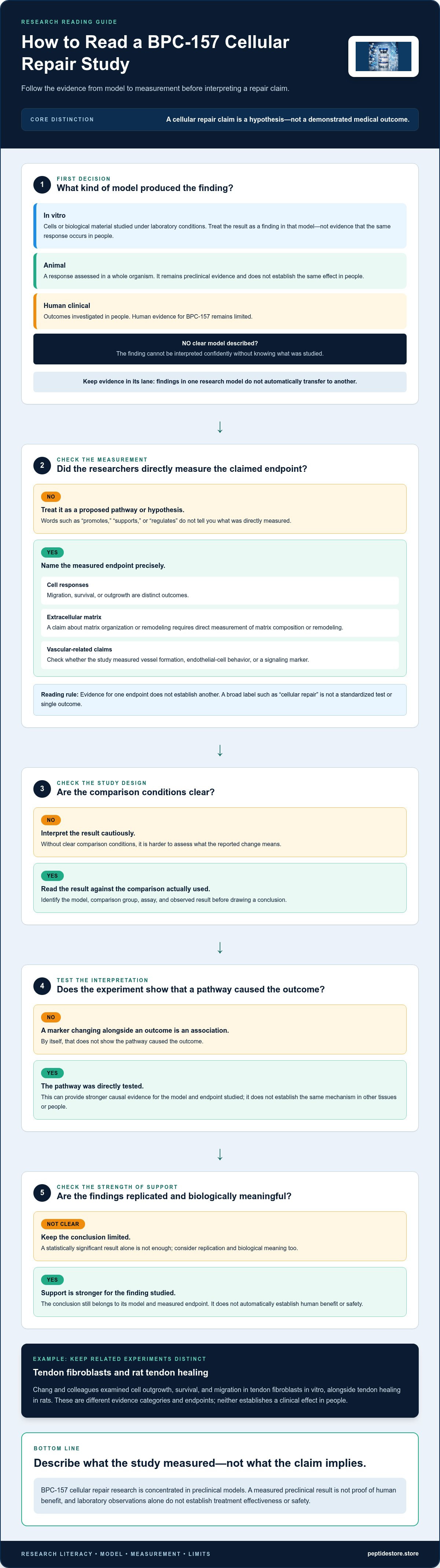
A careful appraisal starts with the paper’s methods, not its headline or abstract. For bpc 157 cellular repair research, identify what was tested, in which model, and how directly the measured result supports the authors’ interpretation.
Questions to ask when reading a study
- What is the research question? Determine whether the experiment tests a proposed mechanism, a defined cellular response, or a broader tissue outcome. These represent different levels of evidence.
- Which model was used? Identify the cell type, tissue, or organism and the experimental context. A result in isolated cells doesn’t establish an effect in an intact organism.
- Were the controls appropriate? Check what the treated condition was compared with, whether relevant control groups were included, and whether the methods are reported clearly enough to assess or reproduce.
- What endpoint was measured? Separate direct measurements, such as cell migration in an assay, from broader interpretations such as “healing.” Ask whether the endpoint answers the stated research question.
- Has the result been replicated? Independent repetition can help establish whether a finding is robust or specific to one experiment, laboratory, or set of conditions.
- What limitations remain? Review the authors’ discussion of sample size, study design, measurement constraints, and alternative explanations. Note whether the conclusions extend beyond the model tested.
From statistical significance to biological relevance
A statistically significant difference indicates that the observed data met a specified statistical criterion under the study design. It doesn’t establish that the difference is large, durable, reproducible, or meaningful for tissue function. Interpretation also depends on assay validity, variability, comparison groups, and whether the measured change corresponds to a relevant biological outcome.
Study-specific details matter. Dose, handling procedures, exposure duration, and assay parameters belong to a particular protocol, not generalized instructions. Interpret them in context, and don’t convert them into human-use guidance.
Avoiding overstatement
Read the full paper where possible, including its methods, figures, and limitations. Distinguish what investigators measured from what they propose those observations might mean. A result in one cell type or animal model doesn’t establish human physiology or treatment efficacy. Keep unreplicated findings and uncertain mechanisms qualified, even when the proposed explanation seems plausible.
For laboratory-focused work, review the research peptide catalog alongside the study design and any material-specific documentation. This section is educational and does not provide human-use or dosing recommendations.
Researching BPC-157 Responsibly: Evidence, Materials, and Next Steps
Responsible research keeps two questions separate: what does a study report, and what can its design support? In bpc 157 cellular repair research, an experimental signal is a finding to evaluate, not proof of an established outcome. This explainer concerns laboratory research and evidence interpretation, not human diagnosis or treatment.
Keep research material and evidence review aligned
Peptide Store supplies BPC-157 as part of its research-grade catalog of more than 150 compounds for scientific and laboratory applications. Selecting a research material and evaluating a published study are separate tasks. Product information does not establish that a material matches a study protocol, validate the study’s conclusions, or prove clinical benefit. When reviewing materials, use the product information available and keep those records distinct from your literature appraisal.
For laboratory-oriented browsing, review the research peptide product catalog. Use it as a catalog resource, not as evidence for efficacy, mechanism, or clinical relevance.
A concise framework for responsible interpretation
When preparing a research summary, document the source and the boundaries of its findings. This checklist can help keep conclusions traceable:
- Primary sources: Read the original paper, including methods and limitations, rather than relying on headlines or secondary summaries alone.
- Model relevance: Record the cell type, tissue, or organism studied, and state clearly what that model can and cannot represent.
- Endpoints and comparisons: Note what was measured, which controls were used, and whether the endpoint directly addresses the research question.
- Reproducibility: Check whether methods and results have been repeated independently, and identify unresolved inconsistencies.
- Cautious claims: Separate observed results from proposed explanations. Label hypotheses as hypotheses, and don’t turn a model-specific result into a human treatment claim.
Preserve uncertainty in the written record. Note study-specific conditions and limitations reported by the authors rather than presenting one finding as a general rule. Keep conclusions proportional to the model, endpoint, and available replication. A biological response observed under experimental conditions does not establish a proven therapy.
For laboratory research context, browse research compounds while keeping material selection separate from evidence assessment.
Keep the Evidence in Focus as Research Advances
The central lesson of bpc 157 cellular repair research is to interpret each result at the level where it was measured. Cell studies can examine defined responses, and animal models can add tissue-level context, but neither establishes treatment efficacy or safety in people. Proposed mechanisms remain hypotheses unless experiments directly test and replicate them.
For a sound assessment, prioritize original studies, note the model and endpoint, review controls and replication, and preserve stated limitations. “Cellular repair” is not a single outcome, so broad claims should never replace the specific measurements behind them. This discussion concerns laboratory research, not human diagnosis or treatment.
Peptide Store lists BPC-157 among its research compounds, within a catalog of more than 150 research-grade compounds for scientific and laboratory applications. Catalog information doesn’t validate study findings or establish clinical benefit. To browse research materials, visit Peptide Store’s research compounds catalog.
Careful questions and cautious interpretation help keep future investigation useful. Continue evaluating the evidence as it develops, one model and one measured result at a time.
Frequently Asked Questions
What is BPC-157 cellular repair research?
BPC-157 cellular repair research examines whether the experimental peptide is associated with measurable biological responses in laboratory or animal models. “Cellular repair” is a broad description, not a single standardized outcome. Studies may investigate specific endpoints, such as cell migration or tissue changes, and results must be interpreted according to the model and methods used. These findings don’t, by themselves, demonstrate treatment efficacy or safety in humans.
Does BPC-157 repair cells in humans?
Current evidence doesn’t establish that BPC-157 repairs cells in humans. As of October 2026, the available human evidence is limited to small, uncontrolled pilot studies, with no large-scale randomized, placebo-controlled trials establishing efficacy. Such preliminary observations cannot reliably determine whether a reported effect is caused by the peptide or applies broadly. Laboratory and animal findings also cannot substitute for well-controlled research measuring relevant outcomes in people.
How does BPC-157 affect cellular repair pathways?
Researchers have proposed effects involving cell migration, fibroblast activity, and vascular-related signaling, but each claim must be checked against what an individual study actually measured. A cell assay might measure migration, while an animal experiment might assess a tissue response. A change in a signaling marker can support a hypothesis, but it doesn’t prove that the pathway caused the outcome or has clinical significance.
What types of studies investigate BPC-157 and cellular repair?
Research includes in vitro experiments using cells or tissue samples and animal studies that examine responses in a whole organism. These models answer different questions: cell studies can isolate a specific response, while animal research adds interactions among tissues and biological systems. Human evidence is much more limited and consists of small, uncontrolled pilot reports. Compare each study’s model, control conditions, endpoint, and limitations rather than treating all findings as equivalent.
Is BPC-157 proven to promote tissue healing?
No. Preclinical studies have reported findings related to cellular or tissue responses, but these results don’t establish BPC-157 as a proven therapy for tissue healing. Evidence from cells or animals may justify further investigation; it cannot confirm efficacy or safety in people. A strong conclusion requires appropriately controlled, reproducible research using relevant outcomes. Proposed mechanisms and positive results in a particular model should not be presented as established medical benefit.
What should researchers look for when evaluating a BPC-157 study?
Start with the original paper and identify its research question, model, comparison groups, and directly measured endpoints. Check whether methods are described clearly, results are replicated, and the authors distinguish observations from interpretations. Review limitations such as small samples, model relevance, or missing controls. Statistical significance alone doesn’t show that a result is biologically meaningful, reproducible, or relevant beyond the conditions tested.
Can preclinical BPC-157 findings be applied to human treatment?
No. Preclinical findings can inform research questions, but they can’t be directly translated into human treatment conclusions. Cell systems and animal models differ from human physiology, and study-specific experimental conditions aren’t human-use guidance. Clinical relevance requires appropriately designed human research with suitable controls and meaningful outcomes. This article discusses laboratory evidence, not diagnosis or treatment; decisions about health conditions should not be based on preclinical research claims.


