
A peptide’s label alone doesn’t establish whether it is appropriate for a laboratory protocol. When researchers search for where to get peptides, the supplier’s stated research scope, batch traceability, and analytical documentation matter as much as the compound name. Research-use-only materials are intended for non-human laboratory applications, not personal use or clinical treatment.
Search results can blur the line between research suppliers and medical sources. Peptide Store supplies research-grade peptides for laboratory and scientific applications, with a catalog of more than 150 compounds. This article explains how to identify an appropriate source for laboratory work, which product and batch details to review, and how to distinguish research materials from products accessed through medical channels. It also explains why sterility, endotoxin, identity, and purity information may matter to laboratory requirements, while keeping research use separate from human use.
Key Takeaways
- Use “where to get peptides” to identify sources by purpose: laboratory suppliers, clinical pharmacies, and custom synthesis providers serve different contexts.
- Define the research question and required compound before comparing listings. Protocol fit is more useful than popularity or promotional claims.
- Review the product description, compound identity, batch identifiers, and available analytical documentation before ordering.
- Assess a Certificate of Analysis by checking what it tests and whether the sample details correspond to the relevant batch.
- Narrow your laboratory requirements before browsing Peptide Store’s research-focused catalog of more than 150 compounds.
Where to get peptides for research, and what does that source provide?
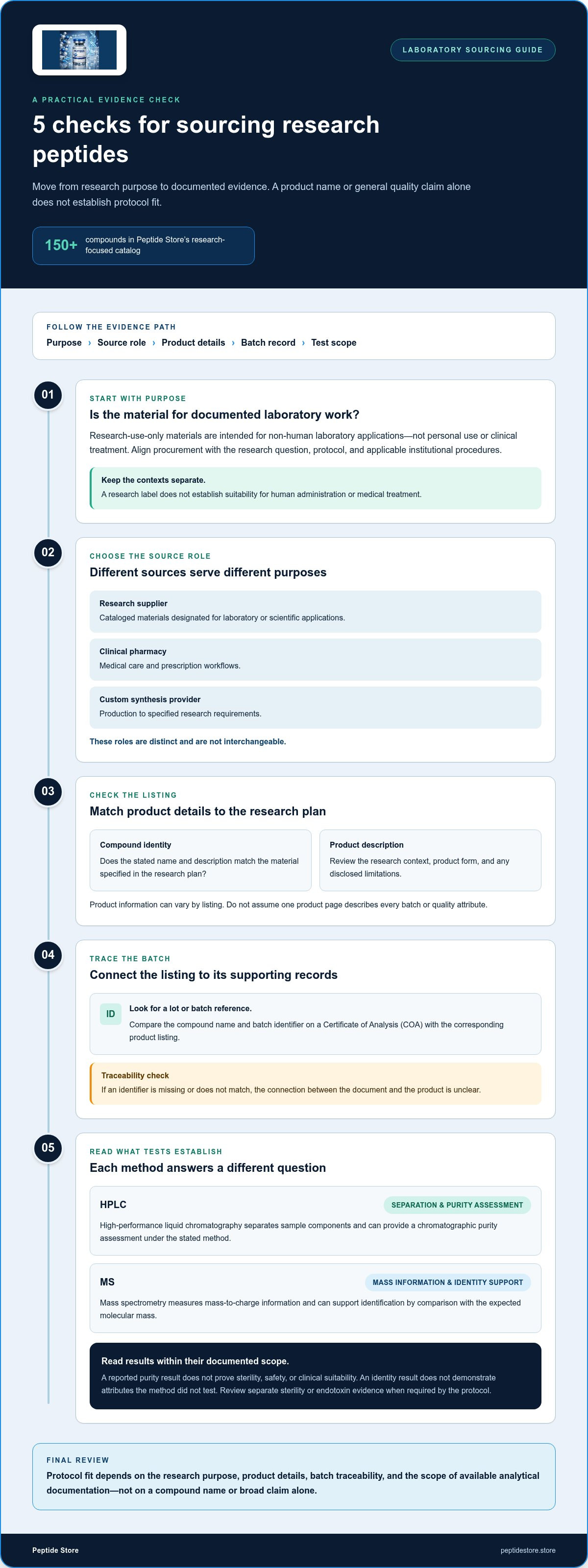
Here, peptide sourcing means acquiring compounds for documented scientific or laboratory work. The appropriate source depends on the purpose. Research suppliers provide cataloged materials for laboratory use, clinical pharmacies operate within medical care and prescription workflows, and custom synthesis providers produce compounds to specified research requirements. These roles are distinct and aren’t interchangeable.
A research-use label describes the intended context. It doesn’t establish that a material is suitable for human administration or medical treatment. Laboratory procurement should align with the research question, protocol, and institutional procedures. For foundational background on peptide structure and classification, see Peptides.
To evaluate a source, first check whether its stated role and product scope match your work. For context, the following video addresses the sourcing question:
What does a research peptide supplier provide?
A research supplier typically presents a catalog, product descriptions, and an online ordering route for compounds designated for laboratory or scientific applications. Product information and supporting documentation can differ by listing, so a catalog entry alone doesn’t show whether a compound fits a particular protocol. Peptide Store is an online supplier focused on research, with a catalog of more than 150 compounds. Researchers can browse its research peptide categories after defining their laboratory requirements.
Are research peptides the same as prescription medications?
No. Research materials are not presented as human prescription medications. They belong in a laboratory context, where use is governed by the study design and applicable institutional procedures. Medical care is a separate context involving clinical assessment and appropriate prescription pathways. A product’s name, research-grade description, or availability through an online catalog doesn’t make it a treatment or establish suitability for human use.
When asking where to get peptides, first identify the intended context. For documented laboratory work, look for a research supplier whose stated scope matches that purpose. A clinical pharmacy serves a medical and prescription role, while custom synthesis addresses specified compound-production requirements. Keeping these categories separate helps prevent confusion between catalog access, laboratory procurement, and clinical care.
What information should you review before sourcing research peptides?
Assess a listing through its verifiable details, not just its compound name or a general quality claim. Before ordering, review the product description, stated compound identity, batch identifier, and available analytical documentation. Check whether the information is specific enough to compare with your protocol and institutional requirements. Supplier information can vary by listing, so don’t assume one product page describes every batch or quality attribute.
- Compound identity: Check that the stated name and description match the material specified in your research plan.
- Product description: Review the stated research context, the product form, and any disclosed limitations.
- Batch identifiers: Look for a lot or batch reference that connects the listing to supporting records.
- Available documentation: Check what was tested, which method was used, and whether the document corresponds to the relevant material or batch.
Claims about testing, batch records, sterility, or handling should be assessed against available documentation, not inferred from general product language. For broader context on peptide-related considerations, Harvard Health Publishing discusses potential benefits and safety concerns. General information doesn’t replace evaluating a specific research material against a laboratory protocol.
How can a Certificate of Analysis support source evaluation?
A Certificate of Analysis (COA) may identify the tested material, analytical method, and reported result. Its value depends on its scope and traceability. Compare the compound name and batch identifier on the document with the corresponding product listing. If an identifier is missing or doesn’t match, the connection between the document and the product is unclear. A COA also doesn’t independently establish every handling, storage, sterility, or performance claim. Interpret its results only within the tests it documents.
What do HPLC and mass spectrometry tell a researcher?
High-performance liquid chromatography (HPLC) separates components in a sample and can provide a chromatographic purity assessment under the stated method. Mass spectrometry (MS) measures mass-to-charge information and can support identification by comparing measured mass with the expected molecular mass. The methods address different analytical questions.
A reported purity result isn’t proof of sterility, safety, or clinical suitability. An identity result likewise doesn’t demonstrate attributes the method didn’t test. Match each result to the requirements of the specific study, including any separate sterility or endotoxin evidence required by the protocol. For catalog context, researchers can review the research peptide product listings and compare the available information with their laboratory criteria.
How do online peptide suppliers differ from other sources?
The answer to where to get peptides depends on the work involved. A research catalog, a clinical pharmacy, and a custom synthesis provider serve different purposes. Source type helps identify the intended context, but doesn’t establish product quality. Evaluate the relevant product details and documentation separately.
| Source type | Intended context | Information to review |
|---|---|---|
| Research peptide supplier | Laboratory projects using catalog compounds | Listing identity, description, batch identifiers, and available analytical records |
| Clinical pharmacy | Medical care through clinical and prescription channels | Prescription requirements, clinical oversight, and information relevant to the prescribed product |
| Custom synthesis provider | Projects requiring a compound produced to specified requirements | Requested sequence or specifications, scope of synthesis, and characterization information |
These categories aren’t interchangeable. Research-grade labeling doesn’t make a catalog material a prescription medication, and a product listing doesn’t establish suitability for a clinical purpose.
When is a catalog supplier relevant to laboratory research?
A catalog supplier is relevant when a project calls for a listed compound rather than a newly specified synthesis. Compare the listing’s identity and description with the experimental requirements, then assess available information for that specific material. Peptide Store supplies catalog compounds for scientific and laboratory applications, not prescription medications or custom synthesis. Its research peptide categories help researchers browse by catalog grouping after defining project needs.
When are clinical or custom synthesis channels different?
Clinical pharmacies belong to a medical channel, where access is connected to clinical care and prescription processes. This article addresses research catalog sourcing, not individual medical access or treatment decisions. Custom synthesis is different again: it means producing a compound to project-specific requirements rather than selecting an available catalog listing. It is a distinct service from catalog supply.
For a laboratory project, select the source category that fits the defined work, then evaluate the specific listing or service information. A catalog can suit a project requiring an available compound; a clinical pharmacy serves a separate medical context, while custom synthesis relates to a specifically defined production need. Neither a source label nor the source category alone verifies suitability for a protocol. Use the project’s documented requirements to guide that assessment.
How can you choose a peptide source for a specific research project?
Choose a source by matching the project’s documented requirements to the material and information available, not by popularity or promotional language. A defined workflow makes evaluation more consistent and helps researchers decide where to get peptides for a particular laboratory purpose.
- Define the research question. Record the experimental context, protocol requirements, and institutional purchasing or review procedures.
- Identify the compound. Specify the required identity and any characteristics called for by the validated protocol. Don’t substitute a compound based only on a broad category or similar-sounding name.
- Review the listing. Compare its description and identity with the project requirements. Note details that are missing or unclear and could affect the assessment.
- Assess the documentation. Compare available records with the material and batch, and determine whether their scope addresses the project’s stated acceptance criteria.
Before browsing, write down the documentation you need and the criteria a candidate material must meet. Keep the final decision consistent with the laboratory’s validated protocol and oversight requirements. A popular listing or persuasive claim cannot establish protocol fit.
How should a laboratory define its sourcing requirements?
Start with the experimental context and required compound identity, then account for institutional purchasing procedures and review. Record acceptance criteria in advance, including the product information and supporting documentation needed to assess a candidate. This gives you a consistent basis for comparing listings and keeps the sourcing decision tied to the study design rather than claims that go beyond the available evidence.
How can catalog categories help narrow the search?
Categories organize compounds by broad research area and can help narrow a large catalog to listings for closer review. They don’t establish a compound’s effect or predict an experimental outcome. Peptide Store’s catalog includes GLP-1 agonists, healing peptides, growth hormone compounds, and cognitive research molecules. Use these groupings to navigate, then assess each listing against the project’s defined identity and documentation requirements.
Once your requirements are documented, browse the research peptide categories to explore catalog groupings relevant to your laboratory work.
Where can researchers browse peptides from Peptide Store?
Peptide Store is an online supplier of research-grade peptides for scientific and laboratory applications. Its catalog contains more than 150 compounds across specialized categories, giving researchers a place to explore listed materials after defining project requirements. Catalog access supports compound discovery; it doesn’t replace protocol review or establish that a product is appropriate for every experiment.
Category names can help orient a search. The catalog includes GLP-1 agonists, healing peptides, growth hormone compounds, and cognitive research molecules. These broad groupings are for browsing, not evidence of a compound’s effect or a prediction of experimental results. Evaluate each listing in the context of the intended laboratory work.
How can readers browse the research peptide catalog?
Start with the research peptide catalog to review listed compounds and their product details. If you have a defined research area, category browsing can narrow the options before you compare individual listings with your protocol. For background on analytical standards, consult relevant scientific references and your institution’s requirements. Interpret standards and testing methods according to the specific material and intended laboratory application.
A useful sequence is to identify the required compound, locate a relevant listing, and review the information provided for that product. Don’t infer batch testing, sterility, or other quality attributes from a category label or general statement. Assess available documentation for its scope and connection to the material under consideration.
What should happen before a research order is placed?
Before ordering, confirm that the selected listing matches the project’s documented research requirements and institutional purchasing procedures. Review the product description and available supporting information, then read the published ordering policies to understand the procurement process. If a detail is essential to protocol fit, address it through project review rather than assuming it from promotional language.
For researchers evaluating where to get peptides for laboratory work, a catalog is a starting point for identifying listed compounds, not a substitute for research oversight. Browse Peptide Store’s catalog to review options for scientific and laboratory applications. Products are intended for research use, not human use or medical treatment.
Apply a clear standard to your next research order
Choosing where to get peptides for laboratory research starts with the project, not a supplier’s promotional claims. Define the required compound and protocol criteria, then compare the listing and available documentation with those requirements. A Certificate of Analysis can support review, but its scope and connection to the relevant material matter. No single analytical result establishes every quality attribute.
Keep laboratory sourcing separate from medical care. Research-grade materials are intended for scientific and laboratory applications, not human use or treatment. Peptide Store focuses on research and laboratory supply, with a catalog of more than 150 compounds across specialized categories.
Use your documented research requirements to guide product discovery and evaluate relevant listing details before ordering. Browse the research peptide catalog to explore available compounds for laboratory applications. A disciplined sourcing process supports clearer procurement decisions and better alignment with your research protocol.
Frequently Asked Questions
Where can I get peptides for research?
Researchers can source catalog compounds from suppliers that clearly state their focus is scientific and laboratory applications. Peptide Store is an online research peptide supplier with a catalog of more than 150 compounds across specialized categories. Start by identifying the compound and requirements of your documented project, then compare the listing and available information with your protocol and institutional purchasing procedures. Research catalog sourcing is separate from obtaining products for medical care.
Is it safe to buy peptides online?
An online purchase alone doesn’t establish that a peptide is suitable or safe for a particular laboratory application. Assess the product description, compound identity, batch information, and available analytical documentation, then compare them with your protocol’s requirements. A purity result, for example, doesn’t by itself demonstrate sterility or other attributes. Research-use-only materials aren’t intended for human use, and online research supply isn’t a substitute for medical care.
How can I tell whether a peptide supplier is legitimate?
Look for a clearly stated research and laboratory scope, identifiable product information, and documentation that can be evaluated for the relevant compound and batch. Check whether claims are specific and supported rather than relying on broad quality language, endorsements, or persuasive marketing. No single label or source type proves product quality. Compare available evidence with your institution’s procurement procedures and the acceptance criteria established for the project.
What should a peptide Certificate of Analysis include?
A useful Certificate of Analysis (COA) identifies the tested material and, where applicable, its batch or lot, alongside the analytical methods and reported results. Researchers can check whether HPLC results address chromatographic purity and whether mass spectrometry supports molecular identity. Other attributes, such as sterility or endotoxin levels, require relevant test information if the protocol calls for them. Match the document’s identifiers to the product listing. A COA supports only claims within its stated scope.
Can I buy research peptides for personal use?
No. Research peptides are intended for laboratory or scientific work, not personal use or human consumption. A research-use-only label doesn’t establish suitability for administration or treatment. In the United States, the distinction matters: research materials may be sold for laboratory purposes, but marketing or selling them for human consumption is not permitted. Don’t treat a research catalog as a route to personal medical products. Medical care and research procurement are separate contexts.
Are research peptides the same as prescription peptides?
No. Research peptides are supplied for laboratory and scientific applications, while prescription products belong to a medical context involving clinical care and appropriate prescription processes. Similar names or molecules don’t make these categories interchangeable. A research-use label doesn’t establish approval, prescription status, or suitability for people. For laboratory procurement, assess the compound and supporting information against the study protocol. Questions about individual care belong with a qualified medical professional.
What is the difference between HPLC and mass spectrometry for peptides?
HPLC separates components in a sample and can provide a chromatographic assessment of purity under the method used. Mass spectrometry measures mass-to-charge information and can help assess whether the measured molecular mass is consistent with the expected identity. The methods answer different analytical questions. Neither result alone demonstrates every quality attribute: a purity assessment doesn’t establish sterility, and an identity result doesn’t establish clinical suitability. Interpret results in the context of the specific protocol.


