
A polished catalog page is not evidence of a well-documented research material. For researchers asking “igf-1 where to buy,” the key questions are whether the listing clearly identifies the material and whether the information provided supports traceability and reproducibility.
Comparing IGF-1 suppliers can be difficult when product descriptions use broad labels, documentation varies, and handling details are unclear. This guide offers a practical framework for reviewing product identity, analytical records, batch traceability, and purchasing information before ordering. It also distinguishes research supply from clinical or therapeutic use.
IGF-1 and IGF-1 LR3 are not interchangeable names. Check the specific form stated in the current product listing rather than inferring identity from a general catalog description. Peptide Store’s research catalog includes IGF-1 for laboratory and scientific applications. The sections ahead explain what to look for in product information, how to compare suppliers consistently, and how to document sourcing decisions for laboratory use.
Key Takeaways
- For “igf-1 where to buy,” prioritize clear product identity and research-use scope over broad catalog claims.
- Review available documentation for batch linkage, analytical methods, reported results, and the issuing laboratory.
- Separate company-wide statements from evidence tied to a specific IGF-1 product or batch.
- Use a consistent procurement checklist, then retain product identifiers, batch references, and supplier records in laboratory documentation.
- Peptide Store’s research-grade peptide catalog includes IGF-1 for laboratory and scientific applications.
Where to Buy IGF-1 for Research: Start with Intended Use and Product Identity
Sourcing research IGF-1 means matching a catalog compound to a defined laboratory requirement. This guide addresses laboratory and scientific research, not diagnosis, treatment, or personal use. A catalog entry may identify a material as IGF-1, but that description alone does not establish whether it fits a particular assay, cell type, or experimental model.
A supplier’s catalog shows where a material is offered; product identity and batch traceability depend on evidence connected to the specific material being considered. Before comparing listings, define the experiment’s requirements. Peptide Store supplies IGF-1 through its research-grade catalog for laboratory and scientific applications. Browse the research peptide categories to find catalog compounds.
What researchers should establish before sourcing IGF-1
Start with the experimental system, target species, and research question. A cell-culture study may have different material requirements from another model, so a broad product label is not a substitute for a fit-for-purpose specification. Before evaluating catalog entries, write down the required identity, format, and documentation criteria in the laboratory’s procurement specification.
Keep product distinctions explicit. Materials with similar names can differ in identity, format, intended research application, or other specifications. Do not assume that one listing is interchangeable with another. Compare each stated identity with the experiment’s documented requirements, then use the accompanying records to assess whether the material can be traced appropriately.
IGF-1 is a growth factor, not a secretagogue
Insulin-like growth factor 1 (IGF-1) is a growth factor associated with growth and metabolism and studied in laboratory settings. This classification matters when sourcing: IGF-1 itself is not a growth hormone secretagogue. Secretagogues are compounds discussed in relation to stimulating hormone secretion, a distinct research category covered in the related overview, “Growth Hormone Secretagogues in Experimental Models.”
This distinction helps align catalog searches with the research question. If the study concerns IGF-1 as a growth factor, evaluate listings for that compound rather than treating a secretagogue as an equivalent substitute. A shared broad category or biological association does not establish that different compounds serve the same experimental purpose.
Before ordering, make the procurement requirement specific: identify the intended model and research question, state the required material identity and format, and define which records the laboratory needs to retain. This gives supplier comparisons a clear basis and prevents a catalog label from doing more work than it can support.
IGF-1 Product Identity and Documentation: What to Compare
When evaluating igf-1 where to buy, focus on evidence associated with the specific listing, not just the supplier’s general claims. A product description identifies what is being offered. Analytical and batch records can help show what was evaluated and whether the evidence relates to the material under consideration.
Batch-linked evidence is more useful than an unsupported purity claim because it connects a reported result to an identifiable lot. Use these points to structure a procurement review.
Listing identity: Does the entry clearly name IGF-1 and distinguish it from similarly named materials?
Stated format: What form does the current listing specify, and does it match the format required by the laboratory protocol?
Batch traceability: Can the material be linked to a batch or lot reference that also appears in its supporting records?
Documentation: Do the records report analytical methods and results, and identify the issuing laboratory?
Research-use scope: Is the intended research context clear, without claims of diagnosis, treatment, or personal use?
How to assess a certificate of analysis
First, match the certificate of analysis (COA) to the product and batch being considered. A document that names a compound but has no traceable link to the catalog item or lot provides limited evidence about that specific material. When details are supplied, record the method, result, document date, and laboratory identification. Note missing fields rather than making assumptions.
High-performance liquid chromatography (HPLC) and mass spectrometry can provide information about a sample. Neither method automatically establishes suitability for every assay or model. A result from one method should not be treated as proof of every quality attribute, including sterility or biological performance.
Separate product claims from research fit
Compare the stated specifications with the laboratory protocol and acceptance criteria for the relevant model. Identity, purity, sterility, and biological performance are separate evidence categories. Documentation that addresses one does not establish the others. For example, do not interpret a purity result as evidence of sterility unless the documentation specifically supports that attribute.
Company-wide capabilities are also distinct from evidence for an individual IGF-1 listing or batch. Keep product-specific records separate in the procurement review. For broader evaluation principles, consult the related research peptide quality standards guide.
Research sourcing should remain distinct from non-laboratory contexts. The USADA information on IGF-1 provides a separate reference concerning sport and anti-doping. For laboratory procurement, Peptide Store’s research peptide catalog provides access to its research-grade compounds. Assess any product-specific information against the current listing and the laboratory’s requirements.
How to Compare IGF-1 Suppliers Without Relying on Catalog Claims
A useful supplier comparison separates general claims from information a researcher can evaluate for a particular IGF-1 listing. Review product identity, batch documentation, research-use scope, and ordering information as distinct criteria. This turns “igf-1 where to buy” into a repeatable procurement decision rather than a judgment based on polished catalog language or broad company positioning.
Use a side-by-side record to note what information is available, what remains to be reviewed, and why each item matters to the laboratory workflow. Record “not shown” as an information gap, not as proof that a product fails a requirement.
| Criterion | Evidence available | Evidence to verify | Workflow relevance |
|---|---|---|---|
| Product identity | Catalog name and description | Whether the exact listed identity matches the procurement specification | Prevents comparison of unlike materials |
| Batch documentation | Documents or identifiers presented with the listing | Whether records identify the relevant product and lot | Supports traceable receiving and recordkeeping |
| Research-use scope | Use statement on the catalog page | Whether the stated scope aligns with laboratory procurement | Keeps purchase purpose clear |
| Ordering information | Catalog navigation and purchasing details | Whether the selected item and order records are identifiable | Helps procurement staff document the transaction |
Supplier evidence versus supplier positioning
Terms such as “high quality” and broad statements about company capabilities are positioning unless supported by evidence connected to the IGF-1 listing or its batch. Check whether a document identifies the relevant material and lot; do not assume that a general company credential applies to every catalog item. Broad credentials and research-focused language do not establish regulatory approval, clinical suitability, or performance in a specific assay.
Match the supplier route to laboratory procurement
Catalog clarity, ordering information, and product documentation each serve a different purpose. Clear navigation helps locate the relevant entry. Purchasing details support internal procurement. Product-specific records support evaluation and traceability. Keep these criteria separate so that convenience is not mistaken for analytical evidence, and a company-wide statement is not mistaken for batch-specific support.
Peptide Store’s research peptide categories page provides a direct route to the catalog. Use it to locate the relevant research-grade entry, then compare the listing and any available records with the laboratory’s procurement requirements. A consistent comparison matrix makes decisions easier to review across purchasing, research, and quality teams without relying on claims that are not directly comparable.
This supplier-level framework focuses on sourcing information. For the procurement decision, keep the comparison centered on catalog identity, documentation, research-use transparency, and the path from listing to laboratory record. Apply specific analytical-grade and cell-culture criteria through the laboratory’s own protocol and acceptance requirements.
A Practical IGF-1 Sourcing Checklist for Laboratory Buyers
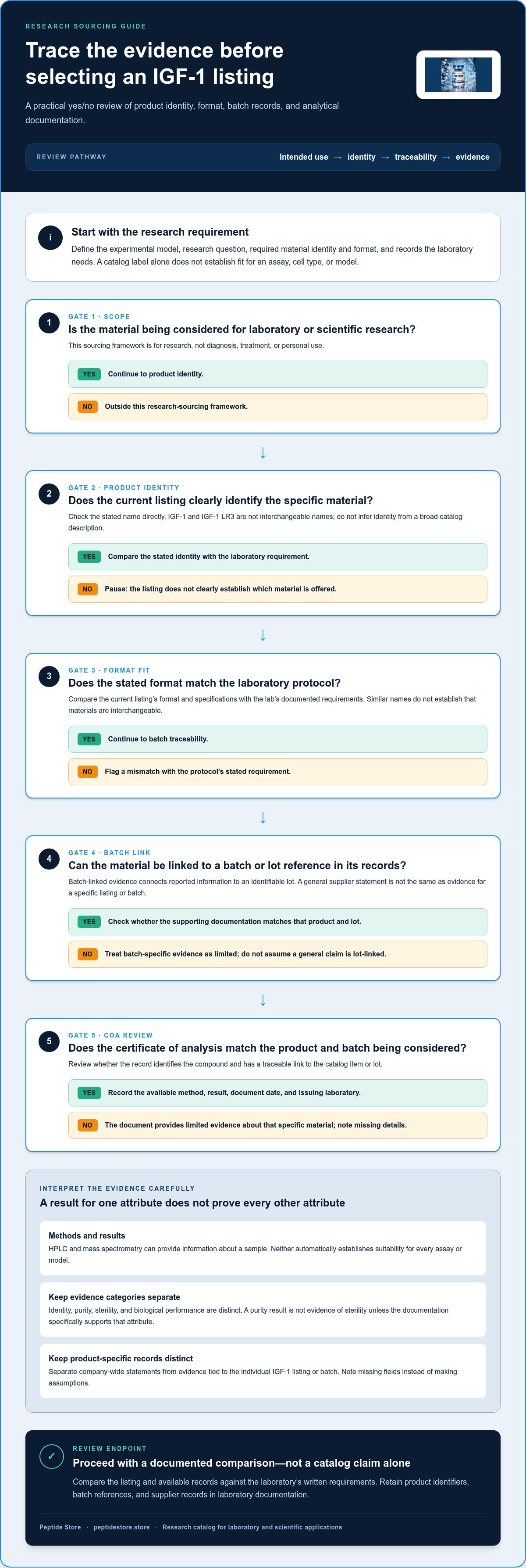
A documented procurement sequence turns research requirements into a clear purchasing decision. Before searching “igf-1 where to buy,” define what the laboratory needs and which records it must retain. Then review the listing, assess available documentation, and follow the institution’s purchasing process. This ties the decision to the study and its records instead of to assumptions based on a product name.
Review the listing before placing a research order
Compare the catalog entry with the laboratory procurement specification. Review the stated identity, format, available documentation, and research-use scope. Treat absent details as unknown; do not infer specifications from similar listings or general supplier statements. Peptide Store’s research peptide products page provides a route to browse the online catalog.
- Define the research need. Record the study question, experimental system, target species, and relevant protocol requirements. Specify the identity and format sought, along with the documentation criteria required for procurement review.
- Compare the listing. Match its product name and stated identity to the specification. Note the described format and research-use scope. Separate information explicitly provided from details that are not stated. A similar label alone does not show that two materials meet the same requirements.
- Review available documentation. Check whether supporting records correspond to the product under consideration and include information the institution needs to evaluate. Record document identifiers and reported details. Do not treat one result as evidence for attributes it does not address.
- Confirm procurement records. Before ordering, make sure the relevant catalog entry and purchasing details can be recorded in the laboratory’s procurement system. Plan to retain order records and any product or batch identifiers supplied with the purchase. Document how the material was assessed against protocol requirements.
- Order for the stated research purpose. Follow the institution’s purchasing process using the selected listing and its recorded details. After receipt, preserve supplier records, product identifiers, and batch references according to laboratory procedures so the material can be linked to the research record.
Record procurement details for reproducibility
Use established laboratory procedures to store purchase records and document review decisions. The record should identify the selected listing, the identifiers supplied, and the evidence considered. This provides a useful reference if the study is repeated, reviewed, or compared with later work. Supplier information supports that record trail, but does not replace institutional review or experiment-specific validation.
Base storage and handling decisions on current product documentation and applicable institutional protocols. Do not apply instructions from a different compound or assume that undocumented conditions are suitable. With the requirements and recordkeeping steps defined, researchers can use Peptide Store’s catalog to locate its research-grade IGF-1 offering for laboratory and scientific applications.
Source Research-Grade IGF-1 Through Peptide Store
Peptide Store supplies IGF-1 through its research-grade peptide catalog for laboratory and scientific applications. For researchers asking “igf-1 where to buy,” the store provides a direct online catalog route. The product is supplied for research purposes only, not human use, diagnosis, treatment, dosing, or clinical suitability.
The catalog is a starting point for procurement, not a substitute for evaluating whether a listing fits a particular laboratory requirement. Review current product information alongside the institution’s procurement specification. Base decisions on details actually provided rather than assumptions about format, purity, storage, availability, or batch testing.
Find IGF-1 in the research peptide catalog
Use the research peptide categories page to navigate the catalog. When reviewing the IGF-1 entry, compare its stated identity and research-use scope with the laboratory’s documented needs. Refer to the current listing for product-specific information, and do not carry specifications over from a different compound or unrelated catalog description.
Keep the procurement assessment focused: does the listed identity correspond to the compound specified for the project, and does the information provided support the laboratory’s review process? Treat details that are not stated as unknown. This avoids turning general expectations about research peptides into unsupported claims about a specific product.
Proceed with a documented research procurement decision
Before ordering, make sure the procurement record captures the listing reviewed, the product identifiers presented, and the documentation considered. If a batch reference or other traceability information is supplied, preserve it with the order and supplier records according to institutional procedures. Record how the material was assessed against the study’s requirements so the purchase can be understood in the context of the research workflow.
Product information supports procurement review, but does not replace institutional oversight or experiment-specific evaluation. Keep IGF-1 sourcing within laboratory and scientific research applications, and use supplier information only for the details it explicitly addresses. Catalog inquiries can be sent through Peptide Store’s contact page; this route is for catalog questions, not clinical guidance.
Review the current listing and its accompanying information as part of the laboratory’s procurement process. Browse the research peptide catalog to locate IGF-1 for laboratory and scientific research.
Make the Next Procurement Decision Traceable
A sourcing decision is most useful when its rationale remains clear after the order is placed. Link the selected material to the research question, procurement record, and laboratory review process. That continuity helps future project reviews establish what was acquired and why it was considered appropriate for the planned research.
For teams evaluating igf-1 where to buy, Peptide Store provides a research-focused catalog for laboratory and scientific applications. Keep the intended research use explicit, and assess information accompanying the relevant listing within institutional procedures. This supports a considered purchasing decision without confusing research supply with clinical or personal use.
Browse Peptide Store’s research peptide catalog to review the IGF-1 listing and take the next step in your laboratory procurement process.
Frequently Asked Questions
Where can I buy IGF-1 for laboratory research?
Peptide Store’s online research peptide catalog includes IGF-1 for laboratory and scientific applications. Researchers searching “igf-1 where to buy” can browse the catalog through its research peptide categories, then assess the current listing within institutional purchasing procedures. Keep the procurement purpose tied to laboratory research. Catalog access alone does not establish that a material meets a particular study’s requirements.
How do I evaluate an IGF-1 supplier?
Evaluate whether the supplier presents a clearly identified IGF-1 listing, a transparent research-use scope, accessible ordering information, and supporting records related to the product. For a practical comparison, document what is available for each candidate and how it relates to the laboratory’s procurement criteria. For example, distinguish a company-wide quality statement from evidence connected to a specific listing or lot. Catalog presentation alone does not prove research suitability.
What documentation should accompany research-grade IGF-1?
Useful supporting documentation helps identify the material and, where applicable, connect it to a particular batch. Review any certificate of analysis for its product name, batch reference, analytical methods, reported results, document date, and issuing laboratory. The records needed may depend on institutional procedures and the experiment. A certificate or test result supports only the attributes it reports, so do not infer sterility or biological performance from unrelated analytical data.
Is research-grade IGF-1 approved for human use?
Research-grade IGF-1 is supplied for laboratory research, not as a product approved for human use. The native form, mecasermin, is a distinct prescription medicine used for specific pediatric conditions; it should not be confused with research-grade catalog material. This distinction is provided for product classification only, not as medical guidance. Keep research compounds within their stated laboratory scope and consult qualified institutional channels for questions about research governance.
Can IGF-1 be used in any cell-culture experiment?
No. Whether a material is appropriate depends on the research question, cell type, target species, and protocol acceptance criteria. For example, a study may require a particular product identity or documented format that a general catalog description cannot establish. Researchers should assess fit before procurement and use appropriate experimental controls. The presence of IGF-1 in a catalog does not demonstrate compatibility with every cell-culture model or assay.
How can I check whether an IGF-1 certificate of analysis is batch-specific?
Compare the certificate’s product name and batch or lot identifier with the identifiers on the relevant listing, order records, or received product label. Check that the document refers to the same material, rather than naming IGF-1 only in general terms. Record any mismatch or missing lot reference for laboratory review. A generic document without a clear connection to the supplied batch should not be treated as batch-specific evidence.
What is the difference between IGF-1 and a growth hormone secretagogue?
IGF-1 is a growth factor, while a growth hormone secretagogue is a compound that stimulates growth hormone secretion. They are different categories and should not be treated as interchangeable materials. This distinction matters when translating a research question into a procurement specification: identify whether the study concerns IGF-1 itself or secretion-related pathways, then select materials and controls according to the approved laboratory protocol. Catalog terminology alone does not establish experimental equivalence.


