
What if the most repeated storage rule for reconstituted Selank is the least useful one for your sample? Online recommendations often give a single refrigerator temperature and discard date, but solvent, formulation, handling history, and product-specific stability evidence all affect how those figures apply. Appearance alone cannot reliably establish whether a sample remains suitable. Knowing how to store reconstituted Selank starts with checking what applies to the specific material, rather than adopting a universal claim.
If you have encountered conflicting advice, the uncertainty is understandable. This guide explains how to assess product-specific handling documentation, account for solvent and storage variables, and keep a traceable record of reconstitution and subsequent handling. It also distinguishes documented instructions from claims that require evidence, including storage duration, light protection, and freeze-thaw limits. The result is a consistent laboratory workflow based on available evidence, without assuming a time or temperature rule where supporting documentation is absent.
Key Takeaways
- Learn how to store reconstituted Selank by prioritizing formulation-specific documentation over universal temperature or shelf-life rules.
- Identify what to record, including solvent, preparation conditions, temperature history, and exposure conditions.
- Compare refrigeration, freezing, and room-temperature storage while distinguishing validated instructions from unestablished conditions.
- Create a traceable sample record with material identity, batch identifier, solvent, preparation date, storage condition, and operator.
- Understand why identity or purity documentation alone does not establish post-reconstitution stability.
Why reconstituted Selank storage guidance cannot be universal
Reconstituted Selank is a prepared research sample: lyophilized material combined with a specified solvent to create a solution. Its handling requirements depend on that formulation and preparation, not simply on the peptide name. Solvent composition, container conditions, and preparation and handling procedures can differ. A temperature or shelf-life recommendation for one preparation may therefore not apply to another.
Storage limits are defensible only when they are tied to the exact documented formulation. General laboratory practices can help reduce avoidable variation, but they are not a substitute for stability evidence. Do not treat a commonly repeated refrigerator temperature or discard date as validated for a sample unless the supporting documentation matches its formulation and conditions.
What changes when a lyophilized peptide becomes a solution?
Reconstitution changes the sample matrix. The peptide is now in a liquid environment, so the solvent composition and other formulation characteristics become relevant to handling. Preparation also adds steps, such as transferring solvent and accessing the container, that should be controlled and recorded. These differences are reasons to consult applicable instructions, not evidence of a particular degradation rate.
The Selank Wikipedia page offers general background on the compound, but a general reference cannot establish storage limits for a specific product or preparation. Visual inspection has similar limits: a clear solution or unchanged appearance does not confirm identity, purity, or retained stability. Those attributes require appropriate documentation or testing; appearance alone cannot demonstrate them.
Which documentation should govern Selank storage?
Start with the product label and applicable supplier documentation for the specific material. Check whether the instructions identify the relevant solvent, preparation conditions, storage conditions, and any stated period of use. A stability study supports a storage limit only when its formulation and experimental conditions match the sample being handled. Do not automatically apply evidence for a different solvent or preparation.
Separate general handling principles from product-specific claims. Limiting unnecessary exposure and keeping consistent sample records can support controlled laboratory practice, but these steps do not establish how long a particular solution remains stable. Similarly, identity or purity information for the starting material does not, by itself, show post-reconstitution stability.
If documentation provides no applicable limit, or if the label and other instructions conflict, do not fill the gap with a generic online recommendation. Record the discrepancy and refer it for laboratory review under the relevant research procedures. This keeps storage decisions traceable and makes clear which conditions are documented, which are general precautions, and which remain unestablished for that sample.
What affects reconstituted Selank stability in a research sample?
Interpreting stability depends on both the formulation and the sample’s handling history. Document the solvent identity, preparation procedure, container closure, temperature changes, and exposure conditions. Their presence does not establish that a sample has degraded or how quickly it might change. Instead, these details define the conditions that relevant evidence needs to address.
Stability conclusions apply only to the formulation and conditions actually evaluated. A result from one peptide solution cannot automatically be applied to another simply because both contain peptides. Bacteriostatic water does not establish a universal stability period for every peptide solution; the presence of a preservative is not a substitute for formulation-matched stability evidence. This distinction matters when deciding how to store reconstituted Selank without turning general handling assumptions into product-specific claims.
How solvent and preparation conditions affect interpretation
Record the solvent name and any formulation details provided with it, along with the preparation date and procedure. These details distinguish samples prepared under different conditions and make comparisons meaningful. If a study evaluates a particular solvent and preparation, its findings support conclusions only within the scope of those evaluated conditions.
Preparation records should also identify the material and batch, the operator, and any procedural deviations. A note that says only “reconstituted” is insufficient if the solvent and method are unknown. Background reading on bacteriostatic water reconstitution science can explain the role of formulation choices, but it does not replace product-specific instructions or establish that a solvent is suitable for uses outside laboratory research.
Why handling history and analytical evidence matter
Each time a container is accessed, or storage conditions change, the sample history gains information relevant to interpretation. Record how often the container was opened, whether it was kept closed between uses, and any temperature excursion, including its duration when known. Note exposure conditions specified by the product documentation. These records let you compare observed outcomes with the sample’s actual history instead of an assumed ideal condition.
Analytical evidence also has limits. A test evaluates particular attributes using specified methods and acceptance criteria; it cannot automatically answer every question about future storage conditions or an untested formulation. The FDA guidance on drug stability testing provides a framework for understanding stability-testing principles, but it does not validate a specific research Selank preparation. A research-peptide laboratory guide can help structure documentation, while conclusions still require evidence that matches the sample.
For laboratory sourcing, the research compound catalog includes Selank and bacteriostatic water. Keep sourcing records linked to the sample record so material identity, solvent, and subsequent handling can be reviewed together.
Refrigeration, freezing, or room temperature: compare only validated options
Storage recommendations should follow evidence for the specific reconstituted Selank formulation, not a general preference for cold storage or a temperature printed on shipping materials. Product-specific post-reconstitution conditions and duration must be supported by relevant documentation. The options below are classified by evidence status rather than presented as instructions.
| Condition | Evidence status for the specific sample | How to interpret it |
|---|---|---|
| Refrigeration | Unestablished unless applicable product instructions or matching stability evidence specify it. | Verify both the temperature range and supported storage duration. |
| Freezing | Unestablished unless the formulation has been evaluated under the stated freezing and thawing conditions. | Do not assume freezing preserves the sample or that thawing has no effect. |
| Room temperature | Unestablished unless matching documentation supports the condition and duration. | Do not infer that brief or extended exposure is acceptable without evidence. |
The table is a decision aid, not a storage protocol. A condition is supportable only when documentation applies to the same material, solvent, preparation, container, and relevant handling conditions. Cold-pack instructions for a shipment describe transit controls; they do not establish storage requirements after reconstitution. Likewise, a temperature range validated for another peptide cannot be transferred to Selank without relevant evidence.
When can refrigeration be recommended?
Refrigeration can be recommended only when product-specific instructions or stability evidence support it for the formulation in question. Establish two details separately: the permitted temperature range and the length of time supported under that condition. Evidence for one does not automatically validate the other. If documentation gives a range but no duration, do not supply a shelf-life estimate from generic online guidance.
When are freezing or room-temperature claims unsupported?
Freezing and thawing are distinct handling conditions that require explicit evaluation for the relevant formulation. A claim that freezing preserves every sample is not justified without matching evidence; nor does a report about a different solution establish that freezing is harmful to this one. Record any temperature excursion and follow applicable laboratory review procedures rather than presuming its impact.
Room-temperature claims require the same discipline. An online time limit is unverified unless its source and conditions match the sample. Convenience does not make a storage option valid. For researchers deciding how to store reconstituted Selank, the defensible approach is to follow applicable product documentation, identify gaps, and avoid presenting an untested condition as an established laboratory recommendation.
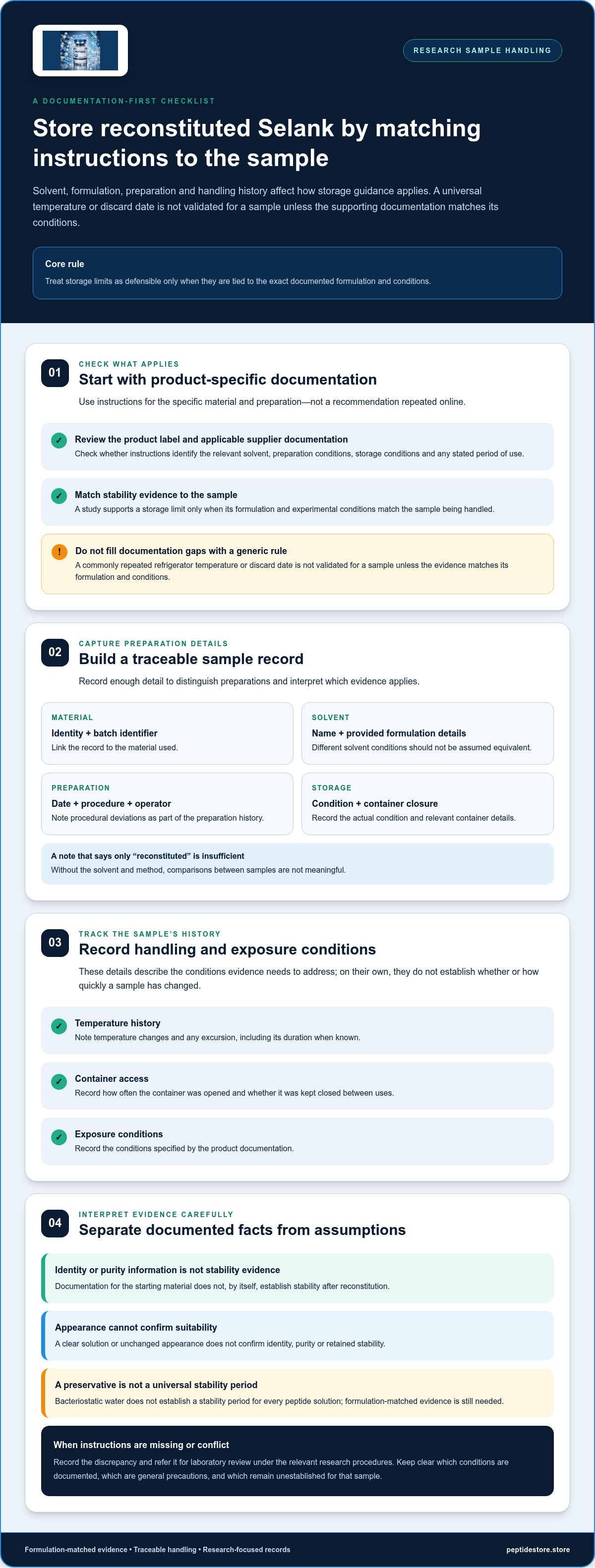
Use a documented workflow for storing reconstituted Selank samples
A repeatable workflow makes storage decisions reviewable across operators and experiments. Before deciding how to store reconstituted Selank, identify the applicable product-specific instructions and any stability evidence that matches the formulation. Carry those instructions through preparation, labeling, storage, and recordkeeping. If a limit is absent, document the gap rather than substituting a generic date or condition.
- Review the governing documentation. Check the product label and applicable supplier documentation for the material and batch. Identify any stated solvent, preparation requirements, storage condition, and duration. If using a stability study, verify that its formulation and test conditions are relevant to the sample.
- Confirm material identity. Record the compound name and batch identifier from the source documentation. Keep this information associated with the prepared sample so later observations and assay results can be traced to the correct material.
- Record preparation details. Document the solvent identity, preparation date and time if required by laboratory procedures, and responsible operator. Include relevant procedure details or deviations in the laboratory’s established format.
- Assign a sample identifier and label. Use the laboratory’s documented identifier system. Ensure the label and log connect the prepared sample to its material identity, batch, solvent, and preparation record.
- Apply only a supported storage condition. Follow the applicable instruction and the laboratory’s procedures. Record the source of any temperature or duration limit used. Do not create a universal beyond-use date when relevant supporting data are absent.
- Complete the traceable storage record. Log the selected storage condition, the documentation supporting it, the sample location if required, and the operator responsible for the entry. Update the record when handling history or storage conditions change.
Label and log each prepared research sample
A label should identify the sample without relying on memory or an informal note. Follow institutional requirements for label content and legibility, and ensure the accompanying log contains the full record. At minimum, retain the material identity, batch identifier, solvent, preparation date, storage condition, and responsible operator. Add the source of any temperature or duration limit so reviewers can distinguish documented instructions from local assumptions.
If the documentation supports a storage condition but does not state a duration, leave the duration unresolved in the record. Do not infer a discard date from another peptide, a shipping note, or a general online recommendation.
Respond to undocumented conditions or temperature excursions
Record an excursion or undocumented condition promptly, including what happened, when it was identified, and its duration if known. Note available temperature or handling details without assuming they prove the sample remains suitable. Follow the laboratory’s deviation and disposition procedure before including the sample in an assay. A recorded decision to retain or exclude a sample is a research decision, not a guarantee of sample integrity.
For research workflows that require peptide starting materials, review the research-grade peptide catalog alongside your laboratory’s documentation and sample-control procedures.
Keep Selank storage decisions traceable and research-focused
Reliable storage decisions connect the prepared sample to evidence that actually applies to it. Product identity or purity documentation and post-reconstitution stability evidence answer different questions. A batch record may characterize material attributes at a defined point, but it does not automatically establish how a solution behaves after preparation under every solvent, temperature, or handling condition.
For researchers deciding how to store reconstituted Selank, the practical standard is traceability: match the material, batch, and formulation to the instructions or stability evidence used to justify a storage condition. Record any gaps clearly. This supports consistent research procedures without turning an assumption into a stability claim.
Separate batch documentation from storage validation
A certificate of analysis may report specified tests and results for a particular batch, such as identity or purity attributes, according to the document’s scope. Review what was tested, the method or criteria stated, and which batch the certificate identifies. This helps establish what the documentation supports, but a certificate alone does not necessarily evaluate a reconstituted solution or validate a storage duration.
Post-reconstitution conclusions require evidence relevant to the prepared formulation and conditions in question. Check whether the documentation matches the material and batch, solvent, preparation, and storage conditions used in the research workflow. If it does not, treat its conclusions as limited rather than extending them to the sample. Neither a certificate nor a storage log guarantees retained potency or a particular experimental outcome.
Apply research-use boundaries to the final guidance
This article provides laboratory handling context for scientific research. It is not personal medical advice or guidance for administration, and it does not recommend Selank for the diagnosis, treatment, or prevention of any condition, or for human use. Keep storage decisions within applicable research procedures and the evidence available for the specific sample.
A well-maintained record helps future reviewers distinguish a documented condition from an unverified assumption. It also lets researchers interpret sample history alongside assay results, without treating appearance, product identity, or general storage advice as proof of stability. Where evidence is incomplete, preserve that uncertainty in the record and follow the laboratory’s review process.
For research supply needs, you can review the research peptide catalog as a separate step. The catalog is intended for scientific and laboratory applications; product information should be considered independently from evidence supporting post-reconstitution storage conditions.
Build storage decisions into your research workflow
Make each storage decision part of the sample’s controlled research record. Before a prepared material enters an assay, ensure its documentation connects the source material and formulation to the conditions applied. If supporting evidence is incomplete, preserve that uncertainty and follow your laboratory’s review procedures rather than treating an estimate as an established limit. This helps researchers interpret results with appropriate context and improves consistency across future work.
Use this guidance for scientific and laboratory handling only. It does not provide personal medical advice or instructions for administration or human use. Peptide Store supplies research-grade compounds, including Selank and bacteriostatic water, for scientific researchers and laboratories. For research-grade peptide supply, review the research peptide catalog.
With clear records and evidence matched to the sample, your team can make storage decisions that are transparent, reproducible, and useful for research.
Frequently Asked Questions
Can the appearance of reconstituted Selank show whether it is still stable?
No. A clear solution does not prove molecular identity, purity, or retained activity, and visual inspection cannot establish sample stability. If you observe a change in appearance, document it with the sample identifier, date, and relevant handling details; do not treat that observation alone as a definitive test. Refer to applicable product documentation and validated analytical procedures for research assessment. Appearance cannot determine suitability for human use.
Does bacteriostatic water guarantee a particular storage life for reconstituted Selank?
No. The solvent alone does not establish a universal storage duration for reconstituted Selank. A defensible limit needs to match the specific formulation and supporting documentation; a duration reported for another compound may not apply. Keep the solvent details in the sample record, then assess storage claims against relevant evidence. The article on bacteriostatic-water reconstitution science provides formulation context, but that context is not a substitute for Selank-specific storage validation.
What should a laboratory do if the storage temperature is unknown?
Record what can be established, including sample identity, batch, solvent, preparation details, and any available temperature history. Do not create a storage limit or assume the sample remains suitable because no problem is visible. Apply the laboratory’s deviation and disposition procedures, then assess whether relevant stability evidence supports continued research use. This quality-management process documents a decision; it does not guarantee sample integrity. Avoid assigning a retrospective temperature based on storage location alone.
Can reconstituted Selank be transported between laboratories?
Transport should follow applicable product-specific documentation and the receiving laboratory’s procedures. Insulated packaging or cold packs do not, by themselves, validate a particular temperature or transit duration. Before research use, preserve available shipment records, such as dispatch and receipt times and any recorded temperature data, then assess deviations against relevant evidence. If the transport conditions cannot be established, document that uncertainty and use the laboratory’s review process rather than assuming the sample remained stable.
How should a laboratory document a temperature excursion involving Selank?
Log the event promptly, noting the sample identifier, date and time, observed conditions, known duration, and the source of any temperature information. Attach relevant instrument or transport records when available, and identify who reported or reviewed the event. The responsible laboratory process should determine disposition using applicable procedures and stability evidence. Do not label the sample usable or unusable based on an unspecified excursion alone; the record supports review, not a stability guarantee.
Can storage instructions for another peptide be applied to Selank?
Not automatically. Another peptide’s guidance may reflect a different solvent, concentration, container, or tested condition, so its temperature and duration limits may not apply to Selank. Use documentation relevant to the specific Selank material and prepared formulation. For example, a protocol validated for a different peptide solution does not establish Selank’s storage period. If matching evidence is unavailable, record the limit as unknown and follow laboratory review procedures rather than adopting an assumed value.


