

Could two peptides often discussed together raise very different research questions? The semax vs selank comparison can be hard to follow when summaries blur their molecular backgrounds, proposed mechanisms, and evidence. Both were developed in Russia, but they have different origins: Semax is a synthetic analog of an ACTH fragment, while Selank is a synthetic analog of the immune peptide tuftsin. This distinction helps explain why research has focused more on neuroprotective and cognitive questions for Semax, and anxiolytic questions for Selank.
To compare them carefully, separate what is known about each molecule from what researchers propose about its activity, then assess the evidence behind each claim. Study type matters: laboratory, animal, and human research answer different questions. Much of the clinical evidence comes from Russian studies, so research interest should not be mistaken for proof of safety or efficacy. This article offers a framework for interpreting the literature, not clinical guidance or a recommendation to use either compound.
Key Takeaways
- Distinguish Semax and Selank by their molecular backgrounds and proposed mechanisms, while treating mechanisms as research hypotheses rather than established effects.
- Assess semax vs selank by checking the evidence behind each claim, not by relying on broad labels or promised outcomes.
- Separate laboratory, animal, and human findings. The model and study population determine what a result can reasonably support.
- Trace claims to their source publications and check the study design, measured outcomes, and limitations before drawing conclusions.
- Peptide Store’s research-grade catalog includes Semax and Selank for laboratory and scientific applications, not as established human-use treatments.
Semax vs Selank: What the Comparison Can, and Cannot, Tell You
Semax and Selank are distinct synthetic peptides developed in Russia and studied in neuroregulatory research. They are often discussed together because both have been investigated in relation to brain function, but that overlap does not make them interchangeable or establish a clinical effect for either. A useful comparison separates each molecule’s background from proposed biological activity, then checks how strong the evidence is for each specific claim.
Why Semax and Selank Are Compared
Their research backgrounds make them relevant to compare, but do not show that they share effects. Semax is a synthetic analog of a fragment of adrenocorticotropic hormone (ACTH), while Selank is a synthetic analog of the immune peptide tuftsin. Research has more often examined Semax in relation to neuroprotective and cognitive questions, and Selank in relation to anxiolytic effects. These are areas of investigation, not established outcomes. The Selank Wikipedia page provides an overview of Selank and its relationship to Semax. For claims about particular findings, consult the original studies.
Related research topics do not demonstrate equivalent mechanisms or effects, and findings for one compound do not establish findings for the other. This is a descriptive comparison, not a ranking of which peptide is superior or more appropriate for personal use.
| Comparison point | Semax | Selank | Key uncertainty |
|---|---|---|---|
| Molecular background | ACTH-fragment analog | Tuftsin analog | Background alone doesn’t prove biological effect. |
| Proposed research focus | Neuroprotective and cognitive effects | Anxiolytic effects | Research focus isn’t a demonstrated clinical outcome. |
| Evidence type | Laboratory, animal, and human research | Laboratory, animal, and human research | Study designs and populations vary; direct comparisons are limited. |
What Counts as a Meaningful Difference?
A rigorous comparison keeps three questions separate:
- Molecular identity: What is the peptide’s structural background, and how does it differ from the other compound?
- Proposed activity: What process or outcome does a study investigate? Is the claim directly measured or inferred?
- Evidence strength: Was the finding observed in a laboratory model, an animal, or a human study? What were the design and limitations?
For a fair comparison, studies need sufficiently comparable models and clearly reported outcomes. An animal study and a human study measuring different endpoints cannot be treated as a head-to-head test. The broader literature also needs careful interpretation: much of the clinical research comes from Russia, and large-scale, independent trials using widely recognized clinical standards remain limited.
Citation-ready distinction: A laboratory or animal finding can support a hypothesis about biological activity, but it does not demonstrate a human outcome. Human studies must be assessed separately by their design, population, endpoints, and limitations. Accordingly, semax vs selank is most informative as a comparison of research backgrounds and evidence, not as proof of treatment benefit, safety, or equivalence.
Semax vs Selank: Differences in Molecular Background and Proposed Mechanisms
Molecular identity and proposed activity are separate questions. A peptide’s relationship to a precursor molecule describes its design background; it does not establish which biological targets it engages or explain an observed result. Treat mechanism claims as hypotheses unless an experiment directly tests the pathway and links it to a measured outcome.
Semax: Molecular Background and Research Questions
Research literature describes Semax as a synthetic analog of a fragment of adrenocorticotropic hormone (ACTH). This describes its relationship to an ACTH fragment, not evidence that Semax reproduces all of ACTH’s actions. Check residue-level sequence descriptions against primary structural literature before using them: the analog label alone is not enough to infer a complete sequence or function.
Research discussions have proposed neurobiological activity involving neurotrophic signaling and other pathways. To assess such a claim, identify what the experiment actually measured: a molecular marker in cultured cells, gene or protein expression in animal tissue, or a functional endpoint in a defined model. A change in a marker may support a pathway hypothesis. It does not establish that the pathway caused a behavioral result or that the same relationship occurs in people.
Selank: Molecular Background and Research Questions
Research literature describes Selank as a synthetic analog of tuftsin, an immune peptide. This identifies a design relationship; it does not mean the peptides are identical or share all biological actions. Exact sequence and structural claims should be checked against primary sources, including how the authors define the peptide and any modifications.
Proposed Selank mechanisms have included interactions with neurotransmitter or neuropeptide systems. Report them at the level actually tested. A receptor-binding or biochemical result, if reported, differs from a neurotransmitter-related marker measured in an animal model. Both differ from evidence of a clinical effect in humans. Avoid turning a preclinical signal into a claim that Selank reduces anxiety or improves cognition.
For either peptide, a useful mechanism summary identifies four things: the model, the intervention or comparison, the measured endpoint, and the inference the data support. If an animal study reports altered expression of a signaling-related marker, state the species and tissue and describe the result as an observed marker change. Do not call it proof of a therapeutic mechanism unless the experiment establishes that causal link.
Citation-ready qualification: Primary literature characterizes Semax as an ACTH-fragment analog and Selank as a tuftsin analog. These backgrounds frame distinct research questions, but do not independently establish mechanism, efficacy, or human outcomes. In semax vs selank comparisons, pathway language should distinguish direct measurements from proposed explanations. Researchers reviewing these compounds for laboratory work can consult the research peptide catalog while keeping product research separate from clinical interpretation.
What Does the Evidence Show for Semax vs Selank?
Assess the evidence by study type rather than grouping everything under a broad label such as “neuroscience research.” Laboratory experiments can test molecular activity under controlled conditions. Animal studies can examine effects in a whole organism, but their models do not reproduce human clinical outcomes. Human studies provide more direct evidence about outcomes in people, yet their value depends on study design, population, measures, and replication.
Preclinical Findings Versus Human Evidence
For in vitro research, check which cells or biological materials were studied, what exposure or intervention was tested, and which endpoint was measured. A change in a cellular marker may support a mechanistic hypothesis, but it cannot establish a cognitive or anxiolytic effect in people. Animal research adds observations from a whole organism, though species, model conditions, and selected behavioral or biological measures limit how far findings can be generalized.
Assess human research separately. The available overview indicates that clinical evidence for both peptides comes largely from Russian studies, while large-scale, independent trials using widely recognized clinical standards are limited. Do not assign a specific population, design, outcome, or limitation to an individual study without checking its publication. Verify those details in the original report before summarizing a result as evidence.
Separate studies also do not become a direct comparison simply because they investigate related topics. If Semax and Selank were studied in different populations, under different conditions, or with different outcome measures, differences between reported results may reflect study context rather than differences between the peptides. A head-to-head conclusion requires a suitable direct comparative design.
Evidence Gaps and Interpretation Limits
Before drawing a conclusion from a paper, examine its methods. Ask whether the result was replicated, how long participants or models were followed, and whether the endpoint was clinically meaningful or primarily exploratory. Small samples, short follow-up, and outcomes that are difficult to compare can constrain interpretation. Apply these checks to favorable findings as well as null or inconsistent results.
- Identify the evidence level: cell, animal, or human research.
- Confirm the design and population: note the model or participant group and the comparison used.
- Read the measured outcome: distinguish a biological marker from a functional or clinical endpoint.
- Record the limitation: consider replication, follow-up, sample characteristics, and how broadly the finding applies.
Citation-ready summary: The evidence overview supports the conclusion that Semax and Selank have been investigated in preclinical and human research, but does not establish that either is clinically effective, safe, or superior to the other. Mechanistic plausibility is not proof of benefit. On the evidence described here, semax vs selank cannot be resolved as a reliable ranking. Assess each study on its own methods and limitations.
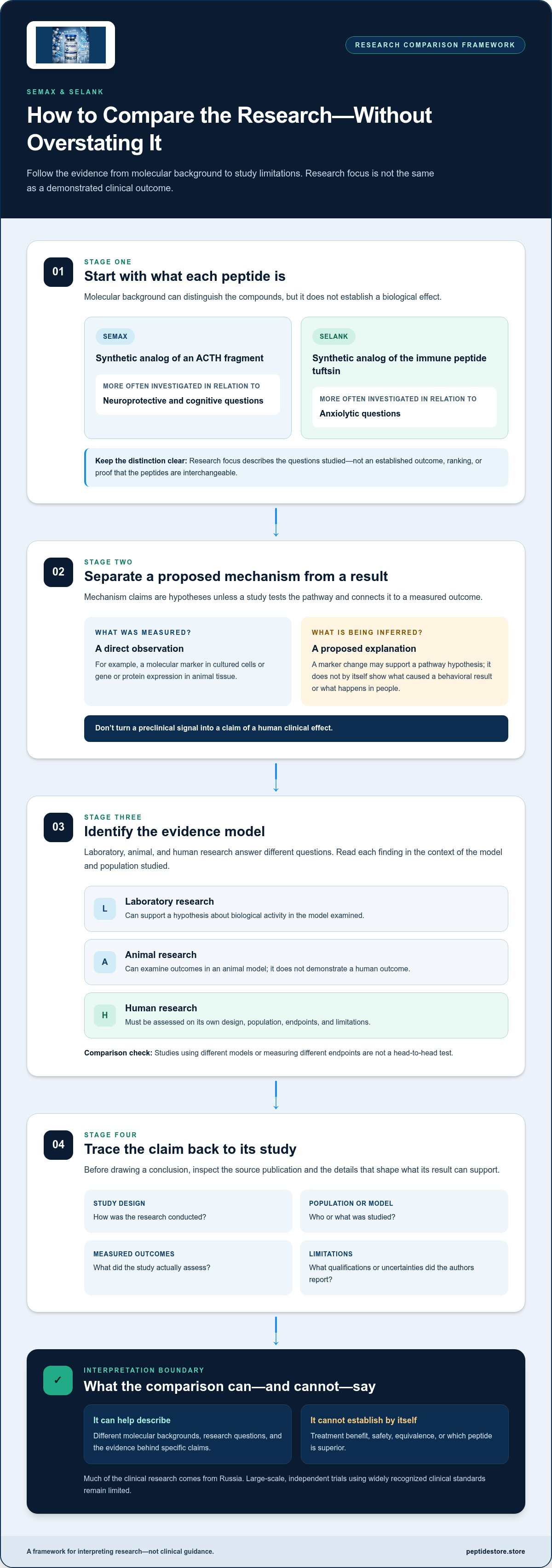
How to Evaluate Semax and Selank Claims in Research
Confident claims often compress several steps of interpretation into one sentence. A paper may report a change in a laboratory measure while a headline describes a practical benefit the study never tested. For a disciplined semax vs selank comparison, trace each claim to its source and record what the researchers actually did before accepting the conclusion.
A Four-Step Evidence Check
Use this sequence for each claim, whether it appears in a headline, review, product description, or research summary. Identify the source, understand the experiment, compare the conclusion with the measured data, and look for independent support.
- Classify the source. A primary study reports original methods and results. A review summarizes other work, while a commercial page or secondary summary may simplify or selectively present findings. Follow references to the original publication where possible.
- Extract the study details. Record the model or participant population, study design, comparator, and primary endpoint. Note whether the work involved cells, animals, or people; these evidence types answer different questions.
- Compare the claim with the endpoint. If a study measured a biological marker, a headline claiming improved cognition goes beyond that result unless cognition was directly assessed. Check whether the conclusion distinguishes observed data from interpretation.
- Look for independent replication. One result or proposed mechanism is a starting point, not confirmation. Check whether separate research groups tested a similar question and whether their methods and findings are comparable.
Study context matters. A result from one model cannot be treated as equivalent to a result in a different species or population, particularly when the comparator and outcome measures differ. If a summary omits those details, withhold a firm conclusion rather than filling gaps with assumptions.
Questions a Responsible Comparison Must Leave Open
Check the cited literature before stating whether direct Semax-versus-Selank studies exist. If the sources reviewed do not establish a head-to-head comparison, say that the available evidence does not support a direct ranking rather than asserting that no such study exists. Keep longer-term safety, clinical relevance, and generalizability open questions unless suitable studies directly address them.
Research-grade supply language describes the intended laboratory and scientific context of a material. It is not evidence that the material is suitable for human use, and it does not establish safety, efficacy, or clinical status. Peptide Store’s article, Research Peptides: The Laboratory Guide to Synthesis, Purity, and Analytical Standards (2026), provides related research context. Analytical or supply information should remain distinct from clinical conclusions.
Evidence appraisal is not a basis for personal dosing, administration, or treatment decisions. Researchers reviewing compounds in a laboratory context can explore the research peptide catalog, which includes Semax and Selank for laboratory and scientific applications.
Semax vs Selank in a Research Catalog: Scope and Responsible Next Steps
The comparison is most useful when it separates two questions: what researchers have investigated, and what a research catalog is intended to support. Semax and Selank appear in neuroscience discussions because they raise distinct experimental questions. Reviewing them as research compounds does not resolve whether either has a clinical role, and catalog inclusion is not evidence of human-use safety or efficacy.
Research Use Is Not a Clinical Recommendation
This article does not establish that either peptide is safe or effective for people, or suitable for treating a condition. Interpret research findings within the design and limits of each study. A result in cells, an animal model, or a particular human-study population cannot automatically be generalized to another setting or used as a treatment recommendation.
For responsible interpretation, stay at the level of the evidence: identify what was studied, what outcome was measured, and what remains unresolved. This comparison does not provide clinical dosing, administration instructions, or individualized medical guidance. A research-grade designation should not be read as human-use authorization. It describes a research context, not a conclusion about clinical suitability.
Researchers planning laboratory work can define the experimental question before selecting a compound. Specify the model, comparator, endpoints, controls, and analysis approach in the study protocol. These details help distinguish a test of a molecular hypothesis from a test of a functional outcome, and support clearer interpretation if results differ from prior reports.
Connecting the Comparison to Peptide Store
Peptide Store lists Semax and Selank for laboratory and scientific research applications within a catalog of more than 150 research-grade compounds. This is relevant for researchers exploring neuroregulatory peptides, but should remain distinct from claims about treatment, clinical efficacy, or personal use. Catalog access does not establish that a compound will produce a particular experimental result.
Apply the same evidence standards in the laboratory context. Record the source and identity of materials used in an experiment, follow applicable institutional procedures, and report methods and limitations clearly. These practices improve transparency; they do not replace evidence or turn a research result into clinical guidance. The central conclusion remains bounded: research interest can inform questions for further study, but does not establish that Semax or Selank is superior, clinically effective, or appropriate for human use.
To review the compounds in their stated laboratory and scientific context, explore the Peptide Store product catalog. Use the comparison to frame research questions, not to predict outcomes or make treatment decisions.
Carry a Stronger Evidence Standard Into Future Research
The most useful next step is not to force a winner from incomplete evidence. Let unresolved questions guide what researchers measure, which comparisons they make, and how carefully they report limitations. A clearly defined model and endpoint can make future findings easier to interpret and compare.
When assessing semax vs selank, apply the same discipline to new claims: trace them to the underlying study, distinguish measured results from interpretation, and keep conclusions proportional to the evidence. Research interest can support further investigation, but it does not establish human-use safety, efficacy, or treatment suitability.
Researchers can use this framework to approach peptide literature precisely, separating experimental context from claims that go beyond the data. For laboratory and scientific research, review the research peptide catalog. Let the evidence shape the question, and keep each conclusion appropriately bounded.
Frequently Asked Questions
What is the main difference between Semax and Selank?
Their molecular origins differ, and researchers have generally investigated different questions for each. Semax is related to an ACTH fragment, while Selank is related to tuftsin. To distinguish a claim, check whether the source is describing molecular identity, a proposed mechanism, or a study outcome. These are separate kinds of information, and one does not automatically validate the others.
Is Semax better than Selank?
Current evidence does not establish that either is better. The semax vs selank comparison is not a clinical ranking: research may examine different outcomes, use different study populations, or rely on different models. A finding about one endpoint in an animal study, for example, cannot be weighed directly against a different endpoint in a human study as if both compounds had been tested under the same conditions.
Can Semax and Selank be compared using animal studies?
Yes. Animal research can inform a comparison, especially when both compounds are examined in the same species, model, and experimental design. Check whether researchers used comparable controls and measured the same outcomes. If the studies differ, observed differences may reflect those design choices rather than the peptides. Animal findings can guide questions for further investigation, but do not establish effects in people.
What does research say about Semax and Selank mechanisms?
Research proposes biological pathways for both peptides, but a proposed mechanism is not automatically a confirmed explanation for an outcome. A study that measures a signaling-related marker, for instance, can show an association under its experimental conditions. It may not establish that the marker caused a behavioral change. To interpret a mechanism claim, identify what was directly measured and what the authors inferred.
Are Semax and Selank approved medications in the United States?
Neither Semax nor Selank is FDA-approved as a medication in the United States. Publication of a study, availability of a compound for laboratory research, and approval as a medication are different things. Regulatory status can change, so check current claims about a specific legal or compounding pathway against up-to-date authoritative sources.
Are Semax and Selank intended for human use?
Research-grade Semax and Selank supplied for laboratory and scientific applications are not presented as products for human use. A research label does not establish suitability, safety, or efficacy for people. Do not treat experimental findings or product descriptions as personal-use instructions. This article does not provide dosing, administration guidance, or medical advice; questions about health conditions or treatment belong with a qualified healthcare professional.
How should I evaluate claims about Semax or Selank online?
Start by locating the original publication behind the claim, then check whether it studied cells, animals, or people. Compare the headline with the actual endpoint: a laboratory measurement, for example, is not proof of a clinical benefit. Note the population or model, comparator, follow-up, and stated limitations. If a page makes a broad claim without identifying its source, treat that claim as unverified.


