
A correct calculation can still rest on the wrong assumptions. A peptide reconstitution calculator 2026 can convert a stated peptide mass and solution volume into a concentration, but the result depends on accurate inputs and consistent units. It does not establish whether that concentration is suitable for an experiment, and it is not a dosing recommendation.
Uncertainty about milligrams, micrograms, milliliters, and a calculator’s assumptions is understandable. The arithmetic may be straightforward, but interpreting the result requires care. This guide explains the concentration formula, how to check units and entries, and what a calculator can and cannot tell you. It also covers how to document the calculated concentration and its assumptions for research use. The key distinction is simple: a calculator standardizes concentration math, while experimental suitability depends on factors beyond that calculation.
Key Takeaways
- Use the peptide reconstitution calculator 2026 as a concentration-math tool, and check that its inputs and assumptions fit the calculation.
- Apply the relationship between material amount and final solution volume, keeping units consistent before interpreting the result.
- Compare calculators, spreadsheets, and manual calculations for visibility, repeatability, and recordkeeping.
- Review each input systematically, including material amount, units, and volume definition, before accepting an output.
- Document the arithmetic separately from reagent handling and protocol-specific research decisions.
What a Peptide Reconstitution Calculator 2026 Is Designed to Calculate
A peptide reconstitution calculator estimates a solution’s concentration from user-entered quantities, typically the material amount and a stated solution volume. The peptide reconstitution calculator 2026 can standardize this arithmetic, but it can only process the values supplied. A mass entered in the wrong unit, an unclear volume definition, or incompatible units can produce an output that looks precise but represents the wrong calculation.
A calculated concentration is an arithmetic result, not a validated experimental protocol. A calculator does not select a concentration for a study, confirm that the input material is suitable, or establish that a planned procedure is valid. Keep those decisions separate from the numerical result.
What concentration means in a research calculation
Concentration expresses an amount of material relative to a stated volume of solution. In a mass-concentration calculation, the amount is expressed as mass and the result uses a mass-per-volume unit, such as milligrams per milliliter. The numerator and denominator describe different quantities, so identify each unit rather than treating the numbers as interchangeable.
Molar concentration is different. It expresses an amount of substance in moles relative to volume, commonly in moles per liter. Converting mass to a molar value requires the relevant molecular weight and consistent unit conversion. A mass-per-volume result is not itself a molar concentration. Before interpreting an output, confirm that the selected concentration unit matches both the inputs and the intended reporting convention.
For foundational context on peptide structure, see What are peptides? This background does not change the calculation, but it helps distinguish the material being described from the units used to report its concentration.
What a calculator result does not establish
Arithmetic alone does not establish solubility, stability, sterility, or suitability for a particular assay. Those properties depend on the material, solvent, conditions, and research method. A concentration value is not evidence that a solution will behave as intended or that a procedure has been validated. Nor can the calculator confirm that entered values match the applicable material documentation.
Calculator outputs are not human dosing instructions or clinical recommendations. Concentration describes the relationship between material amount and solution volume; it does not determine a dose, route, or use in people. Keep research calculations within their documented laboratory context.
For protocol-dependent decisions, follow the applicable laboratory standard operating procedure (SOP) and authoritative documentation for the material and method. For laboratory teams evaluating reconstitution fluids and handling practices, research insights from BacLab provide useful background. Record the inputs, units, volume definition, and calculated unit so another researcher can review how the result was obtained. Treat arithmetic review, reagent handling, and experimental planning as separate checks. A calculator can support the first, but it cannot replace the controls and judgment needed for the others.
How Peptide Concentration Calculations Use Mass, Volume, and Units
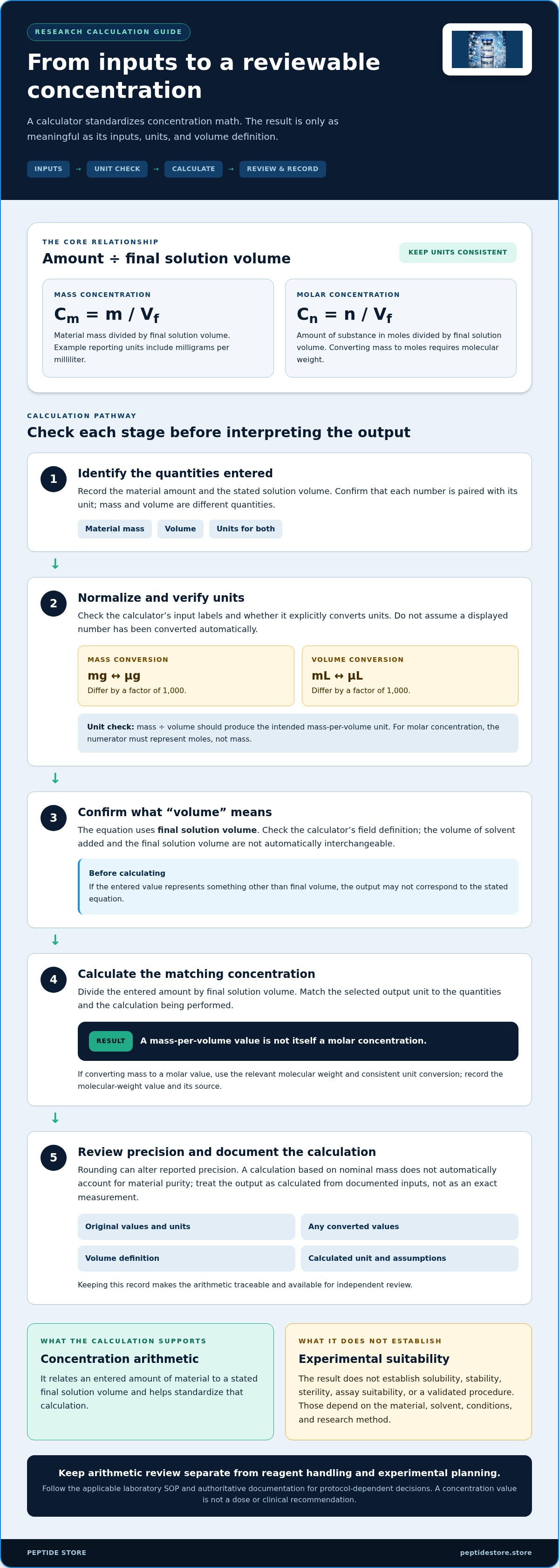
The core relationship is direct: concentration equals the entered amount of material divided by the final solution volume. For mass concentration, use Cm = m / Vf, where Cm is mass concentration, m is the entered material mass, and Vf is the final solution volume. For molar concentration, use Cn = n / Vf, where n is the amount of substance in moles. Converting mass to moles also requires molecular weight.
These equations describe different quantities. A mass concentration might be reported in milligrams per milliliter, while a molar concentration is reported in moles per liter or a related unit. A peptide reconstitution calculator 2026 returns a meaningful result only when its selected output unit matches the entered values and the calculation being performed.
Convert units before interpreting the result
Unit mismatches can change a result by orders of magnitude. Milligrams and micrograms differ by a factor of 1,000, as do milliliters and microliters. Entering a number in one unit while selecting another does not convert the quantity unless the tool explicitly applies that conversion. Check the input labels and conversion behavior rather than relying on the displayed number alone.
Dimensional analysis provides a simple check: divide a mass unit by a volume unit, then confirm that the resulting unit is the intended mass-per-volume unit. For molar concentration, the numerator must represent moles, not mass. Keep a record of each original value and unit alongside any converted value. This preserves traceability and makes independent review possible.
Account for final volume and calculation assumptions
Check what the calculator means by “volume.” The equation requires the final solution volume, but an interface may describe its field differently. If the entered value represents something other than final volume, the output may not correspond to the equation shown here. Do not assume that the volume of solvent added and the final solution volume are interchangeable.
Other assumptions affect how precisely a displayed result represents the material. Rounding during unit conversion or in the calculator’s output can alter reported precision. A calculation based on nominal mass does not automatically account for material purity. Molar concentration depends on the molecular-weight value used, so record its source and the units used in the conversion. Treat the result as calculated from documented inputs, not as an exact measurement of a solution.
For broader regulatory context, the FDA maintains guidance documents for drugs and research. Consult applicable authoritative guidance alongside laboratory procedures. For research sourcing context, review the research peptide catalog, while keeping sourcing records separate from concentration calculations.
Calculator, Spreadsheet, or Manual Calculation: Compare the Methods
Each approach can produce the same concentration when it uses the same formula and inputs. The differences are how easily a researcher can inspect the calculation, reproduce it, and preserve a reviewable record. Convenience does not remove the need to verify the formula, entered values, and units.
The most suitable method is the one whose assumptions and calculations can be checked. A calculator may be efficient for routine arithmetic, while a controlled spreadsheet or documented manual check can make the calculation path easier to review. Choose based on recordkeeping requirements and the complexity of the work, not speed alone.
| Method | Inputs and unit handling | Calculation visibility | Documentation |
|---|---|---|---|
| Calculator | Enter the required quantities and select from supported units. | May show only the result or expose the formula; inspect the interface. | Save the inputs, selected units, output, and tool details separately if needed. |
| Controlled spreadsheet | Use defined input cells, unit labels, and documented conversion rules. | Formulas can be inspected, provided the workbook preserves them. | Can retain inputs, formulas, assumptions, and review notes in one record. |
| Manual calculation | Write down each quantity and convert units consistently. | Visible when each arithmetic step is recorded. | Requires a clear written calculation and independent review where appropriate. |
When a calculator is useful for routine arithmetic
A calculator can support rapid recalculation and consistent application of a formula when inputs change. That convenience is useful only if you understand the tool’s labels and behavior. Inspect which quantities it requests, which units it supports, how it defines volume, and what unit it reports. A displayed result does not verify the entries or validate an experimental plan.
When a spreadsheet or manual check adds value
A controlled spreadsheet can make repeated calculations easier to compare by using a documented formula and clearly labeled inputs. Protecting formula cells and recording changes can help preserve an auditable calculation path. A manual check provides another way to verify arithmetic, especially when a result is consequential or unexpected. If two methods disagree, pause and identify the difference in inputs, units, formula, or rounding before using either result.
Whichever approach you use, retain enough information for another researcher to reconstruct the calculation. Record the source values, unit conversions, formula, assumptions, output, and reviewer notes in the relevant research documentation. Analytical records also include information beyond arithmetic. The research peptide laboratory guide provides related context on documentation and analytical standards.
A Researcher’s Checklist for Checking Calculator Inputs and Outputs
A reliable review separates data entry, arithmetic, and experimental interpretation. Use this sequence to inspect a peptide reconstitution calculator 2026 result before recording it. Each step addresses a different source of error. Completing the arithmetic check does not validate reagent handling or a research protocol.
- Identify the material amount. Compare the quantity entered with the source record, and retain the original value and unit. Check for transcription errors, misplaced decimals, or a mismatch between the documented amount and the calculator field.
- Confirm the units. Verify the mass and volume units independently, then check that the requested output is the intended type: mass concentration or molar concentration. If the calculation depends on molecular weight or purity, note whether those inputs are present and what documentation supports them.
- Inspect the volume definition. Determine whether the field represents final solution volume or another volume measure. Record the meaning used for the calculation rather than assuming that similar labels are equivalent.
- Verify the output. Check the result’s unit and scale against the inputs and formula. If the value is unexpected, repeat the arithmetic independently and resolve any discrepancy before carrying it into a research record.
Check the inputs before relying on a result
Keep original entries visible alongside any converted values. This makes it easier to trace a calculation back to its source and identify where a unit conversion or assumption entered the process. Confirm that the output unit matches the intended reporting convention. For molar concentration, verify that the molecular-weight value and conversion basis are documented. If purity affects the calculation, state whether and how it was considered rather than silently assuming a value.
The review should capture the calculator name or version, date accessed, material amount, volume, all units, selected concentration type, and relevant assumptions. Include the displayed result and enough detail to reproduce it. If the tool does not disclose its formula or unit behavior, record that limitation rather than treating its output as independently verified.
Document interpretation and research boundaries
Keep the calculated value with the applicable research record and analytical context. Arithmetic review addresses whether the recorded inputs produce the stated result. It does not determine how a reagent should be handled, whether a solution is stable, or whether experimental conditions are appropriate. Use the applicable laboratory SOP and reagent documentation for handling and protocol decisions. Solvent-specific context is covered in bacteriostatic water reconstitution science; consult it alongside relevant product documentation without treating the calculator as a substitute.
Calculator results are not instructions for administration or clinical dosing. Keep those boundaries explicit in notes and shared calculations. For research planning, source documentation should identify the material being evaluated. The research-grade peptide catalog provides a reference point for laboratory research compounds.
Apply Peptide Calculations Within a Documented Research Workflow
A concentration calculation is one record within a broader laboratory workflow. To make the result interpretable later, connect it to the compound’s identity, its source, the calculation inputs, and the research context. Keep three kinds of information distinct: sourcing records identify the material, analytical records document measurements and calculations, and protocol records govern handling and experimental decisions.
Keep compound identity and documentation connected
Record the compound identity and source alongside the calculation rather than storing a concentration value without context. Include the original material amount, units, volume definition, output, and any conversion or assumption used. Where relevant, associate the entry with the study or sample identifier used in the laboratory record. This connection helps reviewers understand which material and calculation a result refers to, without implying that arithmetic verifies material characteristics.
Peptide Store supplies research-grade compounds for laboratory applications. Its research peptide catalog is a resource for reviewing compounds in that context. Base product-specific analytical claims on the relevant documentation, not on a catalog listing or calculator output alone.
Choose next steps according to research requirements
After reviewing the peptide reconstitution calculator 2026 output, keep the next decision with the appropriate record and authority. The calculation documents a numerical relationship between entered quantities; it does not select an experimental condition or validate a method. Follow institutional standard operating procedures and applicable reagent documentation for handling, storage, and experiment-specific requirements.
A practical record can separate the workflow into three linked entries:
- Sourcing: compound identity, source, and any material documentation used for the work.
- Calculation: calculator name or version, date, inputs, original and converted units, output unit, and assumptions.
- Protocol: the applicable SOP and the documented rationale for handling and experimental conditions.
This structure supports traceability without assigning the calculator a role it cannot perform. If an output conflicts with documented inputs or seems inconsistent with the intended calculation, resolve the discrepancy before relying on it in a research record. Keep arithmetic review separate from decisions about reagent handling and experimental suitability.
This article addresses concentration calculations for research documentation only. It does not provide instructions for clinical use, therapeutic claims, administration, or human dosing. For laboratory research, review the documentation applicable to the compound and study, and retain enough detail for another qualified researcher to follow the calculation and its assumptions.
To review research-grade peptide compounds for laboratory applications, browse the research peptide catalog.
Carry Calculation Discipline Into the Next Research Step
A clear calculation record can support consistent research documentation over time. Keep material identity, source information, and analytical records connected, then use the relevant laboratory procedures to guide decisions arithmetic cannot resolve. The peptide reconstitution calculator 2026 is a tool for concentration calculations, not a substitute for protocol review or a basis for clinical use or human dosing.
For research and laboratory applications, Peptide Store supplies research-grade compounds. Founded in 2018, the company maintains a catalog of more than 150 research-grade compounds across specialized research categories. Use relevant material documentation and institutional procedures to guide the work, and preserve the assumptions behind each recorded calculation.
When your next research task requires sourcing, review research-grade peptide compounds. Browse Peptide Store’s catalog to find research compounds for laboratory applications.
Frequently Asked Questions
How does a peptide reconstitution calculator work?
A peptide reconstitution calculator divides the entered material amount by the stated final solution volume to calculate concentration. The peptide reconstitution calculator 2026 may accept different mass and volume units, so check how it interprets each field and labels the result. For example, a mass-per-volume output depends on a mass input, not an amount in moles. The calculation reports arithmetic from the entered assumptions; it does not define or validate a laboratory protocol.
What units should I enter in a peptide concentration calculator?
Enter the mass and volume in units the calculator explicitly supports, and confirm that its output unit is appropriate for the calculation. A mass-per-volume result must remain traceable to mass and volume inputs; a molar result requires an amount in moles. If you convert a value before entry, record both the original and converted units. Check that the tool has not interpreted a number under a different unit label than intended.
Can a peptide reconstitution calculator determine a research dose?
No. A concentration calculation describes a relationship between material and solution volume; it does not establish a dose, administration method, or clinical recommendation. Those questions require decisions beyond arithmetic and depend on the research context. Follow the approved study protocol, institutional procedures, and relevant oversight for research decisions. Do not use a calculator result to infer instructions for human use or substitute it for professional clinical guidance.
Is a peptide calculator result exact?
No. A displayed result reflects the entered values, unit conversions, rounding, and assumptions built into the calculation. An unclear volume definition can affect what the output represents, while a molar calculation depends on the molecular-weight value used. Purity may also matter if included in the calculation. Record the tool, inputs, units, and assumptions, then independently check results that appear unexpected or are important to the research record.
What is the difference between peptide concentration and molar concentration?
Peptide concentration can be expressed as mass per volume, such as a mass unit relative to a volume unit. Molar concentration instead expresses the amount of substance in moles per volume. These units describe related but distinct quantities. Converting a mass concentration to a molar concentration requires the compound’s molecular weight and consistent unit conversion. Without that information, do not present a mass-per-volume value as a molar value.
Can I use a spreadsheet instead of a peptide reconstitution calculator?
Yes. A spreadsheet can perform the same arithmetic if its formulas, inputs, and unit conversions are controlled and documented. Its formulas may be easier to inspect, and saved records can support repeatability, but an incorrect cell reference can still produce a plausible-looking error. Validate formulas before use, label input and output units clearly, and preserve relevant changes. Regardless of the tool, verify the quantities and independently check consequential results.
Does a concentration calculator confirm that a peptide is suitable for an assay?
No. A concentration result cannot establish whether a peptide is soluble under planned conditions, remains stable, is compatible with other materials, or is suitable for a particular assay. Those properties require evidence beyond arithmetic. Consult validated research documentation, applicable reagent information, and the laboratory’s standard operating procedures before making assay-specific decisions. Treat the calculated value as one documented parameter, not as evidence that the experimental method is appropriate.


