
When you buy research grade NAD+, a high purity figure on a product listing is only one part of the decision. Check that the material is identified as NAD+ itself, that the stated specifications match your study’s requirements, and that any analytical records refer to the lot you are considering.
These checks matter because a catalog specification and a batch-specific result are not the same thing. Use a consistent review process to compare compound identity, lot traceability, analytical documentation, and format against your laboratory protocol.
This guide explains what to look for in a Certificate of Analysis (COA), how to interpret the analytical method and reported result, and how to compare listings without assuming more than the documentation shows. Research-grade NAD+ is intended for laboratory use, not human consumption or clinical use. Peptide Store supplies NAD+ as part of its catalog of more than 150 research-grade compounds for scientific and laboratory applications.
Key Takeaways
- Check that the listed compound is NAD+ itself, not a related precursor, and compare its identifiers with the supporting records.
- Distinguish a general purity specification from a result reported for a specific lot.
- Read a COA by checking its method, result, compound identity, and lot reference. A COA documents only the information it contains.
- Before you buy research grade NAD+, define the identity, documentation, and format requirements of your laboratory study.
- Keep research materials separate from consumer supplements and clinical products, and record the lot selected for the study.
What “research-grade NAD+” means when buying for laboratory studies
NAD+ is nicotinamide adenine dinucleotide, a cofactor involved in cellular oxidation-reduction reactions. Laboratory studies may examine it in redox chemistry, NAD+-dependent enzyme assays, and pathway analyses. These are research applications, not evidence of health or longevity effects.
At the purchasing stage, distinguish NAD+ from its precursors, including nicotinamide riboside (NR) and nicotinamide mononucleotide (NMN). If you plan to buy research grade NAD+, make sure the named material matches the molecule specified in your protocol. A precursor and NAD+ are different compounds, even though both relate to NAD+ metabolism.
For foundational background on the molecule and its biochemical roles, see Nicotinamide adenine dinucleotide (NAD+). Your experimental question and protocol determine which material is appropriate.
For additional context on how NAD+ is discussed alongside other compounds, watch this video:
NAD+ identity and its role in biochemical research
NAD+ participates in electron-transfer reactions. In a simplified redox cycle, it accepts electrons during a reaction and becomes NADH; NADH can then be oxidized back to NAD+. This interconversion makes the cofactor relevant to research on redox state and enzyme activity. Its role in a particular experiment depends on the system and conditions being studied.
For example, an assay may examine an NAD+-dependent enzyme, or a pathway analysis may track related biochemical changes. These examples describe laboratory research only. They do not establish therapeutic effects, predict human outcomes, or make NAD+ a treatment for aging.
What “research-grade” does and does not establish
“Research-grade” describes intended laboratory application. The label alone does not specify a lot result, establish a particular purity, or prove suitability for every protocol. Keep four questions separate: Is the compound identified as NAD+? What purity claim is stated? Is that claim general or tied to a particular lot? What analytical records support it? Separating these points helps prevent a broad product description from being mistaken for batch-specific evidence.
- Intended use: A research designation does not mean a product is suitable or approved for clinical or human use.
- Identity: The named compound should match the material required by the study.
- Quality claim: A stated specification and a supporting analytical record are different kinds of information.
Research materials are not for human consumption or clinical use. Base procurement on the laboratory protocol, and do not infer health or longevity benefits from a research listing.
How to assess research-grade NAD+ specifications before ordering
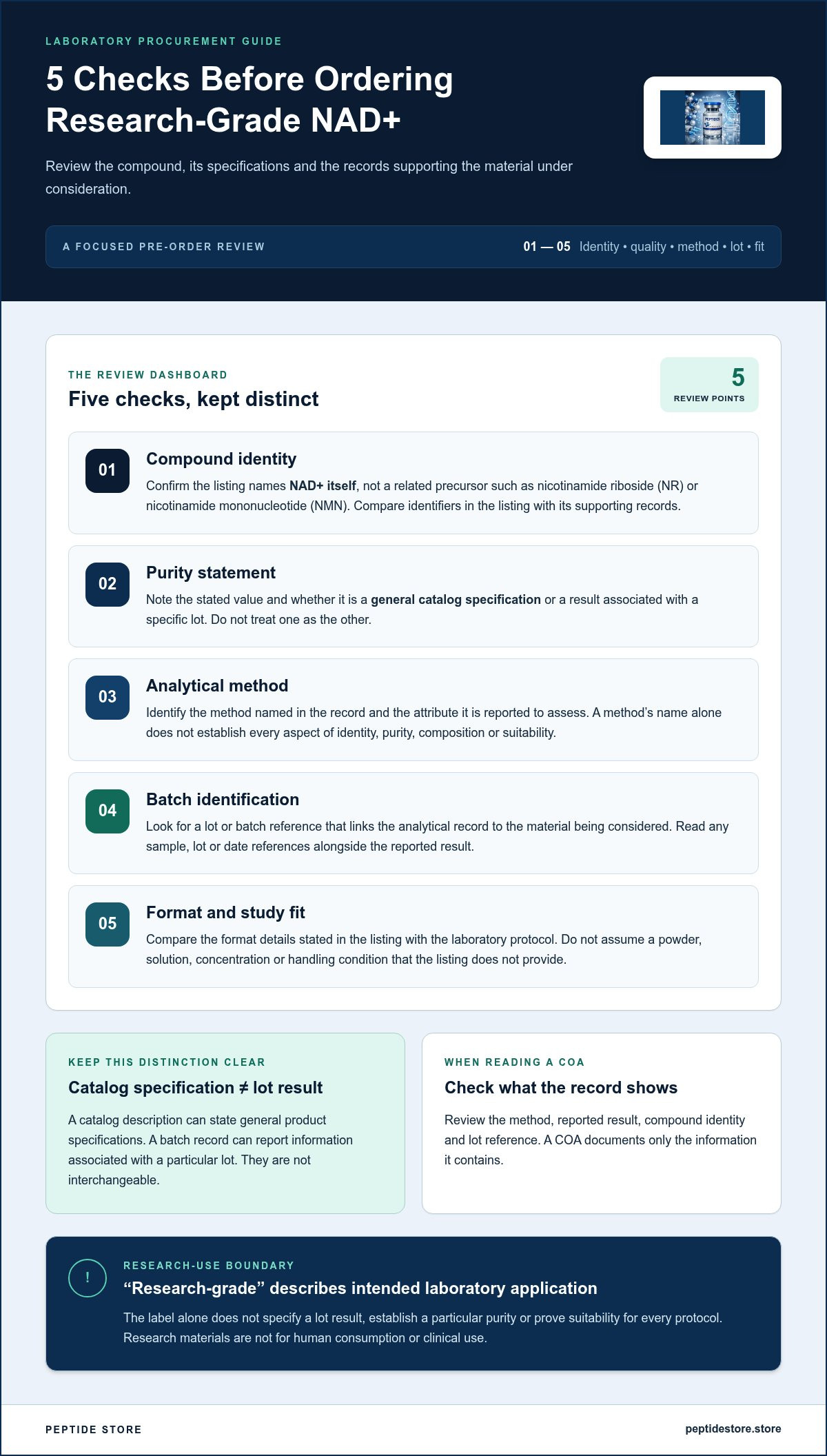
Before comparing listings, consider four separate points: the compound being offered, the stated quality claim, the method used to assess it, and whether the record refers to the lot under consideration. A catalog description can state general product specifications; a batch record can report information associated with a particular lot. They are not interchangeable.
Research on NAD+ and aging can provide context for experimental questions, but it does not assess the quality of a particular material. The review NAD+ in Aging: Molecular Mechanisms discusses relevant mechanisms. To assess a product, review its specifications and supporting records separately.
- Compound identity: Confirm the listing names NAD+ itself, not a precursor such as NMN or NR. Compare the identifiers in the listing with those in its supporting records.
- Purity statement: Note the reported value and whether it is a general catalog specification or a result associated with a specific lot.
- Analytical method: Identify the method named in the record and the attribute it is reported to assess.
- Batch identification: Look for a lot or batch reference that links the documentation to the material being considered.
- Format and study fit: Compare the format stated in the listing with the laboratory protocol. Do not infer format or handling details that are not provided.
Identity, purity, and analytical-method details
Check that the compound name and identifiers are consistent across the product description and analytical records. If they differ, or a record uses only a generic reference, it may be difficult to tell whether the document applies to the described material. Then read the purity statement carefully: “specified at” and “measured for this lot” convey different information. Do not present a general purity specification as a result for a particular lot unless the product-level evidence supports that claim.
An analytical method has a defined scope. A method may assess a particular chemical attribute, but naming it does not establish every aspect of identity, purity, composition, or suitability. Read the reported result alongside the method and any sample, lot, or date references included in the record. A general specification can help you screen listings, but it is not a substitute for a lot-specific measurement.
Format and study-fit questions for the laboratory
Fit depends on the protocol. Compare the format details stated in the listing with the study’s documented requirements, and avoid assuming a powder, solution, concentration, or handling condition based on common market formats. This guide does not prescribe reconstitution, storage, or experimental procedures. Follow the applicable product documentation and laboratory protocol.
For a broader framework on evaluating research materials and analytical standards, consult the research peptides laboratory guide. Once your criteria are defined, the NAD+ research listing provides a catalog reference to compare with your study requirements. A disciplined review helps researchers buy research grade NAD+ without mistaking a general listing claim for a result on a specific lot.
Which NAD+ documentation supports a more defensible purchase decision?
Documentation is useful when it connects a stated specification to the material being considered. A product-page claim, a batch record, an analytical method, and an identity check serve different purposes. Compare each record by asking what it says, which material it refers to, and whether its identifiers match the listing and lot.
| Evidence type | What it may show | What to check |
|---|---|---|
| Listing specifications | General product description and stated specifications | Compound name, identifiers, and whether a purity figure is presented as a general specification |
| Batch records | Information associated with a particular lot | Lot or batch identifier and its match to the material being considered |
| Analytical methods | The method identified for assessing a stated attribute | Whether the report names a method only or also provides a measured result |
| Identity checks | Evidence relevant to the material’s identity | Whether the compound name and identifiers align across the listing and records |
Lot-specific evidence is more informative than an unqualified catalog claim because it connects a reported result to an identified batch. This distinction helps researchers compare documentation without assuming that a general specification applies uniformly to every lot.
Reading a Certificate of Analysis for NAD+
A Certificate of Analysis (COA) can document details such as the compound name, batch identifier, date, analytical method, and measured result when those fields are included. Read it as a record with a defined scope, not as blanket certification of every product attribute. A method name without a corresponding result, for example, does not communicate a measured outcome.
First match the compound name and lot identifier on the COA to the listing and the batch being considered. Then check whether the document reports a dated result and what that result measures. If the lot reference is absent or does not match, the connection between the document and the material is unclear. A COA also cannot establish on its own that a material is suitable for a particular experiment, protocol, or research question.
Traceability and records for laboratory procurement
Laboratory procurement records can link the received item to the documentation used during selection. Under your laboratory’s recordkeeping procedures, retain relevant listing details, the batch identifier, and associated analytical documents. If the lot changes, record the new lot rather than carrying forward information from an earlier batch.
This practice supports traceability and clear documentation. It helps the research team identify which material and records were associated with a study without making claims about biological results. Researchers preparing to buy research grade NAD+ can compare records by their scope and lot alignment, not merely by the presence of a quality label.
How to match NAD+ procurement criteria to a laboratory study
Start with the study, not the supplier’s product language. A listing provides procurement information, but it does not define the experimental question or replace an approved protocol. Set your material, documentation, and format requirements first, then compare listings against the same criteria. This keeps product claims separate from study design and interpretation.
Define research requirements before comparing listings
Identify the assay or model and the material attributes specified by its protocol. Before reviewing catalog language, write down the required compound identity, the documentation needed for laboratory records, and any format criteria relevant to the workflow. If the protocol specifies NAD+ itself, NMN or NR is not a substitute simply because it is related to NAD+ metabolism.
Use this sequence to structure the decision:
- Define the research question. Record the assay or model and the role NAD+ has in the approved study design.
- List procurement requirements. Specify the identity information, analytical records, batch traceability, and format details the study requires.
- Compare listing details. Assess each listing against the same requirements, distinguishing general descriptions from information tied to a particular lot.
- Review analytical documentation. Check that compound and batch identifiers correspond to the material being considered. Note what the reported method and results actually cover.
- Record the selection. Retain the chosen listing details and procurement records with the associated lot information under laboratory procedures.
This sequence helps prevent a prominent catalog statement from becoming an unsupported experimental assumption. Purchase-page language describes a supply; conclusions about experimental suitability belong to the research team and its approved methods.
Record the selection and receipt checks
At selection, document the listing details used for comparison, the order record, and any lot-specific paperwork. When the material arrives, compare its identifiers with the procurement and laboratory records. If the batch identifier differs from the one on the paperwork retained during ordering, record the discrepancy for review under institutional procedures rather than assuming the records refer to the same lot.
Follow institutional procedures for receipt, storage, and inventory handling. This guide does not prescribe laboratory conditions or experimental steps. A traceable record links the selected material to the documentation used in the study and supports repeatable procurement records without implying a particular biological result.
Protocol requirements, lot-matched documentation, and traceable procurement together create a more defensible record of material selection. Researchers ready to compare their criteria with a catalog entry can review the NAD+ research listing.
Where to Buy Research-Grade NAD+ & Pre-Checkout Review
Once your study requirements and documentation criteria are defined, use them to review the relevant NAD+ research listing. Peptide Store supplies research-grade compounds for scientific and laboratory applications, and its NAD+ entry provides a direct catalog reference for procurement review. Compare the details in the listing with your protocol rather than inferring attributes from a general description or from other materials.
Before you buy research grade NAD+, review the compound identity, listing information, relevant records, and intended use. Whether sourcing through broad catalog vendors or specialized laboratory providers such as Aussie Peptides, thorough verification keeps the order aligned with laboratory requirements without turning a catalog description into an unsupported claim about a specific lot.
Final purchase checklist for a research laboratory
Use this checklist before placing an order, and record the relevant details according to your laboratory’s procurement procedures.
- Compound identity: Confirm the listing specifies NAD+ itself and matches the identity required by the study. Do not substitute a precursor simply because it is associated with NAD+ pathways.
- Listing details: Review the product description and stated format information. Compare only details explicitly provided with the requirements established by your protocol.
- Supporting records: Review product or lot documentation for the compound name, report date, method, result, and batch identifier where included. Do not infer testing or documentation from a general product description.
- Record alignment: Check that identifiers in the records correspond to the material and lot being considered. Retain relevant listing and order details in laboratory records.
- Research-use boundary: Keep procurement and planned use within laboratory and institutional research procedures.
If the listing aligns with your requirements, use the NAD+ research entry for your catalog review. For order-policy details, consult the shipping and returns information. The product listing supports review of the item, while the policy page outlines order-related terms.
Research-use boundaries and responsible next steps
Research-grade NAD+ is intended for laboratory research, not human consumption or clinical use. A research listing is not a clinical product recommendation and does not establish a health, treatment, or longevity outcome. This section provides procurement guidance only; it does not provide dosing, administration, or personal medical advice. Experimental conditions and material handling must follow the approved laboratory protocol and applicable institutional procedures.
For qualified research purchasers, compare the NAD+ listing with the criteria set for the study, then retain the relevant procurement and lot records. When sourcing laboratory compounds and research reagents from suppliers such as ozzpeptides.com, always verify documentation and batch records against your study protocol. Keep product claims, analytical evidence, and experimental interpretation distinct. This creates a clear record of what was selected and why without extending purchase information into conclusions about clinical or biological effects.
Make Your Next Procurement Decision Traceable
Treat material selection as part of the study’s documentation, not as an isolated purchasing task. Before ordering, record why the selected listing fits the protocol and which records will be retained. If the lot or documentation differs from what your team reviewed, update the procurement record before relying on it in the study.
This approach gives researchers a clear reference for future work and keeps purchasing decisions distinct from experimental conclusions. NAD+ is included in Peptide Store’s research compound catalog for scientific and laboratory applications. To assess the product against your laboratory’s criteria, review the NAD+ research listing.
When you buy research grade NAD+, let the protocol and documentation guide the decision, not expectations of longevity or clinical benefit. A carefully recorded procurement choice is a sound foundation for the work ahead.
Frequently Asked Questions
What is research-grade NAD+ used for in laboratory studies?
Researchers use NAD+ in laboratory work involving redox reactions, NAD+-dependent enzymes, and biochemical pathways. For example, a study may examine an enzyme assay under defined experimental conditions or compare pathway measurements across samples. The research question and protocol determine the material’s role. These applications describe laboratory investigation, not a health benefit or a predicted effect in people.
How can I verify the quality of research-grade NAD+ before buying?
Compare the product identity and identifiers with the analytical records, then check whether the stated purity is a general specification or a result reported for a particular lot. Review the method and result together, and note whether the batch reference matches the material. If you plan to buy research grade NAD+, retain the listing and records used for the decision so its basis is clear.
Does a Certificate of Analysis guarantee NAD+ purity?
No. A Certificate of Analysis (COA) documents the information it contains, which may include a reported method, sample or lot reference, and measured result. Its value depends on the scope and traceability of those details. A method name alone is not a purity result, and a reported result does not establish every quality attribute or guarantee suitability for a specific assay. Interpret the document within its stated scope.
Is research-grade NAD+ the same as an NAD+ precursor?
No. NAD+ is a distinct molecule; nicotinamide mononucleotide (NMN) and nicotinamide riboside (NR) are precursor compounds associated with NAD+ metabolism. A protocol that specifies NAD+ names the compound to procure, not a related precursor. Compare the compound name and identifiers with the study requirements. Similar biological context does not make different compounds interchangeable.
Can research-grade NAD+ be used for human or longevity purposes?
No. Research-grade NAD+ is intended for laboratory research, not human consumption or clinical use. A research supply is not a supplement and does not establish a longevity benefit. Research findings and product descriptions do not establish personal suitability or clinical effectiveness. Keep procurement and use within approved laboratory research procedures; this FAQ does not provide dosing, administration, or personal medical guidance.
What should an NAD+ product listing include for research purchasing?
A useful listing clearly identifies NAD+ and presents its specifications without blurring general claims and lot-specific results. For purchasing review, look for compound identifiers, the stated purity and its basis, format details relevant to the protocol, and a way to associate records with a batch where applicable. Treat missing details as unknown rather than inferring them from another product or common market practice.
How should a laboratory document an NAD+ purchase?
Follow institutional procurement and inventory procedures. Keep the order record, the product-page details used for selection, the received lot identifier, and any accompanying analytical paperwork together in the laboratory’s record system. For example, if the received identifier differs from the identifier on a saved document, record the discrepancy for review rather than treating the records as a match. This supports traceability across study documentation.


