
A low storage temperature alone does not establish that a peptide has been stored appropriately. To understand how to store lyophilized peptides long term, researchers need to consider moisture exposure, temperature changes, light, and the specific compound’s documentation together. Storage guidance can differ by sequence and formulation, so a general rule may not fit every vial.
This variability matters when a vial is opened repeatedly or moved between storage conditions. Start by identifying the compound and reviewing its current product-specific handling instructions. Do not assume that all lyophilized peptides have identical stability requirements.
This article outlines a documentation-led workflow for protecting unopened lyophilized material, managing vial equilibration before opening, and recording storage conditions for later assessment. It also explains why lyophilized powder and peptide in solution require separate handling considerations, and how to assess temperature excursions without treating them as automatically harmless or damaging. The aim is a clear, traceable process grounded in relevant product information and suitable for laboratory research materials.
Key Takeaways
- Learn how to store lyophilized peptides long term by using the specific compound’s current documentation to guide storage decisions.
- Compare room-temperature, refrigerated, and frozen storage as conditional options rather than applying one temperature to every peptide.
- Reduce moisture and light exposure by keeping vials sealed and limiting handling during each opening.
- Use a consistent workflow to manage temperature changes and document storage conditions for later assessment.
- Distinguish unopened lyophilized material from peptide in solution, since their handling and stability guidance may differ.
Why long-term storage of lyophilized peptides requires controlled conditions
Lyophilization is a freeze-drying process that removes water from a peptide preparation. The resulting dry material may be more suitable for storage than a dissolved preparation, but its powder or cake-like appearance does not prove that it is chemically unchanged or protected from environmental exposure. The lyophilization process and benefits explain why removing water can support preservation of sensitive materials. Storage still depends on controlling conditions after processing.
For researchers assessing how to store lyophilized peptides long term, stability is not determined by temperature alone. Moisture can enter when a vial is opened or exposed to humid air. Temperature affects the rate of chemical change, while light and oxygen can contribute to degradation pathways for susceptible molecules. Handling links these risks: a sealed vial moved between environments may encounter condensation, and repeated openings increase exposure to moisture, air, and light.
These factors can compound. Moisture in a preparation can enable hydrolysis, a chemical reaction in which water contributes to bond changes. Oxygen can promote oxidation of susceptible residues, and temperature and exposure conditions can affect the rate of change. Aggregation, in which peptide molecules associate into larger assemblies, may also affect material properties. The likelihood and significance of these processes vary. A visible change alone cannot establish the extent of chemical degradation.
Storage decisions depend on the peptide’s sequence, formulation, packaging, and current supplier instructions. When evaluating vendors to ensure reliable batch documentation and quality specifications, researchers can consult resources such as eurolabpetides.com. Certain residues, including methionine, cysteine, tryptophan, asparagine, and glutamine, can be associated with particular degradation sensitivities, such as oxidation or deamidation. Their presence does not mean every peptide will behave identically. Formulation and product-specific stability data matter, so general guidance should support, not replace, instructions for the material being handled.
What makes lyophilized peptides different from peptide solutions?
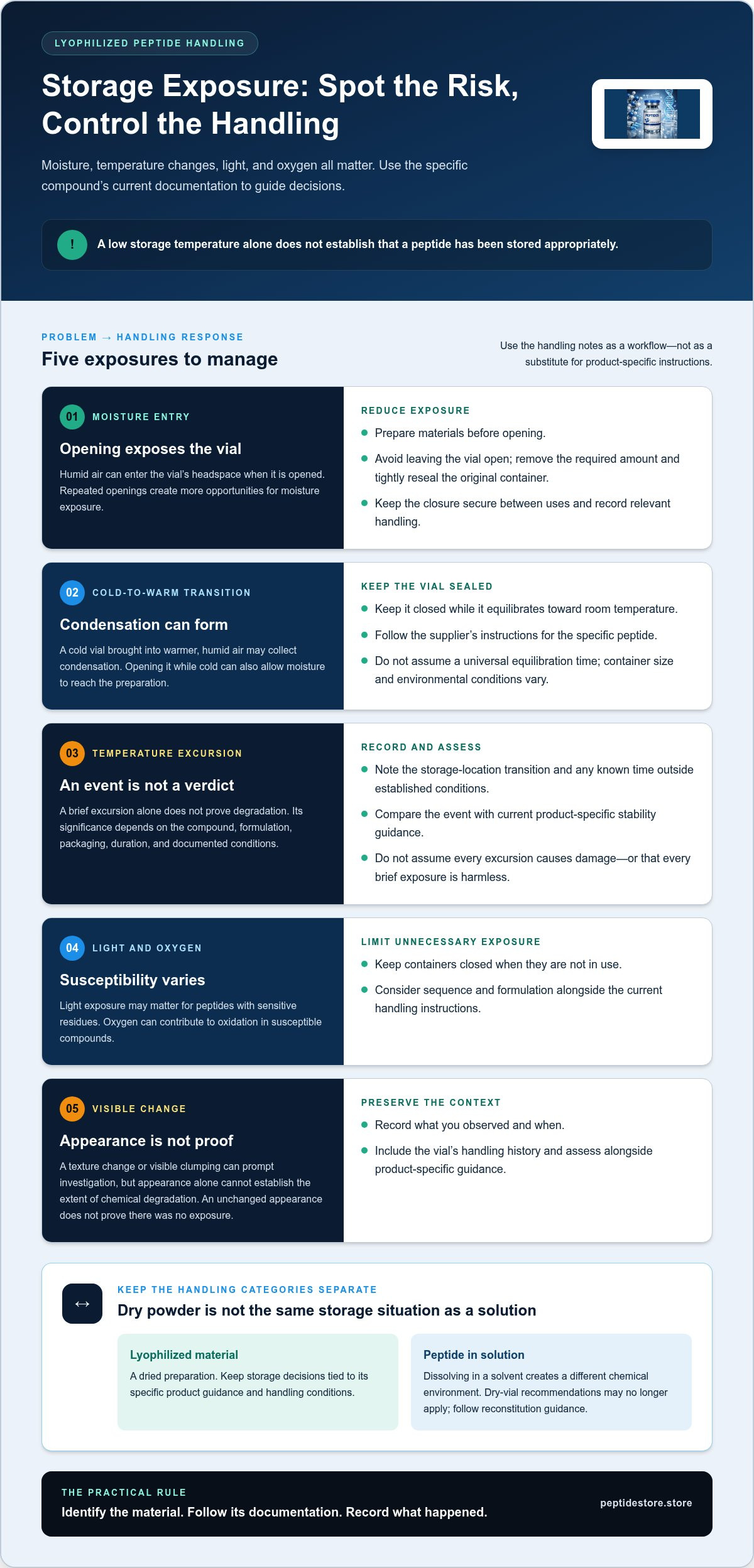
Lyophilized material is a dried preparation; a peptide solution has been dissolved in a solvent and is exposed to a different chemical environment. Adding water or another solvent can change degradation pathways and rates, so storage recommendations for the dry vial may no longer apply after dissolution. Keep solution handling separate from dry-material storage decisions, and follow the product’s reconstitution guidance.
Which conditions can reduce peptide stability?
Moisture may encourage hydrolysis or clumping, oxygen can contribute to oxidation, and temperature or light exposure can affect susceptible compounds. Opening a container changes its exposure to the surrounding environment. These risks depend on the sequence and are not shared equally by all peptides.
Peptide stability depends on sequence and storage conditions. Identify the specific material and consult its current documentation before setting storage practices. A dry appearance, familiar peptide name, or general storage convention cannot substitute for product-specific handling instructions.
How temperature, moisture, and light affect long-term peptide stability
Assess storage exposure from a record of what happened, not as a simple pass-or-fail event. A brief temperature excursion does not, by itself, prove that a peptide has degraded. Its significance depends on the compound, formulation, packaging, duration, and conditions described in current product documentation. Record the event and compare it with the product-specific stability guidance.
Why moisture control matters for a lyophilized vial
Humid air can enter the vial’s headspace when the container is opened, exposing the dry preparation to moisture. Prepare materials before opening, avoid leaving the vial open, and tightly reseal the original container after removing the required amount. Repeated openings create more opportunities for exposure, so keep the closure secure between uses and include relevant handling in the storage record.
Moisture exposure may not be obvious. A change in texture or visible clumping can prompt investigation, but appearance alone cannot establish whether stability has changed. Record what you observed and when, alongside the vial’s handling history. An unchanged appearance is not proof that the material experienced no exposure.
What temperature changes and condensation can mean
A cold vial brought directly into warmer, humid air may collect condensation on its surfaces. If opened while cold, moisture can also reach the preparation. Keep the vial sealed while it equilibrates toward room temperature, following the supplier’s instructions for the specific peptide. Do not set a universal equilibration time because container size and environmental conditions vary.
Equilibrating a sealed vial before opening helps reduce condensation exposure to the dry preparation. If the vial has moved between storage locations, note the transition and any known time outside its established conditions. Assess the event against product-specific guidance rather than assuming every excursion causes damage or every brief exposure is harmless.
Light and oxygen also require consideration, although susceptibility varies across sequences. Light exposure may matter for peptides with sensitive residues, while oxygen can contribute to oxidation in susceptible compounds. Keep containers closed when not in use and limit unnecessary exposure during handling. Apply light-protection measures specified in the product documentation rather than inferring a universal requirement from another peptide.
A useful storage record makes exposure history interpretable. Record the compound and lot identifier, storage location or set point, dates of transfers, known time outside usual conditions, and opening events. If a temperature excursion occurs, record the observed range and duration when available, then consult the peptide-specific source for stability limits. Do not estimate remaining shelf life or potency from an informal assessment.
Connect handling records to the correct compound and its documentation. The research peptide catalog can help identify research materials; storage decisions still depend on the specific product’s instructions and applicable stability information.
Comparing storage options for lyophilized peptides
Room-temperature, refrigerated, and frozen storage are options to assess against the specific peptide’s current documentation, not interchangeable rules. The appropriate choice depends on the material, intended storage duration, packaging, and expected access frequency. The comparison below outlines practical trade-offs; it does not establish stability limits for any individual product.
Use the table as a decision aid, not a substitute for product-specific stability data. A claim about stability over a defined period is meaningful only when the source identifies the peptide and the conditions under which stability was assessed. Do not infer a shelf life from a general recommendation or another compound’s instructions.
When should researchers prioritize freezer storage?
Freezer storage is a commonly stated option for lyophilized peptides when the applicable product instructions support it. Some supplier guidance specifies dry freezer conditions, including temperatures below -20°C, but that recommendation is not a universal guarantee or specification. Review the relevant supplier documentation and handling requirements before applying a particular temperature to a compound.
How should researchers choose between refrigeration and freezing?
Start with the compound’s instructions, then compare the intended storage duration with how often the vial must be accessed. A freezer may align with a product’s long-term guidance, while frequent retrieval can increase transfers and temperature cycling. Refrigeration may be suitable where product documentation allows it, but it is not automatically preferable simply because access is easier. Identify the peptide and its analytical context before choosing.
Make the decision traceable by documenting the selected condition, the source of the instruction, storage-unit monitoring, and any deviations. For research workflows, accurate identification and context support responsible material management. The research peptide materials catalog lists compounds for laboratory applications.
How to store lyophilized peptides long term: a handling workflow
A repeatable workflow helps preserve a clear record of how each vial was handled. Follow the current instructions for the specific peptide and formulation; general practices cannot establish product-specific stability limits.
- Review the documentation. Before handling, confirm the peptide identity, lot information, specified storage conditions, and any instructions for equilibration or opening. Resolve discrepancies between the vial label and accompanying documentation before proceeding.
- Prepare the work area. Gather the materials needed for the planned laboratory work first. This reduces the time the vial needs to remain open and helps avoid unnecessary handling or environmental exposure.
- Equilibrate while sealed. If the vial is cold, keep it closed as it moves toward room temperature, following the supplier’s guidance. Do not open a cold vial directly into ambient air, where condensation may form.
- Open briefly and remove only what is required. Minimize the vial’s exposure to air, moisture, and light. Follow the applicable laboratory protocol for handling the material.
- Reseal and return to specified conditions. Close the original container promptly, then return it to the storage conditions stated in its documentation. Avoid extra storage steps that are not supported by the product instructions or laboratory protocol.
- Record the handling event. Note the date, vial or lot identifier, storage transfer, opening, and any unusual observations in the appropriate record.
A practical sequence for opening and resealing a vial
Use the same order each time: verify identity and instructions, prepare the work area, equilibrate the sealed vial if required, open only when ready, remove the amount needed, reseal, and return the vial to its specified storage. Aliquoting introduces additional handling and containers, so use it only when supported by product documentation and laboratory protocol.
What to record and do after a storage excursion
Document the date, affected vial or lot, observed conditions, and excursion duration if known. Include the source of the information, such as a storage-unit record or direct observation, and note any packaging damage. If exposure is uncertain or the container appears compromised, separate the material pending review under laboratory quality procedures.
Do not infer remaining stability or experimental suitability from the length of an excursion alone. Compare the documented event with relevant product-specific stability information and applicable laboratory procedures. If supporting information is unavailable, preserve the record and maintain the material under review rather than assigning an unverified stability period.
For research workflows, compound identity and lot traceability belong alongside handling records. Apply this storage process with the current product documentation for each material. Review research peptide compounds for laboratory applications.
Apply product-specific storage guidance to research peptides
A defensible storage decision begins with identifying the exact material, not selecting a temperature from a general chart. Compound identity, formulation, lot details, packaging, and current product instructions all inform how to store lyophilized peptides long term. When sourcing materials from research suppliers like NH Peptides, keep applicable supplier documentation with the laboratory record so storage conditions and later handling decisions can be traced to their source.
How product identity and documentation guide storage decisions
Do not automatically transfer storage guidance for one peptide or formulation to another. Confirm that the documentation corresponds to the compound and lot in hand, then record its stated conditions and handling notes. If the material is dissolved, it is no longer in the lyophilized state, and the relevant instructions may differ. Treat guidance for bacteriostatic water and dissolved preparations separately from instructions for unopened dry peptide.
General educational guidance can explain common stability risks and careful handling practices, but it cannot establish validated stability limits for a particular product. A temperature recommendation without a matching compound, formulation, defined conditions, and supporting product-specific information does not establish a shelf life. Avoid estimating remaining stability or experimental suitability from a general rule alone.
Use a short review checklist for each material:
- Identify: Match the compound name and lot information to the vial and records.
- Read: Retain current product instructions and note the specified storage conditions.
- Control: Limit moisture, light, temperature variation, and unnecessary handling in line with those instructions.
- Log: Record storage location, transfers, opening events, and any suspected excursion or packaging concern.
This documentation-led approach supports consistency between researchers and makes differences in handling easier to identify when reviewing laboratory records. It does not guarantee a particular experimental result. It provides a traceable basis for assessing whether the material was managed according to the guidance applicable to it.
Explore research-grade peptides with storage planning in mind
Peptide Store supplies more than 150 research-grade peptide compounds for scientific and laboratory applications. Compound identification and applicable documentation remain central to storage planning across a broad research catalog. Reviewing the material’s identity and instructions before use helps align laboratory handling with the information available for that specific product.
For research planning, the research peptide catalog presents compounds for laboratory use. Consider compound identity and storage documentation as part of material selection and recordkeeping.
Make storage practice part of your research process
Make peptide storage a documented laboratory practice that can be reviewed when materials, procedures, or product instructions change. A clear record helps researchers apply the guidance relevant to each compound and assess handling history without relying on memory or assumptions. Treat general storage principles as a framework, not a substitute for product-specific stability information.
Peptide Store supplies research-grade compounds for scientific and laboratory applications. Use compound identity and relevant product documentation to guide planning for each material, then refer to the catalog when identifying research materials for laboratory work.
Explore the research peptide catalog to identify research materials and support a careful, documentation-led approach to laboratory recordkeeping.
Frequently Asked Questions
How should lyophilized peptides be stored long term?
Use the current instructions for the specific peptide and keep its storage conditions consistent with those instructions. For how to store lyophilized peptides long term, avoid relying on a general temperature rule alone: confirm compound identity and formulation, protect the container from unapproved environmental exposure, and retain relevant product documentation. A record that connects the vial’s lot information to its storage history makes later review more reliable.
Should lyophilized peptides be refrigerated or frozen?
Neither option is correct for every peptide; follow the applicable product instructions. If both are allowed, consider the intended storage period and how frequently the vial will be accessed. Select a condition that can be maintained and monitored consistently, rather than moving the vial between locations without a defined reason. Do not assume that a recommendation for one compound applies to another with a different sequence or formulation.
Can lyophilized peptides be stored at room temperature?
Only if the specific product’s instructions permit room-temperature storage under the stated conditions and duration. A vial being at room temperature during handling or transit does not establish that the same condition is appropriate for ongoing storage. If documentation does not address a planned storage condition, do not infer a stability period from general practice. Record the chosen location and review it against the applicable product information.
Why should a frozen peptide vial warm before opening?
A cold vial can collect moisture from warmer, humid air, and opening it before equilibration may expose the dry material to condensation. Keep the container closed while it approaches room temperature, following the product’s handling instructions. Do not rely on a universal waiting time, since vial and environmental conditions differ. If the vial is still cold to the touch or visibly wet, keep it closed and follow the applicable laboratory procedure.
How long do lyophilized peptides remain stable?
There is no single stability duration that applies to all lyophilized peptides. Use product-specific stability information that corresponds to the compound, formulation, packaging, and stated storage conditions. A duration reported for another peptide, or under different conditions, cannot establish the usable period for the material in hand. Retain the source and conditions alongside the lot record, and do not estimate an expiration or remaining stability from appearance alone.
What should I do if a peptide was exposed to room temperature?
Record the exposure before making a decision: note the vial or lot, when the event occurred, the approximate duration, and any available temperature information. Compare the event with the product’s documented stability conditions and follow laboratory quality procedures. Room-temperature exposure does not by itself prove degradation, but it also does not confirm that the material remains within its stability limits. Keep uncertain material under review until it can be assessed appropriately.
Can repeated opening affect lyophilized peptide storage?
Repeated opening can increase opportunities for moisture, air, and light exposure, particularly if the vial remains open during preparation. Prepare the work area first, retrieve only what the planned procedure requires, and close the container promptly. Track opening events when relevant to laboratory records. Do not assume that aliquoting is automatically beneficial; use it only when supported by product instructions and established laboratory protocol.


