
A polished certificate of analysis (COA) doesn’t necessarily prove that the material in a vial was independently tested. Effective third-party peptide testing verification requires more than a purity figure: the report should identify the tested sample, connect it to the relevant lot, and use methods suited to the claims being made.
A COA may contain supplier-reported results rather than results generated independently. And a purity percentage alone doesn’t establish identity, quantity, or suitability for a particular research application. These distinctions matter when documentation informs procurement decisions.
This guide provides a repeatable way to review a peptide test report. You’ll learn how to assess the laboratory and report provenance, trace sample and lot identifiers, and interpret methods such as chromatography and mass spectrometry within their stated scope. It also explains what reported results can support, and what they cannot establish. The goal is a rigorous documentation review, not a conclusion based on a single number or document.
Key Takeaways
- Third-party peptide testing verification depends on confirming laboratory independence, not simply accepting a document labeled as a COA.
- Match each analytical method to the specific claim it can support, and note its interpretation limits.
- Check that the report’s sample identifiers, lot details, and dates consistently link the analysis to the material under review.
- Assess reports by their traceability and disclosed methods, not by a purity percentage alone.
- Use a consistent procurement record to capture report details, evidence reviewed, and unresolved analytical questions.
What third-party peptide testing verification can, and cannot, establish
Third-party peptide testing verification concerns evidence generated by an analytical laboratory independent of the material’s seller or manufacturer. Independence is about who performed the analysis, not how the document is formatted. A supplier’s analytical certificate may report measured results, but it is not independent testing if the supplier’s own laboratory conducted the analysis.
Independence is only one part of the assessment. A report also needs to identify what was tested and how. Its conclusions apply to the stated sample, analytical method, and analysis date. They don’t automatically establish the properties of every unit in a batch, later batches, or material that has since been handled or stored differently.
What does independent verification mean for a research peptide?
Several parties may be involved: a supplier sells or distributes the material, a manufacturer produces it, and a submitting party sends a sample to a laboratory for analysis. These roles may overlap. Check that the report makes clear who submitted the sample and who conducted the testing.
Assess laboratory independence separately from report provenance. A laboratory may be organizationally separate from a seller, but you still need to establish that the report came from that laboratory and corresponds to the sample in question. Look for identifiable report details and a specific sample description. A report’s existence alone doesn’t authenticate its contents, establish who issued it, or prove that the tested sample represents the material being evaluated.
Analytical methods also have defined scopes. For example, mass spectrometry can provide evidence about molecular mass or identity, depending on the method and interpretation. Peptide mass fingerprinting describes an approach that uses mass-spectrometry data to identify proteins or peptides. The method name alone, however, doesn’t confirm that a particular report examined the relevant sample or answered every identity question.
Which conclusions fall outside a test report’s scope?
A report supports conclusions about measured properties under stated analytical conditions. It does not, by itself, establish overall quality. The scope depends on the sample, method, reported results, and any limitations described. Don’t treat a result as evidence for properties the test did not measure.
A purity result alone doesn’t demonstrate identity or exact content. A reported purity percentage describes an analytical result as defined by the method; it is not necessarily a measurement of how much peptide is present in a vial. Identity requires relevant evidence, and quantity requires an appropriate measurement. Assess these questions separately instead of inferring them from one headline figure.
Analytical testing also does not establish clinical efficacy, human safety, or regulatory approval. A laboratory result cannot show that a peptide is suitable for human use or predict a clinical outcome. Keep conclusions within the report’s stated scope, and record unanswered questions rather than treating them as verified.
Match each peptide testing method to the claim it can support
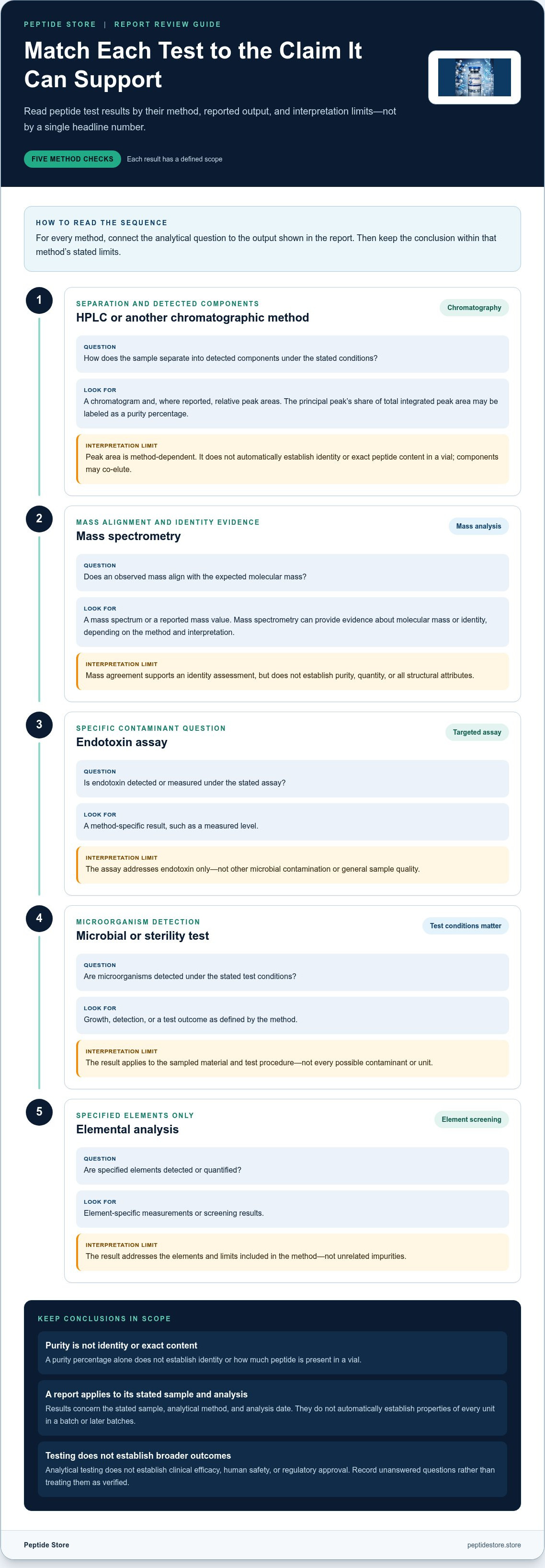
A test report is interpretable only in relation to the analytical question, method, and reported output. HPLC, mass spectrometry, and contaminant panels provide different kinds of evidence. For effective third-party peptide testing verification, assess each result separately. A list of methods is not proof of every quality attribute.
| Method | Analytical question | Report output | Interpretation limit |
|---|---|---|---|
| HPLC or another chromatographic method | How does the sample separate into detected components under the stated conditions? | Chromatogram and, where reported, relative peak areas | Peak area is method-dependent and does not automatically establish identity or exact peptide content. |
| Mass spectrometry | Does an observed mass align with the expected molecular mass? | Mass spectrum or reported mass value | Mass agreement supports an identity assessment but does not establish purity, quantity, or all structural attributes. |
| Endotoxin assay | Is endotoxin detected or measured under the stated assay? | Method-specific result, such as a measured level | It addresses endotoxin only, not other microbial contamination or general sample quality. |
| Microbial or sterility test | Are microorganisms detected under the stated test conditions? | Growth, detection, or test outcome as defined by the method | The result applies to the sampled material and test procedure, not every possible contaminant or unit. |
| Elemental analysis | Are specified elements detected or quantified? | Element-specific measurements or screening results | It addresses the elements and limits included in the method, not unrelated impurities. |
HPLC purity analysis and its interpretation limits
In HPLC, a sample passes through a separation system, and detected components appear as peaks on a chromatogram. A report may calculate the principal peak’s share of the total integrated peak area and label it as a purity percentage. That value describes the detected signal under the method’s conditions. It is not automatically a mass fraction or a measurement of the exact peptide content in a vial.
Interpretation depends on the method. Components may co-elute, meaning they appear together rather than as distinct peaks. Detection settings can also affect which substances produce a measurable signal, while column, solvent, and other method conditions influence separation. Review the chromatogram and method details where available, rather than relying on the percentage alone.
Mass spectrometry and additional analytical panels
Mass spectrometry can compare an observed molecular mass with an expected value, supporting an identity assessment. A match is not comprehensive proof of identity or overall quality, and it does not replace a separate purity or content measurement. Endotoxin, microbial, sterility, and elemental analyses each address different questions. Review the disclosed method and result for each; a test for one contaminant cannot stand in for another.
Don’t apply a universal acceptance threshold without an established method and relevant specification. For research procurement, compare the reported procedure and limits with the question the material must answer. Researchers evaluating compounds for laboratory work can review the research peptide catalog as a separate procurement step, without treating catalog information as analytical evidence.
Verify a peptide COA: laboratory, sample, batch, and report details
A certificate of analysis is useful for procurement only when its origin and connection to the sample can be assessed. Review the report as a traceability record, not just a table of results. The workflow below moves from who issued the report to whether its identifiers connect the analysis to the material under review.
Assess the laboratory and report provenance
Start with the report source. Identify the named analytical laboratory, the report issuer, the analysis date, and the methods stated for each result. A supplier may submit a sample and distribute the resulting document; that does not make the supplier the testing laboratory. Keep these roles distinct in your records.
If the laboratory provides a report lookup or verification route, use it to check whether the identifier corresponds to a report in its records. A searchable number can support document authentication, but it doesn’t establish that the tested sample came from the batch you received. If accreditation is claimed, assess its scope and whether it covers the relevant laboratory activity, rather than treating accreditation as a blanket endorsement of every test.
Connect the result to the material under review
Compare the report’s sample description and identifiers with the product label and accompanying procurement records. Look for a clear relationship between the tested sample and the lot being evaluated. A report number may identify a document; the lot and sample details help establish a link to the material.
- Identify the laboratory and issuer. Record the lab name, the party that issued or supplied the report, and any available means of checking the report’s source.
- Review the analysis details. Note the analysis date and the method associated with each result. Confirm that the report describes the material consistently with the accompanying records.
- Match sample and lot identifiers. Compare the report’s sample ID, lot or batch reference, and material description against the label and procurement documentation. Similar names alone are not a traceable match.
- Check handling and custody information. Review any supplied details about sample receipt, storage, handling, or transfer. Record missing or inconsistent information as an unresolved gap, rather than assuming a complete chain of custody.
For example, a report may have a valid laboratory identifier and a matching peptide name, yet list a sample code that does not appear on the material’s records. The document may be authentic, but its link to that specific lot remains unestablished. A lot match with no disclosed analytical method also leaves the basis for interpreting the result unclear.
Keep discrepancies explicit. Flag mismatched identifiers, ambiguous sample descriptions, missing methods, or dates that don’t align in the procurement documentation. Don’t treat an incomplete link as confirmation.
Terminology can also affect review quality. Consult the research peptide laboratory guide when clarifying analytical standards and report language, then use the same terms consistently in your records. This makes third-party peptide testing verification more reproducible across reports, lots, and reviewers.
Compare test reports without confusing purity, identity, and broader quality
A useful comparison assesses what each report documents, not which one displays the largest headline percentage. First align the samples and lots being compared. Then review method disclosure, result detail, and stated limitations. If two reports describe different samples or answer different analytical questions, their results aren’t directly comparable, even when both use the same general method name.
Method conditions matter. Differences in sample preparation, analytical settings, and detection limits can affect what a method detects and reports. A result below a stated detection limit doesn’t mean a substance is absent; it means it wasn’t detected above that method’s stated capability. Record these differences before drawing conclusions across laboratories.
Purity percentage is not a complete quality score
Read a purity value alongside the method and, where provided, its chromatogram. Area-based reporting expresses the relative signal assigned to peaks detected under particular conditions. It isn’t automatically a direct measurement of peptide mass or exact vial content. Differences in separation, detection, or integration can change reported values, so a higher percentage alone doesn’t establish a better or more suitable material.
There is no universal cutoff that can rank reports without context. Compare the methods, sample linkage, and specifications relevant to the research question. If the method or basis for the percentage is not disclosed, record that limitation rather than treating the number as a complete quality assessment.
Recognize gaps that a COA cannot resolve
A missing identity result leaves identity unassessed; an absent contaminant test leaves that contaminant question unanswered. Neither gap proves that the material failed or that a contaminant is present. It means the report does not supply evidence on that attribute. Keep analytical findings separate from storage history, research design, and regulatory status, which a test result alone cannot establish.
Use this compact matrix to classify evidence consistently during third-party peptide testing verification:
Documented: The report identifies the sample or lot, discloses the relevant method, presents interpretable results, and states applicable limitations.
Partially documented: Some details are available, but an identifier, method condition, result detail, or limitation needed for comparison is missing.
Unresolved: A key attribute cannot be connected to the sample or lot, the method is unclear, or the report does not provide evidence for the question being assessed.
Apply the same categories across reports and preserve the reason for each classification. For example, a report may document a purity result while leaving sample linkage unresolved. Record those as separate attributes rather than collapsing them into a single pass-or-fail judgment. This approach makes differences visible without implying that an untested attribute is positive or negative.
For research procurement, use these criteria to organize comparisons before reviewing research peptide options. Keep the decision tied to documented evidence and the specific analytical questions relevant to the intended laboratory work.
Apply a repeatable verification workflow to research procurement
A consistent review process turns report inspection into a documented procurement decision. Begin with the research question, then define what evidence is needed to address it. Review report provenance and sample linkage against those requirements, and record unresolved gaps instead of filling them with assumptions. This makes third-party peptide testing verification repeatable across materials, lots, and reviewers.
Create a documentation record for each research lot
Maintain a separate record for each material and associated lot. Capture its designation and supplier identifiers, the lot or batch reference, and the COA’s report number or version. Add the laboratory identity, analysis date, methods, sample identifiers, and any available report-verification reference. Preserve the source document with the record so a reviewer can trace conclusions back to the evidence.
Use explicit status labels for missing or unclear information, such as “method not stated” or “sample-to-lot link unresolved.” These labels describe a documentation gap without implying a test result. If a revised report is supplied, retain its version and note which record it supersedes; don’t silently replace the original.
Use verification findings in a research purchasing decision
Match the evidence requirement to the planned laboratory research context. A project that requires identity evidence has a different documentation need from one assessing a specified contaminant. Compare reports based on relevant method disclosure, sample linkage, result detail, and limitations. No single test panel establishes every attribute, and a more extensive-looking panel is not automatically a universal measure of quality.
Keep the procurement conclusion narrow: state which requirements are supported by the records and which remain open. A report’s limitations should inform the decision and any follow-up review, not be recast as proof of failure or absence. Purchasing documentation must also remain separate from conclusions about human use, clinical outcomes, treatment, or regulatory approval.
A practical workflow can be maintained as a short sequence:
- Define the question. Specify the analytical attribute relevant to the research procurement decision.
- Set the evidence needed. Identify the method and report details that would address that question.
- Inspect the documentation. Review the laboratory and report source, methods, dates, sample description, and lot linkage.
- Record the assessment. Log supported findings, missing information, and unresolved limitations in the procurement file.
- Apply the result within scope. Make a research purchasing decision based on the evidence available, without extending it to untested properties.
Before closing the file, check that another reviewer can follow the reasoning from research question to evidence and decision. For research procurement, the research peptide catalog is a useful place to browse available compounds; evaluate catalog information separately from any analytical report. Use this workflow to keep documentation review precise and research-focused.
Make documentation review part of procurement practice
Make report review a standard step in research procurement. A consistent record helps teams preserve the basis for a decision, identify unanswered questions before they become assumptions, and apply the same evidence criteria across future purchases. Keep the scope clear: analytical documentation informs laboratory research decisions, but it does not establish human safety, clinical benefit, or suitability for treatment.
For the next step, explore research-grade peptide compounds intended for laboratory and scientific applications. The catalog includes more than 150 peptide compounds, providing a range of options to consider in research planning. Apply the same documentation standards to each procurement decision, and keep product selection separate from conclusions a test report cannot support.
Review research-grade peptide offerings and continue building a careful, evidence-led approach to procurement.
Frequently Asked Questions
Is third-party peptide testing more reliable than a supplier-issued COA?
Third-party analysis can strengthen independence because the testing laboratory is separate from the supplier, but it isn’t automatically conclusive. For third-party peptide testing verification, check whether the report can be authenticated through the laboratory and whether its sample description matches the material being evaluated. A supplier-issued COA may still provide useful analytical information. Assess both documents according to their source, stated methods, and documented relationship to the sample.
Can an HPLC purity result confirm a peptide’s identity?
No. An HPLC purity result describes separation and detected peak proportions under a particular method; it doesn’t identify the molecules responsible for those peaks by itself. For example, a dominant peak on a chromatogram doesn’t establish that the peak is the intended peptide. Mass spectrometry can provide additional evidence by comparing observed and expected molecular mass, but interpret that result alongside the report’s sample description and method details.
Does a peptide COA prove that a sample is sterile?
Only a COA reporting an appropriate microbial or sterility analysis provides evidence about that question, and its conclusion applies within the stated method’s scope. A chromatogram reporting purity or an identity result doesn’t test for microbial presence. Check whether the document names the analysis and reports its outcome. Even a reported sterility result is not proof of suitability for human use or clinical administration.
Does a third-party test report apply to every batch of the same peptide?
No. A report concerns the sample identified in that document, not every batch with the same peptide designation. For example, a report for one lot doesn’t establish the analytical characteristics of a later lot unless relevant records connect them. Compare the report’s sample and lot references with procurement records. If they differ or cannot be reconciled, document that the report’s relevance to the separate batch is unresolved.
Is a high peptide purity percentage the same as exact peptide content?
No. An HPLC area percentage usually describes the relative detector signal assigned to components under the stated analytical conditions, not the total mass or exact peptide amount in a vial. To assess what a figure represents, review the chromatogram, method, and reference standards if reported. Look for a separate quantitative analysis when exact content is the question, and don’t infer a vial’s amount from a purity percentage alone.
Can a third-party peptide test establish that a compound is safe for human use?
No. Analytical testing reports selected properties of a sample; it doesn’t establish clinical safety, efficacy, appropriate dosing, or regulatory approval. The result is limited to the analyses performed and the sample examined. Peptide Store supplies research-grade compounds for laboratory and scientific applications. Interpret reports as analytical documentation for research procurement, not as medical evidence or a recommendation for human use.


