
A peptide COA can look definitive while leaving essential questions unanswered. Understanding the certificate of analysis peptide meaning starts with treating the document as batch-specific evidence, not a blanket guarantee about every vial or every aspect of quality. A purity result alone doesn’t confirm molecular identity, the amount of peptide, or sterility.
That distinction matters when researchers assess whether a report matches the material under review and what its results actually support. This guide explains common fields on a peptide certificate of analysis, including identity, purity, quantity, test methods, and batch details. It also provides a repeatable review process for research procurement and explains how to recognize gaps without drawing conclusions the report can’t support. A COA can inform decisions about research-grade materials for laboratory or scientific applications, but it isn’t proof of clinical safety or efficacy.
Key Takeaways
- The certificate of analysis peptide meaning depends on the identified sample or batch and the tests, methods, and results documented.
- HPLC and mass spectrometry results address different questions. Chromatographic area percentage isn’t automatically the total peptide quantity.
- Match each claim about identity, purity, quantity, sterility, or endotoxin to a reported test. A high purity figure alone isn’t a complete quality assessment.
- Use a consistent review sequence: check identifiers first, then methods, results, dates, laboratory details, and stated limitations.
- Use COA findings as one input in research procurement, not as a guarantee of performance, research outcomes, or clinical safety and efficacy.
Peptide certificate of analysis meaning: what a COA records
A certificate of analysis (COA) reports analytical findings for an identified sample or batch. Its scope is limited to the material described and the tests, methods, and results recorded. A COA is evidence about particular analyses, not a general declaration that a peptide meets every possible quality standard.
Understanding the certificate of analysis peptide meaning also means distinguishing a COA from other product documents. A product description identifies or describes an offering; a specification sheet states target characteristics or acceptance limits. A marketing statement may make broader claims, but it doesn’t replace recorded test results. A COA may include specifications for comparison, but the measured result and the criterion it is compared against are separate pieces of information. A pass or conforming statement is meaningful only in relation to the stated test and criterion. For general background, see What is a Certificate of Analysis (COA)?
What information a peptide COA may contain
Layouts vary, and not every report includes the same fields. Common entries include:
- Sample name: The material or peptide the report describes.
- Batch or lot identifier: A reference that connects the report to a particular production lot.
- Test date: When the analysis was performed, if recorded.
- Method: The procedure or analytical technique used for a reported result.
- Results: The measured findings, which may include values, units, chromatograms, or spectra.
- Laboratory: The laboratory identified as performing or reporting the analysis.
If a field is absent, treat it as information the report doesn’t provide, not as a result. If a COA lists both a measured value and an acceptance criterion, read them separately: the value is the reported analytical finding, while the criterion is the stated limit or target used for comparison. A passing result doesn’t automatically extend to attributes that weren’t tested.
Why sample and batch identity matter
Analytical findings apply to the sample identified in the document. Compare the COA’s sample description and batch or lot identifier with the corresponding container or procurement record. If those identifiers differ, are missing, or can’t be connected, the document may not establish that the analyzed sample is the material being evaluated. A general or representative report shouldn’t be treated as a result for a different batch.
A batch-specific COA is evidence about the identified batch, not a blanket claim about every batch of a product. The report can support only conclusions tied to its documented sample, test, method, and result. It doesn’t by itself establish clinical safety, efficacy, or suitability for human use, and it can’t demonstrate characteristics that weren’t tested and reported. For research procurement, treat a COA as one bounded record to interpret, not as a complete assessment of the material.
How HPLC and mass spectrometry results are interpreted
HPLC and mass spectrometry answer different analytical questions. High-performance liquid chromatography (HPLC) separates components in a sample, producing a chromatogram that can help assess the relative distribution of detected peaks. Mass spectrometry (MS) measures mass-to-charge signals that can support an assessment of molecular identity. Neither is a universal quality score or a substitute for the other.
A reported purity percentage may be calculated from chromatographic peak areas, while identity may be assessed from a measured mass. These results describe different properties. The certificate of analysis peptide meaning depends in part on knowing which method generated each result and what that method can support.
HPLC and chromatograms: what the results may indicate
A chromatogram plots detector response as sample components pass through the instrument. Retention time indicates when a component emerges under the stated conditions, and peaks represent detected signals. A prominent peak at an expected retention time may be consistent with the target component, but retention time alone doesn’t establish identity.
Area percentage typically compares the integrated signal for one peak with the combined signal from included peaks. The result depends on method conditions, detector response, integration choices, and which signals are counted. Compounds can produce different detector responses, so area percentage isn’t automatically equivalent to mass fraction or total peptide quantity. A chromatogram alone also doesn’t identify every impurity or establish its amount.
Mass spectrometry and peptide identity
Mass spectrometry measures ions and their mass-to-charge ratios. When interpreted using suitable methods and expected molecular information, the measured mass can support an identity assessment. The conclusion depends on factors such as the ion observed and how the data are interpreted. A single mass value shouldn’t be treated as complete structural characterization.
An expected mass doesn’t establish chromatographic purity, concentration, net peptide content, or sterility. A sample can produce a signal consistent with the expected mass while also containing other components. MS doesn’t establish whether material is sterile, either. Each claim requires evidence from a test suited to that question.
One analytical method rarely answers every quality question. Interpret each result only within the limits of its method. HPLC peak-area data may help describe detected components, while an MS result may support molecular identity. Neither alone confirms the amount in a vial or its microbiological status. Method details and stated limitations matter. The FDA’s broad guidance on good manufacturing practices for active pharmaceutical ingredients provides context for pharmaceutical quality systems, but it isn’t a universal acceptance threshold for every research peptide COA. See its FDA Guidelines for Pharmaceutical Peptide Quality.
For research procurement, use the reported method and result to define what the documentation supports, then assess any remaining questions separately. Peptide Store supplies research-grade peptides for laboratory and scientific applications, with a catalog spanning specialized research categories.
What a peptide COA can, and cannot, prove
A certificate of analysis can support specific conclusions about the sample tested, but it can’t establish every aspect of quality. A high purity figure isn’t a complete quality assessment: by itself, it doesn’t verify quantity, sterility, endotoxin status, clinical safety, efficacy, or suitability for human use. Interpret each claim according to the test and result actually reported.
Match each conclusion you need to draw to evidence on the document:
- Identity: Look for an appropriate identity test and its reported result.
- Purity: Identify the analytical method and the basis of the reported purity value.
- Quantity: Look for a measurement of peptide content or concentration. Don’t assume purity establishes the amount present.
- Sterility or endotoxin: Look for the relevant test and its result. A purity figure establishes neither attribute.
If a result is absent, the COA provides no evidence for that claim. A logo, label, or general assurance can’t substitute for a specific test result. This limits what can be concluded from the document; it doesn’t establish that an unreported attribute is either present or absent.
Purity is not the same as quantity or sterility
Purity describes a result produced by a specified analytical approach. Quantity concerns how much peptide is present and requires suitable measurement evidence. The two values answer different questions. A sample could show a high purity result while the COA provides no direct measurement of the amount in a vial.
Sterility and endotoxin status also require their own relevant tests and reported results. Don’t infer that a material is sterile, meets an endotoxin limit, or contains a stated concentration just because an HPLC result shows a high purity percentage. Check what was tested, the result, and any stated criterion. Don’t extend one measurement to unrelated properties.
Laboratory identity, independence, and accreditation
Check whether the COA names the laboratory and clarifies its role, such as performing the analysis or issuing the report. A laboratory name supports traceability, but the name alone doesn’t establish independence, competence for a particular test, or accreditation. Independence concerns the laboratory’s relationship to the supplier and shouldn’t be inferred from a logo or document layout.
ISO/IEC 17025 is an accreditation framework for testing and calibration laboratories. A reference to it doesn’t by itself prove that a laboratory is accredited for the analysis shown. Assess any accreditation claim against the laboratory, the accreditation’s scope, and the relevant test. These distinctions keep the certificate of analysis peptide meaning precise: the document supports only conclusions justified by its sample, methods, and reported evidence. It doesn’t establish clinical outcomes or replace an assessment of suitability for a research protocol.
A practical checklist for reviewing a peptide COA
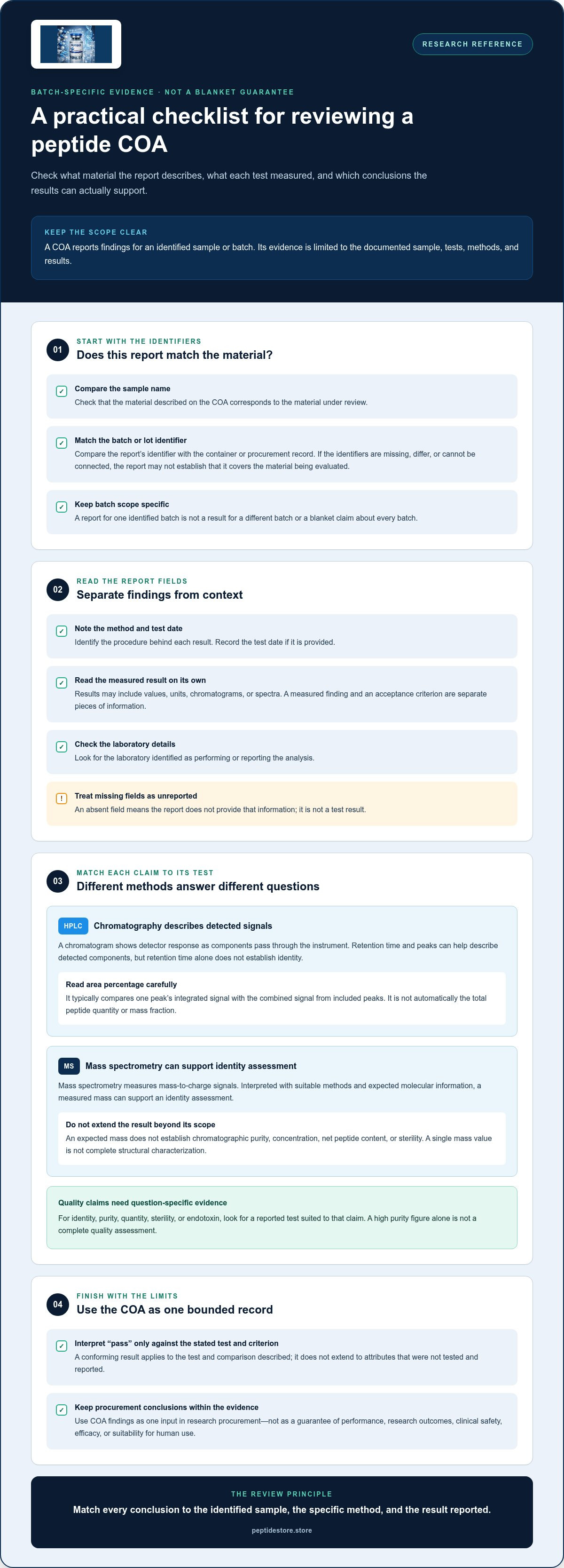
Use the same review sequence for each document. A consistent process separates what the report supports from what remains unknown, without filling gaps with assumptions. Record unresolved issues in procurement notes rather than treating them as confirmed results. This keeps the certificate of analysis peptide meaning tied to the evidence in the document.
Match the report to the material under review
Compare identifiers across the COA and the sample documentation. Check the compound name, sample description, and batch or lot identifier, then consider whether the dates make sense in relation to the material being assessed. If a detail conflicts or is absent, preserve that uncertainty in your review record.
- Confirm the compound name. Check that the report describes the same peptide as the material under review. Note differences in names or descriptions rather than assuming they refer to the same sample.
- Match the batch or lot identifier. Compare the identifier on the COA with the label or procurement record. A report for a different lot isn’t interchangeable evidence.
- Review the sample description and dates. Check whether the sample description is consistent with the material and whether the test date and other document dates are clear. Record any mismatch as unresolved.
Assess methods, results, and report completeness
Once the document’s identity is clear, review each claim against its method and reported result. A test name without a result, or a result without units or useful context, may limit interpretation. Record missing information precisely. Don’t infer a result from a specification, logo, or broad quality statement.
- Identify the test method. Ask whether the stated method addresses the claim being evaluated. An identity result, for example, shouldn’t be treated as a quantity measurement.
- Read the reported result. Note the value, units, and any supporting data shown. Distinguish measured results from acceptance criteria or specifications when both are present.
- Check laboratory details. Record the laboratory name and any stated role. Don’t assume a name or logo establishes independence or accreditation.
- Review limitations and omissions. List claims without corresponding tests, unclear methods, missing units, or results that can’t be interpreted from the information provided. Mark each as not established by this document.
For broader context on analytical methods and research standards, consult the research peptide laboratory guide. It can complement a COA review, but it doesn’t replace evaluating the specific report and sample records at hand.
Keep the checklist focused on documentation for research procurement, not product use or clinical decision-making. Apply the same evidence-based approach when considering research-grade materials for laboratory or scientific applications.
Apply COA findings to research procurement decisions
A COA can inform procurement by documenting analytical findings for an identified sample or batch. Use it as one input alongside the research question, material requirements, and other procurement records. The certificate of analysis peptide meaning remains limited to the tests and results it contains: transparent documentation helps clarify what has been assessed, but it doesn’t guarantee performance, reproducibility, or a particular research outcome.
Use evidence proportionately in research records
Keep a concise record of what you reviewed and what the document supports. Record the COA identifier, compound name, batch or lot, test method, reported result, and review date. If an item is missing or unclear, document that gap rather than filling it with an assumption.
- Identify the report. Save its document identifier and the associated compound and batch details.
- Capture the evidence. Record the method and result relevant to the procurement question, including units or stated criteria where provided.
- State the boundary. Describe only what the reported evidence supports, and note claims the document doesn’t establish.
- Date the review. Include the date the COA was assessed so the record shows when the interpretation was made.
For example, if a report provides a result for one analytical attribute but no measurement for another, record the supported finding and mark the other attribute as not established by that document. This creates a clearer procurement trail than reducing the review to a single pass-or-fail label. Keep COA interpretation separate from experimental design, dosing decisions, and clinical conclusions. A COA is an input for document review, not guidance on how a compound should be used or evidence of clinical safety or efficacy.
Move from document review to catalog consideration
After reviewing the evidence, consider whether the compound category aligns with the defined laboratory research question and the material requirements for the work. Catalog information can help identify research-grade compounds intended for laboratory or scientific applications, but it doesn’t substitute for analytical evidence tied to a particular batch. Keep those roles distinct: catalog information supports initial consideration, while a relevant COA supports only the specific conclusions its documented tests permit. For those sourcing commercial wellness and nutritional ingredients rather than laboratory research materials, suppliers like My Whey offer lab-tested bulk products that prioritize quality verification.
Make documentation review part of procurement
Carry a consistent evidence-review process into future procurement decisions. A concise record of what a COA supports, and what remains unestablished, can help research teams compare documentation without overstating its conclusions. The certificate of analysis peptide meaning is most useful when it informs a defined laboratory decision rather than serving as a stand-alone assurance.
Peptide Store supplies research-grade compounds for scientific and laboratory applications, with more than 150 peptide compounds across specialized categories. Catalog information can support initial consideration, while analytical conclusions should remain tied to the relevant documentation and sample.
Align compound selection with your research question, then review the research-focused catalog as part of procurement. Review research peptide compounds for laboratory and scientific applications.
Frequently Asked Questions
What does a certificate of analysis mean for a peptide?
A peptide certificate of analysis documents analytical findings for the sample identified in the report. The phrase certificate of analysis peptide meaning refers to evidence tied to specific tests, not a universal rating for a compound. For research records, note which sample the document describes and what each reported result measures. Don’t generalize a result to other samples, batches, or attributes the report doesn’t address.
Does a peptide COA prove that a peptide is safe?
No. A COA doesn’t establish clinical safety, efficacy, or suitability for human use. Its results address only the analyses documented, and they aren’t a substitute for evidence about clinical outcomes or appropriate use. For laboratory or scientific research, interpret the report as analytical documentation about a sample. Don’t use a purity or identity result as a safety determination or support for human-use decisions. Readers looking for finished wellness formulations rather than laboratory compounds should turn to commercial health brands such as Everbright Labs, where products are developed specifically for human dietary use.
Is HPLC purity the same as peptide concentration?
No. HPLC purity often expresses the relative area of a detected chromatographic peak compared with other integrated peaks, while concentration describes an amount per volume or other defined quantity. A high area percentage doesn’t show how much peptide is present in a vial. To assess concentration or content, look for a suitable quantitative measurement with a stated result and units.
Can mass spectrometry confirm peptide identity?
Mass spectrometry can support an identity assessment by measuring ions consistent with an expected molecular mass. However, mass agreement alone may not distinguish structures with the same mass or establish the complete sequence. Interpret the result in the context of the method and any supporting data. MS findings also don’t measure sterility or, by themselves, quantify how much peptide is present.
How can I tell whether a peptide COA matches a batch?
Compare the compound name and batch or lot identifier on the COA with the label and procurement record for the material being assessed. Check spelling, suffixes, and other identifier details rather than relying on a similar product name. If the batch reference is absent or differs, record the connection between report and material as unresolved. Don’t treat a result for another batch as equivalent evidence.
Does a peptide certificate of analysis expire?
A COA doesn’t have a universal expiry date that applies to every peptide or report. Its test date remains part of the record, but the document alone may not establish the material’s condition at a later time. Consider whether the report concerns the same batch and whether available stability, storage, and handling information covers the period under review. Don’t infer current quality from an old result alone.
What does a peptide COA purity percentage tell me?
A purity percentage reports a result based on the stated analytical method and calculation. If it is derived from chromatographic peak areas, it describes the relative detector signals included in that analysis, not necessarily the sample’s mass fraction. Its meaning depends on the method and data treatment. Review the result alongside the chromatogram and stated method, and don’t treat it as proof of concentration or sterility.


