
A peptide solution has no universal stability recipe. Temperature, pH, and handling can affect experimental reproducibility, but a general storage rule cannot identify which pathway matters for a particular sequence. Effective preventing peptide degradation in solution starts with that distinction: chemical changes such as hydrolysis, oxidation, or deamidation require different assessments from physical instability, including aggregation or adsorption to container surfaces.
This guide explains how sequence features and solution conditions can influence those risks, without treating general guidance as peptide-specific evidence. It covers a documented workflow for preparation, buffer and container selection, aliquoting, and freeze-thaw exposure, with an emphasis on keeping conditions consistent across experiments. It also explains when visual inspection is insufficient and analytical testing may be needed to assess identity, purity, or emerging degradation products. Use this framework to handle research solutions consistently and decide what must be verified for the molecule under study.
Key Takeaways
- Start preventing peptide degradation in solution by identifying plausible risks for the specific sequence and assay, rather than relying on a universal storage recipe.
- Distinguish chemical changes from aggregation, proteolysis, or adsorption so controls address a documented mechanism.
- Compare temperature, light, pH, container handling, and freeze-thaw exposure against the evidence available for the peptide and experimental use.
- Record preparation date, formulation, container, exposure conditions, and use to support traceability and reproducibility.
- Use stability-indicating analysis when visual inspection or general guidance cannot establish whether the solution remains suitable for its intended experiment.
Preventing peptide degradation in solution starts with identifying the risk
Preventing peptide degradation in solution begins by defining what counts as a change. In a research workflow, solution stability describes how well a peptide retains its chemical integrity and composition under specified conditions over a defined period. There is no universal benchmark: acceptable change depends on the molecule, the intended assay, and the evidence needed to support the result.
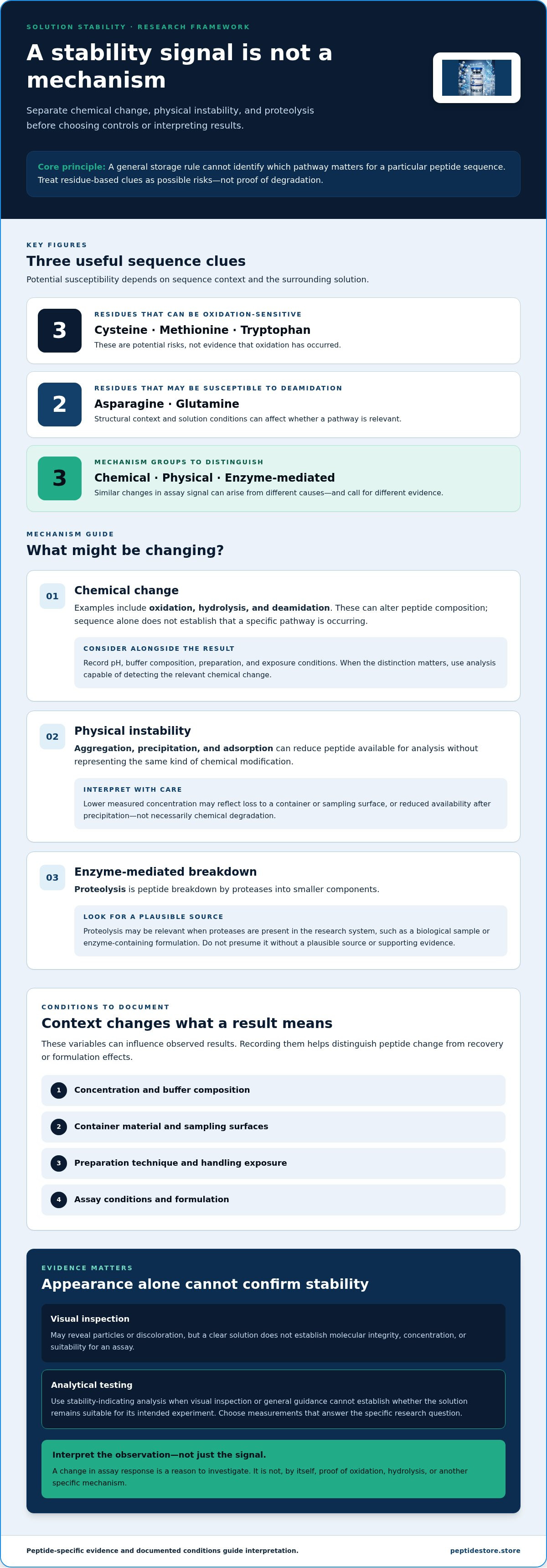
A lower measured concentration does not by itself prove chemical degradation. Peptide may be lost through adsorption to a container or sampling surface, or become less available after precipitation. Conversely, a sample can look unchanged while its molecular composition or assay response has shifted. Distinguish these outcomes before selecting controls or interpreting results.
What changes when a peptide is in solution?
Solvent exposure changes the environment around a peptide and may affect which processes are relevant. Chemical changes can include hydrolysis or oxidation; enzyme-mediated breakdown is proteolysis. Proteolysis describes the breakdown of proteins and peptides by proteases into smaller components. Physical effects, including aggregation, precipitation, or adsorption, can reduce the amount available for analysis without indicating the same kind of chemical change.
These categories can affect an experiment in similar ways but require different evidence. A decrease in assay signal could reflect altered peptide structure, loss to a surface, or interference from the formulation. Visual inspection may reveal particles or discoloration, but a clear solution does not establish molecular integrity, concentration, or suitability for an assay. Those conclusions require measurements chosen to answer the specific research question.
Why peptide sequence and experimental context matter
Susceptibility depends partly on amino-acid composition and sequence. For example, cysteine, methionine, and tryptophan residues can be oxidation-sensitive, while asparagine and glutamine may be susceptible to deamidation. These are potential risks, not proof that a particular peptide will degrade through that route. Structural context and the surrounding solution can affect whether a pathway is relevant, so residue-based guidance is a starting point for reviewing evidence, not a stability conclusion.
Concentration, buffer composition, container material, preparation technique, handling exposure, and assay conditions can all influence observed results. A buffer compatible with one peptide or assay may not suit another. An assay may also respond to a formulation change or sample recovery issue even when the peptide has not undergone chemical degradation. Record these variables so differences between runs can be interpreted instead of attributed to the peptide by default.
Preserving a prepared solution and validating its stability for an assay are related but distinct tasks. Handling controls aim to limit avoidable change; validation asks whether the solution remains fit for a defined experimental purpose under documented conditions. For broader context on available research materials, consult the research peptide categories. Next, identify plausible degradation mechanisms and match each one to an appropriate control and evidence.
How oxidation, hydrolysis, aggregation, and proteolysis affect peptide solutions
Peptide instability is not a single process. A signal change or reduced recovery can arise from different chemical, physical, or enzyme-mediated mechanisms, and each calls for a different investigation. These pathways are possibilities, not inevitable outcomes. The relevant risk depends on the peptide and the documented preparation, formulation, storage, and experimental conditions.
Chemical degradation pathways in aqueous conditions
Oxidation changes susceptible chemical groups through reactions with oxidizing species. Hydrolysis involves bond cleavage through reaction with water. Both may alter peptide composition, but susceptibility depends on molecular structure and the solution environment. Do not infer a specific pathway from sequence alone; peptide-specific evidence is needed to establish whether a change occurs and under what conditions.
Record pH and buffer composition alongside preparation and exposure conditions. These variables can influence reaction pathways and observed rates, but no single pH or buffer is optimal for every peptide. A change in assay response is a reason to investigate, not proof of oxidation or hydrolysis. When the distinction matters, use an analytical method capable of detecting the relevant chemical change.
Physical instability and enzymatic breakdown
Aggregation and precipitation are physical changes: peptide molecules associate or leave the dissolved phase. These processes can affect recovery, apparent concentration, or assay response, while differing from chemical modification. A clear solution does not rule out soluble aggregates or other molecular changes; choose an analysis that fits the question and the assay’s sensitivity.
Proteolysis is enzyme-mediated cleavage and may be a concern when proteases are present in the research system, such as in a biological sample or enzyme-containing formulation. Do not presume proteolysis in a prepared solution without a plausible source of protease or supporting evidence. Proteolysis provides an overview of enzyme-mediated breakdown into smaller peptide fragments or amino acids.
Different degradation mechanisms require different controls: chemical pathways call for evidence of molecular change, physical instability requires assessment of aggregation or recovery, and proteolysis requires consideration of protease exposure. Treat this as a framework for selecting tests, not a universal protocol.
- For oxidation or hydrolysis, document formulation variables and seek evidence of altered chemical composition.
- For aggregation or precipitation, examine sample recovery and the dissolved or particulate state.
- For suspected proteolysis, document whether protease exposure is plausible and assess for cleavage products.
General pathway descriptions help frame a hypothesis, but they do not establish a particular peptide’s stability profile. Use primary literature or relevant technical data to support molecule-specific conclusions, then choose controls that fit the assay. Researchers comparing materials can review the research peptide catalog separately from evaluating solution stability.
Compare solution controls by mechanism, evidence, and experimental fit
Controls are variables to evaluate, not guaranteed stabilization methods. Temperature management may reduce some time-dependent changes, while light protection may be relevant when a molecule or formulation is light-sensitive. Neither establishes stability on its own. Select controls according to the peptide, formulation, assay, and laboratory requirements, then record the evidence supporting each choice.
Compare environmental and formulation variables
Temperature management
Potential benefit: limits exposure to conditions that may accelerate change. Limitation: does not identify the pathway or establish a suitable storage condition. Evidence needed: peptide-specific stability data under relevant conditions and time points.
Light exposure
Potential benefit: reduces exposure if photochemical change is plausible. Limitation: protection may not address other degradation routes. Evidence needed: documented light sensitivity for the peptide or formulation, or a controlled comparison.
pH and buffer choice
Potential benefit: may support compatibility with the peptide and assay. Limitation: a buffer suitable for one molecule or method may be unsuitable for another. Evidence needed: formulation compatibility and assay performance data at the selected pH.
Container handling
Potential benefit: may reduce sample loss associated with container interactions or repeated transfers. Limitation: surface adsorption and recovery depend on the peptide, concentration, and container. Evidence needed: recovery measurements using the intended container and handling procedure.
Freeze-thaw exposure
Potential benefit: aliquoting can reduce repeated cycles for stored samples. Limitation: freezing and thawing may themselves affect recovery or physical state. Evidence needed: comparison under the planned cycle and use conditions.
These comparisons are starting points, not universal directions. For example, choosing a buffer based only on a general pH recommendation can introduce a formulation variable that changes assay response. Likewise, reduced recovery after transfer calls for investigating handling and container effects before attributing the result to chemical degradation.
Choose controls using evidence rather than assumptions
Rank candidate controls by how directly the available evidence applies. A useful order is:
- Peptide-specific data in a formulation and condition close to the intended experiment.
- Published findings for the same peptide under different conditions, with the differences stated.
- General peptide chemistry used only to identify plausible risks for local evaluation.
Published results can guide a test plan, but they do not automatically validate a local workflow. Label extrapolations clearly, and confirm that the analytical method can detect the change of interest. For example, a method that measures total peptide concentration may not distinguish intact peptide from certain degradation products. Record both the rationale for a control and the outcome observed in the intended experimental system.
For reconstitution decisions, distinguish the role and composition of the selected diluent from the stability evidence for the peptide itself. Information about research peptide materials provides catalog context, but does not replace formulation-specific validation. This evidence-based approach to preventing peptide degradation in solution supports a defensible choice of controls without treating any single condition as universally protective.
Build a documented workflow for handling peptide solutions
A repeatable workflow makes handling choices traceable and helps separate process variation from a change in the sample. Preventing peptide degradation in solution does not mean applying the same conditions to every molecule. Build a documented plan around peptide-specific evidence, the intended assay, and the laboratory’s approved procedures.
Before preparing or transferring a solution
Begin with the peptide’s available technical documentation and relevant primary literature. Note which findings apply directly to the molecule and which are extrapolated from related peptides or different formulations. Define the assay purpose before preparation, since the criteria for an acceptable sample depend on what the experiment measures and how the result will be interpreted.
- Review the evidence. Identify documented risks, formulation constraints, and analytical methods relevant to the specific peptide. Record evidence gaps rather than filling them with general assumptions.
- Set the experimental plan. Specify the intended assay, preparation approach, and variables that must remain consistent across samples, such as formulation, container, and handling sequence.
- Prepare and identify the sample. Follow the laboratory’s approved procedures for sample identification and aseptic technique. Assign a traceable identifier before preparation or transfer, and link it to the peptide and applicable records.
- Choose storage and aliquoting practices. Consider single-use aliquots if they fit the validated protocol and experimental design. Reducing repeated freeze-thaw events may be useful, but aliquoting can add transfers and handling. Assess whether that trade-off is appropriate.
During storage, handling, and stability assessment
Maintain a record that another researcher can use to reconstruct the sample’s history. At minimum, capture the preparation date, formulation, container, relevant environmental exposures, transfers, and experimental use. Use the laboratory’s traceability process to record changes or deviations as they occur, rather than relying on memory when interpreting results later.
- Log each relevant event. Record transfers, exposure conditions, storage transitions, and freeze-thaw events according to the laboratory’s procedure. Include enough detail to compare samples handled under different conditions.
- Assess stability with a suitable method. If the research question requires determining whether peptide integrity is maintained over time, use an analytical method validated for that purpose. Confirm that the method can detect the type of change being investigated.
- Interpret observations carefully. A change in assay response is an observation, not confirmation of chemical degradation by itself. Consider formulation, sample recovery, and assay performance, then rely on analytical evidence before assigning a mechanism.
- Document the decision. Record whether the sample was used, further assessed, or excluded, and state the evidence supporting that decision. This makes the handling workflow reviewable and improves consistency between experiments.
Apply this documentation framework to research materials selected for your laboratory workflow. Browse research peptide options for laboratory and scientific applications.
Apply peptide-specific evidence and document the next research decision
A handling plan becomes defensible when its conclusion is limited to the evidence collected. When preventing peptide degradation in solution, distinguish general chemical principles from findings for the specific peptide, formulation, and experimental conditions. A published result can guide the next test, but it does not automatically establish that the same conditions preserve another solution or produce equivalent assay performance.
Use this decision checklist before setting or revising a workflow:
- Identify the peptide. Confirm the molecule and review sequence-specific evidence relevant to plausible instability pathways.
- Define the assay. State what the experiment measures and what kind of change could affect interpretation.
- Select evidence-backed controls. Prioritize findings that match the peptide and intended system; label indirect evidence as extrapolation.
- Document outcomes. Record tested conditions, observations, analytical results, and limitations to support the next research decision.
When analytical confirmation is necessary
Analytical confirmation may be warranted when a visual check or assay response cannot determine whether peptide integrity has changed, or when the decision depends on detecting degradation products. HPLC can separate components under a suitable method, while mass spectrometry can help characterize molecular mass. These are possible approaches, not universal tests. Method suitability, sample preparation, detection capability, and interpretation must align with the research objective and the change under investigation.
No single analytical result proves every aspect of stability or confirms assay performance. For example, evidence of an intact molecular mass does not necessarily establish that the sample behaves equivalently in a functional assay. Define the question first, then select and assess a method capable of answering it. Report what the method supports, and do not extend the conclusion beyond its demonstrated scope.
Translate findings into a reproducible research record
Summarize the peptide identity, formulation, conditions evaluated, exposure and handling history, observations, and analytical evidence. Include the method used and its relevant limitations. If a result is based on a related molecule, different formulation, or non-matching assay, identify that gap clearly. This record helps researchers distinguish directly observed findings from working assumptions and determine what to test next.
Keep conclusions bounded: state that a finding applies to the tested peptide, formulation, and experimental conditions, rather than treating it as a general stability claim. If results are inconclusive, document the uncertainty and define the next measurement or control needed. Broader context on research materials is available through the research peptide categories, and the catalog supports review of available research peptides for laboratory and scientific applications.
For research planning, review the research peptide catalog. Product selection and solution-stability evaluation are separate decisions; catalog information does not establish stability under a particular laboratory protocol.
Turn stability findings into a stronger next experiment
Use each stability assessment to refine the next research decision. A documented result can show which handling variables deserve further evaluation, which controls are supported for the intended assay, and where evidence remains incomplete. Keep conclusions limited to the peptide and conditions tested. This makes future comparisons more useful and helps prevent assumptions from becoming routine protocol.
For preventing peptide degradation in solution, apply a consistent evidence standard to sample handling and material selection. Peptide Store supplies research-grade peptides for laboratory and scientific applications, with a catalog spanning more than 150 compounds across specialized research categories. Catalog information can support research-material selection, while solution stability remains specific to the molecule and experimental conditions.
Review the research peptide catalog as you plan your next laboratory study. Clear records and appropriately bounded conclusions make stability decisions more reproducible and better supported by evidence.
Frequently Asked Questions
What causes peptides to degrade in solution?
Peptides may undergo chemical change, physical loss, or enzyme-mediated breakdown, depending on their sequence and surroundings. Oxidation and hydrolysis can alter molecular composition; aggregation or adsorption can reduce recoverable material; proteases can cleave peptide bonds when present. For a specific sample, identify plausible causes from its formulation and handling history before choosing a control. The same observed loss can have different explanations.
How can I tell whether a peptide has degraded in solution?
A change in color, clarity, or assay signal can prompt investigation, but none alone confirms degradation. Compare the sample with an appropriate reference, such as a freshly prepared aliquot, using a method suited to detect the suspected change. A shift in chromatographic peak pattern or a changed mass profile may support chemical modification, while recovery measurements can help investigate sample loss. Interpret results within the method’s limits.
Does pH affect peptide stability in solution?
Yes. pH can affect peptide charge, solubility, and the rate or likelihood of some chemical reactions, so a buffer that works for one peptide may not suit another. For preventing peptide degradation in solution, treat pH as a variable to evaluate rather than choosing a universal target. Record the buffer and measured pH, and consider whether the assay itself is sensitive to those formulation conditions.
Can light or repeated freeze-thaw exposure degrade a peptide solution?
They can contribute to change for some peptides or formulations, but the effect should not be assumed without supporting evidence. To assess a suspected handling factor, compare otherwise equivalent samples while varying that factor alone, and record exposure consistently. Aliquoting may reduce repeated freeze-thaw events if it fits the laboratory’s validated procedure. It can also introduce additional transfers, so evaluate recovery and handling effects.
How should peptide solution stability be tested?
Define the question first: are you assessing intact peptide, degradation products, sample recovery, or assay performance? Compare samples across relevant conditions with a suitable baseline and analytical method. HPLC or mass spectrometry may be appropriate for particular questions, but method suitability must be established for the peptide, formulation, and expected changes. A result from one method cannot establish every aspect of stability or functional activity.
Is one solvent or buffer suitable for every peptide?
No. Solubility and compatibility depend on the peptide, intended concentration, buffer composition, and experimental method. A solvent that produces a clear solution may still interfere with an assay or fail to maintain the properties being measured. Review peptide-specific technical evidence, then evaluate the selected formulation in the intended system. Keep formulation constant across comparison samples so it does not become an uncontrolled source of variation.
What information should a laboratory record when handling peptide solutions?
Record enough detail to reconstruct the sample’s preparation and use. Include peptide identity and available batch or lot reference, preparation date, formulation, container, sample identifier, transfers, relevant exposure conditions, and experimental use. Add analytical methods, results, deviations, and limitations when stability is assessed. Consistent records make it easier to compare runs and identify whether a difference may relate to the sample or the handling process.


