
A shelf-life number on a vial isn’t a universal countdown. The lyophilized peptide shelf life before reconstitution depends on the specific sequence, batch documentation, storage conditions, and handling history. Estimates from different sources may not apply to a particular sample.
Product labels don’t always explain the evidence behind a stated storage period. Exposure to moisture, light, heat, or temperature changes can also complicate laboratory inventory planning. General estimates offer context, but they shouldn’t replace product-specific records.
This guide explains how peptide chemistry and storage conditions affect dry-state stability, which product and batch records help support a storage decision, and why appearance alone can’t confirm peptide integrity. It also provides a practical workflow for documenting storage before reconstitution, without treating one timeframe as suitable for every peptide.
Key Takeaways
- Assess lyophilized peptide shelf life before reconstitution using sequence- and batch-specific documentation, not a category-wide estimate.
- Consider how moisture, heat, light, and oxygen may affect stability, even when a peptide is dry.
- Compare ambient, refrigerated, and frozen storage by weighing handling risks against the product’s instructions.
- Keep a traceable storage record with the lot identifier, receipt date, label guidance, storage location, and any temperature excursions.
- Use documented storage history to inform research planning. Keep dry-state storage guidance separate from reconstitution procedures.
Lyophilized Peptide Shelf Life Before Reconstitution: Why There Is No Universal Timeframe
Lyophilization is a freeze-drying process that removes water from a preparation, leaving dry peptide material. Reduced water availability can support storage stability, but it doesn’t establish a standard expiry period. The lyophilized peptide shelf life before reconstitution must be interpreted in relation to the material and its documented storage conditions.
A broad estimate in the literature or general supplier guidance is not the same as a validated shelf-life claim for a particular product. It may not account for the peptide’s sequence, formulation, packaging, or the temperatures and handling conditions experienced by a specific batch.
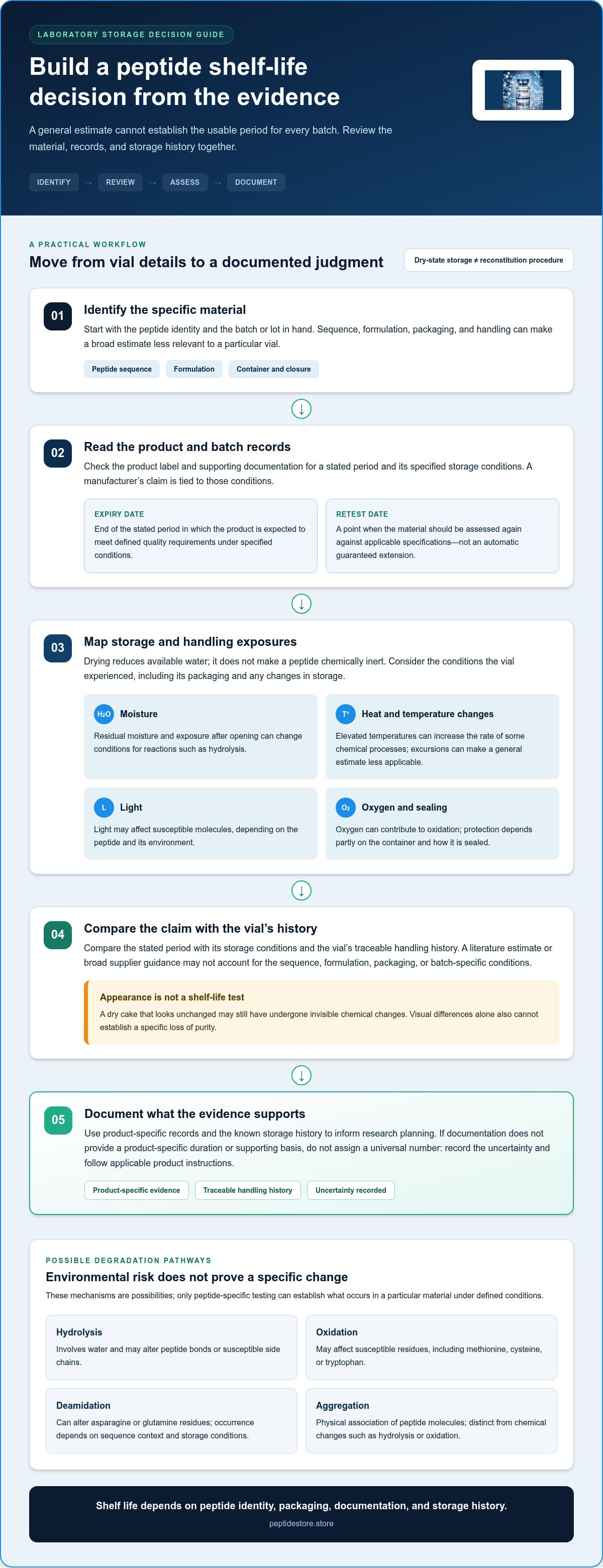
Quotable principle: Shelf life depends on peptide identity, packaging, documentation, and storage history, so a general estimate cannot establish the usable period for every batch.
A manufacturer’s stated expiry or retest date is tied to product documentation and specified storage conditions. An expiry date marks the end of the stated period in which the product is expected to meet defined quality requirements under those conditions. A retest date indicates when the material should be assessed again against applicable specifications; it should not automatically be treated as a guaranteed extension. Neither date should be replaced by a general estimate without product-specific evidence.
What does shelf life mean for a lyophilized peptide?
Shelf life is a time-bound quality expectation under stated storage conditions. It doesn’t promise that every property remains unchanged or that the material will suit every experiment. Chemical integrity, measured purity, and performance in a particular assay are related but distinct considerations. A peptide may meet a purity criterion yet behave differently in an assay sensitive to impurities, aggregation, or other sample characteristics. The assessment method and acceptance criteria matter.
Appearance provides limited evidence. A dry cake that looks unchanged may still have undergone chemical changes that aren’t visible. Visual differences alone also don’t establish a specific loss of purity. When integrity matters to a research decision, analytical results and batch documentation are more informative than appearance alone.
Why can one peptide’s storage period differ from another’s?
Peptide sequence and structure affect susceptibility to chemical change. The position and environment of particular residues can influence stability, so two peptides stored under similar conditions may not retain quality for the same period. Formulation components, residual moisture after drying, and the vial’s container-closure system can also affect protection from environmental exposure.
Batch handling adds another variable. Temperature excursions, compromised packaging, or differences in storage history can make a published estimate less relevant to a specific vial. For background on the process, see Understanding Lyophilization (Freeze-Drying). Lyophilization explains why water is removed; it doesn’t validate a shelf-life duration for an individual product.
For laboratory inventory decisions, start with the product label and supporting batch records. Compare the stated period with its storage conditions and the vial’s traceable handling history. If the documentation doesn’t provide a product-specific duration or supporting basis, avoid assigning a universal number. Record the uncertainty and follow the applicable product instructions.
How Lyophilized Peptides Degrade: Chemistry and Storage Conditions
Removing water during lyophilization reduces the medium available for some chemical reactions and can limit molecular movement. It doesn’t make a peptide chemically inert. Residual moisture, exposure after opening, and the peptide’s sequence can influence which changes occur and how readily they progress. Storage risks therefore depend on both the molecule and its environment.
General degradation mechanisms describe possible pathways. Only peptide-specific testing can establish which changes occur in a particular material under defined conditions.
Which chemical processes can affect peptide stability?
Several mechanisms may be relevant. Their likelihood and extent depend on the molecule and its environment:
- Hydrolysis involves water and may alter peptide bonds or susceptible side chains. Reduced water availability can limit this pathway, while moisture exposure may change the conditions.
- Oxidation can affect susceptible residues, including methionine, cysteine, or tryptophan, depending on the sequence and surrounding environment.
- Deamidation can alter asparagine or glutamine residues. Its occurrence depends on local sequence context and storage conditions.
- Aggregation is the physical association of peptide molecules. It may affect sample behavior or analytical results, but it is distinct from chemical changes such as hydrolysis or oxidation.
These pathways can occur separately or together. A list of possible mechanisms doesn’t prove that a specific peptide has degraded or establish a rate for an individual batch.
How do temperature, moisture, light, and oxygen contribute?
Environmental effects depend on peptide chemistry and packaging. Elevated temperatures can increase the rate of some chemical processes, but a universal temperature threshold cannot be assigned without product-specific evidence. Light may affect susceptible molecules, while oxygen exposure can contribute to oxidation. The level of protection depends partly on the container and how it is sealed.
Moisture is a practical concern because it can enter through compromised packaging or be introduced during repeated handling. Opening a container exposes its contents to ambient moisture and air. Keep the vial closed until handling is necessary, and protect it from avoidable environmental exposure in line with the product instructions.
These factors can compound. For example, oxygen exposure may matter more for a peptide with oxidation-sensitive residues than for a sequence without the same vulnerabilities. Packaging and storage history further shape the assessment. That interaction is why a degradation mechanism alone can’t define the lyophilized peptide shelf life before reconstitution. Peptide Store’s research peptide catalog includes compounds for laboratory work across specialized categories. Use the relevant product documentation when assessing storage guidance for a specific material.
Room Temperature, Refrigerated, or Frozen: Comparing Pre-Reconstitution Storage
Ambient, refrigerated, and frozen storage each involve different practical considerations. None should be selected using category-wide advice alone. Start with the product label and supporting stability information, then consider whether the stated conditions match the vial’s packaging and documented storage history.
Ambient storage
Potential benefit: convenient during brief handling or transport when consistent with product instructions. Risk: temperature fluctuations and exposure to light or moisture may be harder to control. Follow the conditions and time limits stated for the product.
Refrigerated storage
Potential benefit: appropriate when product documentation specifies refrigerated conditions. Risk: temperature variation and condensation during handling can complicate storage. Keep the container closed and follow product-specific instructions.
Frozen storage
Potential benefit: may be specified for longer-term storage of particular materials. Risk: repeated removal and return can create freeze-thaw exposure. Freezing is not automatically suitable for every peptide or package.
This comparison is a decision aid, not a substitute for a validated storage statement. Shipment temperature and the temperature maintained after receipt form part of the same handling history. Transit conditions can therefore matter when interpreting a storage record, even if the current storage location follows the label.
How should researchers compare storage conditions?
Prioritize the product label and supporting stability information over generic recommendations. Check the stated condition, any limits or handling notes, and whether the package remains intact. Compare those details with the actual storage location and known excursions before assigning an inventory period. If documentation omits a condition or duration, flag the gap instead of filling it with a general estimate.
What should be recorded about transport and temperature excursions?
At receipt, record the date, package condition, and any available shipment or temperature information. If a deviation occurs, document its known timing and circumstances. Don’t assume that a brief excursion has the same predictable effect on every sample. Use laboratory quality procedures to determine how to assess and record an event when integrity is uncertain.
Repeated freeze-thaw exposure is a handling concern because temperature cycling can stress a sample. It doesn’t, by itself, prove a fixed loss of quality for every vial. Record known removals and returns where relevant, and distinguish measured results from assumptions about potential impact.
For inventory decisions, compare the storage condition stated in the product documentation with the vial’s complete handling history. Keep unsupported duration estimates separate from documented expiry or retest information. This makes the lyophilized peptide shelf life before reconstitution a traceable, product-specific assessment rather than a blanket rule based on storage category.
A Laboratory Workflow for Managing Lyophilized Peptide Shelf Life
A reproducible record links each vial to product documentation and storage history. That makes inventory review more defensible than relying on a shelf location or general estimate. As when cataloging standard chemical supplies and solutions from RMR Reagents, use this workflow alongside laboratory procedures and the specific product instructions.
- Log receipt. Record the product identity, lot identifier, received date, and package condition. Add available shipment or temperature information, and note visible damage or uncertainty.
- Transcribe label guidance. Record label dates, stated storage conditions, and handling instructions as written. Keep label information separate from internal assumptions or general guidance.
- Assign and document storage. Record the storage location and place the vial under the conditions specified for that product. Minimize unnecessary light and moisture exposure, and avoid opening the container unless needed, in accordance with laboratory procedures.
- Maintain a handling history. Log relevant access events and known temperature excursions, including the date and available details. Document deviations even when their effect on the sample is unknown.
- Review before use. Compare the label, batch records, dates, and storage history. If information is missing or conditions are uncertain, flag the issue for review under laboratory quality procedures before deciding how to use the sample.
What records support a defensible storage decision?
Keep records specific to the vial or lot: product identity, lot identifier, label dates, stated storage conditions, storage location, and documented excursions. Link available analytical records, such as a batch-specific certificate or test result, to the same lot. A generic product name or an unrelated batch record cannot establish the history or measured properties of a particular vial.
Use a consistent format so staff can distinguish recorded facts from interpretation. For example, “temperature excursion recorded” is an observation; “sample remains suitable” is a conclusion that requires an appropriate basis.
When should a sample be reviewed before laboratory use?
Review the record if dates, storage instructions, or shipment history are unclear, or if a deviation has been documented. Discoloration, visible moisture, or another unusual physical change can prompt investigation. These observations don’t confirm peptide identity, purity, or activity, and a normal appearance doesn’t verify them either. Follow laboratory quality procedures to determine whether additional analysis is appropriate.
Separating observations from evidence supports careful interpretation of the lyophilized peptide shelf life before reconstitution. A visual check may identify a reason to pause, while analytical evidence and batch-linked documentation provide different information. Preserve that distinction in inventory notes and don’t record an assumption as a test result.
For laboratory sourcing, browse research peptides and apply the same batch-specific documentation and storage review to incoming materials.
Applying Shelf-Life Guidance to Research Peptides and Reconstitution Planning
Use product-specific records, not a category-wide number, to plan storage of a lyophilized research peptide. The label, batch documentation, stated storage conditions, and recorded handling history together provide a more defensible basis for inventory decisions than a general estimate. A catalog description can help identify research materials—such as when browsing specialized formats on biomodpeptides.com—but it isn’t validated stability data for a particular batch.
Identity and purity records also serve different purposes. They may describe material at a documented point in its history, but don’t automatically establish that every vial retains the same characteristics after storage or an excursion. For context on peptide identity, purity, and analytical standards, see the research peptide laboratory guide. Interpret records alongside the storage conditions and batch identifiers they actually cover.
How does reconstitution change the storage question?
Adding a solvent changes a lyophilized preparation into a solution, so its physical state and relevant storage considerations change as well. Dry-state guidance does not establish a post-reconstitution storage period. That requires separate, product-specific information and falls outside this article’s scope. For background on the separate topic, consult bacteriostatic water and peptide reconstitution science. This section does not provide a reconstitution protocol.
How should researchers translate guidance into an experiment plan?
Before scheduling laboratory work, compare the planned storage interval with the product label, batch records, and applicable laboratory quality procedures. Confirm that the recorded storage history is consistent with the stated conditions, and flag gaps or excursions for review rather than assuming they have no effect. If the available documentation doesn’t support a storage period, record that limitation instead of substituting a broad estimate for evidence.
This approach keeps the lyophilized peptide shelf life before reconstitution tied to the identity and history of the material planned for research. It also keeps claims proportional to the evidence: a general storage recommendation can inform a review, but it can’t establish the validated shelf life of a specific peptide or batch.
Storage claims require defined conditions and peptide-specific evidence.
Use the research peptide catalog to identify materials for laboratory work, then base storage decisions on relevant product documentation.
Make Storage Decisions Part of Research Planning
Build storage review into experimental planning rather than treating it as an afterthought. A documented decision gives the laboratory a clearer basis for scheduling work, tracking material, and responding when storage history or product records leave uncertainty. Tie the decision to the specific peptide and batch, and distinguish documented evidence from assumptions.
The lyophilized peptide shelf life before reconstitution is most useful as a product-specific planning question, not a single number to apply across an entire category. Peptide Store supplies research-grade compounds for laboratory and scientific applications across specialized research peptide categories. Review the research peptide catalog to find materials for your laboratory work, and use the relevant product documentation to guide storage decisions.
Careful records support consistent research planning. Apply the same disciplined review to each incoming batch so inventory decisions remain clear, traceable, and aligned with laboratory procedures.
Frequently Asked Questions
How long does a lyophilized peptide last before reconstitution?
There’s no single duration that applies to every lyophilized peptide. The lyophilized peptide shelf life before reconstitution depends on factors such as sequence, formulation, packaging, stated storage conditions, and temperature history. Use the product label and batch-specific records as primary references. General ranges found online aren’t guarantees of purity or assay performance. For inventory planning, distinguish a documented expiry or retest date from an estimate that isn’t supported for the specific material.
Does a lyophilized peptide need to be refrigerated?
Storage requirements depend on the specific peptide and product instructions. Some materials may have refrigerated or frozen storage guidance, while others may specify different conditions. Don’t assume the same temperature applies to every sequence. When transferring vials between storage locations, record the new location and conditions, then follow laboratory procedures for any deviation. This connects the sample’s handling history to its product documentation.
Can lyophilized peptides be stored at room temperature?
Room-temperature storage is appropriate only when supported by the product’s instructions or relevant stability information. An online estimate can’t establish a duration for a particular vial. If a shipment or laboratory handling period involved ambient exposure, document what is known, such as the receipt date and package condition. Assess the event under laboratory procedures before using the material in planned work. Don’t assume brief exposure had either no effect or a known effect.
Do lyophilized peptides expire?
A lyophilized peptide may have an expiry or retest date tied to defined conditions and product records. That date applies to the documented material, not automatically to other peptides or lots. If a date is missing or unclear, don’t create one from a general shelf-life estimate. Review the records associated with the specific batch and follow laboratory procedures to determine whether the available evidence supports its intended use in a particular experiment.
What happens if a lyophilized peptide is exposed to moisture?
Moisture exposure may affect stability, but the result depends on the material, exposure, packaging, and storage history. If a vial or closure appears wet, record the observation and keep it separate from conclusions about sample quality. A visible change can prompt an investigation, but it can’t establish purity or assay performance. Use product documentation and laboratory quality procedures to assess the incident rather than presuming the sample is unaffected or unusable.
Can light or oxygen reduce lyophilized peptide stability?
Light or oxygen may contribute to degradation in susceptible materials, but effects vary with peptide chemistry, formulation, and packaging. Keep the vial in its designated container and limit unnecessary exposure during routine handling, consistent with its instructions. If a container is left open or its packaging is compromised, record the event and review it under laboratory procedures. This creates a traceable account without treating every exposure as proof of a specific quality change.
Is a lyophilized peptide still usable if it looks unchanged?
An unchanged appearance doesn’t confirm molecular identity, purity, or suitability for an assay. A vial that appears normal may still require review if its documentation or storage history raises questions. Discoloration or another visible difference is a reason to investigate, not a conclusive analytical result. Keep observations separate from test findings, and use batch records and applicable laboratory procedures to determine whether further assessment is warranted before the sample enters an experiment.
Is the shelf life different after a peptide is reconstituted?
Yes. Reconstitution changes the preparation from a dry material into a solution, so the relevant stability evidence and storage considerations may change. Don’t apply a dry-state estimate to a solution or infer a post-reconstitution period from the original label unless its documentation specifically addresses that state. Review solution-phase guidance separately, including whether it applies to the particular peptide and preparation. This FAQ addresses storage before reconstitution, not a reconstitution protocol.


